Subscriptions are the holy grail of ecommerce. While most Shopify stores are stuck on the revenue roller coaster, great month, bad month, great month, bad month, subscription-based brands wake up on the first of every month already knowing a chunk of their revenue is locked in. That predictability changes everything about how you run your business.
What’s in This Article
But here is the thing most people get wrong about subscriptions: they think it only works for consumables like coffee, supplements, or skincare. In reality, subscription models can work for almost any product category, you just need to find the right model for your brand. Curated boxes, replenishment subscriptions, VIP membership programs, and subscribe-and-save models each serve different customer needs and product types.
Australian Shopify stores with subscription revenue see 2-3x higher customer lifetime values, 40-60% lower churn rates compared to one-time buyers, and predictable monthly cash flow that makes inventory planning and growth forecasting dramatically easier. If you are not offering some form of recurring revenue, you are working harder than you need to.
Choosing the Right Subscription Model for Your Store
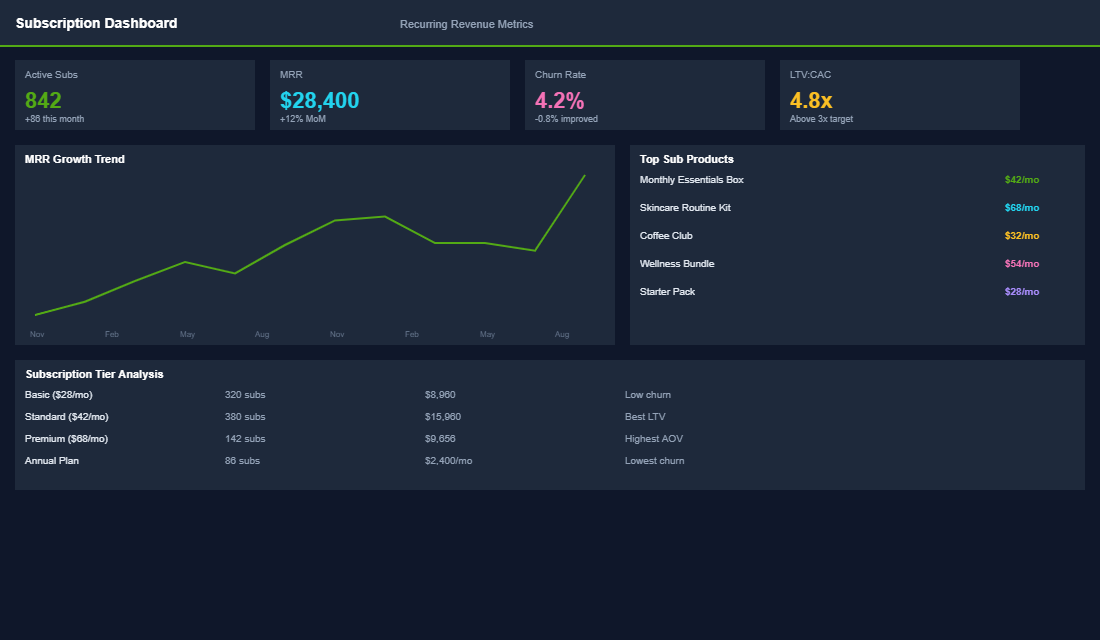
The subscription model you choose should match your product type and customer behaviour. Here are the four models that work best for Shopify stores, and when to use each one.
Replenishment subscriptions (subscribe and save). This is the simplest and most common model. Customers sign up to receive the same product on a regular schedule, every 30, 60, or 90 days. It works brilliantly for consumable products: coffee, supplements, skincare, pet food, cleaning supplies, and anything else customers use up and need to reorder. Offer a 10-15% discount on subscription orders vs one-time purchases to incentivise sign-ups. Brands using this model typically see 30-40% of eligible customers opt into subscriptions within the first 6 months.
Curated subscription boxes. Customers pay a monthly fee to receive a curated selection of products. This works well for discovery-oriented categories: beauty, gourmet food, wine, fashion accessories, and lifestyle products. The curation is the value, customers enjoy the surprise element and the feeling of having an expert pick products for them. The challenge is logistics and sourcing variety, but the margins can be excellent because customers accept that they are paying for the experience, not just the products.
VIP membership programs. Customers pay a recurring fee (monthly or annual) for exclusive benefits: free shipping, member-only pricing, early access to launches, exclusive products, and loyalty perks. This model works for stores with a broad catalogue and repeat purchase behaviour. Think of it as the Costco model, the membership fee creates a sunk cost that drives more frequent purchasing.
Build-your-own bundles. Customers select their own products each month from a curated menu. This combines the predictability of subscriptions with the personalisation customers crave. It works well for food, beverages, and personal care, any category where individual preferences vary widely.
Setting Up Subscriptions on Shopify
Shopify has native subscription support, but you will get much better results with a dedicated subscription app. Here are the top options for Australian stores.
Recharge is the market leader and handles everything from simple subscribe-and-save to complex build-your-own-box models. It integrates with Klaviyo for subscription-specific email flows and supports the customer portal natively. Pricing starts at $99 USD per month but is worth it for stores doing over $20K monthly in subscription revenue.
Skio is a newer alternative with a cleaner interface and passwordless customer portal that reduces churn. It is gaining popularity with DTC brands for its superior customer experience. Skio works particularly well for replenishment subscriptions and offers advanced analytics on subscription health.
Loop Subscriptions is a strong budget-friendly option with Australian-specific features including GST handling and AUD pricing. It covers subscribe-and-save and curated box models and integrates with most major email and loyalty platforms. Good for stores just starting with subscriptions and wanting to test the model without a large upfront investment.
Reducing Churn: The Make-or-Break Metric
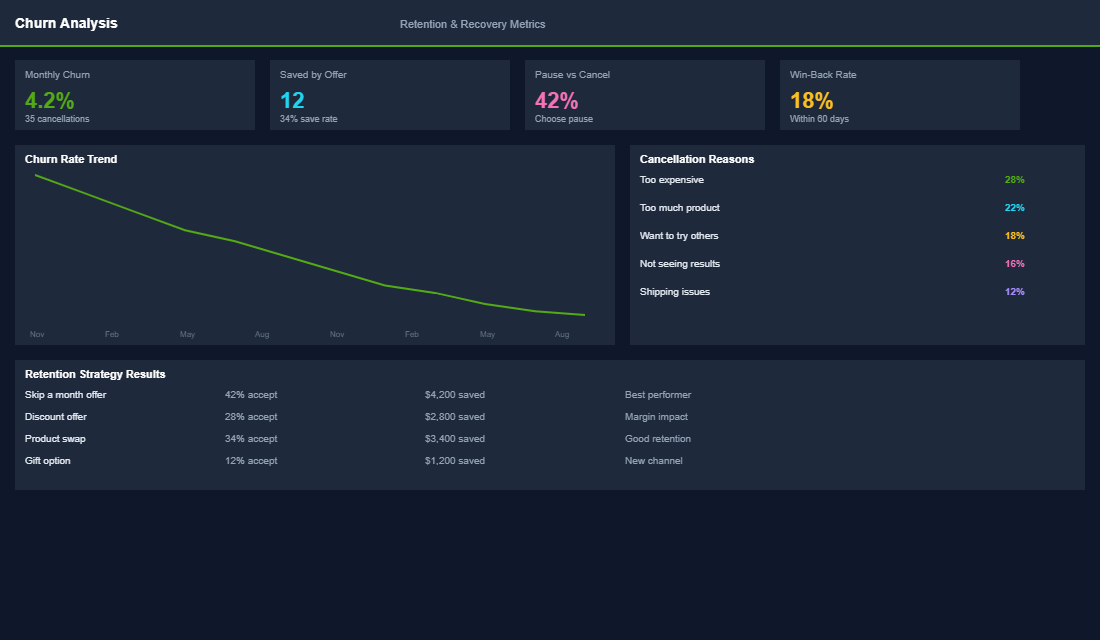
Getting subscribers is the easy part. Keeping them is where the money is made, or lost. Monthly churn rates for ecommerce subscriptions typically range from 5-15%. A 10% monthly churn means you lose half your subscribers every 7 months. Reducing churn by even 2-3 percentage points can double the lifetime value of your subscription base.
Make it easy to pause, skip, or swap, not just cancel. When a customer wants to cancel, offer alternatives: “Would you like to skip your next delivery, swap to a different product, or pause for a month?” Most subscription churn is not because customers dislike the product, it is because they have too much product building up, their needs changed, or they are on a budget temporarily. Flexible options retain 20-30% of would-be cancellations.
Send a pre-shipment reminder. Email subscribers 3-5 days before their next order ships with a summary of what is coming and options to modify, skip, or add items. This reduces surprise charges (a top cancellation reason) and increases AOV when customers add extra products to their upcoming shipment.
Address payment failures immediately. Failed payments (expired cards, insufficient funds) cause 20-40% of all subscription churn, and most of it is involuntary. Use a dunning system that automatically retries failed payments and sends friendly update-your-card emails. Recharge and Skio both include dunning management that can recover 50-70% of failed payments automatically.
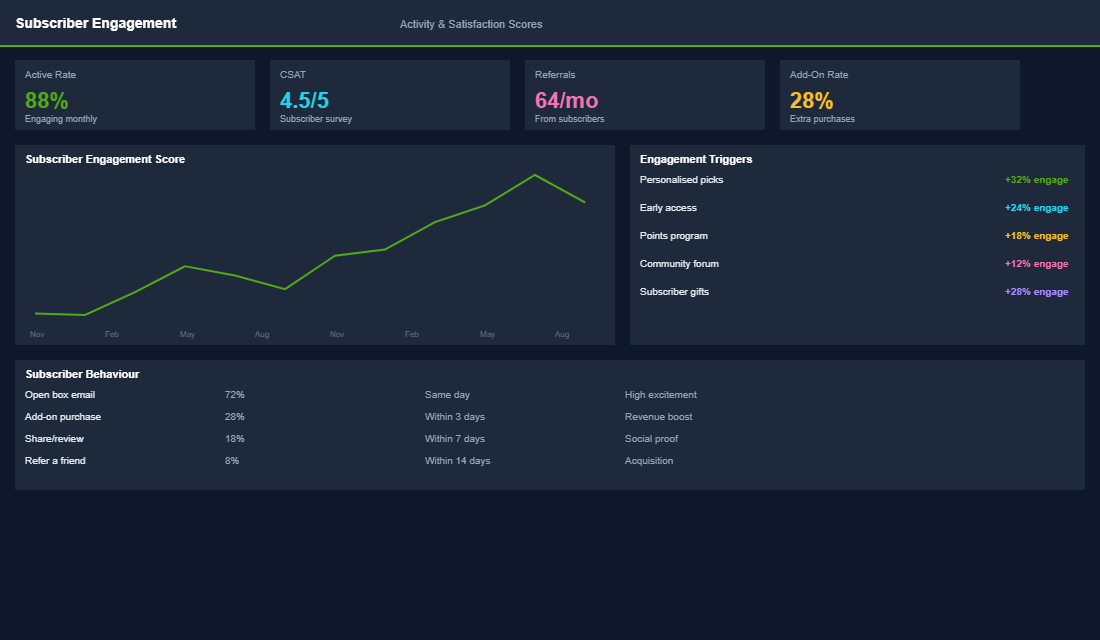
Survey every cancellation. When someone does cancel, ask why with a short exit survey. Track the reasons monthly and address the top causes. Common fixable reasons include: “too much product” (offer smaller sizes or longer intervals), “too expensive” (offer a downgrade tier), and “want more variety” (add a swap or build-your-own option).
Subscription-Specific Email Flows
Your subscription customers need dedicated email flows that are different from your standard ecommerce sequences. Here are the essential flows to set up in Klaviyo or Omnisend.
- Subscription welcome series. Welcome new subscribers with a 3-email series: confirmation and what to expect, brand story and community introduction, tips for getting the most from their subscription. This builds excitement and reduces early cancellations by 15-20%.
- Pre-shipment notification. Sent 3-5 days before each renewal. Includes order summary, modification options, and upsell suggestions.
- Post-delivery check-in. Sent 5-7 days after delivery. Ask how they are enjoying the product, request a review, and suggest complementary products.
- Win-back for cancelled subscribers. Sent 30, 60, and 90 days after cancellation. Offer an incentive to reactivate: free shipping on their next box, a bonus product, or an upgraded tier at the same price.
- Anniversary celebrations. Celebrate subscription milestones: 3 months, 6 months, 1 year. Include a thank-you gift or exclusive discount. This reinforces the relationship and makes subscribers feel valued.
Measuring Subscription Health
Track these metrics monthly to understand and improve your subscription programme. Monthly Recurring Revenue (MRR) tells you your predictable baseline. Churn rate (aim for under 8% monthly) shows customer retention. Subscriber acquisition cost tells you how efficiently you are growing. Average subscription length (aim for 6+ months) shows long-term value. And expansion revenue (upsells and cross-sells to existing subscribers) shows whether your base is growing in value, not just size.
The Subscription Apps Worth Paying For in 2026
The app you choose decides how much friction sits between a customer and a recurring order. Get it wrong and you bleed churn through a clunky customer portal and failed payments. Get it right and most of the retention work runs on autopilot. Here is how the main options stack up for an Aussie Shopify store.
- Recharge. The category veteran, with the deepest Klaviyo integration and the widest app ecosystem. Pricing starts around AUD 150 per month plus a small per-transaction fee, so it suits stores already doing real subscription volume.
- Loop Subscriptions. Strong on the customer portal and bundle building, with a cancellation flow that wins back roughly 1 in 5 customers who try to leave. A favourite of mid-size Aussie brands.
- Skio. Built by ex-Shopify engineers. Fast checkout and passwordless login that lifts portal logins. Good for brands obsessed with conversion.
- Appstle and Seal Subscriptions. The value picks. Seal has a generous free tier and Appstle starts under AUD 15 per month, which makes either a sensible place to validate before you commit to a premium platform.
Whatever you pick, the single most important feature is dunning: the automated retry logic that recovers failed payments. Card failures cause 20 to 40% of all subscription churn, and a good dunning sequence recovers about half of those before the customer ever notices. If your app does not do this well, none of the rest matters.
The Unit Economics That Make a Subscription Worth It
Subscriptions only build wealth when the numbers underneath them work. Before you launch, get clear on three figures so you are not just stacking recurring orders that quietly lose money.
- LTV to CAC ratio. Aim for at least 3 to 1. If it costs you AUD 40 to acquire a subscriber, that subscriber needs to be worth AUD 120 or more over their life. Subscriptions usually get you there, because they lift lifetime value 2 to 3x versus one-off buyers.
- Payback period. How many billing cycles before you recover acquisition cost. Under three months is healthy. Beyond six and you are funding growth out of your own pocket for too long.
- Monthly churn. Keep it under 8%. Every point you shave compounds, because a retained subscriber keeps paying for months with zero extra ad spend.
This is where subscriptions and the rest of your retention engine connect. The same logic that powers a strong win-back email flow applies here: it is far cheaper to keep a paying customer than to replace them. And once recurring revenue is predictable, you finally have room to think clearly about pricing power instead of discounting to hit a monthly number.
Your First 90 Days: A Subscription Launch Plan
You do not need to rebuild your store to test this. Here is the lean version that proves demand before you invest heavily.
- Days 1 to 14. Pick one hero product your customers already reorder. Install a value-tier app like Seal or Appstle and add a subscribe-and-save option at 10 to 15% off.
- Days 15 to 45. Promote it to your existing customers first. Your repeat buyers are the warmest audience you will ever have, and a focused email push to them usually converts better than any cold campaign. The same audience-first thinking sits behind a good Shopify product launch.
- Days 46 to 90. Watch churn and payback weekly. Once you can show a subscriber is worth 2x a one-off buyer, justify upgrading to a premium platform and roll subscriptions out across your reorderable range.
Start Building Predictable Revenue
Subscriptions are not just for mega-brands. Any Shopify store with repeat-purchase products can build a subscription offering that adds predictability and increases customer lifetime value. Start with the simplest model that fits your products, usually subscribe-and-save with a 10-15% discount, prove the economics with your first 50-100 subscribers, then expand into more sophisticated models as you learn what your customers want.
Inside the eCommerce Circle, subscription strategy falls under our Patrons pillar, building deeper customer relationships that drive recurring revenue. If you are considering adding subscriptions to your Shopify store and want help choosing the right model and tech stack, our coaching walks you through the entire setup and optimisation process. Predictable revenue is not a dream, it is a system you can build.
Inside eCommerce Circle, building predictable subscription revenue is one of the core Patrons pillars we work on with every member. If you want a second opinion on yours, let’s talk.