Every marketing course tells you to “know your customer.” So you spend an afternoon filling out a template (age, income, hobbies, favourite Netflix shows) and save it to a Google Doc you’ll never open again.
What’s in This Article
Sound familiar? You’re not alone. Most customer avatars are useless because they’re built from assumptions instead of data, and they never connect to actual marketing decisions. They’re creative writing exercises disguised as strategy.
The brands that consistently win (the ones hitting 3-5x ROAS on their ads and 40%+ email open rates) have avatars built differently. They’re built from real customer behaviour, real survey responses, and real purchase data. And they directly inform every ad, email, and product page the brand creates.
The Problem With Most Customer Avatars
Here’s the typical avatar exercise: you sit down and guess that your ideal customer is “Emma, 32, lives in Sydney, loves yoga, shops at Bondi markets, earns $90K.” It feels productive. But ask yourself: how does knowing she likes yoga change your Meta ad headline? How does her suburb change your email subject line?
It doesn’t. That’s the problem. Most avatars describe who the customer is but completely miss why they buy, what almost stops them, and where they need convincing. The demographics are the least useful part. The psychology is everything.
Step 1: Start With Your Data, Not Your Imagination
Before you write a single word of your avatar, pull these three reports from your Shopify admin and Google Analytics:
Customer cohort analysis: Who are your repeat buyers? What do they have in common? Sort your customers by total spend over the last 12 months and look at the top 20%. These are your real VIPs, not the ones you imagine.
Acquisition channel breakdown: Where did your highest-LTV customers come from? If your best customers all came through Instagram while your Facebook ads bring one-time bargain hunters, that’s critical intelligence for ad spend allocation.
Product affinity data: Which products do your best customers buy first? Which products do they come back for? This tells you what to feature in acquisition campaigns versus retention campaigns.
Step 2: Ask Your Customers Directly (The Right Questions)
Data shows you what customers do. Surveys show you what they think. You need both. But most brands either don’t survey at all, or they ask the wrong questions.
The magic questions aren’t “How old are you?” or “Where do you live?” The questions that transform your marketing are:
“What almost stopped you from buying today?” This reveals your real objections. Fix these and conversions climb. “What problem were you trying to solve?” This gives you ad copy that speaks to real pain points, not made-up ones. “How did you first hear about us?” This shows your real attribution, which is often very different from what Google Analytics reports. “What would make you buy from us again?” This hands you your retention strategy on a platter.
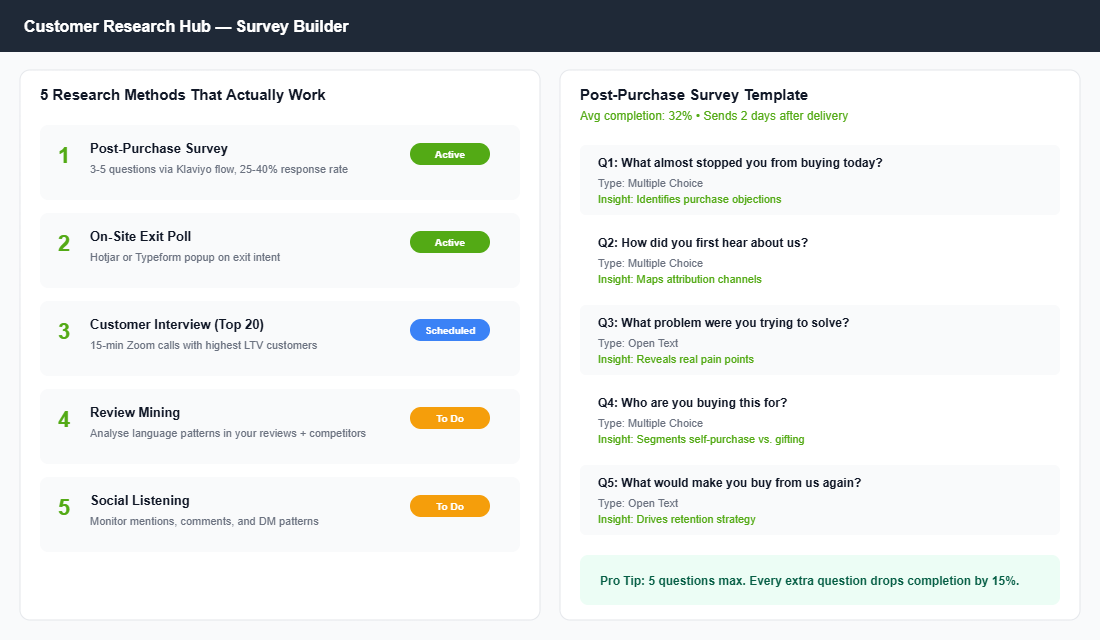
Send a short post-purchase survey (5 questions max) via Klaviyo or Typeform, timed 2 days after delivery when satisfaction is highest. Keep it to multiple choice where possible. Open text is gold for insights but kills completion rates if overused. One open-text question per survey is the sweet spot.
Step 3: Build Segments, Not Just One Avatar
Here’s a mistake we see constantly: brands build one avatar and try to make all their marketing speak to that single person. But every store has at least 2-3 distinct buyer segments, and they need different messaging.
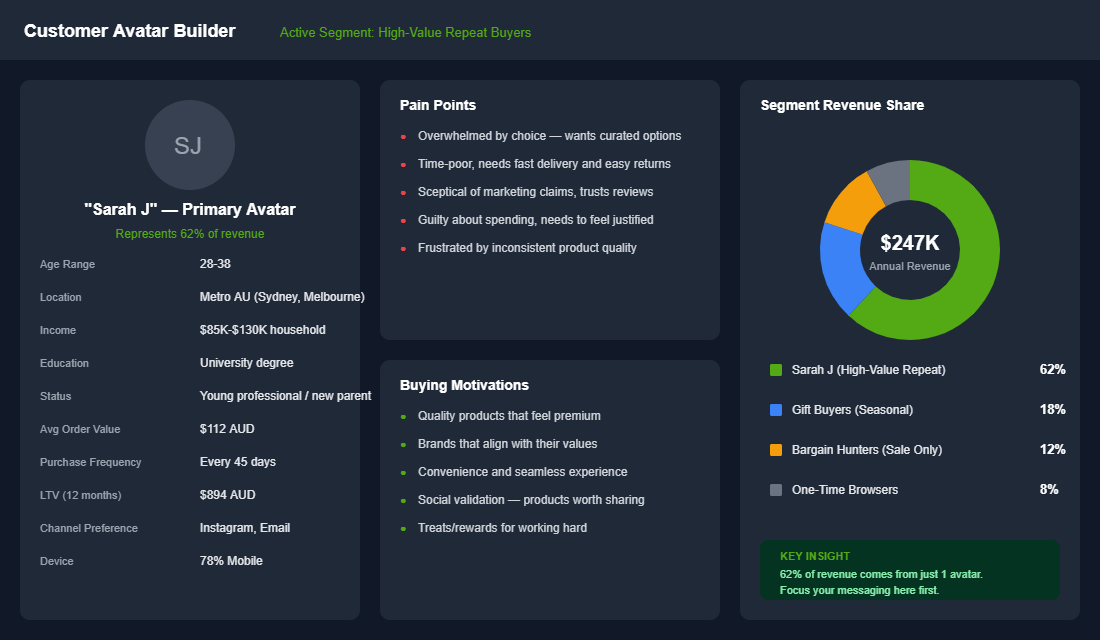
Common segments for Australian ecommerce brands include: the self-purchaser (buying for themselves, motivated by quality and results), the gift buyer (seasonal, motivated by presentation and ease), and the bargain hunter (discount-driven, low loyalty, high volume during sales). Your primary avatar (the one representing 50-60% of revenue) gets most of your marketing attention. But acknowledging the secondary segments lets you capture revenue you’d otherwise miss.
Step 4: Map Pain Points to Messaging
This is where most avatar exercises stop, and where the real value starts. Once you know your customer’s pain points, objections, and motivations, you need to translate them into specific messaging for every touchpoint.
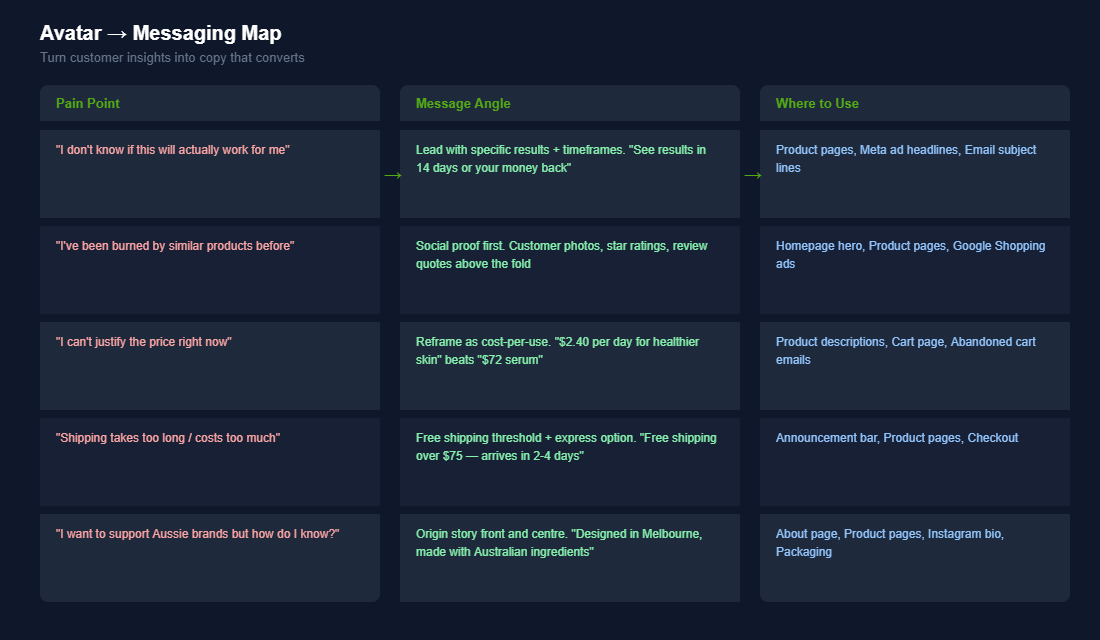
For every pain point, define: the message angle (how you address it in copy), and the placement (where that message appears). “I don’t know if this will work for me” becomes a results-focused headline on your product page and a guarantee in your abandoned cart email. “Shipping takes too long” becomes a free shipping threshold in your announcement bar and express options at checkout.
This is the difference between an avatar that sits in a doc and an avatar that drives revenue. Every piece of marketing should trace back to a specific pain point or motivation from your avatar research.
Step 5: Validate and Update Quarterly
Your customer avatar isn’t a one-time exercise. Customer behaviour shifts. New competitors change expectations. Seasons bring different buyer types. The brands that stay sharp revisit their avatar every quarter with fresh data.
Set a calendar reminder. Pull your updated cohort data, re-read your latest survey responses, and check if your messaging still matches reality. A 30-minute quarterly review prevents months of talking to the wrong customer with the wrong message.
The Tools That Do the Heavy Lifting for You
You do not need an enterprise research budget to build a data-backed avatar. The whole stack costs less than $150 AUD a month, and most of it you already have.
- Shopify customer reports. Free and already running. Sort customers by total spend, find your top 20%, and export their order history. This is your VIP segment in raw form.
- KnoCommerce or Grapevine. Post-purchase surveys that sit on your thank-you page. Response rates of 30 to 50% are normal because the customer has just bought and is still engaged. This is where your five research questions live.
- GA4 audience reports. Age brackets, locations, devices and the channels your converters actually come from. Cross-check this against who you think your customer is. The gap is usually humbling.
- Hotjar or Microsoft Clarity. Watch 20 session recordings of people on your product pages. You will see what they hesitate on, what they re-read, and where they bail. That hesitation is your messaging gap.
- Klaviyo segments. Build a segment of repeat buyers and compare their first product against one-time buyers. The difference often reveals which product attracts your best avatar.
Social channels round this out. Your DMs, comments and reviews are unprompted customer language, and the way customers describe the problem in their own words is the copy that converts. Our social listening playbook covers how to mine this systematically.
A Worked Example: From Spreadsheet to Avatar in One Afternoon
Imagine you run an Aussie activewear brand doing $60k a month. You export 12 months of orders and find that 58% of revenue comes from women aged 28 to 42 who bought leggings first, and 70% of them came through Instagram.
Your post-purchase survey (214 responses over six weeks) tells you the real purchase driver is not fitness performance. It is feeling confident at the school pickup and the weekend market, not just the gym. The phrase “actually fits” appears in 31 responses.
That single afternoon of work rewrites your marketing:
- Ad hook: “Activewear that actually fits” beats “Premium performance leggings” because it is their words, not yours.
- Product page: Lead with fit guarantee and real-body photos instead of athlete shots.
- Email welcome flow: Segment by first product purchased and speak to the everyday-wear use case, not the marathon-training one.
- Budget: Shift spend toward Instagram and lookalikes built from the VIP segment, because that is where the avatar already lives.
Brands that run this exercise typically see ad click-through rates lift 20 to 40% within a month, simply because the message finally matches the buyer. Once your avatar is live, pair it with RFM segmentation so your best customers get treated like it.
The Anti-Avatar: Who You Should Stop Marketing To
Here is the part almost nobody does. The same data that shows you your best customer also shows you your worst, and knowing who to repel is worth as much as knowing who to attract.
Pull your refund and support data and look for the pattern. In most stores, a small slice of customers (often 5 to 10%) generates 40%+ of support tickets, the bulk of returns, and most of the one-star reviews. They usually share traits: they arrived through a deep discount, bought once, and price was their only decision driver.
Build a one-paragraph anti-avatar and use it as a filter:
- Ads: Stop running broad discount-led hooks that attract bargain hunters who never return. A 25% off acquisition offer attracts a customer worth a fraction of one acquired on a value message.
- Email: Suppress chronic non-openers and serial refunders from promotional sends. Your deliverability improves and your revenue per send climbs.
- Copy: Be specific enough that the wrong buyer self-selects out. “Designed for serious home baristas” politely tells the instant-coffee crowd this is not for them, and saves you both the refund.
One Melbourne homewares brand we worked with found that customers acquired through a sitewide 30% off sale had a 90-day repeat rate of just 4%, versus 19% for full-price first orders. They cut the discount-led campaigns, took the short-term revenue dip, and were ahead on contribution margin within two quarters.
The Compound Effect: Avatar-Driven Marketing
When your avatar is built from real data and mapped to real messaging, everything in your marketing gets sharper. Your Meta ads stop trying to appeal to everyone and start resonating with someone. Your email sequences address real objections instead of generic “Hey, you left something in your cart” copy. Your product pages lead with the benefits your actual customers care about.
The result? Higher ROAS, better email engagement, stronger conversion rates, and more repeat customers. All because you stopped guessing and started listening.
Your Next Step
This week, do one thing: set up a 5-question post-purchase survey and let it run for 30 days. The responses will give you more actionable insight than any avatar template you’ll find online.
Inside the eCommerce Circle, customer avatar development is one of the core pillars we build with every member, because everything else in your marketing depends on getting this right. If you want help building an avatar that actually drives sales, let’s talk.