Your customer avatar is probably lying to you.
What’s in This Article
Not because you wrote it badly. Because the entire model is the wrong shape. Most Shopify brands describe their customer like a dating profile – 32 years old, lives in Melbourne, household income $120K, follows wellness influencers. Then they wonder why their ads convert at 1.2% and their product pages read like a press release.
The brands actually scaling past seven figures don’t sell to demographics. They sell to jobs. They know exactly what their customer was trying to get done at the moment they hit “buy now” – and they design every word, image, and offer around that job. It’s the difference between a 1.2% conversion rate and a 4.5% one. And it’s almost entirely free to fix.
This is the Jobs to Be Done framework. It’s the most underused customer research tool in ecommerce, and the brands that bother to run it usually find their next 12 months of marketing buried inside three customer interviews. Here’s how it works, why it beats every persona doc you’ve ever made, and the exact script you can run this week.
What Jobs to Be Done Actually Means (And Why the Milkshake Story Matters)
Jobs to Be Done was popularised by the late Harvard professor Clayton Christensen, with practical interview methodology developed by Bob Moesta and Chris Spiek. The core idea is brutal in its simplicity: people don’t buy products, they hire products to make progress in their lives. When the product does the job, they keep using it. When something better comes along, they fire your product and hire a new one.
The most famous example is the McDonald’s milkshake study. McDonald’s wanted to sell more milkshakes, so they ran a typical demographic survey – what flavour, what thickness, what price. Customers gave detailed answers. McDonald’s improved the milkshake along every dimension. Sales didn’t budge.
Then Christensen’s team showed up and asked a different question: “What job did you hire this milkshake to do today?” The answer floored them. Almost half of all milkshakes were sold before 8:30am, to commuters who were alone in their car. They weren’t buying a treat. They were hiring the milkshake to make a long, boring drive less miserable, keep one hand free, and hold them over until lunch. The competition wasn’t other milkshakes. It was bananas, donuts, and bagels.
Once McDonald’s understood the job, the answer was obvious: make the shake thicker so it lasted the whole commute, move it to a self-serve front counter so commuters didn’t queue, and load it with chunks of fruit so it felt less like junk food. Sales went up. The product barely changed. The understanding of the job changed everything.
Now apply that to your Shopify store. You probably know what your customers buy. You almost certainly don’t know what they were hiring it to do.
Why Customer Avatars Alone Don’t Cut It Anymore
I’ve reviewed hundreds of brand strategy docs inside the eCommerce Circle. Almost every one starts with the same template: name, age, location, income, hobbies, “Sarah is a busy mum who loves yoga and clean living.” The avatar is fine as far as it goes. The problem is that two Sarahs with identical demographics will buy your product for completely different reasons – and respond to completely different marketing.
One Sarah hired your magnesium supplement to fix her sleep so she could stop yelling at her kids by 4pm. The other hired it to look more recovered after CrossFit. Same product, same demographic, completely different job. If your ads talk about magnesium “for active women” you’ll convert one of them at half the rate you should be – and miss the second one entirely.
This is the fundamental gap JTBD fills. Avatars tell you who the customer is. JTBD tells you what they were trying to do. The first is helpful for media buying. The second is what writes your product page, your ad hook, your email subject line, and your homepage headline.
If you’ve already built customer avatars, treat JTBD as the upgrade – not a replacement. Most of our coaching members who go through this process keep their customer avatar work and bolt JTBD on top so each persona has 2-3 specific jobs attached. That’s when the marketing gets sharp.
The Four Forces That Decide Every Purchase
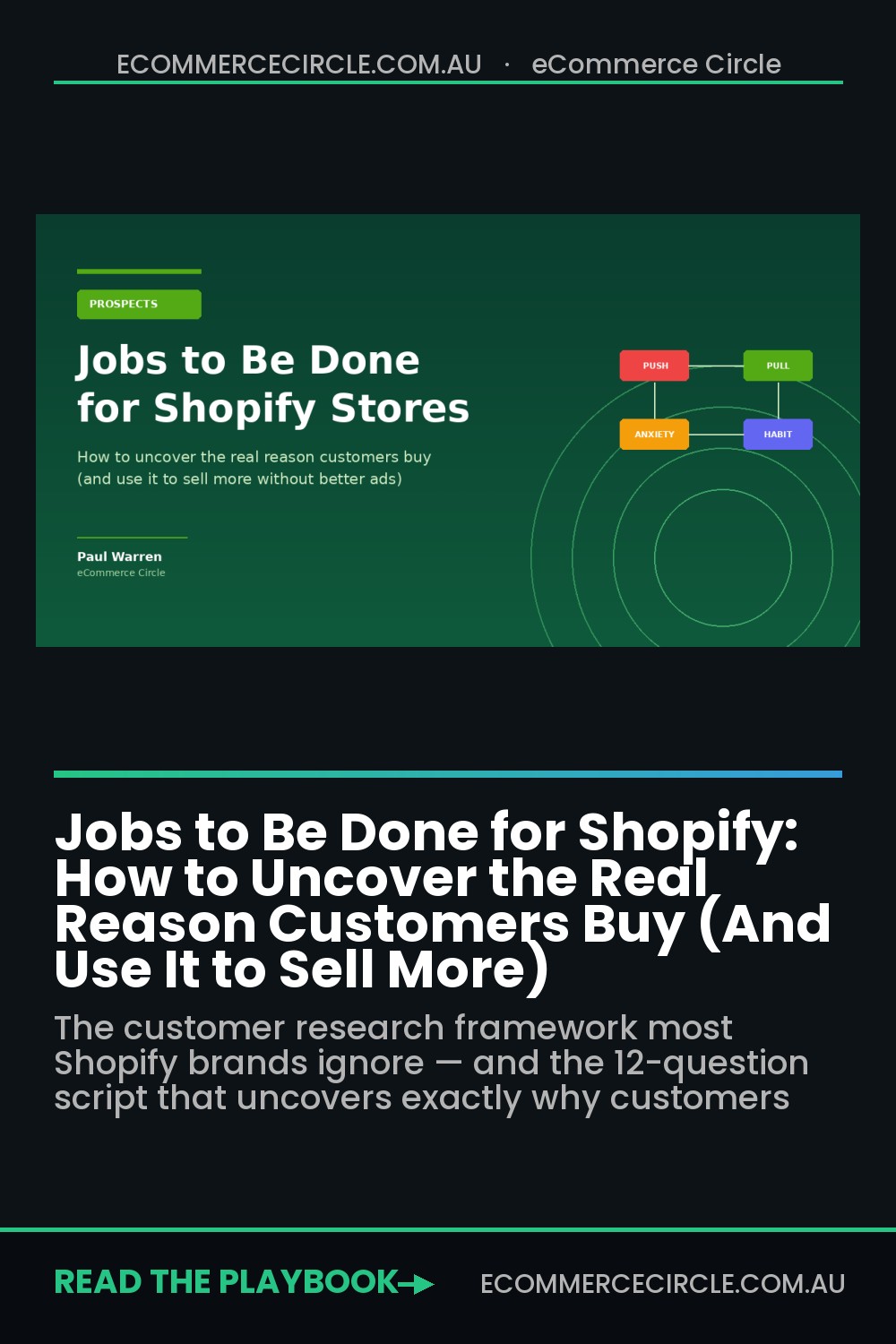
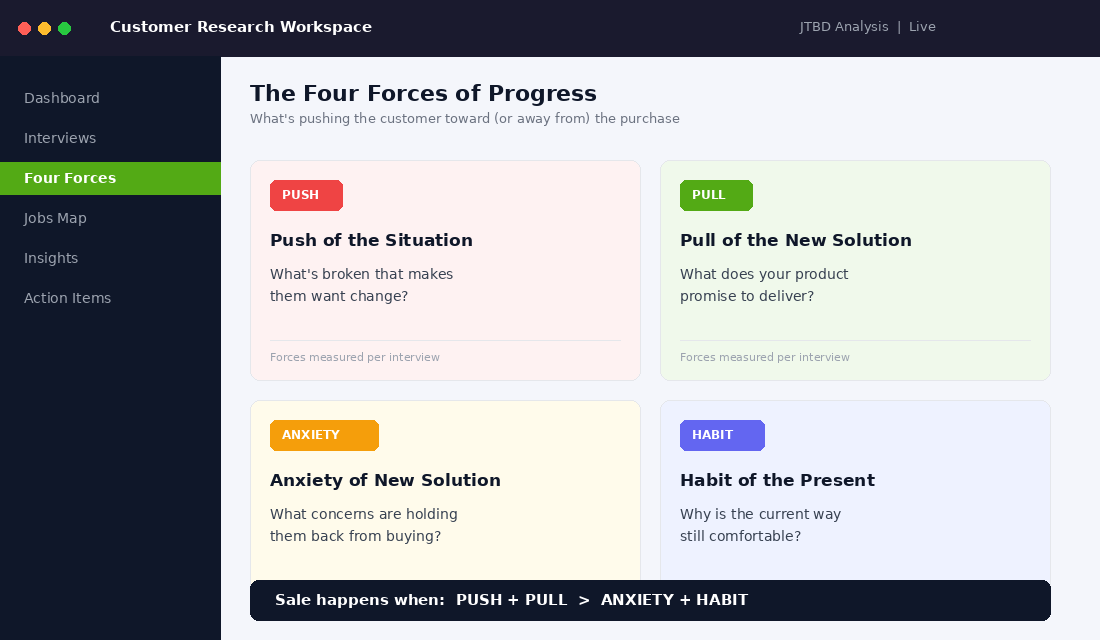
Bob Moesta’s most useful contribution to JTBD is the Four Forces of Progress model. Every purchase decision is the outcome of four forces fighting each other – and if you understand all four, you understand exactly what to put in your marketing.
- Push of the Situation. What’s wrong right now that makes the customer want to change? “I’m sick of waking up tired every morning.”
- Pull of the New Solution. What does the new product promise? “This magnesium has 5-star reviews and Aussie women rave about deeper sleep.”
- Anxiety of the New Solution. What’s worrying them about your product? “Is this going to taste chalky? Will it actually work?”
- Habit of the Present. What’s holding them in place with the current solution? “I already take a multivitamin, will adding this be too much?”
Sales happen when Push + Pull are stronger than Anxiety + Habit. That’s it. Every objection-handling section on your product page, every FAQ, every reassurance email is just you reducing anxiety or breaking a habit. Every hook, every benefit, every headline is amplifying push or pull. Once you see marketing this way, you can’t unsee it.
Most Shopify brands obsess over Pull (features, benefits, ingredients) and ignore the other three forces entirely. That’s why their conversion rate stalls. The customer wanted to buy. The push was real. But the anxiety was higher than the brand realised, and nothing on the page addressed it.
How to Run a JTBD Switch Interview (The 5-Step Framework)
The interview format we use is the switch interview. You’re not asking customers what they think of your product. You’re rebuilding the timeline of how they got from “I have a problem” to “I bought your thing.” Done well, you’ll get the four forces, the trigger event, the comparison set, and the language they use to describe the job – all in 30 minutes.
Here’s the 5-step framework I run with every coaching member who’s serious about scaling.
Step 1: Recruit the Right Customers
Pull a list of customers who placed their first order in the last 60 days. Not loyal customers. Not lapsed customers. Recent first-time buyers. They still remember exactly why they bought. After 90 days, the memory blurs. After 6 months, they’re rationalising. You want fresh data.
Email them with a personal-feeling subject line. “Quick question from the founder, Paul” works. Offer a $50 store credit or a $30 gift card for 30 minutes of their time. Aim to book 8-10 interviews. You’ll start hearing the same patterns by interview 5, but the last few sharpen the picture.
Step 2: Find the First Thought
Every purchase has a “first thought” – the moment the customer first considered buying something in your category. It’s almost never the moment they bought. Sometimes it’s months earlier. Your job is to find that exact moment and walk forward from there.
Open with: “Tell me about the first time you thought about buying [product category]. Where were you? What was happening?” Then shut up. Let them rebuild the scene. The story they tell next is gold – and it’s almost always something you’d never put in your marketing because it sounds too specific. That specificity is exactly what converts.
Step 3: Map the Timeline
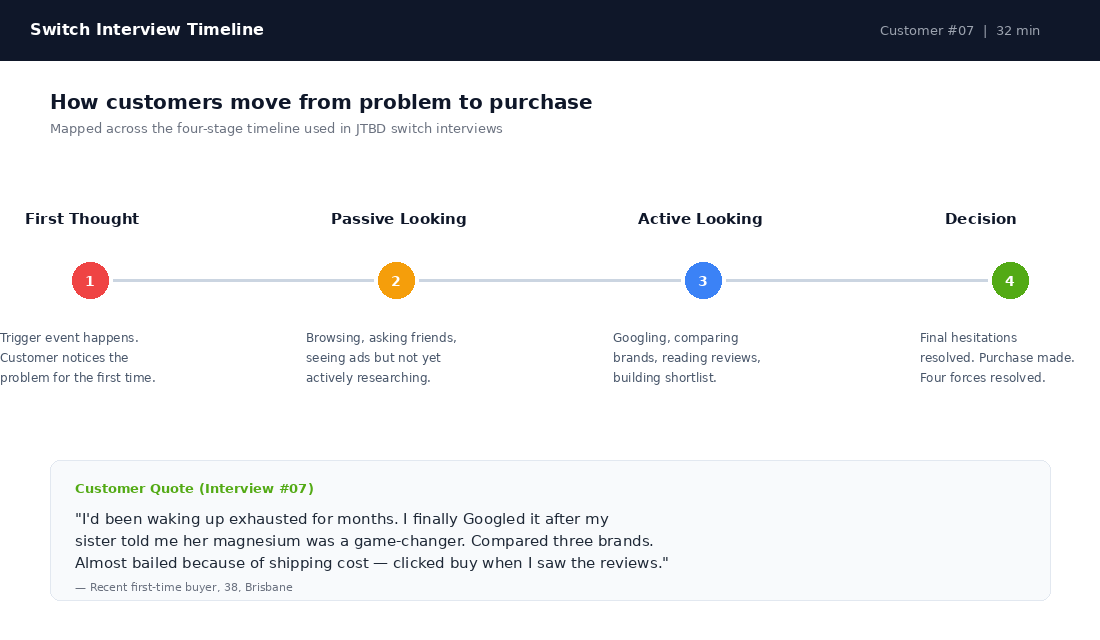
From the first thought, walk forward chronologically. What happened next? When did they actively start looking? What did they Google? Who did they ask? What products did they consider and reject? Why? Most JTBD pros use a four-stage timeline: First Thought → Passive Looking → Active Looking → Decision. You’re filling in events, emotions, and triggers at each stage.
The transitions matter most. What flipped them from passive to active? What flipped them from active to deciding? Those triggers are what your ads should be built on.
Step 4: Surface the Anxieties
Once they describe the moment of buying, ask: “What almost stopped you from clicking buy?” Customers usually pause here, then tell you something incredibly specific. “I wasn’t sure it would arrive before my trip.” “I worried it would taste like grass.” “I almost added it to wishlist instead.” Every one of those is an anxiety force you can defuse on your product page or in a follow-up email.
Step 5: Capture Their Language
Throughout the interview, write down the exact words they use – not your interpretation of them. If they say “I just wanted to feel like myself again before the school run,” that phrase goes in your ad copy. If they say “I needed something I could take while I was already running out the door,” that’s a homepage hero subhead. The customer is writing your marketing for you. Your job is to transcribe.
The 12-Question JTBD Interview Script You Can Steal
Use this exact sequence. Don’t deviate. The order matters because it walks the customer chronologically through the purchase decision instead of letting them jump to the rationalised summary.
- Tell me about the first time you thought about buying [product category]. Where were you? What was happening?
- What was going on in your life that made you start looking? Anything change recently?
- What were you doing before that wasn’t working? What had you tried already?
- When you started actively looking, what did you Google or where did you go?
- What other options or brands did you consider? What were the three or four you compared?
- Why did you rule out the others? What was missing?
- How did you find us? What was the first thing you saw?
- What made you click buy on this particular product? Was it a specific moment?
- What almost stopped you from buying? Any hesitations?
- How did you feel right after the purchase? Excited? Nervous?
- What changed once you started using it? What’s different now?
- If a friend asked what we sell, how would you describe it in one sentence?
Question 12 is sneaky-important. The way customers describe your product in their own words is almost always better than the way you describe it. That sentence is your next homepage headline, your next ad hook, and the answer to “what do you sell?” that you’ve been struggling to nail for a year.
Real Numbers: What Customer Research Actually Drives
If you’re still on the fence about whether 6 hours of customer interviews is worth it, the numbers are blunt:
- 97% of customers research before buying online, and customer reviews influence over 90% of purchase decisions, according to GRIN’s consumer research data referenced by Shopify in 2025. The brands writing for the actual research journey win.
- About 75% of first-time purchases happen within 24 hours of the shopper’s initial visit, with 90% converting by day 12 (Shopify, 2025). If you don’t address the four forces in those first touches, you’ve lost them.
- 80% of consumers say they’d pay up to 5% more for sustainably produced goods (Shopify, 2025), but only when the brand’s story makes the job clear. Pure feature lists do not earn that premium.
- Only 28% of typical Shopify shoppers are repeat buyers (Shopify merchant data, 2025). Customer interviews surface why the other 72% never return – and almost always it’s a job mismatch, not a product mismatch.
- TileCloud, an Australian Shopify brand, saw a 24% surge in new wholesale signups and a 34% jump in average order value after redesigning their B2B store around what their trade customers actually wanted (Shopify, 2025). That’s not a product change. That’s a JTBD-driven UX change.
One Aussie supplements brand we coached ran 8 JTBD interviews and rewrote their hero product page using the exact language customers gave them. Conversion rate on that page went from 2.1% to 4.4% in 6 weeks. No ads were changed. No price was changed. The product wasn’t reformulated. The page just started speaking to the actual job.
How to Turn JTBD Insights Into Marketing That Sells
Customer research that sits in a Notion doc is worthless. The point of running interviews is to rewrite specific assets in the business. Here’s how to translate insights into output across your store and ads.
Rewrite Your Product Page Hero in Customer Language
Take the most common phrasing from your interviews and write it directly into your product page hero. If five out of eight customers said something like “I needed something quick I could take in the morning while getting the kids ready,” that’s your subhead. Not “Premium magnesium for active women.” The first one converts because it sounds like the customer’s own internal monologue.
Add an Anxiety-Defusing FAQ Block
List the top 5 anxieties customers told you about. Answer each one in 1-2 sentences. Add it directly above the add-to-cart button or in the product description. This single addition often lifts conversion 10-20% because you’re addressing the silent objections most brands ignore.
Build Your Ad Creative Around the Trigger Event
The “what was going on in your life” answers from your interviews are the basis of your next 90 days of ad creative. If three customers mentioned that they bought after a particularly bad sleep week with their toddler, that exact scenario is your ad hook. The specificity is what makes the customer stop scrolling. Generic “are you tired?” doesn’t.
Email Sequence Built on the Four Forces
Restructure your welcome flow so each email handles one of the four forces. Email 1 amplifies the push (the pain you’re solving). Email 2 amplifies the pull (the transformation). Email 3 defuses the top anxiety. Email 4 breaks the habit (“here’s why what you’re doing now isn’t working”). Email 5 gives them an offer to act. The conversion lift on flows restructured this way is consistent – usually 30-50% better than generic welcome sequences.
Update Your Customer Segmentation
Most stores segment by what people bought or how recently. JTBD tells you to segment by why. Tag customers in Klaviyo or Shopify by the job they hired you for, then send job-specific email content. If you’ve already built RFM segmentation using the RFM playbook, layer the JTBD job tag on top. That’s when retention email starts pulling 35%+ of revenue instead of 18%.
A Real Example: How One Brand Rewrote Its Whole Funnel in 4 Weeks
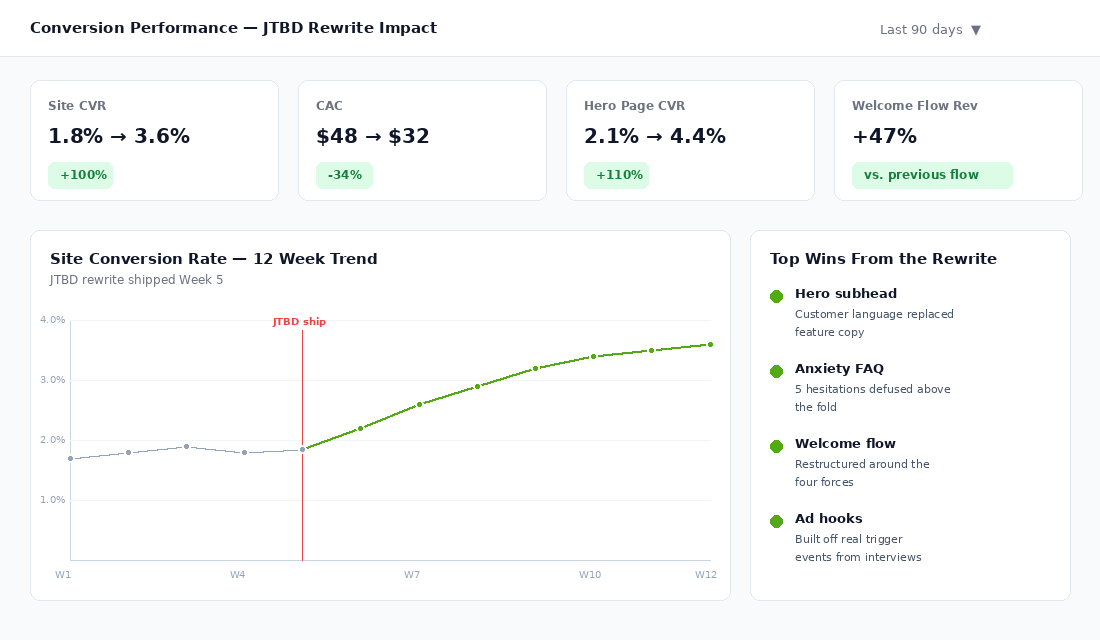
A coaching member of ours runs a $2.4M Aussie wellness brand. They were stuck at 1.8% site conversion despite spending $30K a month on Meta. The team had built three customer avatars and an extensive brand strategy doc. Everything looked right. Nothing was working.
We ran 9 JTBD switch interviews over two weeks. The pattern was unmissable. Customers weren’t buying for the reasons the brand assumed. They thought they were selling premium wellness products. The actual job customers were hiring them for was “help me feel competent and put-together as a parent again.” The product was almost incidental. The customer wanted to feel like the version of themselves they were before kids.
That single insight rewrote the brand. The new homepage headline became something close to “For the version of you that wakes up at 5am and still has it together.” Ad creative shifted from product shots to scenes of “Aussie mums actually owning their morning.” The welcome email lost 60% of its product feature copy and gained anxiety-defusing real-talk lines pulled directly from the interview transcripts.
Site conversion went from 1.8% to 3.6% in 5 weeks. Cost per acquisition dropped 34%. Same product, same media spend, completely different language. That’s the ROI of one good week of customer research.
Where JTBD Fits in Your Wider Customer Research Stack
JTBD isn’t a replacement for the rest of your customer work. It’s the deepest layer in a research stack that should also include surveys, journey mapping, and Voice of Customer mining. Each tool answers a different question:
- Customer surveys tell you scale and patterns across thousands of customers – see our customer surveys playbook for the survey-design framework we use with members.
- Voice of Customer mining turns reviews, support tickets, and DMs into systematic insight. The full process is in our VoC program guide.
- Customer journey mapping shows you where the friction is across the full lifecycle.
- JTBD interviews tell you the why behind everything else. They give context to the data.
If you only have time for one, start with JTBD. The depth of insight per hour invested is higher than any other research method. Eight one-hour interviews will reshape more of your marketing than 800 survey responses.
The Compound Effect: Why JTBD Becomes a Moat
Here’s what most brands miss. JTBD isn’t a one-time exercise. The job evolves. The customer who hired your magnesium for sleep this year might hire it for energy next year. New competitors enter the comparison set. Anxiety drivers shift as the category matures. Brands that build customer interviewing into their quarterly rhythm develop a structural advantage that compounds.
Within 18 months of running 4 interviews per quarter, you’ll know your customers better than any agency, ad buyer, or competitor possibly can. Your product page copy will be sharper. Your hooks will be sharper. Your anxiety-defusing content will be sharper. Every part of the funnel will be tuned to the actual job – not the assumed one.
Meanwhile your competitors will still be running off a customer avatar doc someone wrote 18 months ago, wondering why their CAC keeps creeping up. The gap widens every quarter you keep running the interviews and they don’t.
This is what world-class brands actually do behind the scenes. It’s unsexy, low-tech, and outrageously effective. Half an hour with eight customers a quarter is the cheapest competitive advantage in ecommerce.
Your JTBD Action Checklist for the Next 14 Days
If you do nothing else this fortnight, run the loop end-to-end once. The first run is always the most painful and the most valuable.
- Day 1: Pull 200 recent first-time buyers from the last 60 days. Email them with a $50 store credit offer for a 30-minute chat.
- Day 2-7: Book 8-10 interviews. Send a Calendly link, no pre-survey. Don’t pre-screen aggressively.
- Day 3-10: Run the interviews using the 12-question script above. Record (with permission) and transcribe.
- Day 11: Pull out the four to six forces driving purchase (push, pull, anxiety, habit) from across the transcripts.
- Day 12: Rewrite your top-three product page headlines, your hero, and your top abandoned-cart subject line using the actual buyer language captured.
- Day 13: Brief your retention email team with the new positioning. Update the welcome sequence accordingly.
- Day 14: Set a 30-day check-in. Compare conversion rate and click-throughs on the rewritten assets versus the previous version.
By the end of two weeks you will have transformed customer language into store assets, and you will have a baseline to measure against the next time you run the loop. The brands that compound on this work quarterly are the ones who eventually own their category.
The JTBD Numbers That Most Aussie Founders Get Wrong
JTBD work feels qualitative, but it is one of the highest-ROI activities you can do measured in cold revenue terms. Here are the benchmarks we have seen across eCommerce Circle members after one quarter of disciplined JTBD work:
- Conversion rate lift on rewritten product pages: 12-25% within 30 days.
- Email open-rate lift on rewritten welcome sequences: 8-18% (because subject lines now use buyer-language phrasing).
- Click-through-rate lift on rewritten Meta Ads creative: 20-40% on the same media spend.
- Return rate drop: 1.5-3 percentage points when JTBD reveals that buyers were buying for a job your product was not quite delivering.
- Customer service ticket reduction: 10-20% as pre-purchase confusion drops because your store finally speaks the buyer’s language.
Compound those over a year and you are talking about a 20-40% lift in efficient revenue without spending an extra dollar. That is why we put JTBD work into the Prospects pillar of the 10 P’s Operating System – it is the cheapest, most repeatable growth lever in the entire stack.
Pairing JTBD With The Rest Of Your Growth Stack
JTBD is the qualitative source of truth that makes every other discipline sharper. Once you have the language, plug it into:
- Conversion rate optimisation: Rewrite hero, PDP, and checkout copy. See our CRO playbook for the order to attack.
- A/B testing: Use the new buyer language as the variant in headline tests. Read the A/B testing playbook for how to run the experiments cleanly.
- Email and SMS: Welcome flow, browse abandonment, post-purchase. Plug verbatim buyer phrases into subject lines.
- Paid ads creative: Hand the transcripts to your creative team. The best Aussie performance creative is almost always written verbatim from customer interview transcripts.
- Product development: The “anxieties” and “habits” you uncover almost always point to product, packaging, or bundle improvements that lift AOV and LTV.
How to Recruit Interviewees Who Give You Honest Answers
Most JTBD projects die at recruitment. You email your whole list asking “can we chat about your experience?”, six people reply, and five of them are your biggest fans who will tell you everything is wonderful. That is not research. That is a testimonial harvest.
The people you actually need are the ones who bought once in the last 60 days and have not bought again. They still remember the struggle that pushed them to you, and they have no relationship equity to protect. Expect a reply rate around 3 to 5% on a cold research ask, so to book 12 interviews you need to reach roughly 300 recent buyers.
Build the segment in Klaviyo in about five minutes. Placed Order at least once in the last 60 days, Placed Order zero times in the last 30 days, and not already in your VIP tag. Send from a personal address, not a branded template. A plain-text email from “Paul at [brand]” outperforms a designed campaign by a wide margin on this specific ask, because it reads like a person and not a marketing asset.
Pay them, but pay them the right way
A $50 gift card is the going rate for 30 minutes in the Australian market. Make it a general-purpose card (Prezzee, Visa, Coles Group), not store credit. Store credit selects for people who already love you and quietly biases every answer toward “I would buy again”, which is the one thing you did not need to find out.
Say the incentive is for their time regardless of what they say, and say it in the invitation. It sounds small. It is the difference between a transcript full of polite hedging and a transcript where someone tells you they nearly bought from a competitor because your delivery date was vague.
Book through Calendly with a 45-minute slot for a 30-minute call, record on Zoom or Google Meet with permission, and run the transcript through Otter or Fathom. Budget about $600 in incentives and four hours of your own calendar for a full round of 12. That is a rounding error against a month of ad spend, and it produces assets you will use for two years.
The Synthesis Session: Turning 12 Transcripts Into 4 Jobs
Interviews are the easy part. The place most founders stall is the pile of 12 transcripts sitting in a folder, each one interesting, none of them obviously adding up to anything. Synthesis is a separate skill and it needs its own block of time.
Block three hours. Not three sessions of one hour. The pattern recognition only happens when you hold all twelve stories in your head at once, and that does not survive a lunch break.
- Pull quotes, not summaries. Go through each transcript and lift every sentence where the customer describes a struggle, a workaround, a trigger, or a comparison. One quote per line in a spreadsheet or a Miro board. Twelve interviews will usually yield 150 to 250 quotes.
- Cluster without labelling. Group quotes that feel like the same underlying situation. Resist naming the groups. The moment you write a label you stop seeing evidence that contradicts it.
- Name the job last. Once a cluster has 15 or more quotes behind it, write the job as a situation and an outcome: “When my old one finally gave out mid-season, help me replace it fast without risking another dud.” Not a demographic. Not a persona name.
- Size each job. Count how many of the twelve buyers show up in each cluster. A job that appears in 8 of 12 gets your homepage. A job that appears in 2 of 12 gets a landing page or an email segment, not your main above-the-fold message.
- Write the kill list. For every job, note the specific anxiety that nearly stopped the purchase. That list becomes your FAQ, your PDP objection blocks, and your abandoned cart copy.
You are aiming for three to five jobs. If you finish with nine, you have clustered too finely and you will end up with a homepage that speaks to nobody. If you finish with one, you have clustered too coarsely and lost the thing that makes the research useful.
Two things make synthesis stick. Do it with one other person from your team, ideally whoever writes your ads, because the arguing is where the insight sharpens. And write the four jobs onto a single page that lives somewhere everyone sees it, the same way you would treat your weekly scorecard numbers. Research that lives in a folder changes nothing. Research that lives on a wall changes every brief you write for the next 18 months.
Re-run the whole cycle every 12 months, or immediately after you launch a genuinely new product line. Jobs shift when your category shifts, and the brands that get caught out are the ones still selling against a struggle their customers solved two years ago. If you want the standing version of this, pair it with a continuous voice of customer program so you are not starting from zero each time.
Where To Go From Here
JTBD is one of those frameworks where reading about it does almost nothing – you have to actually book the calls, do the interviews, and rewrite the assets. The good news: nobody else in your category is doing it. The bad news: that means there is no shortcut.
Inside eCommerce Circle, JTBD is one of the first frameworks we run with new members. We help you build the interview script, recruit the right buyers, run the synthesis session, and rewrite your top-five assets in the first month. Most brands see meaningful conversion lift within 60 days.
Let’s Talk About Your Buyer Research →