You check your Shopify dashboard on a Monday morning and see 14 new orders over the weekend. The dopamine hits. Then you start reviewing them — and three have mismatched billing and shipping addresses, two used the same email with different card numbers, and one has a shipping address that Google Maps says is a vacant lot in western Sydney.
What’s in This Article
Welcome to ecommerce fraud. It is not something that only happens to big retailers running millions a month. Small and mid-sized Shopify stores are actually more vulnerable, because they rarely have systems in place to catch it early. And by the time a chargeback hits your account 60 days later, the product is gone, the money is gone, and you are paying a $25-$50 dispute fee on top of it.
Global ecommerce fraud losses hit $48 billion in 2025 — and that number is climbing fast. For every $1 of fraud, merchants lose $4.61 when you factor in chargebacks, fees, lost product, and operational costs. The good news? Most fraud follows predictable patterns. And with the right setup, you can block the vast majority of it without accidentally rejecting good customers.
Why Shopify’s Built-In Fraud Analysis Is Not Enough
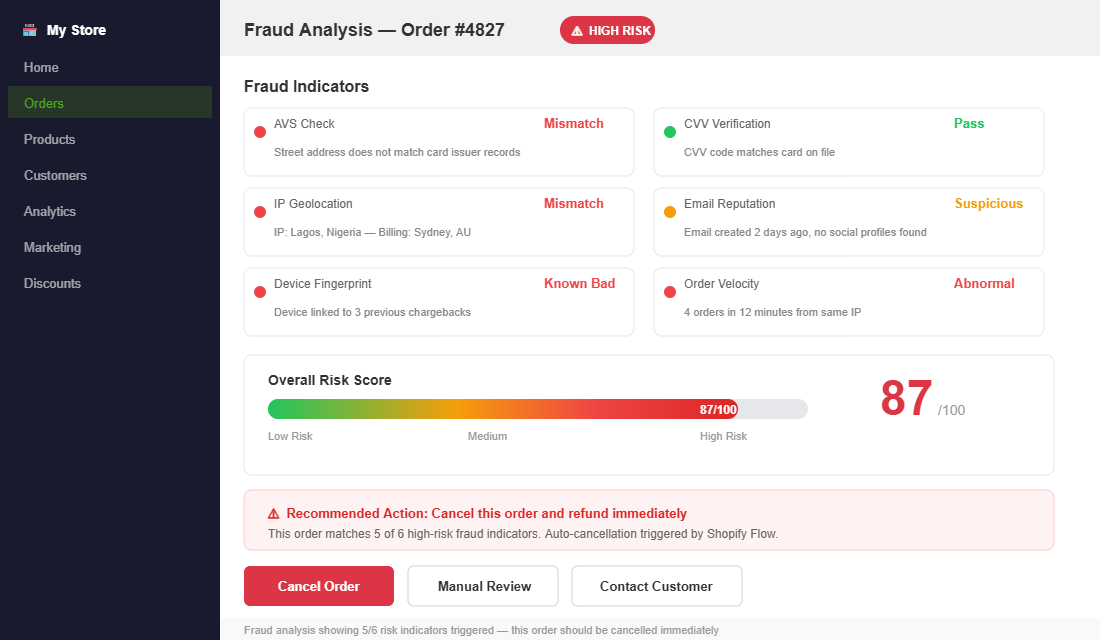
Shopify does include basic fraud detection on every plan. When an order comes in, you will see a fraud analysis indicator — low, medium, or high risk — based on checks like AVS (Address Verification System) matching, CVV validation, and IP geolocation.
Here is the problem: Shopify’s native fraud analysis is a signal, not a solution. It tells you something might be off, but it does not block the order, cancel it, or refund it automatically. You still have to manually review every flagged transaction. And if you are doing 20-50 orders a day, that becomes a full-time job.
Worse, the built-in system generates a lot of false positives. A legitimate customer using a VPN or shipping a gift to a different address will often trigger a medium-risk flag. If you cancel those orders out of caution, you are losing real revenue.
The built-in tools are a starting point — not a strategy. You need layers.
The 5 Types of Fraud Hitting Australian Shopify Stores
Before you can prevent fraud, you need to understand what you are actually up against. These are the five most common types we see with ecommerce brands in Australia.
1. Card testing. Fraudsters use stolen card details (sourced from data breaches or the dark web) and run small test transactions on your store to see which cards are still active. If a $2.99 order goes through, they will immediately use that card for a $500 purchase elsewhere. You get stuck with the chargeback on the test order and a flagged payment processor.
2. Stolen card purchases. This is the classic: someone uses a stolen credit card number to place a real order. The legitimate cardholder disputes it, and you lose the product plus the revenue. Card-not-present fraud accounted for 81% of all payment fraud cases globally in 2025.
3. Friendly fraud (first-party fraud). A real customer buys something, receives it, and then disputes the charge with their bank claiming they never got it or did not authorise the transaction. This now accounts for 36% of all global fraud cases — and it is growing fast because many consumers see chargebacks as an easier alternative to returns.
4. Account takeover. Fraudsters gain access to a customer’s existing account on your store (usually through credential stuffing or phishing) and place orders using their saved payment methods. The real customer has no idea until the charges appear.
5. Refund fraud. A buyer claims an item arrived damaged or not as described, gets a full refund, and keeps the product. Some fraudsters do this systematically across dozens of stores. In Australia, Scamwatch received over 6,300 reports of shopping scam losses in just the first half of 2025 — the highest of any scam category.
Your Fraud Prevention Stack: The 4 Layers That Actually Work
Effective fraud prevention is not about one tool or one setting. It is about building layers — each one catching what the others miss. Here is the stack we recommend for Shopify stores doing $10K-$500K per month.
Layer 1: Shopify’s Native Settings (Free)
Start by making sure you are using everything Shopify already gives you. Go to Settings → Payments and confirm these are enabled:
- AVS (Address Verification System). Checks if the billing address matches what the card issuer has on file. Mismatches are a red flag.
- CVV verification. Requires the three-digit security code on the back of the card. This blocks the most basic stolen card attempts.
- Shopify Protect. Available on Shop Pay orders, this gives you free chargeback protection on eligible transactions. If a fraudulent chargeback is filed, Shopify covers the order total and the chargeback fee.
These are your baseline. They will not stop sophisticated fraud, but they filter out the low-effort attempts.
Layer 2: Automated Fraud Filtering with Shopify Flow
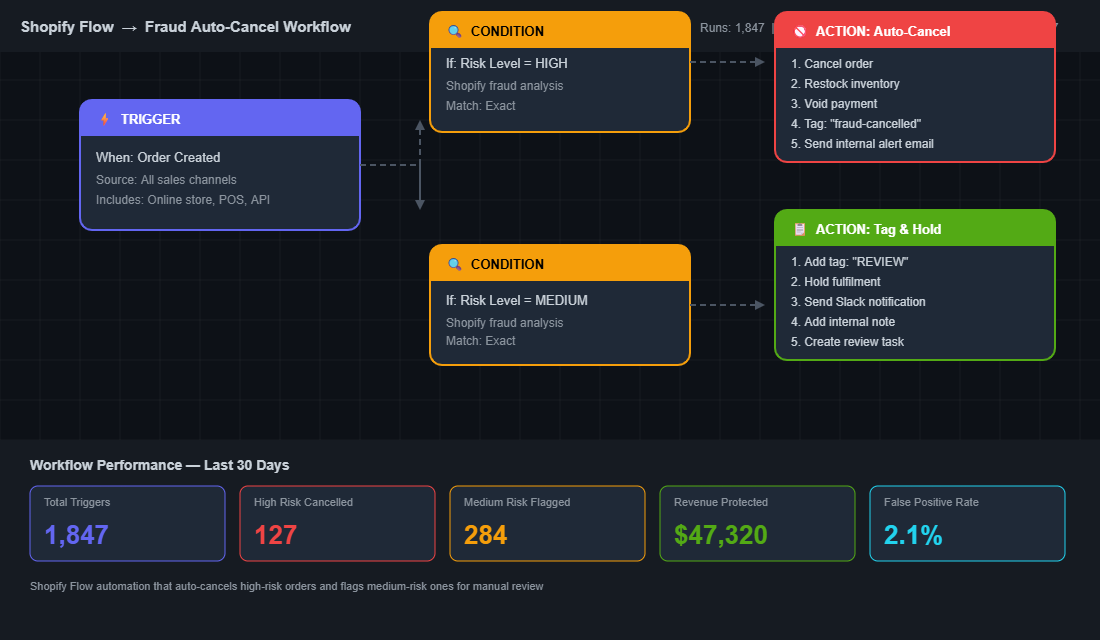
Shopify Flow (available on Shopify and Advanced plans) lets you build automated workflows that act on fraud signals in real time. This is where things get powerful.
Here are three workflows every store should set up:
- Auto-cancel high-risk orders. Trigger: Order risk level = high. Action: Cancel order, restock inventory, send email notification. This catches the most obvious fraudulent transactions before you ship anything.
- Tag and hold medium-risk orders. Trigger: Order risk level = medium. Action: Add tag “REVIEW” and send Slack/email notification to your team. This gives you time to manually verify without losing the order.
- Block repeat offenders. Trigger: Customer email or IP matches a known bad actor from your cancelled-order list. Action: Auto-cancel and tag. Build your own blocklist over time.
Flow costs nothing extra on qualifying plans, and it runs 24/7. You should have these three automations live within the next hour.
Layer 3: A Dedicated Fraud Prevention App
For stores processing more than $30K per month — or stores in high-risk categories like electronics, fashion, or supplements — you need a dedicated fraud prevention tool. These apps go far beyond what Shopify’s native analysis can do.
Here are the three we recommend, depending on your needs:
Chargeflow (best for chargeback recovery). Chargeflow automates the entire chargeback dispute process using AI — collecting evidence, submitting disputes, and tracking outcomes. You only pay a 25% fee on chargebacks you win. If you are already getting hit with disputes, install this first. Rating: 4.8 stars from 142 reviews.
NoFraud (best for real-time order screening). NoFraud combines AI screening with human fraud analysts. Every order gets an instant pass/fail/review decision. What makes it stand out is the chargeback guarantee — if NoFraud approves an order and it turns out to be fraud, they cover the loss. Rating: 4.5 stars from 166 reviews.
SEON (best for data enrichment). SEON digs into the digital footprint behind each transaction — checking email reputation, social media profiles, phone number history, and device fingerprinting. It is ideal if you want granular control over your fraud rules and want to build custom risk scoring.
Layer 4: Manual Review Protocols for Your Team
Technology catches most fraud, but your team needs a clear process for handling the edge cases. Create a simple SOP for orders flagged as medium risk:
- Check the email address. Does it look legitimate? A string of random characters at a free email provider is a red flag. Google the email — does it appear anywhere online?
- Compare billing and shipping addresses. Mismatches are not always fraud (gifts are a thing), but a billing address in Melbourne and shipping to a PO Box in a different state warrants a closer look.
- Look at order history. Is this a first-time customer placing an unusually large order? Did they skip straight to the most expensive items without browsing?
- Verify by phone or email. For high-value orders from new customers, a quick verification message can save you thousands. Legitimate customers rarely mind. Fraudsters never respond.
Train your team (or your VA) on this process. A 2-minute check on a $400 order is the best insurance you will ever buy.
Setting Up Chargeflow on Your Shopify Store: Step by Step
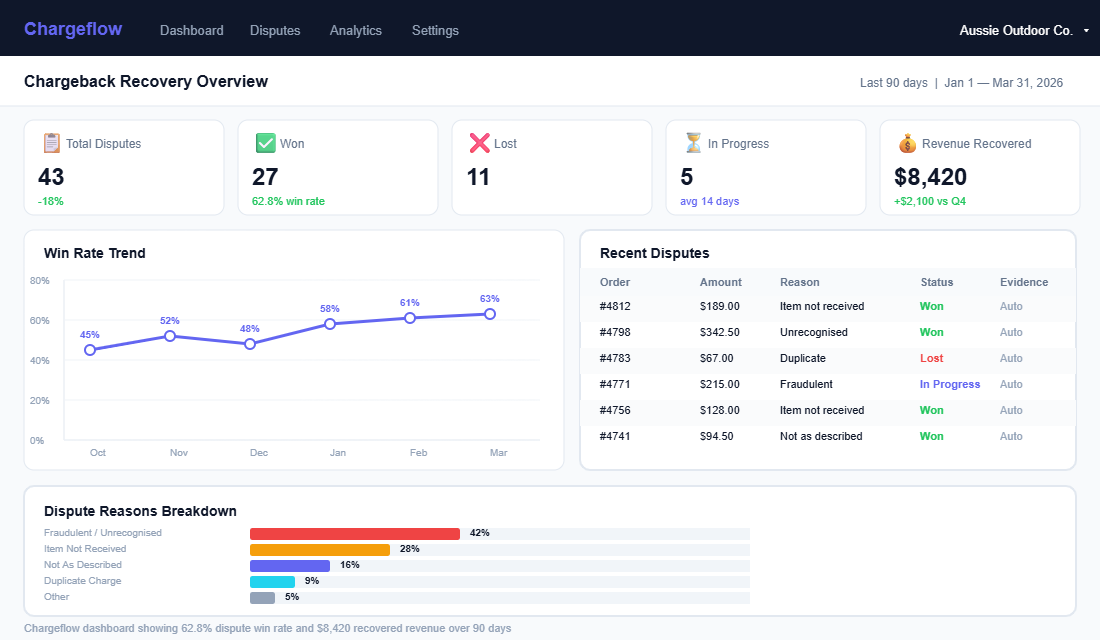
If you are going to add one fraud tool today, start with Chargeflow. Here is how to get it running in under 10 minutes:
- Install from the Shopify App Store. Search “Chargeflow” or go directly to apps.shopify.com/chargeflow. Click “Add app” and authorise the connection.
- Connect your payment processor. Chargeflow will prompt you to link your Shopify Payments, Stripe, or PayPal account so it can monitor incoming disputes.
- Configure your evidence templates. Chargeflow auto-generates dispute evidence using your order data, tracking info, and customer communications. Review the default templates and add any custom policies (like your returns policy URL).
- Enable Chargeflow Alerts. Set up notifications so you know immediately when a chargeback is filed and when a dispute is won.
- Review your first disputes. Chargeflow handles evidence submission automatically. Check your dashboard after the first week to see win rates and recovered revenue.
The app is free to install — you only pay the 25% success fee when Chargeflow wins a dispute on your behalf. For most stores, the ROI is immediate since the average chargeback costs $100-$300 in lost revenue plus fees.
The Fraud Prevention Checklist: Your Quick-Start Framework
Use this checklist to audit your store’s fraud defences today. If you cannot tick off at least six of these, you are leaving yourself exposed.
- ☐ AVS and CVV verification enabled in Shopify Payments settings
- ☐ Shopify Protect activated for Shop Pay transactions
- ☐ Shopify Flow automation: auto-cancel high-risk orders
- ☐ Shopify Flow automation: tag and hold medium-risk orders for review
- ☐ Dedicated fraud app installed (Chargeflow, NoFraud, or SEON)
- ☐ Manual review SOP documented and shared with team/VA
- ☐ Delivery confirmation and signature required on orders over $150 AUD
- ☐ Clear refund and returns policy published and linked in checkout
- ☐ Customer communication templates ready for order verification
- ☐ Monthly fraud review: chargeback rate, dispute outcomes, flagged patterns
Print this out, stick it next to your desk, and work through it this week. Every box you tick is another wall between your revenue and the fraudsters.
How It All Compounds: From Reactive to Protected
Here is what happens when you run all four layers together.
Shopify’s native tools catch the obvious stuff — the orders with no CVV match, the clearly mismatched addresses. That filters out maybe 30-40% of fraud attempts before they even reach your queue.
Shopify Flow then automates the next layer, auto-cancelling high-risk orders and flagging medium-risk ones for review. This eliminates the manual overhead of checking every single order, and it runs around the clock — including the 2am transactions you would otherwise miss until morning.
Your dedicated fraud app adds intelligence that Shopify cannot match: device fingerprinting, email reputation scoring, social media verification, and chargeback guarantees. It is the difference between a smoke detector (Shopify’s tool) and a full fire suppression system.
And your team’s manual review process catches the edge cases — the orders that look almost right but have one detail that does not add up. That gut check from an experienced team member is often the last line of defence on sophisticated fraud attempts.
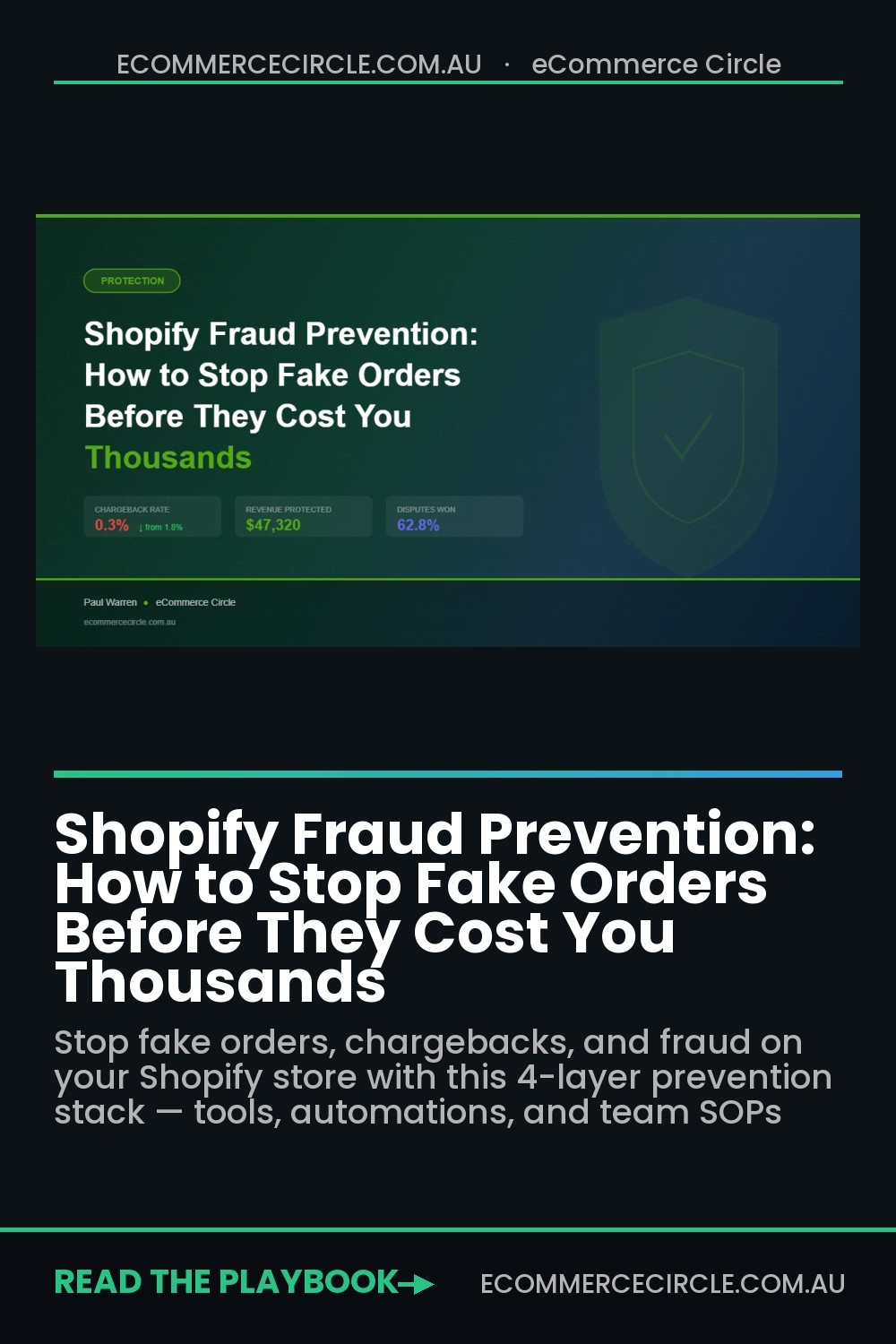
The compound effect is dramatic. Stores running this full stack typically see their chargeback rates drop below 0.3% (well under the 1% threshold where payment processors start threatening account holds) and recover 40-60% of disputes through automated evidence submission. That is real money back in your pocket — often thousands of dollars per quarter for mid-sized stores.
If you have already been through the pain of chargebacks eating into your margins, you know how much this matters. And if you have not — this is how you make sure you never do. For related reading, check out our guide on building a returns and chargeback policy framework and our breakdown of the 12 metrics every Shopify owner should track — including your fraud and dispute rates.
False Declines: The Fraud Cost Nobody Puts on a Spreadsheet
Here is the part most founders get wrong. You tighten your fraud rules, chargebacks drop, and you declare victory. Meanwhile you are quietly cancelling good orders from real customers.
These are false declines, and across global ecommerce they cost merchants roughly five to seven times more than actual fraud. Industry benchmarks put false decline rates between 2% and 5% of attempted orders for stores running aggressive rules. On $200K a month in attempted revenue, a 3% false decline rate is $6,000 of good money you handed to a competitor — every month.
Australian stores get hit harder than most, for three reasons that have nothing to do with fraud:
- Legitimate address mismatches. Plenty of Aussie shoppers bill to a home address and ship to a work address, a parcel locker, or a Hive box. Rules-based systems read that as a red flag. It is not.
- Regional and rural postcodes. A delivery to a rural NSW or WA address with no street number often scores badly on address verification, because the address genuinely does not match a standard format.
- Travelling and expat customers. An Australian card used from a Bali or London IP looks foreign. It usually just means your customer is on holiday.
The fix is not to loosen everything. It is to separate cancel from review. Reserve automatic cancellation for orders that trip two or more high-severity signals — mismatched billing country, a disposable email domain, and an unusually large first order all at once. Everything with a single soft flag goes to manual review, not the bin.
Then measure it. Tag every cancelled order in Shopify with the reason, and once a month pull the list and ring five of them. If three of the five were genuine customers, your rules are too tight and you are burning margin to avoid a problem you do not have. This is the same discipline behind a good service recovery process — the customer you wrongly accused is still recoverable if you move fast and apologise properly.
The 6 Fraud Numbers to Check on the First Monday of Every Month
Fraud prevention fails quietly. Nobody notices a slow drift until a payment processor sends a warning letter. Build a six-line scorecard, review it monthly, and you will catch problems while they are still cheap to fix.
- Chargeback rate. Total chargebacks divided by total orders. Target under 0.3%. Shopify Payments, Stripe and PayPal all begin monitoring programs around 0.65% to 1%, and the fees escalate fast once you are in one.
- Dispute win rate. What percentage of contested chargebacks you actually win. A well-evidenced store wins 40% to 60% of friendly-fraud disputes. Under 20% usually means your evidence pack is missing delivery confirmation or a signed terms acceptance.
- Manual review queue volume. How many orders needed a human last month. If it is climbing past 5% of orders, your rules need tuning, not more staff hours.
- Average review time. Orders sitting in review for more than four hours start generating “where is my order” tickets. Track it, and set a same-day clearance standard.
- Cancelled-order recovery rate. Of the orders you cancelled as suspicious, how many customers came back and completed a clean order. High recovery means real customers were caught in the net.
- Card testing attempts. Spikes in tiny declined transactions are the early warning of a bot attack, and they carry gateway fees whether they succeed or not. If you are seeing them, the card testing defence playbook covers the specific rate limits and checkout settings that shut it down.
Pull these six from Shopify Analytics, your payment processor dashboard and your fraud app in about fifteen minutes. If gift cards or store credit are a meaningful part of your revenue, add a seventh line for gift card balance anomalies and read the gift card fraud playbook — that attack vector sits completely outside your normal order screening.
Protect the Business You Have Built
Fraud prevention is not glamorous. Nobody starts an ecommerce brand because they are excited about chargeback management. But it is one of those operational foundations that separates stores that scale sustainably from stores that bleed money they did not even know they were losing.
Inside the eCommerce Circle, fraud prevention and risk management sit within our Protection pillar — one of the 10 P’s we work through with every member to build a store that is not just growing, but growing safely. If you want a second set of eyes on your fraud setup, let’s talk.