Returns are the tax every ecommerce brand pays for selling online. Customers can’t touch, try, or smell your product before buying — so a percentage of them will inevitably send it back. That’s the deal. But most Shopify brands treat returns as a cost of doing business and never actually optimise their policy to minimise returns, reduce costs, and protect profit.
What’s in This Article
The average ecommerce return rate sits around 10-15%. For fashion and apparel, it’s even higher — 20-30%. Every return costs you: the refund itself, return shipping (if you cover it), restocking labour, and potential product damage. For a store doing $100K/month with a 12% return rate, that’s $12,000/month walking back out the door. Some of that is unavoidable. But a lot of it isn’t.
The right policy framework doesn’t just handle returns — it prevents them, converts them to exchanges, and protects you from chargebacks. Here’s how to build one.
Understanding Where Your Returns Come From
Before you can fix your returns problem, you need to know why customers are returning. Most brands don’t track return reasons systematically — they just process the refund and move on. That’s leaving money on the table.
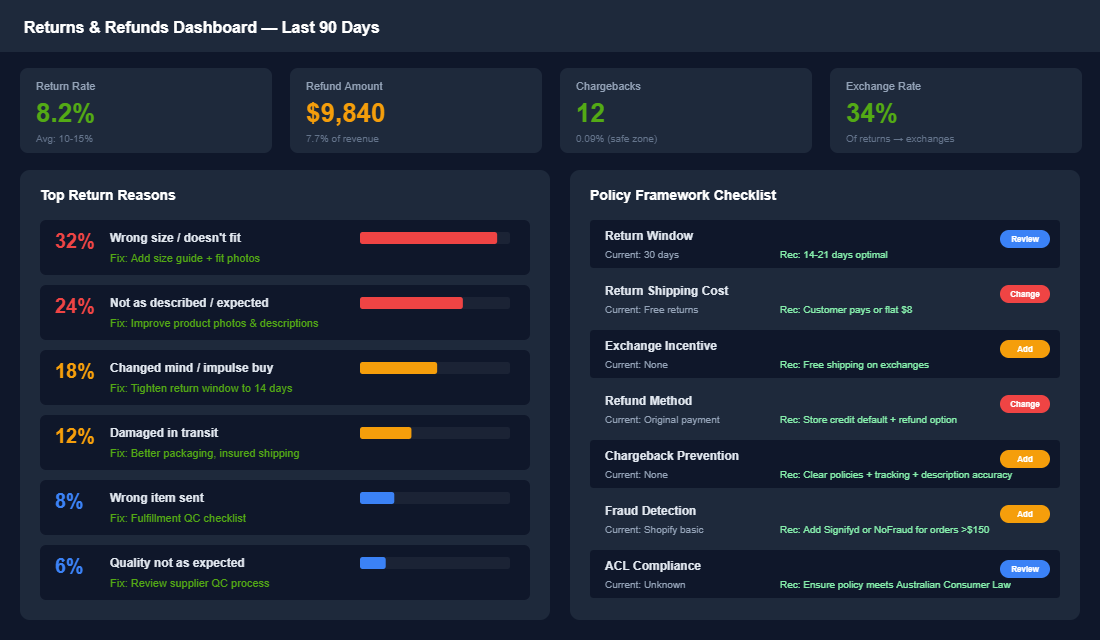
The top return reasons are almost always the same: “Doesn’t fit / wrong size” (30-35%) — fix this with detailed size guides, fit photos on real bodies, and size recommendation quizzes. “Not as described / expected” (20-25%) — fix this with better product photography, accurate descriptions, and user-generated photos in reviews. “Changed mind” (15-20%) — reduce this by tightening your return window and making exchanges more attractive than refunds.
Set up a simple return reason dropdown in your returns process (apps like Loop Returns or ReturnGO make this easy). After 90 days of data, you’ll know exactly where to focus.
The Optimal Return Policy for Australian Ecommerce
Your return policy needs to balance two things: customer confidence (a generous policy increases purchase likelihood) and profit protection (too generous and you’re haemorrhaging money). Here’s the sweet spot for most Aussie brands:
Return window: 14-21 days. Long enough that customers feel safe buying, short enough to discourage “wear and return” behaviour. 30 days is too long — it gives customers time to forget about the purchase entirely and default to a refund. Return shipping: Customer pays. This single change reduces return rates by 20-30%. Offer a flat-rate return label ($8-$10) for convenience. The exception: faulty or wrong items should always be free returns — this is also your legal obligation under Australian Consumer Law.
Refund method: Store credit as default. When a customer initiates a return, make store credit the primary option (with a bonus — e.g., “$5 extra credit if you choose store credit”). Offer a full refund as a secondary option. This retains 40-50% of return revenue as store credit that gets spent on a future purchase. Exchange incentive: Free shipping on exchanges. Make it more attractive to exchange than to return. If the customer wants a different size or colour, offer free exchange shipping. You keep the sale, they get what they want — everyone wins.
Chargeback Prevention: Protect Your Merchant Account
Chargebacks are the nuclear option — a customer disputes a charge with their bank instead of contacting you. Each chargeback costs you the transaction amount plus a $20-$50 fee, and if your chargeback rate exceeds 1%, Shopify Payments (or your payment processor) can shut down your account. That’s a business-ending event.
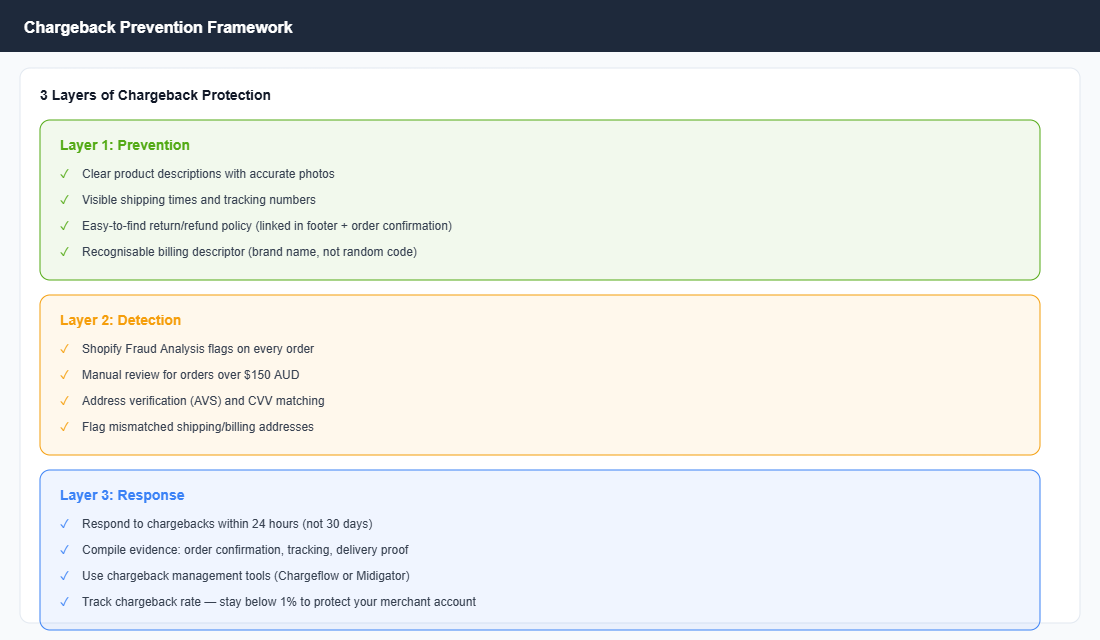
Most chargebacks happen for preventable reasons: the customer didn’t recognise the charge on their statement (your billing descriptor shows a random company name instead of your brand), they claim the product wasn’t as described (your photos or descriptions were misleading), or they say the item never arrived (you didn’t provide tracking or delivery confirmation).
The fix is a three-layer approach. Prevention: use a recognisable billing descriptor, provide clear product descriptions with accurate photos, send shipping confirmation with tracking, and make your return/refund policy easy to find. Detection: use Shopify’s built-in fraud analysis, manually review high-value orders, and flag mismatched shipping/billing addresses. Response: when a chargeback does hit, respond within 24 hours with comprehensive evidence — order confirmation, tracking number, delivery confirmation, and communication history.
The Profit Impact of Policy Optimisation
Most brands think of their return policy as a fixed cost. It’s not. Strategic policy changes can recover $5,000-$10,000+ per month in profit for a store doing $80K-$100K/month.
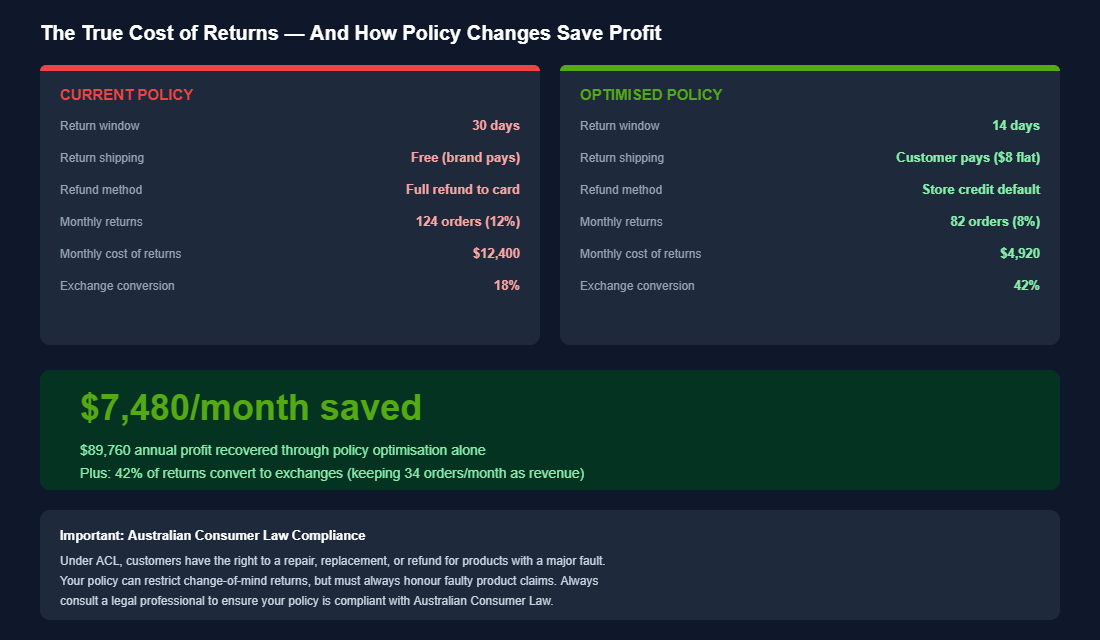
The maths: moving from a 30-day free return policy to a 14-day customer-pays-shipping policy with store credit as default typically reduces return rate from 12% to 8% and converts 42% of remaining returns into exchanges instead of refunds. On a $100K/month store, that’s $7,480/month in recovered profit — $89,760 per year.
Australian Consumer Law: What You Must Know
One critical note for Australian ecommerce brands: you cannot override Australian Consumer Law (ACL) with your store policy. Under ACL, customers have the right to a repair, replacement, or refund for products that are faulty, not as described, or don’t do what they’re supposed to do. This applies regardless of what your return policy says.
However, ACL does not require you to accept returns for change of mind. If a customer simply changed their mind, decided they don’t like the colour, or found a better price elsewhere, you’re not legally obligated to offer a refund. This is where your policy has room to be strategic. Always consult a legal professional to ensure your specific policy is compliant.
The Compound Effect: Protection as a Profit Centre
When you combine return prevention (better product pages, size guides, accurate descriptions), policy optimisation (shorter windows, exchange incentives, store credit defaults), and chargeback protection (clear billing, proactive tracking, rapid response), your returns operation goes from a cost centre to a strategic advantage. Lower returns mean higher effective revenue. More exchanges mean retained sales. Store credit means future purchases. And chargeback prevention protects the merchant account that your entire business depends on.
The Benchmarks: What Healthy Returns Actually Look Like
You cannot manage what you have not benchmarked. Across ecommerce, average return rates sit between 16% and 18% of orders. Apparel and footwear run much hotter, anywhere from 20% to 30%, mostly driven by sizing. Hard goods like homewares and tools usually sit under 10%.
So if you run an Aussie fashion label and your return rate is 24%, you are not broken. You are average. The play is not panic, it is shaving three to five points off with better sizing data. If you sell supplements and you are returning 12%, something is genuinely wrong with expectations set on the product page.
- Sizing fixes work. Brands that add a proper size guide or fit quiz routinely cut size-related returns by 30% to 50%.
- Exchanges save revenue. Stores that push exchanges over refunds retain 25% to 40% of would-be refund value.
- Chargebacks are winnable. Merchants who respond with solid evidence win roughly 30% to 45% of disputes. Merchants who ignore them win zero.
For the full dispute-evidence system, see our Shopify chargeback defence playbook.
The Tech Stack That Runs Returns Without You
Manual returns eat founder hours. Every email back-and-forth costs you 10 to 15 minutes, and at a 20% return rate on 500 orders a month, that is 100 returns chewing up a full week of someone’s time. The fix is a self-serve returns portal with your policy rules baked in.
- Shopify native returns: free, fine for low volume, but no automation rules or exchange incentives.
- AfterShip Returns or ReturnGO: from around $29 USD a month. Self-serve portal, automated approvals, exchange-first flows.
- Refundid: the Aussie option. Instant refunds before the item is even posted back, which converts hesitant buyers on the front end.
- Loop Returns: the premium pick for brands past $250k a month. Deep exchange logic and bonus-credit incentives that keep cash in the business.
Whichever tool you pick, switch the default outcome to store credit or exchange, not refund. That single setting is usually worth more than the software subscription many times over.
Turn Return Reasons Into Product Fixes
Your returns data is a free product research department. Tag every return with a reason code: too small, too big, not as pictured, arrived damaged, changed mind. Review the tags monthly. One Aussie member found 60% of returns on a single SKU were “runs small”. They added one line to the product page (“size up if between sizes”) and cut returns on that product by a third inside eight weeks.
This is also where your guarantee strategy ties in. A confident, well-structured guarantee lifts conversion more than it costs in extra returns, and we break down exactly how to build one in the money-back guarantee playbook. Pair it with the Australian Consumer Law playbook so your policy stays on the right side of the ACCC while still protecting your margin.
The 7-Day Policy Sprint: From Leaky to Locked Down
You do not need a quarter to fix this. One focused week gets the whole framework live. Here is the sprint we run with members.
- Day 1 and 2: Pull the data. Export the last 90 days of returns and chargebacks. Tag each with a reason code and find your top three leak points. Most stores discover one SKU or one courier is behind a third of the pain.
- Day 3: Rewrite the policy. Plain English, exchange-first, store credit as default, clear timeframes. Put it in the footer, the FAQ, and on every product page near the buy button.
- Day 4: Set up the portal. Install your returns app, load the policy rules, and switch automated approvals on for low-risk requests under $100.
- Day 5: Add the fraud filters. Turn on address verification and CVV matching in your payment settings, and flag orders where shipping and billing addresses differ on amounts over $250.
- Day 6 and 7: Brief the team and test. Run two test returns end to end, one exchange and one refund, and make sure the emails, labels and credits all fire correctly.
A week of setup, and from then on the system handles the volume while you only see the exceptions. That is the difference between returns as a tax and returns as a managed cost line.
Your Next Step
This week, pull your return data from the last 90 days. Calculate your return rate, average refund amount, and top return reasons. Then review your current policy against the framework above. The three quickest wins: add a return reason tracker, switch to customer-pays-shipping for change-of-mind returns, and make store credit your default refund option.
Inside the eCommerce Circle, profit protection is one of the core pillars we build with every member — because the revenue you keep is just as important as the revenue you generate. If you want help building a returns framework that protects your bottom line, let’s talk.