You’re spending money on Meta Ads, sending email campaigns, posting on social media — and yet your conversions feel stuck. Your cost per acquisition keeps climbing. Your messaging sounds like every other store in your niche.
What’s in This Article
Here’s the uncomfortable truth: most Shopify store owners have no idea who they’re actually selling to. They’ll describe their target customer as “women aged 25-45 who like fashion” and wonder why their $50-a-day ad budget is going nowhere. That’s not a customer avatar. That’s a vague guess.
The brands that consistently outperform — the ones converting at 3-5% while competitors sit at 1.2% — build everything around deeply researched buyer personas. According to research from the ITSMA, companies using well-defined personas see a 171% increase in marketing-generated revenue. And 82% of companies using personas report an improved value proposition that resonates with their actual customers.
This isn’t some abstract marketing theory. Building proper customer avatars is the single most profitable exercise you can do for your ecommerce brand. It changes everything — your ad targeting, your product page copy, your email sequences, even which products you develop next. Let me show you exactly how to do it.
Why Most Ecommerce Brands Get Customer Avatars Wrong
The typical approach to customer research in ecommerce goes something like this: you open a Google Doc, write down some demographics (age, gender, income), add a stock photo, give them a name like “Marketing Mary,” and call it done. Then you shove it in a folder and never look at it again.
That exercise is almost worthless. Demographics tell you who someone is on paper. They don’t tell you why they buy, what keeps them up at night, what objection stops them from clicking “Add to Cart,” or what language they use when describing their problems to a friend.
A real customer avatar goes three layers deeper. It captures psychographics — the fears, frustrations, desires, and aspirations that drive purchasing decisions. It documents their buying triggers: the moment they go from “I should probably look into this” to “I need to buy this today.” And it maps out where they spend their time online, whose recommendations they trust, and what competing products they’ve already tried.
When you build avatars at this level of detail, something shifts. Your ad copy starts speaking directly to real pain points. Your product pages address specific objections before customers even think of them. Your email sequences feel personal rather than generic. Research from McKinsey shows that companies excelling at personalisation (which starts with knowing your customer) generate 40% more revenue than competitors who don’t.
The Five-Layer Customer Avatar Framework
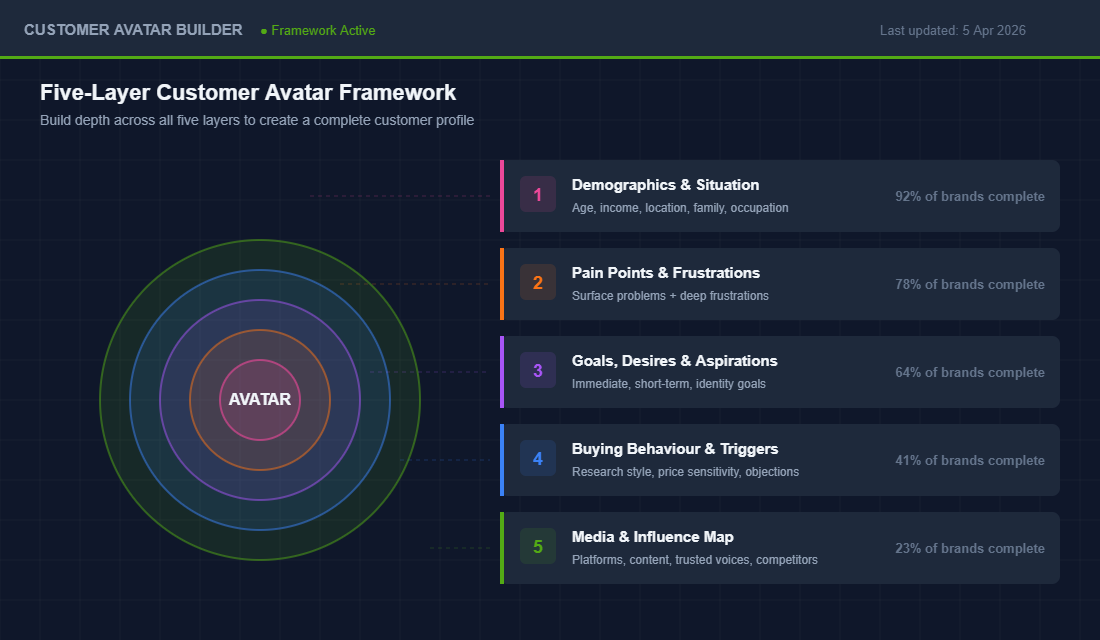
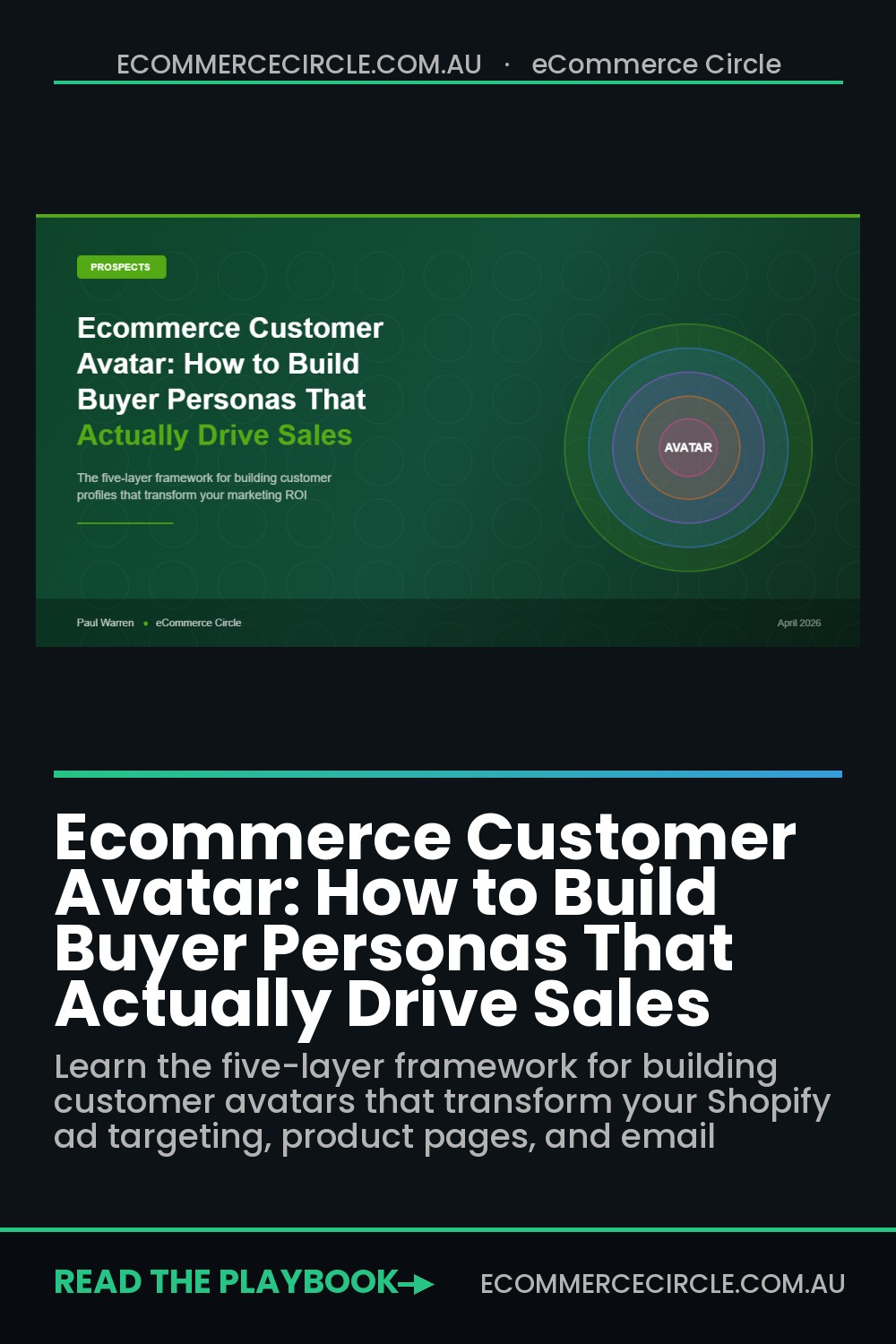
Forget the one-page templates that skim the surface. The framework I use with eCommerce Circle members has five distinct layers, and each one gives you a different marketing angle. You’ll want to complete all five for each of your primary customer segments — most Shopify stores should have two to four distinct avatars.
Layer 1: Demographics and Situation
This is your starting point, but treat it as context rather than the main event. Document age range, gender split, household income (in AUD), location (metro vs. regional), occupation, and family situation. For Australian ecommerce brands, knowing whether your customer base skews metro Sydney/Melbourne or regional matters enormously for shipping expectations and messaging.
Where to find this data: Shopify Analytics > Customers section gives you location and repeat purchase data. Google Analytics 4 provides demographics and interests reports. If you’re running Meta Ads, your Audience Insights panel is gold for age, gender, and interest overlap.
Layer 2: Pain Points and Frustrations
This is where most brands stop too early. You need to document two types of pain points: surface-level problems (what they’d type into Google) and deep frustrations (what they’d complain about to a friend over coffee).
For example, if you sell natural skincare, the surface-level problem is “I need a moisturiser for sensitive skin.” The deep frustration is “I’ve spent hundreds of dollars on products that promise to be gentle and they all irritate my face. I don’t trust any brand’s marketing claims anymore.”
That deep frustration is what your product page hero section should address. That’s the hook for your Meta Ad creative. That’s the subject line of your abandoned cart email.
Where to find this data: Read your product reviews (especially 2-3 star reviews — they contain the richest insight). Browse Reddit threads and Facebook groups in your niche. Check competitor reviews on Amazon. Run a post-purchase survey asking “What almost stopped you from buying?”
Layer 3: Goals, Desires, and Aspirations
What does your customer want their life to look like after using your product? This isn’t about features — it’s about the transformation they’re buying. People don’t buy a $120 yoga mat. They buy the identity of being someone who has a serious, consistent yoga practice.
Document three types of goals for each avatar:
- Immediate goal. What they want right now. “Find a moisturiser that doesn’t cause a reaction.”
- Short-term aspiration. What they want in the next 3-6 months. “Have clear, healthy skin I feel confident about.”
- Identity aspiration. Who they want to become. “Be someone who has their health and self-care routine sorted.”
Your product pages should address the immediate goal. Your email nurture sequences should speak to the short-term aspiration. Your brand story and content marketing should connect with the identity aspiration. This is how brands like Frank Body and The Nue Co build cult followings — they sell the transformation, not the product.
Layer 4: Buying Behaviour and Decision Triggers
This layer is pure gold for your conversion rate. You need to understand exactly how your customer makes purchasing decisions — and what tips them over the edge from “browsing” to “buying.”
Document these specifics:
- Research behaviour. Do they compare 2-3 options or buy impulsively? Do they read reviews, watch YouTube comparisons, or ask friends?
- Price sensitivity. Is price the primary objection, or are they happy to pay premium for quality? What AUD price point triggers “I need to think about it”?
- Trust signals. What makes them trust a new brand? Reviews, certifications, social proof, Australian-made claims, influencer endorsements?
- Purchase triggers. What event or moment pushes them to buy? Running out of a product? A friend’s recommendation? A seasonal change? A sale?
- Objections. What stops them from buying? Shipping costs? Uncertainty about sizing? Ingredient concerns? “I already have something similar”?
Once you have this data, you can map your entire funnel around it. If your avatar researches heavily before buying, you need comparison content and detailed FAQ sections. If they’re triggered by social proof, you need UGC and reviews front and centre. If shipping cost is their top objection, you need a free shipping threshold prominently displayed.
Layer 5: Media Consumption and Influence Map
The final layer tells you where to find your avatar and whose opinions they trust. This directly shapes your marketing channel strategy and influencer partnerships.
Map out:
- Social platforms. Where do they scroll daily? Instagram, TikTok, Facebook, Pinterest, LinkedIn?
- Content consumption. Do they prefer short-form video, long-form blog posts, podcasts, or newsletters?
- Trusted voices. Which influencers, publications, or communities do they follow and trust?
- Competitor awareness. Which other brands in your space have they purchased from or considered?
This layer prevents the classic ecommerce mistake of spreading your marketing budget across every channel. If your avatar spends 90 minutes a day on TikTok and never opens Pinterest, you know exactly where your ad dollars should go.
How to Research Your Customer Avatar (Without Guessing)
The difference between a useful avatar and a fictional character is data. Here are the six most reliable research methods for Shopify store owners, ranked by the quality of insight they produce.
Method 1: Post-Purchase Surveys
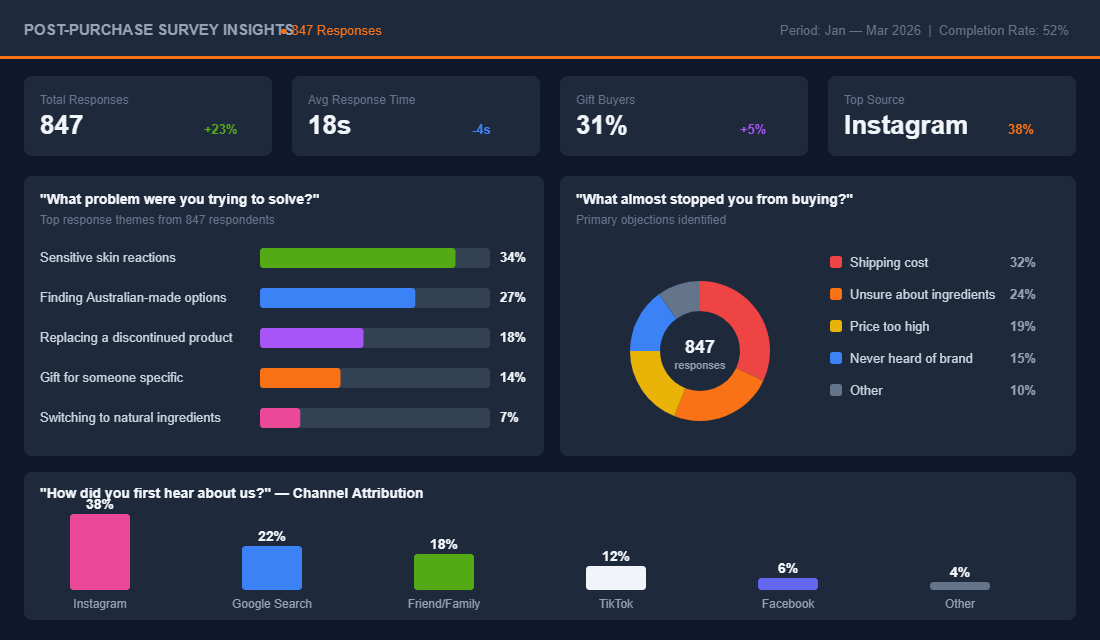
This is the highest-ROI research method available to you. Set up a short survey (3-5 questions max) that triggers after someone receives their order. Use a tool like Fairing (formerly Enquire Labs) which integrates directly with Shopify and captures responses at the order confirmation stage when completion rates are highest — typically 40-60%.
The questions that produce the richest avatar data:
- “What problem were you trying to solve when you bought [product]?” — This reveals their true pain point in their own language.
- “What almost stopped you from purchasing today?” — This surfaces objections you need to address on your product pages.
- “How did you first hear about us?” — This tells you which channels are actually driving awareness (not just last-click attribution).
- “Who is this purchase for?” — This reveals whether you’re selling to end users or gift buyers (two very different avatars).
After 100-200 responses, patterns emerge that no amount of demographic data can give you. You’ll see the same phrases repeated, the same objections surfacing, the same discovery channels mentioned. That’s your avatar speaking directly to you.
Method 2: Customer Interview Deep-Dives
Pick 8-12 of your best customers — people who’ve purchased multiple times, left reviews, or referred friends — and offer them a $50 store credit for a 20-minute video call. You’ll learn more in these conversations than months of analytics can teach you.
The trick is asking open-ended questions and then staying quiet. Let them talk. Ask “Can you walk me through the day you decided to look for a product like ours?” and then listen. They’ll tell you the trigger event, the research process, the competing options they considered, and the reason they chose you. That’s your entire funnel mapped from the customer’s perspective.
Method 3: Review Mining
Your own product reviews (and your competitors’ reviews on Amazon, Google, and Trustpilot) are a goldmine of avatar data. Pay special attention to reviews that mention why they bought, what they tried before, and what surprised them about the product.
The 2-3 star reviews are especially valuable. These customers liked the product enough to write a review but had specific complaints. Those complaints are objections that your future customers share but won’t verbalise — they’ll just leave your site instead.
Method 4: Analytics Behavioural Data
Google Analytics 4 and Shopify Analytics together paint a detailed picture of how your customers behave. Look at:
- Device split. If 78% of traffic is mobile, your avatar is browsing on their phone during commutes or downtime — design your experience accordingly.
- Top landing pages. These reveal what search terms and problems brought people to your store.
- Time to purchase. If the average is 12 days across 4 sessions, your avatar is a researcher who needs nurturing. If it’s same-session, they’re impulse buyers who need urgency triggers.
- Product affinity. Which products are frequently purchased together? This reveals use cases and lifestyle patterns.
Method 5: Social Listening
Join the Facebook groups, subreddits, and TikTok comment sections where your customers hang out. Don’t post — just read. Search for your product category and note the questions people ask, the frustrations they vent, and the language they use.
For Australian ecommerce brands specifically, check communities like the Shopify Entrepreneurs Australia Facebook group, local niche Facebook groups (e.g., “Australian Natural Beauty Lovers”), and relevant Australian subreddits. The language your customers use in these spaces is the language your ad copy and product descriptions should mirror.
Method 6: Klaviyo Segment Analysis
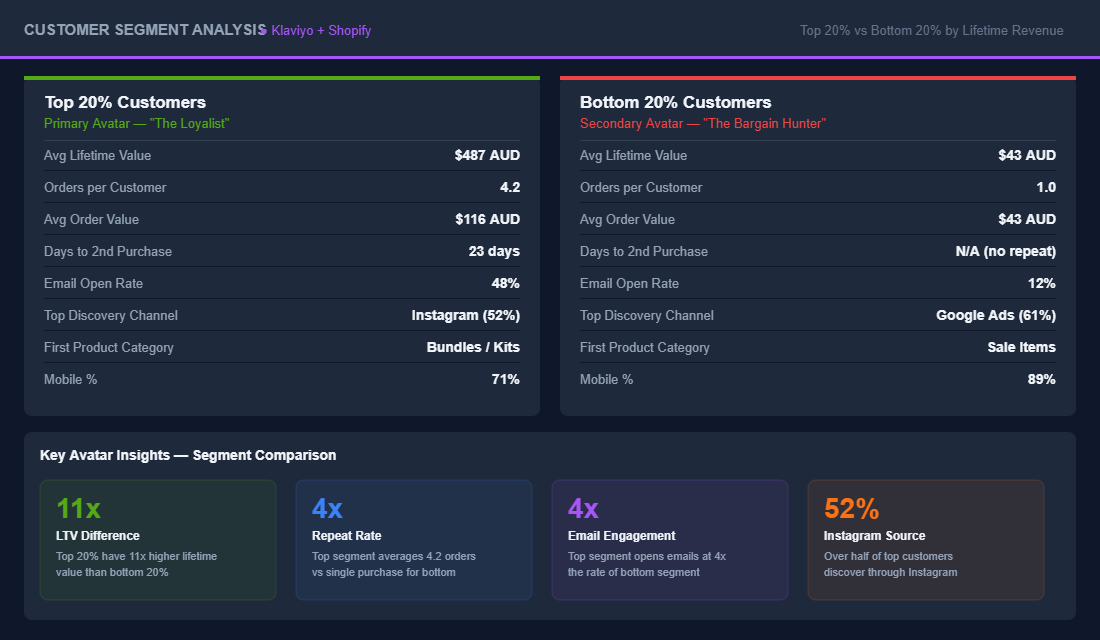
If you’re using Klaviyo (and you should be), your email data contains avatar-level insight most brands ignore. Klaviyo’s predictive analytics can segment customers by predicted lifetime value, churn risk, and expected next order date — all of which help you distinguish between your best customers and one-time bargain hunters.
Build a segment of your top 20% customers by revenue and compare their behaviour against the bottom 20%. You’ll likely find stark differences in how they discovered you, which products they bought first, and how quickly they made their second purchase. Those top 20% customers are your primary avatar — build everything around them.
Turning Your Avatar Into a Revenue Machine
A customer avatar sitting in a document is useless. It becomes valuable when you actively apply it across every customer touchpoint. Here’s exactly how your avatar data should shape each part of your Shopify store and marketing.
Product Pages That Convert
Your avatar’s top pain point becomes your product page headline. Their most common objection gets addressed in the first three scrolls. Their trust signals (reviews, certifications, Australian-made badges) sit above the fold. When Aussie skincare brand Aesop builds product pages, every word is crafted for their specific customer — the design-conscious, ingredient-aware buyer who values aesthetics as much as efficacy.
Run through your avatar’s buying behaviour layer and audit your product pages against it. If your avatar researches heavily, do you have comparison charts and detailed ingredient/material breakdowns? If they rely on social proof, are your reviews prominently displayed with photos and specific use-case details?
Ad Creative That Stops the Scroll
The words your customers used in surveys and reviews should appear almost verbatim in your ad copy. This isn’t a creative hack — it’s proven psychology. When someone scrolling through their feed sees the exact phrase they’ve used to describe their problem, it creates an instant pattern interrupt.
For each avatar, build a creative brief that includes their top three pain points in their own language, the transformation they want, and the trust signal that matters most. Then test ad variations against each element. Brands that align ad creative with specific avatars see cost-per-acquisition drop by 30-50% compared to generic messaging.
Email Sequences That Feel Personal
Your customer avatar directly informs your customer journey mapping and email flow architecture. If your avatar’s purchase trigger is running out of a consumable product, set up replenishment reminders timed to the average usage cycle. If they’re gift buyers, your post-purchase flow should include “treat yourself” messaging to convert them into personal customers.
Klaviyo makes this practical. Create segments for each avatar based on their identifying behaviours (product category purchased, acquisition source, average order value) and build tailored flows for each. According to Klaviyo’s own benchmarking data, segmented email campaigns generate 3x the revenue per recipient compared to batch-and-blast sends.
Content Strategy That Attracts the Right Traffic
Your avatar’s pain points and questions become your content calendar. Each question they ask before buying is a blog post, a YouTube video, or a social media carousel. This approach to content marketing doesn’t just drive traffic — it drives qualified traffic from people who match your ideal customer profile.
Australian activewear brand P.E Nation does this brilliantly. Their content doesn’t just showcase products — it speaks to the lifestyle and mindset of their specific avatar: the style-conscious woman who wants performance gear that works at the gym and on the street. Every piece of content reinforces that identity.
Setting Up Your Avatar Research System in Shopify
Here’s the practical tech stack to systematise your customer avatar research so it continuously improves over time.
Step 1: Install Fairing (from $49 AUD/month). Connect it to your Shopify store and set up 3-4 post-purchase survey questions. The integration takes about 10 minutes and questions appear on the order confirmation page. Start with: “What problem were you solving?”, “What almost stopped you from buying?”, and “How did you first hear about us?”
Step 2: Set up Klaviyo segments. Create segments for your top 20% customers by lifetime revenue, your one-time buyers, your repeat purchasers, and your lapsed customers (no purchase in 90+ days). Compare the behavioural patterns across these segments monthly.
Step 3: Configure GA4 audiences. Build audiences based on your avatar definitions — matching demographic and behavioural criteria. Use these audiences for remarketing and lookalike targeting on Meta and Google Ads.
Step 4: Schedule quarterly customer interviews. Block out one week each quarter to speak with 5-8 customers. Use Calendly with a Shopify discount code as the incentive. Record with Zoom and use Otter.ai for automatic transcription.
Step 5: Build your avatar document. Use the five-layer framework above and store it somewhere your entire team can access — a Notion page, a Google Doc, or even a pinned Slack canvas. Update it quarterly with fresh survey and interview data.
The Compound Effect: When Everything Speaks to the Same Person
Here’s what happens when you build your entire Shopify store around well-researched customer avatars: everything compounds.
Your Meta Ads attract the right people because the copy mirrors their language. Those people land on product pages that address their specific objections, so your conversion rate climbs. They receive email sequences that speak to their actual goals, so your repeat purchase rate grows. They see content that reinforces their identity, so they become advocates who refer friends.
The numbers back this up. Research from Epsilon found that 80% of consumers are more likely to purchase from brands that offer personalised experiences. Businesses that segment their audience based on detailed personas see conversion rates improve by up to 73%. And customers who receive personalised marketing messages (including SMS and email) show 33% higher lifetime value than those who receive generic communications.
This is the difference between a store that’s “doing okay” at $30K per month and one that’s scaling to $100K+. The product is often the same. The traffic sources are the same. The difference is that every touchpoint in the scaling store is calibrated to resonate with a specific, deeply understood customer — and that specificity compounds across every interaction.
Most Shopify store owners I work with have never done this exercise properly. They’ve been running ads to broad audiences, writing product descriptions for “everyone,” and wondering why their conversion rate is stuck below 2%. The avatar work isn’t glamorous, but it’s the foundation that makes everything else work harder.
Common Avatar Mistakes That Cost You Sales
Before you start building your avatars, watch out for these traps that I see Shopify store owners fall into repeatedly.
Building avatars from assumptions instead of data. If you haven’t spoken to customers or analysed survey responses, you’re writing fiction. Even five customer interviews will challenge assumptions you didn’t know you had.
Creating too many avatars. If you have more than four primary avatars, you’ve diluted your focus. Start with one or two and add more only when you have data proving a distinct segment exists with different buying behaviours.
Treating avatars as static. Your customers evolve. Market conditions shift. Competitors enter and exit. Review and update your avatars quarterly using fresh survey data, review analysis, and interview insights. The brands that treat this as a living document outperform those who do it once and file it away.
Ignoring the gift buyer segment. Many ecommerce stores discover through surveys that 20-40% of purchases are gifts. That’s a completely different avatar with different motivations (ease, presentation, confidence in the recipient liking it) that requires different messaging and product page elements like gift wrapping options and “gift guide” collections.
Not connecting avatars to your A/B testing strategy. Your avatar hypotheses should drive your split tests. If your avatar research says customers care most about ingredient sourcing, test a product page that leads with sourcing story versus one that leads with results. Let data validate your avatar insights.
The Avatar Quality Benchmarks That Separate Hobbyists from Operators
Most founders write an avatar once, file it in a Google Doc, and never look at it again. The operators who scale do the opposite — they treat avatars as living documents, audited every 90 days against actual purchase data. Here are the benchmarks we use inside eCommerce Circle to grade avatar quality on a scale that makes them useful, not decorative.
An avatar is “production-ready” when you can answer five questions in under 30 seconds without guessing: What is their average order value range? What three objections come up in your post-purchase survey from this segment? Which two competitors did they consider before buying you? What is their primary acquisition channel (paid social, organic, referral, retail)? What does their second purchase look like and when does it land? If you cannot answer any of those in 30 seconds, the avatar is fiction.
The data sources that give you those answers without guessing: post-purchase surveys via Fairing or KnoCommerce (aim for 250-plus responses before drawing conclusions), Klaviyo segments built on first-purchase product to identify entry points, GA4 path analysis to understand pre-purchase behaviour, and Hotjar or Microsoft Clarity recordings of avatar-matched users on your top three product pages. Stores that run this stack quarterly typically see customer acquisition cost drop 12 to 20 percent within two quarters because targeting and creative get sharper, not because they spend more.
Inside the eCommerce Circle, customer avatar development is one of the first exercises we work through with every member — because it shapes every other decision in your business, from ad creative to product development to email strategy. If you want help building avatars that actually drive revenue, let’s talk.
The 90-Day Avatar Refresh: Stop Your Persona Going Stale
The most expensive avatar is the accurate one you built two years ago. Your customer base shifts as you add products, change price points and win different traffic. If you built your avatar when your average order value was $80 and it is now $140, you are targeting a person who has largely stopped buying from you.
Put a 90-day refresh in the calendar and treat it as a 3-hour job, not a rebuild. Here is the cycle that works.
- Hour one, the numbers. Pull your last 90 days in Shopify Analytics: top five entry products, average order value, new versus returning split, and state-level order concentration. Compare against the previous 90 days. Anything that moved more than 15% is a signal your buyer has shifted.
- Hour two, the words. Read the last 50 post-purchase survey responses and the last 30 support tickets. You are hunting for language, not sentiment. The phrases customers repeat are the phrases that belong in your ad copy and product pages.
- Hour three, the update. Change only what the evidence supports. Date-stamp the document and note what changed and why, so in six months you can see the drift instead of guessing at it.
The Response Rates You Should Expect
Founders abandon avatar research because they send one survey, get eleven replies, and decide customers do not care. The benchmarks say otherwise, they just need the right placement.
- Broadcast email survey: 2-5% response. Low, and skewed toward your superfans.
- Post-purchase survey on the thank-you page: 10-20% response. Far better, because you are asking at peak intent. One question only. “What almost stopped you buying today?” outperforms every other question we have tested.
- Paid 20-minute customer interviews: 15-30% acceptance with a $50 gift card. You need 8 to 12 before you hit saturation and start hearing the same three stories, which is the point at which more interviews stop adding information.
Imagine you run a 60-SKU supplements brand doing $2M AUD a year. Twelve interviews across your top two entry products will typically surface one objection you did not know existed and one use case you were not marketing to. That is usually worth more than a quarter of creative testing, because it changes what you test rather than how fast you test it.
If you want the full interview scripts and the recruitment sequence, the customer research playbook covers it end to end. And once your avatar is current, feed it straight into RFM segmentation so the person you just described actually receives different messaging from everyone else on your list.
The Research Tools That Do the Heavy Lifting
You do not need a research budget to build a real avatar. You need three inputs, and each has a cheap or free way to get it.
What they say in their own words. A post-purchase survey on the Shopify thank-you page is the single highest-value tool here. Fairing and Enquire both sit natively in checkout. One open question outperforms five multiple-choice ones, because multiple choice only returns the answers you already thought of. Budget on a 15 to 30 per cent response rate and do not read the results until you have 60 or more, or you will pattern-match on noise.
What they do on the site. Microsoft Clarity is free and unlimited. Filter recordings to buyers rather than all sessions and watch fifteen. You are watching for hesitation — where they scroll back, what they re-read, which tab they open. That hesitation is the objection your avatar needs to answer.
What they say when you are not listening. Your own review corpus first — Judge.me or Okendo export, sorted to 3 and 4 star reviews where people are honest rather than polite. Then competitor reviews, Reddit threads and Facebook groups in your category. Amazon reviews of adjacent products are a goldmine because the volume is high and the language is unfiltered.
Feed all three into one document per avatar and highlight every phrase you would never have written yourself. Those phrases are your ad copy, your product page headings and your email subject lines. Do not paraphrase them into marketing language — that is the exact step where the avatar stops being useful.
Your Next Step: A 30-Day Avatar Sprint
Start with the highest-impact action: install a post-purchase survey tool this week and get your first 50 responses. Those responses will give you more actionable customer insight than any amount of Google Analytics data. Then use the five-layer framework to build your first complete avatar, and audit your top three product pages against it.
Here is how that lands across a month if you want a schedule rather than a to-do list.
Week 1 — collect. Survey live on the thank-you page. Export your last 200 reviews. Pull the top 30 organic search queries from Search Console. No analysis yet, just gathering. This week costs you about two hours.
Week 2 — build one avatar. Not four. One, for your highest-revenue segment, across all five layers. Write it in the customer’s language, with real quotes attached to each layer. If a layer has no quote behind it, you have guessed, and you should mark it as an assumption to test rather than a finding.
Week 3 — apply it to three places. Your best-selling product page, your welcome email, and your top-spending ad set. Rewrite each against the avatar. Change the headline, the first 100 words and the objection handling. Leave everything else alone so you can read the result.
Week 4 — measure and decide. Product page conversion rate, email click rate and ad click-through against the fortnight before. A well-built avatar applied to a previously generic product page commonly moves conversion 8 to 20 per cent in relative terms. If nothing moved, your avatar is describing a demographic rather than a decision, and the fix is more quotes, not more detail.
Then repeat for avatar two. Most Australian Shopify stores need two or three, not ten. Any more than that and you are segmenting for the sake of it, and no one on your team will remember them well enough to write to them.
Once you know who you are talking to, the next question is when. Avatars tell you who buys; category entry points tell you the moments they start looking, and the two together are what make a marketing plan obvious instead of a guessing game. And when they do buy, your post-purchase sequence should be written to the same avatar, in the same words.
Inside eCommerce Circle, avatar work is one of the first things we do with every member, because it makes every downstream decision faster — from product page copy to ad targeting to which products to build next. If you want a second opinion on yours, let’s talk.