You spent months building your brand. You designed the logo, nailed the packaging, wrote product descriptions that actually convert, and built a loyal customer base. Then one morning you’re scrolling through a marketplace and see it — someone selling knockoffs of your product with your brand name slapped on the listing.
What’s in This Article
It happens more often than most Shopify store owners realise. Counterfeit and pirated goods now account for roughly 3.3% of global trade according to the OECD, and the problem is accelerating. Online trademark infringement has surged, with brand impersonation involved in over 51% of phishing attempts. For Australian ecommerce brands, the risk is particularly sharp — Scamwatch recorded a 31.8% jump in online-based scam reports with financial losses in 2025 alone.
The brands that survive this aren’t the biggest or the best-funded. They’re the ones that treated intellectual property protection as a business priority from day one — not an afterthought they got around to when something went wrong. Here’s exactly how to do it for your Shopify store.
Why Most Ecommerce Brands Are Dangerously Exposed
Here’s the uncomfortable truth: most Shopify store owners have zero legal protection over their brand name, logo, or product designs. They assume that because they registered a business name with ASIC or bought a domain, they own the brand. They don’t.
A business name registration in Australia does not give you trademark rights. It doesn’t stop someone else from registering your brand name as a trademark — and then sending you a cease-and-desist letter. Without a registered trademark, you have very limited legal recourse when a copycat appears on Amazon, eBay, or Instagram selling products under your name.
The numbers tell the story. Over 30% of consumers who unknowingly purchase a counterfeit product lose trust in the original brand, regardless of whether the brand was involved. That’s not just lost revenue from the copycat sale — it’s permanent damage to your reputation with customers who may never come back. And in Australia, online shopping fraud was the most-reported scam type involving financial loss in 2025, with 9,628 reports and $8.6 million in losses through the first nine months alone.
If your brand is growing, someone will eventually copy it. The question isn’t if — it’s whether you’ll have the legal foundations in place to actually do something about it when it happens.
Step 1: Register Your Trademark Through IP Australia
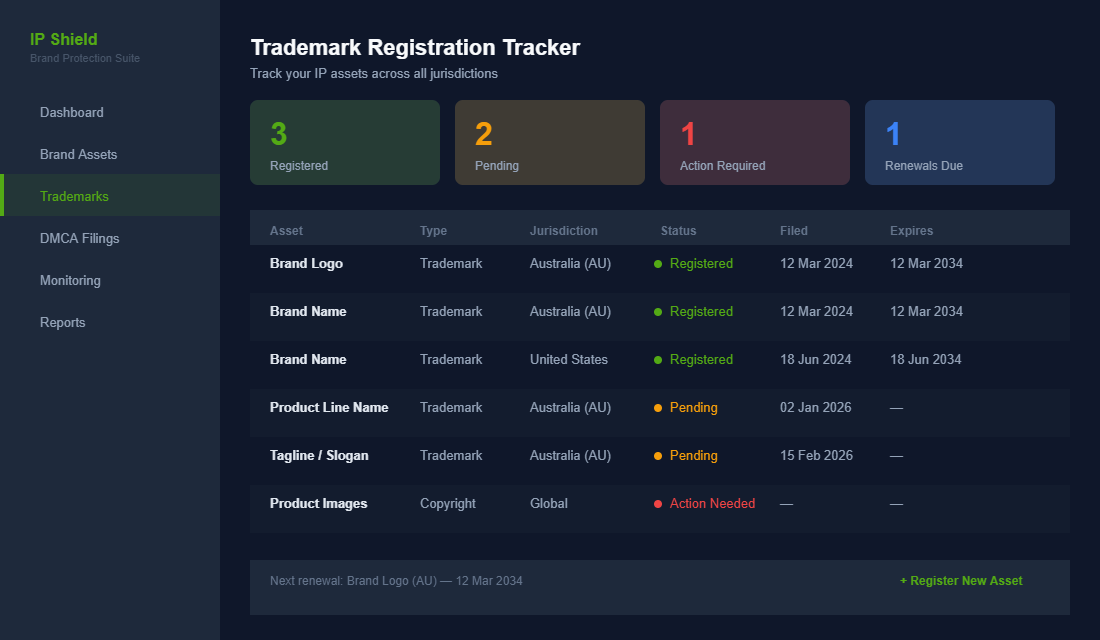
Registering a trademark is the single most important legal step you can take to protect your ecommerce brand. In Australia, this is handled through IP Australia — the government agency that administers intellectual property rights. A registered trademark gives you exclusive legal ownership of your brand name, logo, or slogan within the classes you register under, and it’s enforceable in court.
The process is more straightforward than most people expect. Here’s the step-by-step breakdown:
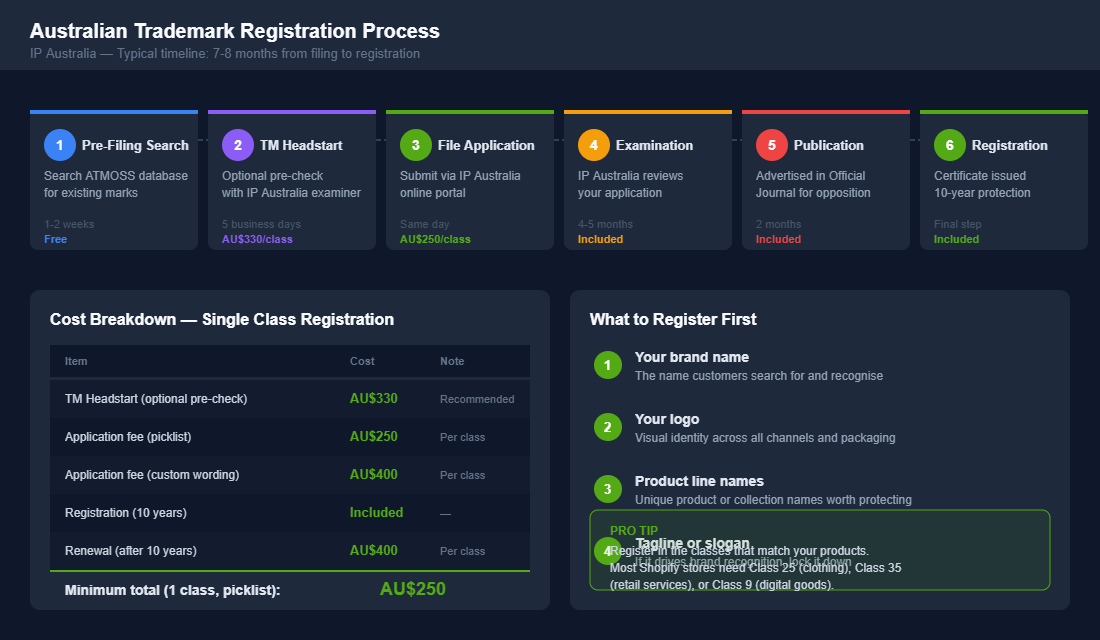
Search the ATMOSS database first. Before you file anything, check IP Australia’s Australian Trade Marks On-line Search System (ATMOSS) for existing marks that might conflict with yours. This is free and takes minutes. Look for identical or similar names in your product classes. If there’s a conflict, you’ll save yourself the filing fee and months of waiting.
Consider TM Headstart. IP Australia offers an optional pre-application service called TM Headstart that gives you early examiner feedback before you formally file. It costs AU$330 per class and takes about five business days. For first-time applicants, this is well worth the investment — it flags potential issues before you commit to the full application.
File your application. You can file online through IP Australia’s portal. If you use their pre-approved picklist of goods and services, the fee is AU$250 per class. If you write your own custom description, it’s AU$400 per class. Most Shopify store owners need Class 35 (retail services) and the class that matches their product type — Class 25 for clothing, Class 9 for electronics or digital goods, Class 3 for cosmetics, and so on.
Wait for examination and publication. After filing, IP Australia examines your application over roughly four to five months. If it passes, your trademark is published in the Australian Official Journal of Trade Marks for two months. During this window, anyone can oppose your registration. If nobody opposes (which is the case for the vast majority of applications), your trademark is registered.
Total timeline: roughly seven to eight months from filing to registration. Total cost for a single class using the picklist: AU$250. Your registration lasts 10 years and can be renewed for AU$400 per class.
What to Register First (and What Can Wait)
You don’t need to trademark everything at once. Prioritise based on what’s most commercially valuable and most vulnerable to copying.
Register immediately:
- Your brand name. This is what customers search for, talk about, and recognise. It’s your most valuable IP asset. If someone else registers it before you, you could be forced to rebrand entirely.
- Your logo. File this as a separate trademark from your word mark. A word mark protects the name in any visual form; a logo mark protects your specific design.
Register when you can:
- Product line names. If you have hero products or collections with distinctive names, these are worth protecting — especially if they drive significant search traffic or brand recognition.
- Taglines or slogans. If your tagline is central to your marketing and customers associate it with your brand, register it. Think of it as defensive protection — you’re preventing someone else from claiming it.
Don’t bother with:
- Generic product descriptions. You can’t trademark “organic cotton t-shirt.” Trademarks must be distinctive — they need to identify your brand specifically.
- Common industry terms. Phrases like “premium quality” or “handmade” aren’t registrable because they describe a characteristic, not a brand.
Step 2: Set Up Copyright Protection for Your Creative Assets
Here’s something most store owners don’t realise: in Australia, copyright protection is automatic. You don’t need to register anything. The moment you create original work — product photos, website copy, blog content, packaging design, videos — it’s protected by copyright under the Copyright Act 1968.
The challenge isn’t getting copyright protection. It’s being able to prove ownership when someone steals your work. And they will. Product image theft is rampant in ecommerce. Competitors and dropshippers routinely scrape product photos and use them on their own listings.
Here’s how to build a defensible paper trail:
- Keep original files with metadata. Always retain the original RAW files from product photography shoots. The EXIF data (camera model, date, GPS coordinates) serves as evidence of original creation.
- Watermark selectively. For product images on your Shopify store, visible watermarks hurt conversions. But for images you share on social media, wholesale lookbooks, or press kits, a subtle watermark deters casual theft.
- Use a copyright notice. Add “© 2026 [Your Brand Name]. All rights reserved.” to your website footer, image descriptions, and anywhere your content appears. This isn’t legally required in Australia, but it eliminates the “I didn’t know it was copyrighted” defence.
- Timestamp your work. Use a service like the Wayback Machine, Google Drive (which timestamps uploads), or a blockchain-based timestamping service to create a verifiable record of when your content was first published.
- Document your creative process. Save sketches, drafts, mood boards, and correspondence with designers or photographers. This evidence chain makes it much harder for someone to claim independent creation.
Step 3: Monitor for Infringement Across Marketplaces and Social Media
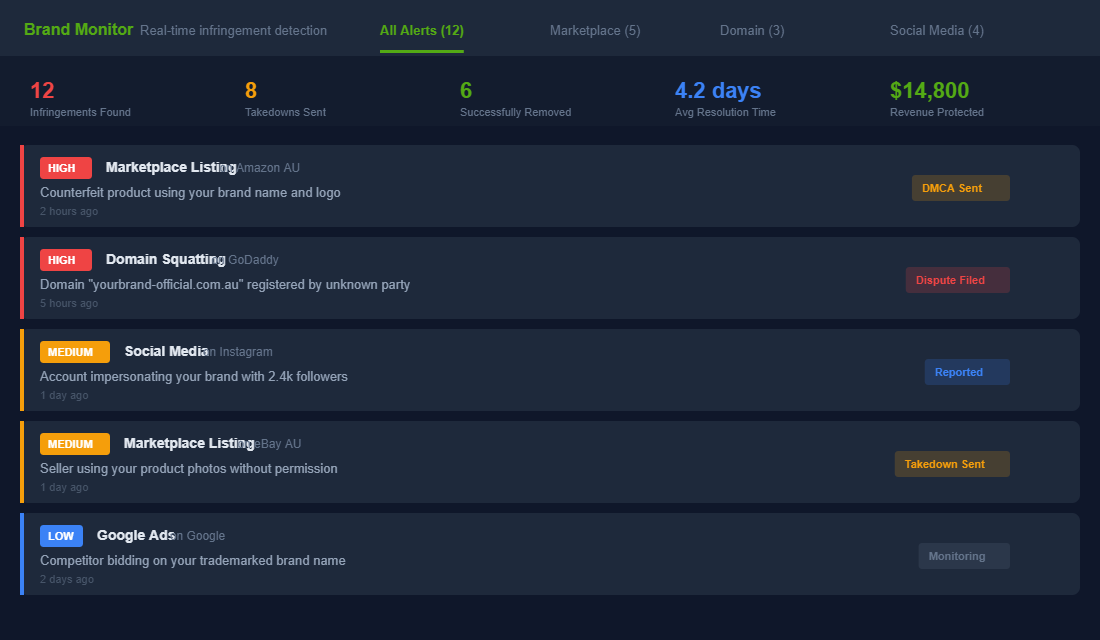
Having trademarks and copyrights means nothing if you don’t enforce them. And you can’t enforce what you can’t see. That’s why proactive brand monitoring is critical.
The World Intellectual Property Organization handled 6,168 domain-name dispute cases in 2024 alone — and that’s just domains. Factor in marketplace listings, social media impersonation, and ad fraud, and the scope of the problem becomes clear.
Here’s where to focus your monitoring:
- Marketplaces (Amazon, eBay, Etsy, Catch). Search for your brand name, product names, and distinctive product descriptions. Look for listings using your product photos. Set up saved searches so you get notified when new listings match your terms.
- Domain registrations. Use a domain monitoring service to track new registrations that include your brand name. Domain squatting — where someone registers “yourbrand-official.com.au” or “yourbrandshop.com” — is a common tactic used to redirect your customers or run phishing scams.
- Social media. Search for accounts using your brand name, logo, or product images on Instagram, Facebook, and TikTok. Brand impersonation accounts often use your imagery to sell counterfeits or run scams that damage your reputation.
- Google Ads. Check if competitors are bidding on your trademarked brand name in paid search. In Australia, bidding on competitor brand terms isn’t automatically illegal, but using your trademark in the ad copy itself may constitute infringement if it confuses consumers.
Tools that help: BrandShield and Bustem are purpose-built for online brand monitoring and can scan marketplaces, social platforms, and domains automatically. For smaller stores on a budget, setting up Google Alerts for your brand name and doing a monthly manual sweep of major marketplaces is a solid starting point.
Step 4: File DMCA Takedowns and Trademark Complaints
When you find an infringement, you need to act fast. The longer a copycat listing stays live, the more revenue it siphons and the more brand damage it causes. Here’s the playbook for each platform:
Shopify stores copying you: Shopify has a dedicated intellectual property reporting process. You can file a trademark infringement notice or a DMCA copyright takedown through Shopify’s legal removals page. Include your trademark registration number, links to the infringing content, and evidence of your original work. Shopify typically responds within a few business days.
Amazon: Use Amazon’s Brand Registry program. Once your trademark is registered with Amazon, you get access to powerful tools including automated brand protection that proactively removes suspected counterfeit listings. You can also file individual infringement reports through Amazon’s Report a Violation tool.
eBay: File through eBay’s VeRO (Verified Rights Owner) Program. You’ll need to submit proof of your IP rights and identify the infringing listings. eBay typically removes listings within 24 hours of a valid report.
Instagram and Facebook: Both platforms have IP reporting forms in their Help Centre. For trademark complaints, you’ll need your registration details. For copyright (stolen photos), you can file a DMCA takedown. Meta generally acts within one to three business days.
Google (ads and search): If someone is using your trademark in their ad copy, file a complaint through Google’s Ads trademark complaint form. For organic search results featuring counterfeit content, use Google’s DMCA removal request process.
Key tip: Always file from an email address that matches your domain (e.g., legal@yourbrand.com.au). This adds credibility and speeds up processing. Keep a spreadsheet logging every takedown you file — the date, platform, infringing URL, and resolution. This creates a paper trail that strengthens any future legal action if the infringer is a repeat offender.
Step 5: Build a Defensive IP Strategy That Scales
One-off trademark filings and occasional takedowns aren’t enough as your brand grows. You need a repeatable system that protects your IP without consuming all your time.
Here’s the framework that works for scaling ecommerce brands:
Quarterly IP audit. Every three months, review your brand assets and ask: what’s new that needs protection? Have we launched new product lines, collections, or sub-brands that should be trademarked? Are any existing registrations approaching renewal? This 30-minute check prevents gaps in your protection.
Monthly monitoring sweep. Set a recurring calendar event to search key marketplaces, social platforms, and domain registrations for your brand name. Even if you use automated tools, a manual check catches things that algorithms miss — like slightly misspelled brand names or translations.
Takedown templates ready to go. Pre-draft your DMCA and trademark complaint letters so you can file within minutes of finding an infringement. Include your trademark registration number, a description of the original work, links to your legitimate store, and a clear demand for removal. Having these templates ready turns a stressful discovery into a five-minute admin task.
International expansion planning. A trademark registered in Australia only protects you in Australia. If you sell to New Zealand, the US, UK, or EU, you need separate registrations in those jurisdictions. The Madrid Protocol — an international treaty Australia is part of — lets you file a single international application through IP Australia that extends to over 130 countries. It’s more cost-effective than filing individually in each country.
Relationship with an IP lawyer. You don’t need a lawyer on retainer. But having one you’ve consulted before means you can escalate quickly when a simple takedown doesn’t work. For Australian ecommerce brands, an initial consultation with an IP lawyer typically costs $300-$500 and gives you a clear roadmap tailored to your specific situation.
What Brand Protection Actually Costs (and How Long It Takes)
Most founders put this off because they assume it’s a five-figure legal exercise. It isn’t, and knowing the real numbers usually removes the excuse. Here’s what you’re looking at in Australia, in AUD.
- IP Australia trademark filing, DIY: roughly $250-$400 per class through the standard application pathway, or around $330 per class if you file outside the pre-approved goods list. Two classes covers most product brands.
- With a trademark attorney: add $800-$1,800 per application for the search, classification advice and drafting. Worth it if your name is anywhere near an existing mark, because a rejected application is money you don’t get back.
- Timeline: around 3-4 months to examination, then a 2-month opposition period. Budget 7-9 months from filing to registration if nothing is contested. Protection backdates to your filing date, which is why filing early matters more than filing perfectly.
- Monitoring tools: $50-$300/month for services like Bustem or BrandShield. Free alternative: Google Alerts on your brand name plus a monthly manual sweep of eBay, Amazon AU, Etsy and Instagram.
- Enforcement: DMCA takedowns and marketplace complaints cost nothing but your time — usually 20-40 minutes each. A solicitor’s cease-and-desist letter runs $500-$1,500 and resolves most copycat situations without going further.
Set against that: rebranding a store doing $80K a month because someone else registered your name first will cost you a new logo, new packaging, new domain, lost SEO equity and months of customer confusion. Founders who’ve been through it put the real cost well into six figures. The $600 filing fee is not the expensive part of this decision.
The Order to Do This In If You Only Have One Weekend
You don’t need to do everything above at once. If brand protection has been on your list for a year, here is the sequence that removes the most risk for the least effort.
Hour one: search before you assume. Run your brand name through the IP Australia trade mark search and check the ASIC business name register. Do this before anything else. If someone already holds your mark in your class, every other task on this list changes.
Hour two: lock the obvious gaps. Register the .com.au and .com if you don’t hold both, plus the handle on every social platform you’re not yet using. Domains and handles cost tens of dollars and are the cheapest thing a squatter can take from you.
Hour three: file the trademark. Word mark first, in your primary goods class. The logo can follow later — a word mark is broader protection because it covers the name in any styling.
Hour four: turn on monitoring. Google Alerts on your brand name and your two hero product names. A saved eBay and Amazon AU search. A reverse image search on your three best-selling product photos. Diarise a 20-minute sweep on the first Monday of every month.
That’s one Saturday and roughly $700, and it moves you from completely exposed to defensible. Everything else in this guide is refinement on top of those four hours. Brand protection sits alongside the operational risks covered in the store security playbook — same principle, different attack surface.
The Brand Protection Checklist Every Shopify Store Needs
Use this checklist as your action plan. Work through it from top to bottom — each step builds on the one before it.
Foundation (Do This First):
- ☐ Search ATMOSS for conflicting trademarks before filing
- ☐ Register your brand name as a trademark with IP Australia (AU$250/class)
- ☐ Register your logo as a separate trademark
- ☐ Add copyright notices to your website footer, product images, and content
- ☐ Store original files (RAW photos, design files) with metadata preserved
Active Protection (Set Up Within 30 Days):
- ☐ Set up Google Alerts for your brand name and product names
- ☐ Register with Amazon Brand Registry (if you sell on Amazon)
- ☐ Register with eBay’s VeRO program
- ☐ Create a takedown template letter for DMCA and trademark complaints
- ☐ Create a tracking spreadsheet for all infringement reports and outcomes
Ongoing Maintenance (Monthly/Quarterly):
- ☐ Monthly marketplace and social media sweep for brand name misuse
- ☐ Quarterly IP audit — review new assets, check renewal dates
- ☐ Annual review with an IP lawyer if you’re expanding to new markets
- ☐ International trademark filings via Madrid Protocol as you enter new countries
How All of This Works Together
Brand protection isn’t one action — it’s a system. Your trademark registration gives you the legal standing to enforce. Your copyright documentation gives you the evidence to prove ownership. Your monitoring catches infringements early. Your takedown process removes them quickly. And your quarterly audit keeps the whole system current as your business evolves.
The brands that build this system early save themselves enormous headaches later. A single trademark dispute that goes to court can cost $50,000 or more in legal fees. A proactive registration that costs AU$250 and 20 minutes of your time is the best insurance policy in ecommerce.
Think of it this way: you wouldn’t build a $500,000 house and skip the insurance. Your ecommerce brand is a business asset with real, growing value. Protecting it isn’t a nice-to-have — it’s a requirement for anyone serious about building something that lasts.
If you’re unsure where to start, the first move is always the same. Go to IP Australia’s trade mark search and check whether your brand name is available. If it is, file the application today. Every week you wait is another week someone else could file first.
Want Help Building a Protected, Scalable Brand?
Inside the eCommerce Circle, brand protection is one of the foundations we cover in the Protection pillar of the More Orders Operating System. From fraud prevention to risk management and intellectual property strategy, we help Shopify store owners build businesses that are resilient and legally protected — not just profitable.
If you’re ready to get your brand protection foundations right, let’s talk.