Most Aussie founders treat SMS like a side dish to email. They send the occasional sale blast, leave their welcome flow at one limp “thanks for subscribing” message, and quietly accept that email does 95% of the lift. That is a six-figure mistake. SMS flows account for just 7.6% of total sends, yet they drive 45.2% of total SMS revenue. The revenue-per-send maths is even more brutal: average ecommerce SMS revenue-per-send hit $0.71 in 2026, with the top quartile pulling $1.46, and DTC subscription brands sitting at $0.92.
What’s in This Article
When you do the back-of-the-envelope on a $1m a year Shopify brand with 25,000 SMS subscribers, that is the difference between a $90,000 a year channel and a $190,000 a year channel. Same list. Same product. Same ad spend. Different architecture.
And then there is the 1 July 2026 deadline. From that date, every branded (alphanumeric) sender ID sending to Australian numbers must be registered under the new ACMA framework. Klaviyo has confirmed that unregistered brands will be blocked from sending to Australian recipients from that date. Registration takes 7 to 10 business days. The Australian DTC founders who treat SMS as a serious channel are already through registration. The ones still treating it as an afterthought are about to find out their winter campaign will not deliver.
This is the architecture we use inside eCommerce Circle with members who want SMS to become their second-biggest revenue channel inside 90 days.
Why SMS Is Now the Highest-ROI Channel in Your Stack (the maths)
Email is still the workhorse. SMS is the closer. The reason comes down to attention and timing.
A campaign email has to fight a 2.09% click-through rate, a smashed Gmail Promotions tab, and a Klaviyo-suppressed list that quietly trims 20% of your “active” subscribers every month. An SMS, by contrast, lands on a locked screen with a 90%+ open rate within 3 minutes. The benchmarks back this up:
- Flow-based SMS click rates average ~10%, with top performers above 16%. That is roughly 5x the average email CTR.
- Cart-recovery SMS converts at 24.6 to 39.4%, recovering $5.60 per message sent.
- Welcome SMS holds the highest CTR of any flow at around 42%, with a 14.4 to 27.2% conversion rate.
- 64.4% of SMS flow revenue comes from new buyers vs only 20% for campaigns. That is enormous. SMS is not just a retention channel, it is your fastest first-purchase accelerant.
- Median opt-out rates sit at 0.42% per send and 1.7% per month. Send well-targeted SMS and you keep the list healthier than most founders keep their email list.
The implication: if you have 25,000 SMS subscribers and you are not running a proper 6-flow lifecycle plus a weekly campaign cadence, you are leaving money in the same league as your entire Meta retargeting line item.
The 1 July 2026 ACMA Sender ID Deadline (the boring part most brands will trip on)
Before we get to the architecture, sort the compliance. Otherwise the rest is academic.
The Australian Communications and Media Authority (ACMA) is rolling out a registered sender ID framework under the Spam Act 2003. From 1 July 2026, any branded (alphanumeric) sender name used to send marketing SMS to Australian numbers must be registered with a recognised registrar. Klaviyo, Postscript, Attentive and the rest of the major ESPs are routing registrations through their platforms.
What this means in plain English:
- If your store sends from “BondiCo” instead of a long number, you must register the sender ID “BondiCo” before 1 July 2026.
- Klaviyo’s in-app guided registration launched in April 2026. Registration itself takes 7 to 10 business days. Rejections take the same time to re-submit. So if you start in mid-June, you may not make the deadline.
- After 1 July 2026, any SMS to Australian recipients from an unregistered sender ID will be blocked by Klaviyo (and the other major ESPs).
- Sender ID registration is free inside Klaviyo. Branded sender IDs, toll-free numbers, and long codes are all included with your existing Klaviyo SMS plan.
One Australian-specific quirk to know: inside Klaviyo, one SMS to an Australian number counts as three credits. That is not the deal you get in the US. Plan your sends accordingly.
The compliance checklist for an Australian Shopify brand sending SMS in 2026 looks like this:
- Express opt-in. Email consent is not SMS consent. Spam Act 2003 requires explicit opt-in for each channel.
- Clear sender identification. Your brand name appears in every message.
- Functional opt-out in every message. “Reply STOP” minimum. No buried Bitlys.
- Registered alpha sender ID by 1 July 2026.
- Records of consent for every subscriber, including timestamp and source.
Now we can build the architecture.

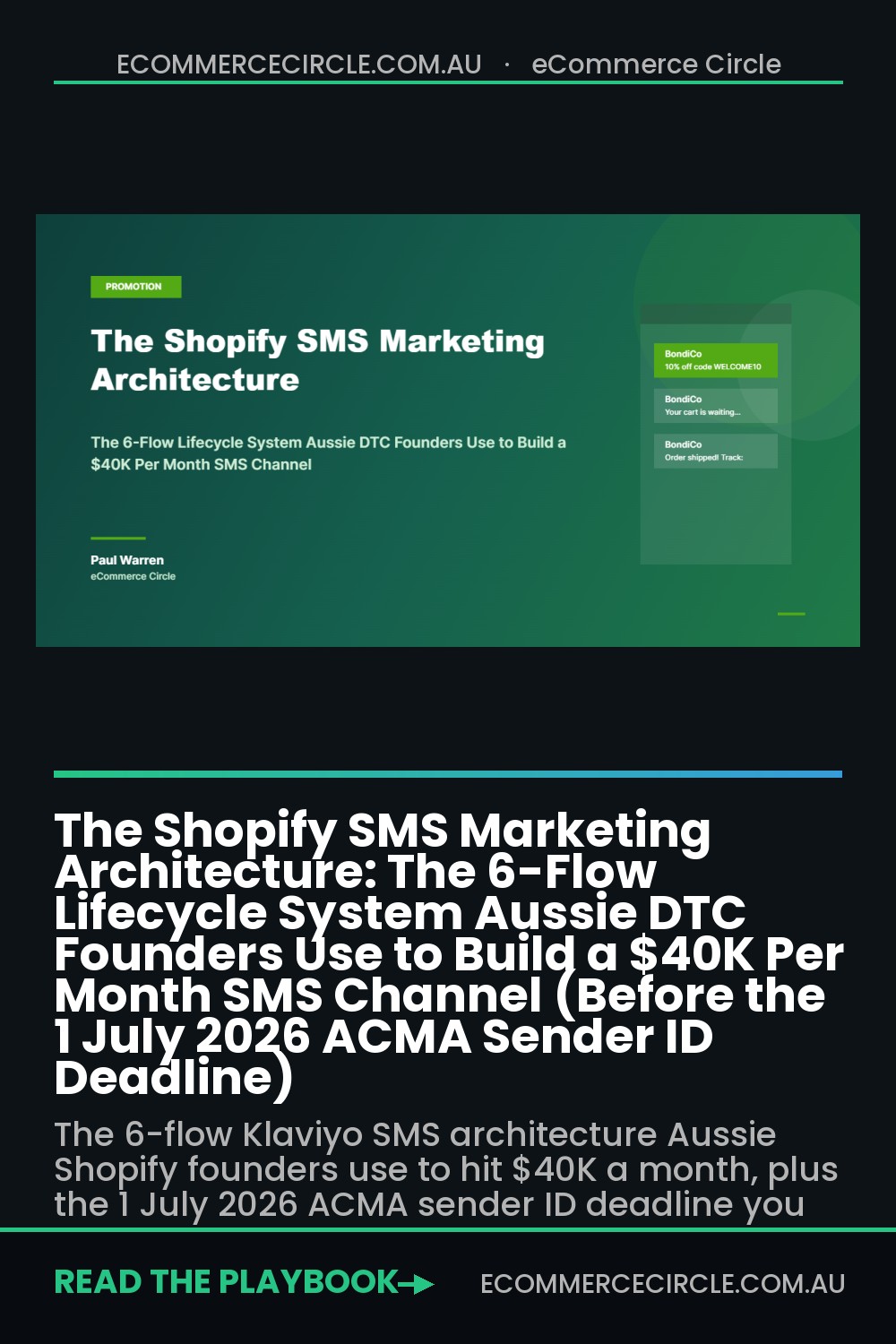
The 6-Flow SMS Architecture (overview)
Every SMS program inside eCommerce Circle is built around six core flows plus a campaign rhythm. The flows do the unsexy daily revenue work. The campaigns do the spike work. Together they hit the $40k a month target on a 25,000-subscriber list, assuming a healthy email program alongside.
The six flows:
- Opt-In Engine. Pop-up + checkout consent + landing page capture.
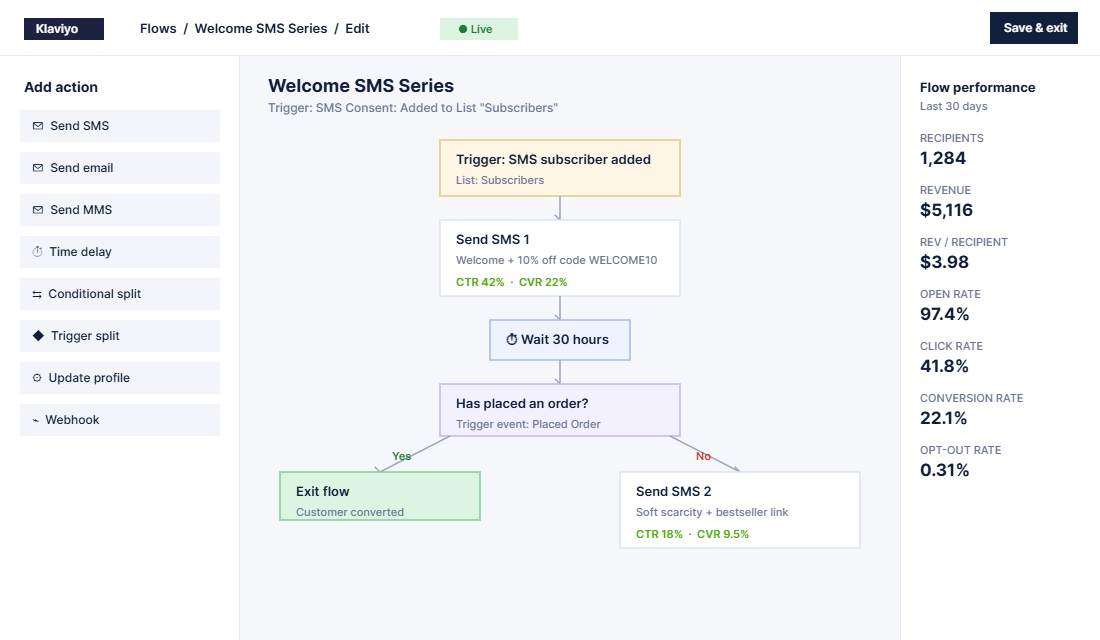
- Welcome Series. Two SMS messages over 36 hours.
- Browse Abandonment. Triggered by viewing a product without adding to cart.
- Cart Abandonment. The single highest-ROI flow you will run.
- Post-Purchase + Replenishment. Shipping updates, review request, replenishment nudge.
- Win-Back + Sunset. Reactivate the lapsed before you suppress them.
Build them in this order. Each one earns its keep before you turn on the next.
Flow 1: The Opt-In Engine (capture the right people, not the most people)
The single biggest mistake Aussie founders make with SMS is treating it like a list-size game. It is not. SMS list quality compounds harder than email because every message has a cost (three credits per AU send in Klaviyo) and a higher unsubscribe friction.
Three places to capture SMS opt-in:
- Welcome pop-up (two-step). Email first, SMS as a second-step upsell. This is the modern best practice and a topic we cover in depth in our Shopify Email Pop-Up Playbook. Average SMS opt-in via this method runs 1.8 to 3.2% of website visitors, though incentive-based opt-ins (a $10 off code, free shipping, free gift) convert 54% better.
- Checkout opt-in. Shopify’s native marketing consent at checkout converts at 35 to 55% of buyers. This is the single highest-converting opt-in source in your entire program. Turn it on, place the consent above the email field, and word it human (“Get shipping updates and exclusive subscriber drops”).
- Landing page capture. Dedicated SMS-first landing pages from Meta and TikTok ad creative. Use a 2-field form (mobile + first name) and offer a single, specific incentive. Aussie brands like Hismile and Bondi Sands lean on this for paid-social-to-SMS funnels.
A combined opt-in engine across these three places should add 800 to 1,500 net new SMS subscribers per month for a $1m a year brand.
The opt-in messaging rule. Every opt-in needs three things in the consent language: (1) what they get, (2) frequency expectation, (3) “Reply STOP to opt out”. Vague pop-ups like “subscribe to our list” tank conversion and trip the Spam Act 2003 express-consent requirement.
Flow 2: Welcome Series (the highest-converting 36 hours of the entire customer relationship)
Welcome SMS holds the highest CTR of any flow at 42%, and the highest conversion rate at 14.4 to 27.2%. The reason: peak intent. The subscriber just gave you their mobile number. They are 5 minutes from the buying decision. Most brands waste this moment with a single “thanks for joining” message.
The 2-message structure that works:
SMS 1 (immediate, within 5 minutes of opt-in). Brand intro + the promised incentive + clear CTA. Example: “Hey Sarah, welcome to BondiCo. Your 10% off code is WELCOME10. Shop the bestsellers: [link]. Reply STOP to opt out.”
SMS 2 (24 to 36 hours later, only if SMS 1 did not convert). Soft second touch with social proof or scarcity. Example: “Sarah, your WELCOME10 code expires Thursday. The cult-favourite Glow Mist sold 800 units last month, here is why customers love it: [link].”
The 36-hour two-message structure aligns to the same logic we use in the Shopify Welcome Email Flow Playbook, but compressed. Email gets 7 messages over 14 days because you have inbox real estate. SMS gets 2 messages over 36 hours because you do not want to burn the opt-in.
Flow 3: Browse Abandonment (the underused flow that prints money on PDP traffic)
This is the flow most Aussie founders skip. Big mistake. Browse abandonment SMS is triggered when an identified subscriber views a product page without adding to cart. The trigger fires once per 7 days per subscriber to avoid burn.
Why it works: PDP traffic is your highest-intent traffic outside of an active cart. An SMS within 2 to 6 hours of a product view lands while the subscriber is still in consideration mode.
The message structure (single SMS, no follow-up):
“Hey Sarah, saw you eyeing the Glow Mist. It is one of our top 3 best-sellers (and ships free over $80). Here is a quick look: [link]. Reply STOP to opt out.”
Two important rules:
- Only fire on identified subscribers. You need the mobile number AND the browser cookie matched. Klaviyo handles this if your opt-in form sets the profile correctly.
- Suppress if cart abandonment is about to fire. No subscriber should get both a browse and a cart message inside 12 hours. Layer your flows.
Expected performance: 6 to 10% CVR on browse SMS, contributing 8 to 12% of total SMS flow revenue.
Flow 4: Cart Abandonment (the single highest-ROI flow you will run)
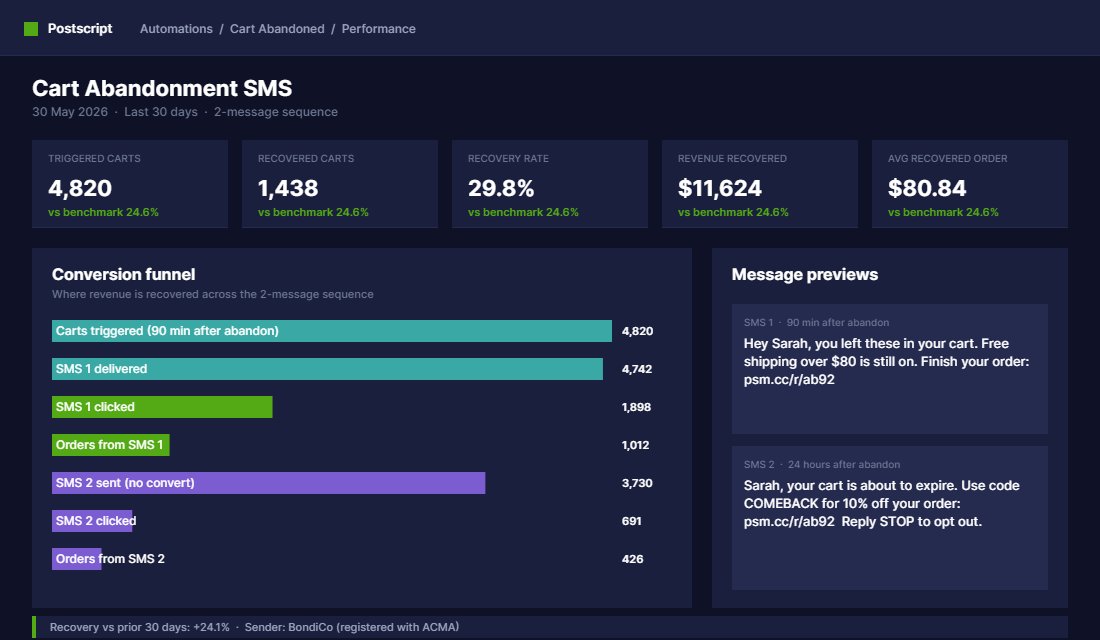
Cart abandonment SMS converts at 24.6 to 39.4%. Read that again. Compared to a 7-email cart abandonment series that recovers ~20% of carts (and our Shopify Abandoned Cart Recovery 7-Email Flow is the deeper read on the email side), SMS sits at the top of the funnel for sheer conversion power.
The 2-message cadence:
SMS 1 (90 minutes after abandonment). Friendly, urgency-light. “Hey Sarah, you left these in your cart. Free shipping over $80 is still on. Finish your order: [recovery link].”
SMS 2 (24 hours after abandonment, only if SMS 1 did not recover). Stronger incentive. “Sarah, your cart is about to expire. Use code COMEBACK for 10% off the order: [recovery link]. Reply STOP to opt out.”
Three tactical notes that matter:
- Suppress the second SMS if SMS 1 converted. Obvious, but many founders miss it because their flow logic is wrong.
- Use the Shopify checkout-recovery URL so the cart is pre-filled and any abandoned-checkout discounts auto-apply.
- Pair with an email cart-abandonment flow. SMS plus email together recovers 35 to 45% of abandoned carts. SMS alone underperforms because not every subscriber has both channels.
On a brand doing $1m a year with a 70% cart-abandonment rate, the cart flow alone should produce $8k to $14k a month in recovered revenue.
Flow 5: Post-Purchase + Replenishment (turn one purchase into the foundation of repeat buying)
Post-purchase SMS is where the retention compound starts. We cover the full 5-message post-purchase architecture in The Shopify Post-Purchase SMS Flow Playbook. Here is the SMS layer condensed:
- Order confirmation SMS. Triggered immediately after purchase. Functional, not promotional. “Your order #1234 is confirmed. We will text you when it ships.”
- Shipping update SMS. When the carrier marks dispatched. Boring but valued. Drives 30%+ open rates on the next promotional touch.
- Review request SMS. 7 to 14 days after delivery, calibrated to your product type. Direct link to your review provider (Yotpo, Stamped, Junip). Aussie brands typically pull 8 to 12% review rates through SMS vs 3 to 5% through email alone.
- Replenishment SMS. Calibrated to your repurchase window. For a 60-day consumable like Hismile’s whitening kit refills, that is day 45 to 50. The trigger is simple: customer’s last-order-date plus the median repurchase interval, minus 10 days for the buying decision.
The replenishment trigger alone tends to lift 60-day repurchase rate by 8 to 14 percentage points on consumables. That is a transformational lift on LTV.
Flow 6: Win-Back + Sunset (reactivate the lapsed before you suppress them)
The final flow plays defence. Most Aussie founders run SMS lists that are quietly bloated with subscribers who have not engaged in 6+ months. That is dead weight inflating your send cost and dragging your engagement signals.
The win-back structure:
SMS 1 at 90 days lapsed. Soft. “Sarah, it has been a while. Here is what is new: [link].” No discount yet.
SMS 2 at 120 days lapsed. Single-use code. “We miss you. Use code COMEBACK20 for 20% off any order: [link].”
SMS 3 at 150 days lapsed. Sunset warning. “We want to keep you on the list only if you want to be. Reply YES to stay subscribed, or we will pause your messages.”
Subscribers who do not reply YES go to a suppressed list. They stay on your file (for compliance and future reactivation) but stop receiving sends. Your active list is now clean, your engagement signals are stronger, and your $/SMS ratio jumps.
Run this quarterly. Aussie brands that sunset properly see SMS revenue-per-send climb 20 to 30% inside two quarters.
The Campaign Rhythm (weekly cadence that does not burn the list)
Flows are the daily revenue machine. Campaigns are the spike machine. The campaign cadence that works for Aussie DTC brands:
- 2 SMS campaigns per week max. Tuesday + Thursday, or Wednesday + Saturday.
- Mix campaign types. New drop, content/story, sale, low-stock, event-based.
- Segment hard. Send your big sale to engaged-90-day. Send your soft-content message to the wider engaged list. Send your win-back to lapsed.
- Hard-cap on consecutive promotional sends. No subscriber gets more than two pure-promo SMS in a 7-day window across both flows and campaigns.
The 0.42% per-send opt-out benchmark holds when you follow this. Push past 3 SMS in a week and opt-outs climb past 1% per send, which destroys the list inside a quarter.
The Australian Compliance Checklist (run this monthly)
- All sender IDs registered with ACMA framework (deadline: 1 July 2026)
- Express SMS opt-in captured at every collection point, separate from email consent
- Opt-out instruction (“Reply STOP”) in every message
- Consent timestamp + source recorded for every subscriber
- No SMS sent between 9pm and 9am AEST without subscriber opt-in to “anytime” sends
- Sender name matches registered brand identity
- Suppression list synced across all marketing tools (Klaviyo + checkout + Shopify customer tags)
- Australian credit cost factored into ROI maths (1 AU SMS = 3 Klaviyo credits)
The Compound Effect (how the 6 flows add up to $40K a month)
The maths on a $1m a year Aussie Shopify brand with 25,000 SMS subscribers and the full 6-flow architecture running:
- Welcome series: ~$4,000 / month in first-purchase revenue
- Browse abandonment: ~$3,500 / month
- Cart abandonment: ~$11,000 / month
- Post-purchase + replenishment: ~$8,000 / month in repeat revenue
- Win-back: ~$2,500 / month
- Campaigns (8 per month): ~$13,000 / month
Total: ~$42,000 / month, or $504k a year. On a $1m a year brand, that is SMS doing more than half of every email pound-for-pound. And it compounds. As the list grows from 25k to 50k, you do not need to do anything different to the architecture. The revenue scales with the list.
This is why we structure the build in 30 days, not 90.
The 30-Day SMS Build Plan
Days 1 to 5: Compliance + setup
- Register your alpha sender ID with ACMA (start here, 7 to 10 day lead time)
- Update opt-in language on pop-up, checkout, and landing pages to express-consent standard
- Confirm Klaviyo SMS plan, AU credit consumption, and sender ID assignment
Days 6 to 12: Build the opt-in engine + welcome flow
- Two-step pop-up (email then SMS upsell)
- Checkout consent placement and copy
- Welcome series: 2 SMS over 36 hours, with branching logic
Days 13 to 20: Build cart and browse abandonment
- 2-SMS cart abandonment flow with checkout-recovery URL
- Browse abandonment single-SMS flow with 7-day suppression
- Flow-priority logic so subscribers do not double-receive
Days 21 to 27: Build post-purchase, replenishment, win-back
- Shipping update + review request triggers
- Replenishment timing calibrated to median repurchase interval
- 3-SMS win-back with sunset logic at day 150
Days 28 to 30: Campaign cadence, dashboard, and review
- Set up weekly campaign template and calendar
- Build SMS revenue dashboard: opt-in rate, revenue per send, opt-out rate, flow CVR
- Audit first 30 days of sends against the compliance checklist
Most Aussie founders we work with hit their first $30k SMS month inside 60 days. The serious ones hit $50k by month 4 as the list compounds.
The SMS Benchmarks That Tell You the Channel Is Working
SMS is the most intimate channel you own, and it punishes sloppiness faster than email. Before you scale your sends, anchor the programme to the numbers that separate a profitable list from an opt-out machine.
- Click-through rate. A healthy campaign sits around 8 to 15%, several times higher than email. Under 5% and your offer or timing is off, not the channel.
- Opt-out rate. Keep it under 2% per campaign. Cross that line consistently and you are sending too often or to the wrong segment.
- Revenue per recipient. Aim for $0.10 to $0.25 per send on campaigns. Lifecycle flows like welcome and abandoned-checkout should run far higher.
- List growth rate. A subscriber list decays. You want net growth every month, fed by on-site capture and checkout opt-ins.
Klaviyo SMS, Postscript, and SMSBump all report these out of the box, so there is no excuse for flying blind. Treat SMS as a profit channel with a budget and a scoreboard, not a megaphone. To keep email and SMS working as one system rather than two competing channels, line this up with your welcome flow architecture.
Inside eCommerce Circle, the SMS lifecycle is one of the first systems we build with every member, because the ROI clock starts ticking the day the opt-in form goes live. If you want a second opinion on yours, let’s talk.