Most Aussie DTC founders treat their email list like a megaphone. New drop, discount weekend, restock: the same message goes to all 40,000 people at once, and the founder crosses their fingers and hits send.
What’s in This Article
Then the open rate limps in at 22%, a handful of unsubscribes trickle through, and the campaign does a fraction of what it should. The list feels tapped out. It is not tapped out. It is being treated as one giant blob when it is really a dozen different audiences with wildly different intent and value.
Here is the number that should sting. Klaviyo analysed 2.5 billion emails and found properly segmented sends produce 3x higher earnings per recipient, 1.63x higher open rates and 2.16x higher click rates than unsegmented ones. Same list. Same products. The only thing that changed is who got which message.
This is the exact playbook we run with members inside eCommerce Circle when their email revenue has flatlined. Five parts, built in order. You can stand the whole thing up in an afternoon inside Klaviyo, and it keeps paying you back every send after that.
Why blasting your whole list quietly kills it
When you send the same email to everyone, two bad things happen at the same time, and neither shows up on the campaign report.
First, you bore your best customers. Your Champions, the people who buy often and spend the most, do not need a 20% off code to come back. Handing them one trains them to sit on their hands and wait for the next discount, which quietly shreds your margin on people who would have paid full price.
Second, you annoy the people who have not opened in six months. Every send to a dead contact drags your sender reputation down, and deliverability is a shared pool. Cold contacts poison the inbox for the customers who actually want to hear from you. You end up in spam for your Champions because you kept emailing ghosts.
The upside of fixing this is not marginal. Moving from broadcast blasts to behaviour-based segments typically lifts email revenue 40 to 80% without adding a single new subscriber. Segmented emails have been shown to drive around 760% more revenue than one-size-fits-all campaigns, and automated flows built on good segments generate roughly 41% of email revenue from just 5.3% of sends. You are not short on subscribers. You are short on relevance.
Part 1: Build your engagement tiers first (protect the pipes)
Before any clever RFM work, build the segments that protect your deliverability. This is the unglamorous foundation nobody posts screenshots of, and it is the reason everything else works.
Create three engagement segments in Klaviyo based on opens and clicks:
- Engaged 30 days. Opened or clicked any email in the last 30 days. This is your money segment. It can handle more frequency than the rest of your list combined.
- Engaged 90 days. Opened or clicked in the last 90 days. This is your standard audience for most promotional campaigns.
- Unengaged 120 days plus. No open, no click and no purchase in 120 days. Quarantine these and stop blasting them.
The rule is simple. Big promotional sends go to Engaged 90. Your Engaged 30 crowd tolerates more frequency, so they get the extra sends. The unengaged pile gets one dedicated win-back attempt, covered in Part 5, and then a sunset. Do not keep emailing people who have ignored you for four straight months. It costs you the inbox for everyone else, and the maths never works in your favour.
One Australian-specific point most global guides miss: send in AEST or AEDT, not whatever US timezone your account defaulted to. Schedule campaigns for around 10am or 7pm local. A perfectly relevant email that lands at 3am Sydney time gets buried under the morning pile and looks like a dud when it was really just badly timed.
Part 2: The RFM foundation (let the data sort your customers)
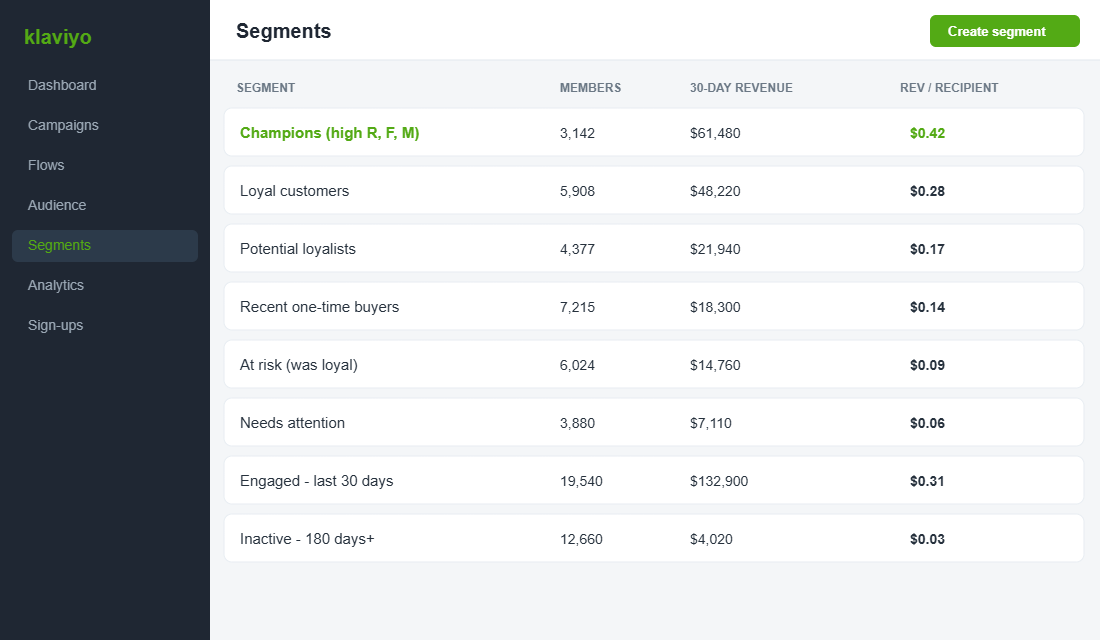
RFM stands for Recency, Frequency and Monetary value. It is the backbone of serious ecommerce segmentation, and Klaviyo now scores it automatically off your Shopify order history. That automation matters, because the model calibrates to your brand. A frequent buyer for a coffee subscription looks nothing like a frequent buyer for a mattress company, and Klaviyo works that out from your own data rather than a generic template.
Once RFM is on, Klaviyo sorts every customer into cohorts you can segment on directly:
- Champions. Bought recently, buy often, and spend the most. Usually a small percentage of your list that drives an outsized share of revenue.
- Loyal. Buy often or recently and spend well. Your reliable core.
- Potential loyalists. Recent buyers you can push toward a crucial second and third order.
- At risk. Were loyal and valuable, but have gone quiet. The highest-value people to win back.
- Needs attention. Used to buy frequently, now drifting toward the exit.
- Inactive. Have not bought in a long time and rarely did. Suppress, do not chase.
The move is to stop sending these groups the same email. Champions get early access and a genuine thank-you, not a discount. Potential loyalists get a nudge toward order two. At risk customers get a real “we miss you” before they are gone for good. To build one of these, create a segment, add the condition “Properties about someone” and choose the RFM group, for example RFM group equals Champions. That is the whole build.
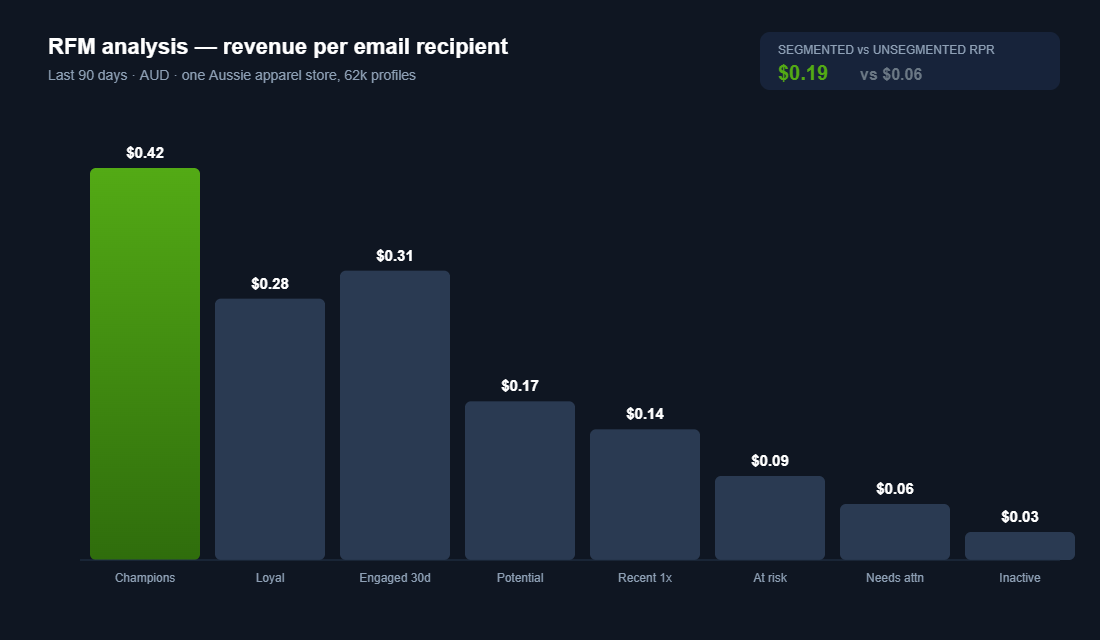
Look at what happens to revenue per recipient once you split by RFM. Your Champions might be worth $0.42 per email while your inactive pile is worth $0.03. In an unsegmented blend that whole story collapses into one useless average, often around $0.06 for an untuned list versus $0.19 for a well-segmented one. Segmenting does not create that value. It reveals money that was always sitting in your list.
Match your recency windows to what you sell. If you move consumables like skincare, coffee, supplements or pet food, tighten recency to 30 or 60 days, because a customer who has not reordered a monthly product in 60 days is genuinely drifting. For considered, one-off purchases, a 90 or 180 day window is the honest frame.
Part 3: Behavioural and product-affinity segments (intent beats demographics)
RFM tells you how valuable a customer is. Behaviour tells you what they want next. Layer behavioural segments on top of the RFM foundation and your messages stop being generic.
Build segments around what people actually do, not who you assume they are:
- Category buyers. Everyone whose orders include a specific collection. If a customer only ever buys your candles, do not lead every email with apparel.
- Browsed but never bought. Viewed a product three or more times in 30 days with zero orders. Prime for a targeted reminder or a first-order incentive.
- High AOV shoppers. Average order value above your store mean. They respond to bundles and premium launches, not clearance bins.
- Discount-only buyers. Only ever purchase on a code. Segment them out of full-price launches so you stop cannibalising margin on people who were never going to pay full price anyway.
Brands that get this right treat their list as a set of conversations, not a single broadcast. A brand like Frank Body does not send an identical email to a first-time lip scrub buyer and a repeat coffee-scrub loyalist, and neither should you. The gap between those two people is the whole opportunity.
This is not theory. The Swanky Growth Accelerator team ran a behaviour-based, multi-channel approach for Brisbane business Salon Supplies and Furniture across a BFCM push and reported nearly doubling monthly DTC sales over six months. A separate documented Klaviyo segmentation build drove a 323% lift in conversion. Those results come from matching message to buyer, not from sending more email.
Part 4: The suppression segments (who NOT to email)
This is the part founders skip, and it is where half the gains hide. Good segmentation is as much about exclusion as inclusion. Every name you correctly leave off a send protects both your margin and your reputation.
Before any campaign, suppress:
- Recent buyers of the featured product. Anyone who bought it in the last 30 days. Nothing sours a loyal customer faster than a discount on something they just paid full price for.
- Active subscription customers when the offer does not apply to them.
- Anyone currently in an automated flow, so they do not receive a campaign and a flow email in the same hour and mark you as noise.
- Your unengaged 120 day plus pile on every send except the one dedicated win-back.
Build these once as saved exclusion segments, then attach them to any campaign with two clicks. It takes ten minutes to set up and it quietly improves the result of every single send you make from that point on. Most founders never do it, which is exactly why it is such an easy edge.
Part 5: Wire your segments to flows (where it compounds)
Segments are static lists. Flows are the automations that fire when a customer moves between them. Connecting the two is what turns segmentation from a tidy spreadsheet into revenue that runs while you sleep. Automated flows already punch far above their weight, delivering revenue per recipient nearly 18x higher than one-off campaigns.
Wire up these four, in this priority order:
- Win-back flow. When a customer lands in At risk, start a sequence. Wait three days, send a “we miss you” with your best sellers, then split on whether they opened. Openers get social proof and no discount. Non-openers get one final SMS with a time-limited code.
- VIP flow. When a customer enters Champions, trigger a thank-you with early access and a small unexpected perk. No discount. You are rewarding loyalty, not buying it back.
- Second-order flow. When a potential loyalist hits day 21 after their first order with no second purchase, trigger a replenishment or cross-sell nudge. Order two is the hardest and most valuable jump in the entire customer lifecycle.
- Sunset flow. When a contact crosses 120 days unengaged, send one last “are you still in?” email. Openers stay on the list. Silence means you remove them and protect deliverability for everyone else.
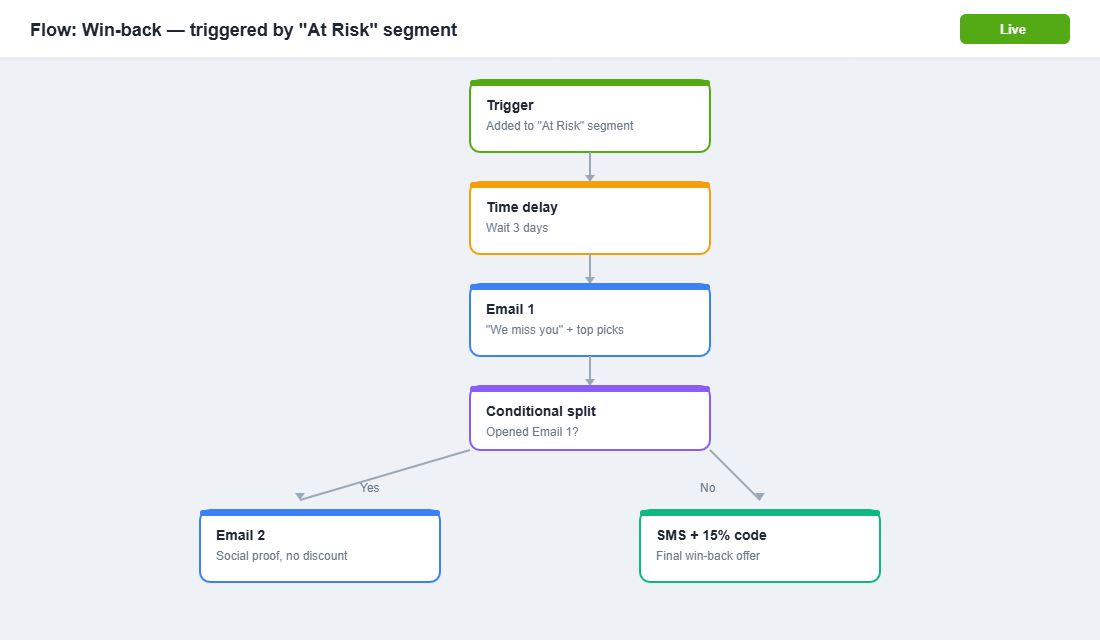
Build the win-back flow first. The At risk segment is full of people who already loved your brand enough to buy from you more than once. Recovering even a slice of them is dramatically cheaper than any cold acquisition you will run on Meta. It is the same logic behind a strong birthday flow and a well-built thank you page: the highest-converting moments are the ones where the customer has already raised their hand.
The compound effect: relevance stacks
Here is why this beats bolting on one clever segment and calling it a strategy. Each part multiplies the others.
Engagement tiers keep you in the inbox. RFM tells you who deserves what. Behavioural segments make the message actually land. Suppression protects your margin and your reputation. Flows fire all of it automatically as customers move between groups. Miss the engagement tiers and your best RFM work goes straight to spam. Skip suppression and your flows hand discounts to loyal buyers. Build all five together and a subscriber quietly travels from first purchase, to potential loyalist, to Champion, and if they ever drift, your win-back flow catches them, all without you touching a thing.
That is the difference between a list you blast and an asset that works for you. Brands running this level of depth typically operate 20 or more live segments off RFM scores, purchase behaviour and predicted value. You do not need 20 by Friday. You need the five parts above, built in order.
And unlike an ad account, this compounds on data you already own. Every order, every open and every click sharpens the model, so your list gets more valuable the longer you run it properly. Getting your returns and exchanges right helps here too, because it keeps more customers inside the profitable segments in the first place instead of churning out through a bad refund experience.
Your segmentation build checklist
Work through this in Klaviyo in one sitting. Tick all eleven and your email programme stops being a megaphone and starts being a machine:
- Engaged 30-day and Engaged 90-day segments built
- Unengaged 120-day-plus segment built and quarantined
- RFM turned on, with Champions, Loyal and At risk segments saved
- Recency windows matched to your product (tighter for consumables)
- Category-buyer and high-AOV behavioural segments created
- Discount-only buyers segmented out of full-price launches
- Saved suppression segments for recent buyers and active flows
- Win-back flow live off the At risk segment
- VIP flow live off Champions
- Second-order flow live for potential loyalists
- Every campaign attaches an exclusion segment before it sends
How to tell it is actually working
Segmentation is easy to fake and easy to fool yourself about, so measure it properly. Do not judge success on open rate alone, because a tighter, more engaged audience will naturally open more without necessarily selling more. Watch revenue per recipient instead. It is the single honest number, and it should climb as your segments get sharper.
Track three things monthly. First, campaign revenue per recipient split by segment, so you can see your Champions and Engaged 30 groups pulling their weight against the blended average. Second, the share of total email revenue coming from flows versus campaigns. A healthy Aussie DTC store usually sees flows contribute 35% or more of email revenue, and if yours is far below that, your segment-triggered automations are underbuilt. Third, list health: your engaged percentage should hold steady or rise, not slide, as you sunset dead contacts.
Give each change four to six weeks before you judge it. Email is a compounding channel, not a slot machine, and the win-back and second-order flows in particular need a full purchase cycle to show their real numbers. If revenue per recipient is trending up and your flow share is growing, the system is working, even on the weeks a single campaign underperforms.
The tools and numbers that make segmentation pay
Segmentation only earns its keep when you can measure the lift, so judge every segment on revenue per recipient (RPR), not open rate. A well-segmented list should push email to 25-30% of total store revenue. The build itself lives in Klaviyo for most Aussie DTC stores (its segment builder and RFM-style conditions are the benchmark), with Omnisend a cheaper alternative under about US$59/mo and Shopify Email fine only until you outgrow it — which is fast.
Here are the numbers worth holding yourself to:
- Segmented campaigns earn roughly 14% higher opens and double the clicks of batch-and-blast sends. Relevance is not a nicety; it is a measurable revenue lever.
- Your RFM “champions” — often the top 10% — drive 40-60% of revenue. Losing a few of them costs more than winning fifty new subscribers.
- A win-back to a 90-180 day lapsed segment reactivates 5-10% of it. On a 20,000-person list that is 100-200 customers you had already paid to acquire.
- Suppressing 90-180 day non-openers protects inbox placement. Deliverability is a compounding asset — one spam-folder slide can quietly halve your email revenue.
Segments are the targeting; flows are the engine. Once your tiers are clean, point them at the core Klaviyo flows every store needs so the right message fires automatically instead of waiting on a campaign. And because aggressive suppression is what keeps a big list healthy, treat your segmentation and your email deliverability as two halves of the same job.
Where most founders should start
If eleven line items feels like a lot at 40,000 subscribers, start with two moves this week. Turn on RFM and build the At risk segment, then wire the win-back flow to it. That single loop tends to recover more revenue in a month than most founders expect, and it proves the model before you invest the afternoon in the full build. Momentum beats perfection here.
Inside eCommerce Circle, customer segmentation is one of the core pillars we work on with every member, because it is the fastest way to grow email revenue without spending more on acquisition. If you want a second opinion on how your list is set up, let’s talk.