Almost every Aussie brand I work with that sells a considered product has tried sampling. They throw a few sachets in the box, hope somebody notices, and quietly conclude that samples do not do much.
What’s in This Article
They are right, but for the wrong reason. Free samples dropped into an existing order are not a sampling programme. They are packaging filler. The customer already bought. There is no decision being resolved, no data being captured, and no way to tell whether the sachet did anything at all.
A real sample programme is a paid, tracked, deliberately awkward little product that exists for one job: to get a stranger who would never risk 90 dollars on your hero product to risk 24 dollars instead. Done properly the numbers are genuinely strange. Sampling has been shown to cut acquisition cost by around 15%, and 90% of people who receive a sample buy again within six months. Against a global average ecommerce conversion rate of 2.74%, a sample-to-full-size conversion of 25 to 35% looks like a typo. It is not.
Free Samples Do Not Convert, Paid Ones Do
The instinct is that free lowers the barrier, so free must convert better. In practice the opposite happens, and it comes down to how people treat things they did not pay for.
A free sachet in the box gets used whenever. A sample pack somebody paid 24 dollars for gets opened that night. Payment creates a small commitment, and commitment creates usage, and usage is the only thing that actually sells the full-size product.
Charging also does three unglamorous things that matter more than the psychology.
- It filters out freebie hunters. A free sample offer attracts people who collect free things. A paid one attracts people who are actively deciding whether to buy your product.
- It creates a customer record and an order. Now you have an email, a shipping address, a purchase date and a product-level record you can segment and trigger against. A free sachet in someone else’s order gives you none of that.
- It funds itself. A well-priced pack covers its own landed cost, which means the programme is not a marketing expense you have to defend at the end of the quarter.
The single most common mistake is treating this as a discount play. It is not. It is a trial mechanic that happens to charge money, and the money is doing a job.
The Credit Is The Product, Not The Sample
Here is the part that separates programmes that work from programmes that limp along. The sample pack is not what converts people. The credit inside it is.
The mechanic is simple: whatever they paid for the pack comes back as credit toward a full-size purchase. Pay 24 dollars for the trial kit, get 24 dollars off your first full-size order. In retrospect the trial was free, and the customer is no longer making a purchase decision. They are activating credit they already own. Those are very different psychological jobs.
Watch what happens to the cohort numbers when the credit gets a proper reminder sequence behind it.
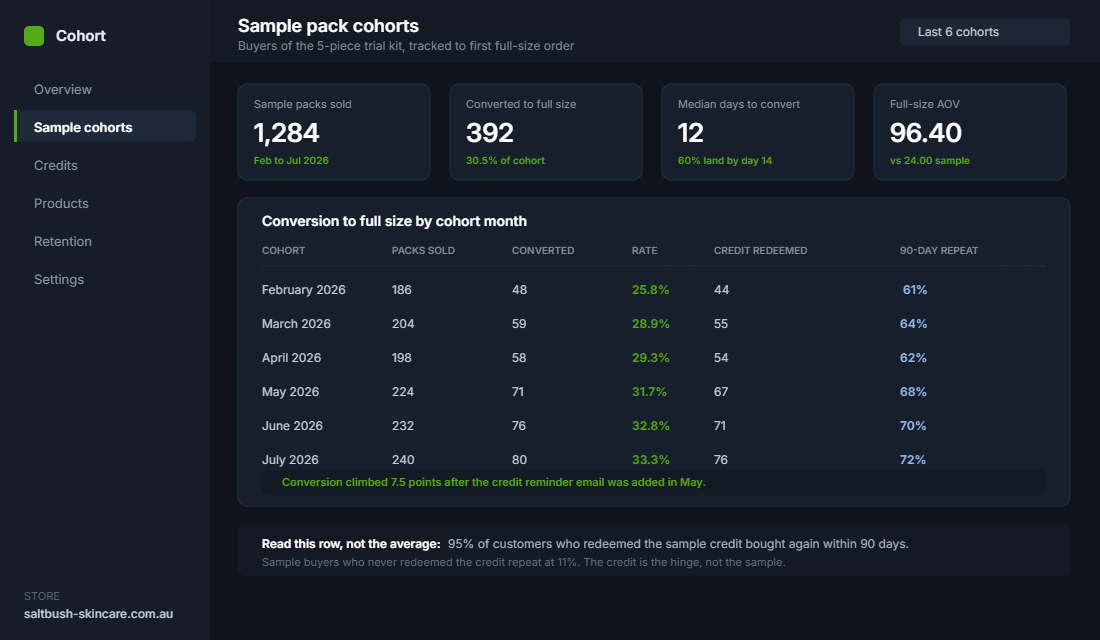
Look at the bottom line of that dashboard rather than the headline rate. Sample buyers who redeemed the credit repeat at 95% within 90 days. Sample buyers who never redeemed it repeat at 11%. The credit is not a discount you are grudgingly funding. It is the hinge the entire programme swings on.
Three rules on the credit itself, learned the expensive way:
- Make it equal to the pack price, not a percentage. Twenty-four dollars off reads as getting your money back. Twenty percent off reads as a coupon, and everybody has coupon blindness.
- Give it an expiry between 21 and 30 days. Recreation Beauty, the Bondi fragrance brand, puts a 20 dollar voucher inside its discovery set and expires it three weeks after delivery. That deadline is doing real work.
- Restrict it to full-size products only. Otherwise people spend the credit on a second sample pack and you have built a loop that costs money and teaches nothing.
Price The Pack To Cover Its Own Landed Cost
Founders get nervous here and either give the pack away or price it so low it bleeds. Both are avoidable if you model it once before you launch.
The rule is that the pack price should at minimum cover product cost, secondary packaging and postage. If it does that, every sample sold is contribution-neutral or better, and the full-size conversions are pure upside.
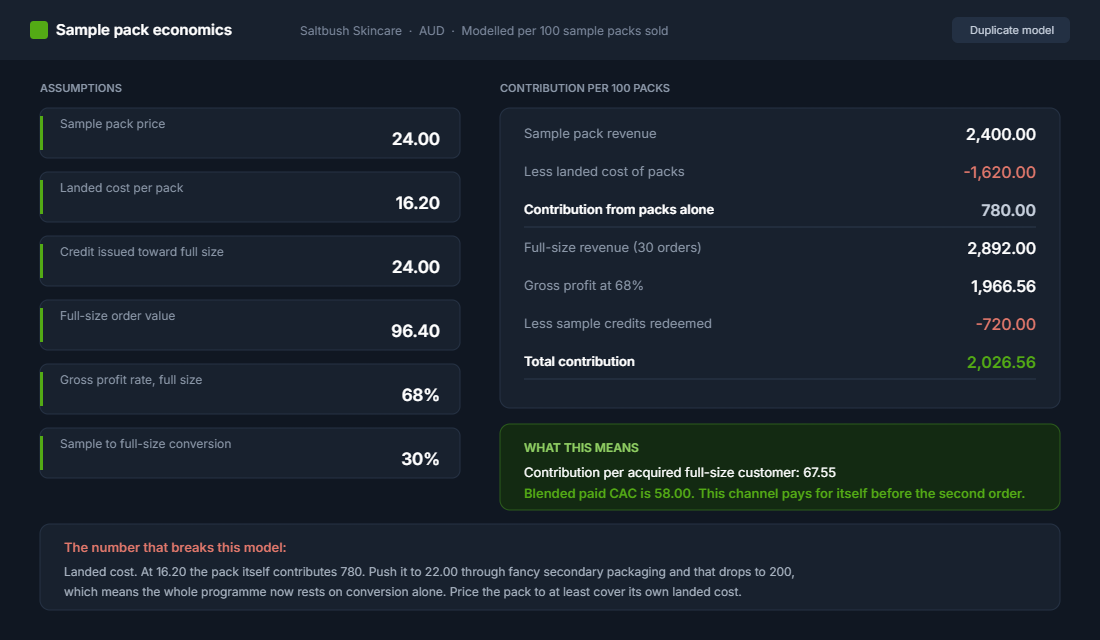
Two things in that model deserve attention.
- Landed cost is the killer variable, not conversion. At 16.20 per pack the samples alone contribute 780 dollars per hundred. Push landed cost to 22.00 with heavier printed boxes and tissue paper and that collapses to 200 dollars, which means the entire programme now depends on conversion holding up. Restraint in the packaging is a financial decision.
- Judge it against blended CAC, not against zero. Contribution per acquired full-size customer in that model is 67.55 against a blended paid CAC of 58.00. That is the comparison that matters. If you only look at the credit you are funding, you will kill a channel that is beating your ads.
Postage is where Australian brands get caught. A pack that works beautifully at 24 dollars in a domestic satchel stops working the moment you try to run it internationally. Model your regions separately or restrict the offer to Australia and New Zealand at launch.
The Conversion Window Is Short And Front-Loaded
Sample buyers do not think about you for months. The window is roughly 45 days from delivery and it is heavily weighted to the start.
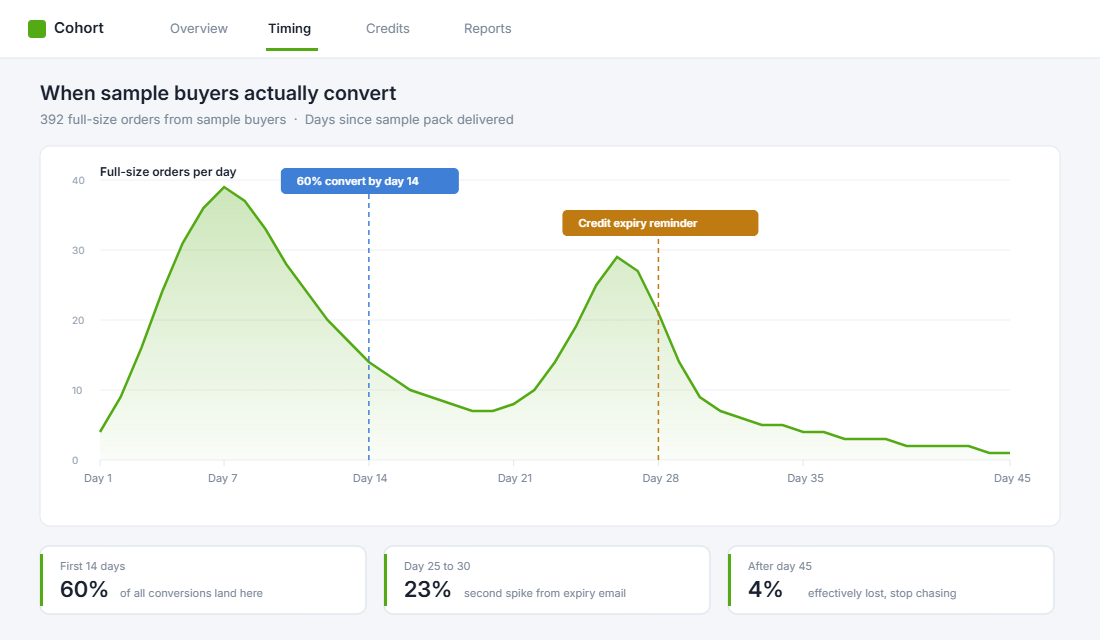
Around 60% of conversions land in the first 14 days, then volume falls away, then there is a distinct second spike around day 25 to 30 that only exists if you send an expiry reminder. After day 45 you are chasing about 4% of the total and it is not worth the sends.
That shape should dictate your sequence exactly. Most brands send one email a week after the pack ships and wonder why it underperforms.
What Actually Goes In The Pack
The contents decision looks cosmetic and is not. Get the count and the sizes wrong and conversion drops even with a perfect credit and a perfect sequence.
- Four to six items, never more. Three feels thin and does not justify the price. Eight creates choice paralysis and, worse, guarantees most items never get used before the credit expires. Five is the number I see working most often.
- Size each sample for a real trial, not a taste. The sample has to last long enough for the customer to form a view. For skincare that is seven to ten uses. A single-use sachet cannot answer whether something suits their skin, so it cannot sell anything.
- Include your hero product every time. The pack is a discovery mechanic, but it is also a conversion mechanic, and your hero converts best. Let people find it rather than hoping they order it later.
- Add one product nobody buys. Sample packs are the cheapest product research you will ever run. If a slow-moving line converts well from trial, your problem was never the product, it was the product page.
- Skip the printed booklet. It adds landed cost, it adds weight, and it goes straight in the bin. Put the instructions in the day 0 email where you can measure whether anyone read them.
One more decision worth making deliberately: fixed kit or customer-chosen. Fixed is cheaper to pick and pack, simpler to forecast, and easier to standardise. Customer-chosen converts better because people trial what they were already curious about, but it multiplies your pick complexity and your inventory headaches. Start fixed. Move to chosen only once the programme has earned the operational cost.
The Follow-Up Sequence That Does The Work
Five emails, triggered off delivery rather than dispatch. Delivery is the only date that matters, because the customer cannot try anything until the satchel is in their hands.
- Day 0, delivered. How to use the samples, in what order, over how many days. This is the highest-value email in the sequence and most brands skip it entirely. If nobody uses the product, nothing else works. Our product adoption playbook covers this properly.
- Day 4. One piece of education tied to the category, not the sale. Why the formulation works, or how to tell if it suits you. No offer.
- Day 8. The credit reminder. State the exact dollar amount sitting in their account and the exact date it disappears. Link straight to the full-size collection with the credit pre-applied.
- Day 14. Social proof. Reviews from customers who started with the same pack. This is the moment fence-sitters need somebody else to go first.
- Day 21 to 25. Final expiry notice, sent about five days before the credit dies. This is the email that creates the second spike and it is the one most programmes are missing.
Suppress anyone who has already converted, obviously, and suppress anyone with an open support ticket. If your segmentation is not set up to do that cleanly, start with our guide to Shopify customer segmentation.
What Four Brands Actually Charge
Rather than theorise, here is what is live right now across four brands, and what each one is optimising for.
Recreation Beauty (Australia)
Bondi-based fragrance brand. Discovery set ships with a 20 dollar voucher toward a 50ml bottle, expiring three weeks after delivery, limited to one per order. Tight, specific, and the restriction to a 50ml purchase means the credit cannot be spent on another sample.
Henry Rose
Five fragrances at 2ml each. Customers receive a 20 dollar credit toward a first purchase of around 120 dollars, and the brand reports discovery-set-to-full-size conversion in the high double digits. Small sample sizes, high-value conversion, credit sized at roughly 17% of the target order.
Kosas
Runs Kosas Try Outs at three to five dollars per sample, with the sample cost deducted from the full-size product if the customer buys it. Low price point, very low risk, and the deduction is automatic rather than a code the customer has to remember.
Fulton and Roark
Charged in the sixteen to twenty-four dollar range for a sample set, then credited the full amount back on a full-size purchase. Same mechanic, higher entry price, which suits a considered grooming purchase with a longer decision cycle.
The pattern across all four: the credit sits between roughly 15 and 25% of the target full-size order, the sample is small enough to be genuinely used up, and the credit has a hard boundary on what it can buy.
Who Should Not Run A Sample Programme
This is not a universal mechanic and I would rather you skip it than run a version that loses money quietly for a year.
- Products that cannot be meaningfully sampled. A mattress, a coffee table, a pair of boots. If a miniature version does not answer the buyer’s real question, a sample pack is theatre. Try a strong returns policy instead.
- Single-product brands. The mechanic relies on choice. If you sell one thing in one variant, there is nothing to discover and the pack is just a smaller version at a worse unit economic.
- Very low AOV. If your full-size order is 35 dollars, a 12 dollar sample pack plus postage plus a credit leaves nothing. You generally want a full-size order of 60 dollars or more for the maths to breathe.
- Anyone without delivery-triggered email. The whole sequence hangs off delivery date. If you cannot trigger on that, fix the tracking integration before you build the pack.
If your problem is really that first purchases are too expensive, the better move may be a properly designed cheaper hero item rather than a sample. That is a different mechanic and we covered it in the piece on choosing an entry product.
Building It In Shopify Without Buying Another App
You can run the first version of this on native Shopify. Do not add an app until you have proven the mechanic.
- Create the pack as a normal product. Its own SKU, its own product page, priced to cover landed cost. Do not make it a variant of the hero product or your reporting will be a mess.
- Set up an automation to tag the customer. In Shopify Flow, trigger on order created containing that SKU and apply a tag such as sample-buyer with the date. Everything downstream keys off this tag.
- Generate unique credit codes in bulk. Under Discounts, create an amount-off-products code restricted to your full-size collection, with a minimum order value and a per-customer usage limit of one. Bulk-generate unique codes rather than one shared code, or it will end up on a coupon site within a fortnight.
- Set the expiry to 21 to 30 days from delivery, not from purchase. Build in a few days of shipping buffer when you set the end date.
- Print the code on a physical card in the pack. Redemption is measurably higher when the credit is in the box as well as in the inbox. It is the first thing they see when they open it.
- Build the five-email flow in Klaviyo, triggered on fulfilment delivered. Not on order placed. Suppress on the converted tag.
- Report on it as its own cohort. Track packs sold, conversion to full size, days to convert, and 90-day repeat rate. Four numbers, reviewed monthly.
Once that is running and the numbers hold for two or three cohorts, a tool like Rebuy is worth adding so returning sample buyers see a finish-the-routine module instead of being sold the sample pack a second time.
Why This Compounds When Discounting Does Not
A discount buys you an order and teaches the customer to wait for the next sale. A sample pack buys you an order, a usage occasion, an email trigger, a product preference signal, and a customer who has physically handled your product before they commit.
That last part is why the retention numbers look the way they do. Brands running sampling report roughly 15% higher retention than brands that do not, and 63% of consumers say samples let them discover products they would never have tried otherwise. You are not buying a transaction. You are buying the conditions under which somebody becomes a repeat customer.
It also feeds the cheapest channel you have. Someone who trialled five products, picked a favourite, and bought the full size has a specific story to tell, which is exactly the raw material a referral programme needs to work.
The Unit Economics, Worked End to End
Sample programmes fail on arithmetic more often than on execution, and the arithmetic is worth doing before you order packaging. Here is the full model on a skincare brand selling a $79 hero serum.
The pack sells for $15 with free shipping. Inside it: four 5ml decants at a landed cost of $1.60 each, a $2.10 mailer and insert card, and $8.50 to ship satchel post within Australia. Total landed cost is $17.00, so the pack itself runs at a $2.00 loss before any credit is redeemed. That negative number is the part founders flinch at, and it is the wrong number to look at.
Now run it to the second order. Say 32% of sample buyers redeem their $15 credit on a full-size purchase within the 30-day window, which sits at the healthy end of the 20-40% range these programmes typically produce. That converted customer spends $94 on average, redeems the $15 credit for a net $79, and costs you $23 in COGS and $9 in fulfilment. Contribution on that second order is $47.
Across 100 packs sold: you lose $200 on the packs, and 32 conversions return $1,504 in contribution. Net contribution is $1,304, which works out to about $41 per acquired customer at an effective acquisition cost of roughly $6.25. Compare that against a blended paid CAC that most Aussie DTC brands are running somewhere between $35 and $70, and the case makes itself.
Three variables break the model, and they are worth stress-testing before you commit. If conversion drops below about 18%, the programme stops beating paid acquisition. If your pack price falls under roughly 60% of landed cost, the loss per pack outruns what conversion can recover. And if shipping is more than about 55% of your pack price, you are running a courier subsidy rather than a sampling programme, which is the most common failure we see on heavy or bulky products.
Build the model in a sheet with those three as inputs before you spend anything. Then track actuals against it monthly, because the number that quietly moves is conversion rate, and it moves with the quality of your follow-up sequence rather than the quality of the sample. A programme running at 32% in month one and 19% in month four almost always has a broken email flow, not a broken product. Watch the 90-day repeat rate on sample-acquired customers as your second cohort metric, and compare it against customers acquired through a low-priced entry product to see which door produces better long-term buyers. If sample buyers are converting but not repeating, the problem sits downstream in your repeat purchase system, not in the pack.
The Sample Pack Scorecard
Run this before you launch, and again after your third cohort. Each no is a specific task.
- Is the pack paid rather than free?
- Does the pack price cover product cost, secondary packaging and postage?
- Is the credit equal to the pack price rather than a percentage?
- Is the credit restricted to full-size products only?
- Does the credit expire between 21 and 30 days after delivery?
- Is the code unique per customer rather than shared?
- Is the credit printed on a card inside the pack as well as emailed?
- Are sample buyers tagged automatically at order creation?
- Is the email sequence triggered on delivery rather than dispatch?
- Does the sequence include a day 0 how-to-use email?
- Is there a final expiry reminder around day 21 to 25?
- Are converted customers and open support tickets suppressed from the flow?
- Are you tracking packs sold, conversion rate, days to convert and 90-day repeat as a cohort?
- Is contribution per acquired customer compared against your blended paid CAC?
Eleven or more yes answers and you have a channel. Under seven and you have an expensive box of miniatures.
Inside eCommerce Circle, working out the cheapest honest way to get a stranger to try your product is one of the core pillars we work on with every member. If you want a second opinion on yours, let’s talk.