Every November you buy thousands of new customers. Every February you quietly lose most of them, and the P&L never shows you the moment it happened.
What’s in This Article
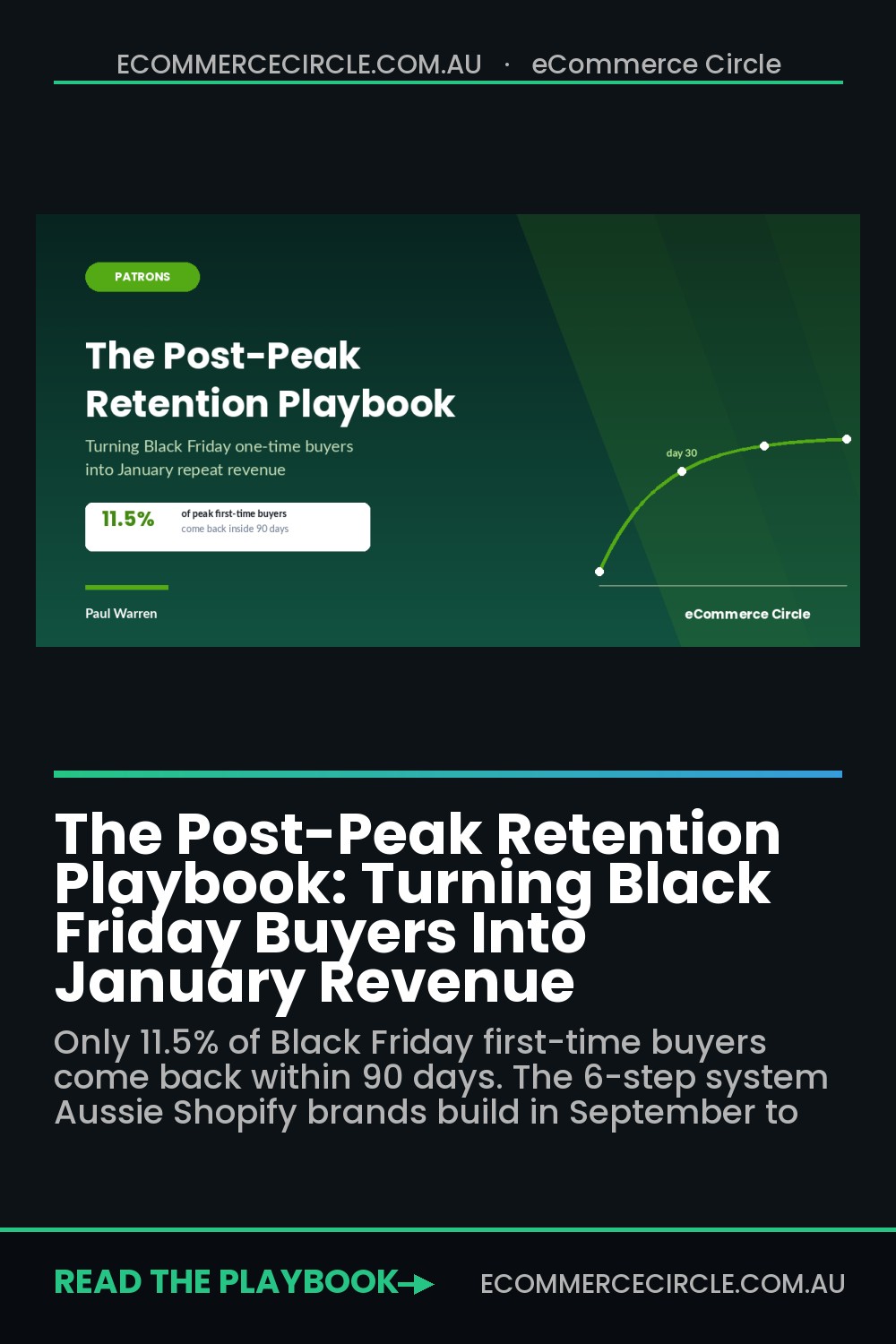
Here is the number that should reset how you think about peak season. Across 8,076 first-time buyers acquired during the Black Friday window, only 11.5% placed a second order within 90 days. The same brands see an 18.8% repeat rate across their all-year customers. The peak cohort retains roughly 39% worse than everyone else you acquire.
Most Aussie founders read that and shrug. Black Friday buyers are deal hunters, of course they do not come back. That is the wrong conclusion. The data shows peak buyers absolutely do come back, they just come back on a completely different clock. 70% of every repeat order from that cohort lands inside 30 days, with a median of 19.2 days to the second purchase. Your all-year cohort takes twice as long.
So the problem is not the customer. The problem is that your post-purchase system was built for a 90-day window and your peak buyers are gone in three weeks. This playbook is the fix, and September is exactly when you build it, because by the time the orders start landing in late November it is far too late to be wiring flows.
Why Your Biggest Acquisition Week Is Also Your Worst Retention Cohort
Peak season in Australia is now genuinely enormous. The Australian Retailers Association and Roy Morgan tipped a record 6.8 billion dollars across the Black Friday and Cyber Monday weekend in 2025, up 4% year on year, with around 6 million Australians taking part and average planned spend of 804 dollars per person.
Australia Post moved almost 111 million parcels across November and December, a 7.6% lift, and recorded its busiest delivery day ever with more than 3 million parcels on Monday 8 December. Some 7.9 million Australian households shopped online across those two months, 300,000 more than the year before.
That is a lot of new names in your database. The trap is what those names actually represent. A peak first-time buyer arrived through a fundamentally different door than someone who found you in March and paid full price. They came for a discount, or they were buying a gift for someone else, or both. The purchase occasion was never really about your brand.
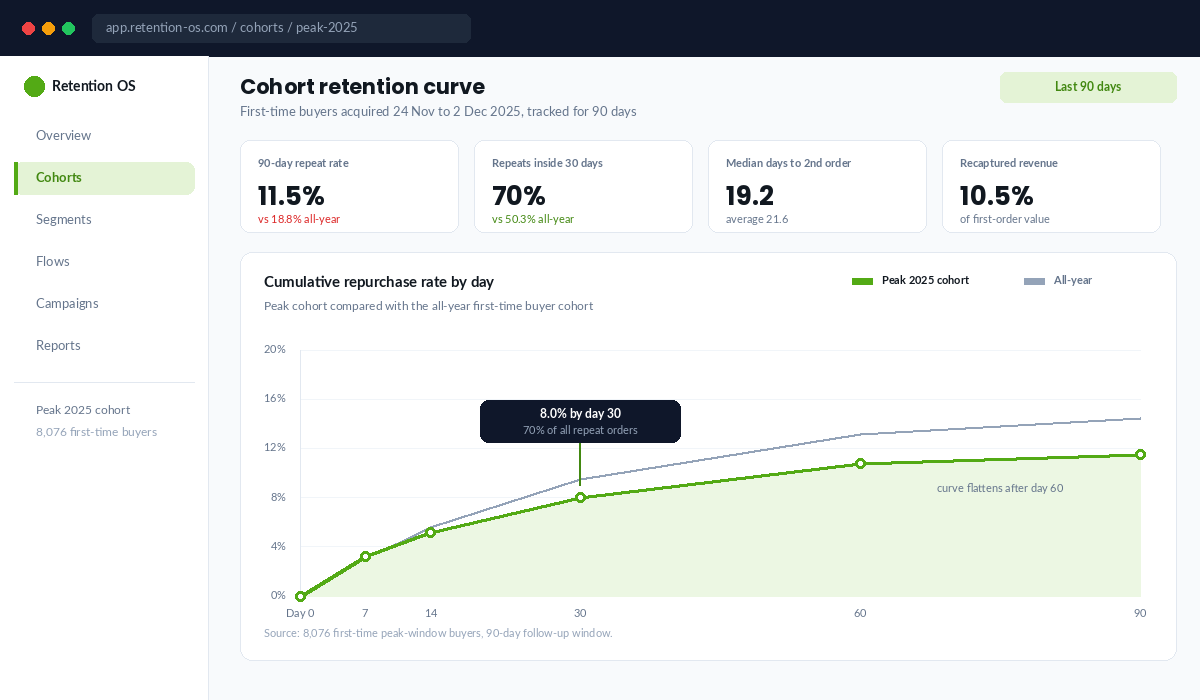
Look at the shape, not just the level. The peak curve hits 3.2% by day 7, 8.0% by day 30, and 10.8% by day 60. Between day 60 and day 90 it gains almost nothing. For your all-year customers, 50.3% of repeat orders happen inside 30 days and 76.4% inside 90. For your peak customers, 70% happen inside 30 days and 28% happen in the first week alone.
The uncomfortable translation: if your win-back flow fires at day 90, you are fighting over roughly 6% of the people who were ever going to return. The decision was made in December while you were on the beach.
Step 1: Tag the Cohort Before a Single Order Lands
You cannot fix what you cannot see, and almost no Aussie brand separates peak buyers from everyone else. They sit in the same “all customers” list, get the same flows, and get measured against the same benchmark. Then in March the founder looks at a flat repeat rate and has no idea which cohort dragged it down.
Build the segment in Klaviyo now, before the window opens. Here are the exact conditions.
- Go to Audience, then Lists and Segments, then Create New, then Segment. Name it “Peak 2026 first-time buyers” so it is obvious to whoever inherits it.
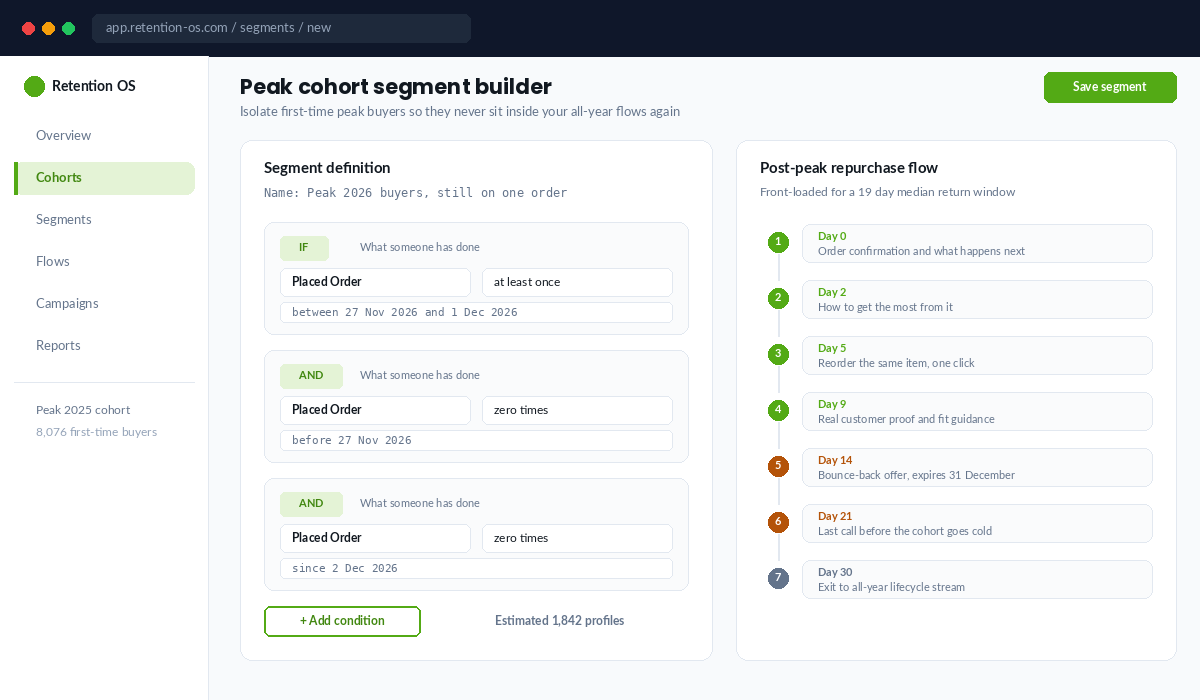
- Condition one. What someone has done: Placed Order, at least once, over all time, then add a date filter for between 27 November 2026 and 1 December 2026.
- Condition two. AND, What someone has done: Placed Order, zero times, before 27 November 2026. This is the line that turns it from “everyone who bought at peak” into “everyone new”.
- Clone it into a chase segment. Duplicate the segment, add a third condition: Placed Order zero times since 2 December 2026. That gives you the live list of peak buyers still sitting on one order, which is the group every flow and campaign below is aimed at.
- Add a Shopify customer tag as backup. Use a Shopify Flow automation that tags any order in the window with
peak-2026. Klaviyo segments are great, but a tag on the customer record survives platform changes and shows up in your reporting stack.
Build it early for a practical reason. Large segments take time to populate and Klaviyo recalculates some time-based conditions on a daily cycle, so a segment created on Black Friday morning may not be usable when you need it that afternoon.
Step 2: Rebuild the Post-Purchase Flow for a 19-Day Window
Your standard post-purchase flow is almost certainly a thank you on day 0, a shipping update on day 3, and a review request around day 14. Then silence until a win-back sequence fires months later. That structure is defensible for an all-year buyer. It is close to useless for a peak buyer whose median second order lands on day 19.
Build a separate flow, triggered off the peak cohort segment, and front-load it hard. Here is the sequence that matches the curve.
- Day 0, order confirmation with a job to do. Confirm the order, set the delivery expectation honestly given peak freight, and include one line about what else the brand makes. Confirmation emails get opened at rates campaigns will never touch. Do not waste that attention on a receipt.
- Day 2, help them get value. How to use it, how to care for it, how to size it. This is not a sales email, it is the one that makes the product actually work for them, which is what earns the second order.
- Day 5, the reorder email. One click, same product, no browsing required. This is the single highest-return email in the sequence and most brands do not send it at all.
- Day 9, proof. Real customer photos and reviews of the exact product they bought. Reinforce the decision before buyer’s remorse or a competitor’s January sale gets there first.
- Day 14, the bounce-back offer. A dated incentive that expires 31 December. Not a bigger discount than they got at peak, a different kind of value: free express shipping, a bundled add-on, early access.
- Day 21, last call. Direct and short. The curve is already flattening.
- Day 30, exit. Move them into your normal lifecycle stream and stop treating them as a peak buyer.
Seven touches in thirty days sounds aggressive. It is not, when the alternative is 88.5% of that cohort never buying from you again. If you want the underlying architecture, our 7-email post-purchase sequence is the all-year version of this. The peak flow is that same logic compressed into a third of the time.
Step 3: Lead With the Reorder, Not the Cross-Sell
This is the finding that quietly breaks most post-purchase programs. Across 7,454 second-purchase journeys, 77% of second orders were a reorder of the same product. Only 23% were a cross-sell into something different.
Now think about what your post-purchase emails actually contain. Product recommendation grids. “You might also like.” A carousel of four things the customer has never expressed interest in. Every one of those blocks is optimised for the 23%.
It gets sharper by category. Supplement brands hit 82% to 93% reorder. Food and beverage runs 45% to 91%. Even apparel, where everyone assumes customers want something new, shows 48% to 66% same-product repurchase, driven by gifting, replacement and genuine loyalty to one item.
There is one clean exception. Home decor shows effectively 0% reorder and 100% cross-sell. Nobody buys the same rug twice. If you sell durables, the recommendation grid is exactly right. If you sell anything consumable or wearable, “ready for another?” beats “have you seen this?” almost every time.
Melbourne brand Who Gives A Crap is the local case study worth studying here. They built their whole model around the reorder rather than the catalogue, using Recharge for subscription management and a customer portal that lets subscribers skip or delay shipments instead of cancelling. That combination drove a 250% increase in subscriptions. When they went further and adjusted Klaviyo send times so Australian customers stopped receiving notifications in the middle of the night, notification open rates hit 75%.
The lesson is not “sell toilet paper”. It is that they removed every decision between the customer and the next order. That is what a reorder-led post-purchase flow does for brands without a subscription model.
Step 4: Stop Suppressing Peak Buyers From December Campaigns
Almost every brand I look at has a suppression rule that hides recent purchasers from campaigns for 30 to 60 days. It feels considerate. Nobody wants the “I just ordered and you are already emailing me” reply.
That rule is costing you the entire peak retention window. If 70% of peak repeat orders happen inside 30 days, and you have muted that cohort for 30 to 60 days, you have gone silent during the only stretch that matters. You are excluding your warmest audience from your December gift guides, your Boxing Day campaign and your New Year sends.
Peak buyers have already cleared every hurdle. Trust, payment details, shipping risk, all of it. They are demonstrably in buying mode: 6.3% of repeat buyers order again the same day and 15.9% inside a week.
- Audit your suppression list this week. Find every campaign exclusion built on “purchased in the last X days” and check what X actually is.
- Carve out the peak cohort. Exclude them from anything that would be jarring, like a deeper discount on the exact item they just paid for, and include them in everything else.
- Give them their own December angle. “You bought for yourself, here is the gift edit” is a different message to your cold list and it converts because it is true.
- Watch complaint and unsubscribe rates, not your gut. If unsubscribes on the cohort stay under 0.3% you have room to keep sending.
Step 5: Put the Second-Purchase Offer Inside the Box
Email deliverability during peak is at its worst exactly when you need it most. Every brand in the country is sending, inbox providers are throttling, and your carefully built day 14 email may simply not get seen.
The parcel always gets seen. A physical bounce-back card is the most underused retention asset in Australian ecommerce, and the timing works perfectly: the parcel arrives somewhere between day 3 and day 10 of a window where the median second order is day 19.
- Print one card, not a brochure. A single dated offer with a short code and an expiry of 31 December. Dated beats open-ended because it matches the compressed window.
- Make the offer non-monetary where you can. Free express shipping on the next order, a free add-on, or early access to your January range. You have already discounted once. Do not teach the cohort that your full price is fictional.
- Use a unique code per cohort, not per customer. One code such as
NEXT26that only your peak cohort receives. It is trivial to track and tells you exactly what the insert produced. - Order the print run in September or October. Print lead times blow out in November, and a card that arrives in January is a card you paid for twice.
- Mirror it digitally. Put the same offer on the order tracking page. WISMO checking is the highest-intent moment in the entire post-purchase journey and most brands leave it as a bare carrier widget.
If you run retail as well as online, this is where the two channels stop being separate businesses. Bared Footwear, the Melbourne podiatrist-founded label, moved to Shopify POS specifically to unify its store and online operations so the customer record follows the person rather than the channel. That matters enormously post-peak: a customer who bought online in November and walks into your store in January should be recognised, and the staff should know they are still sitting on one order.
Step 6: Score the Cohort in February, Not in November
The last week of November is the worst possible time to judge peak season. Revenue is up, the dashboard is green, and every decision looks correct. The truth arrives in late February when the 90-day window closes on that cohort.
Put a calendar entry in for the last week of February 2027 right now and pull four numbers.
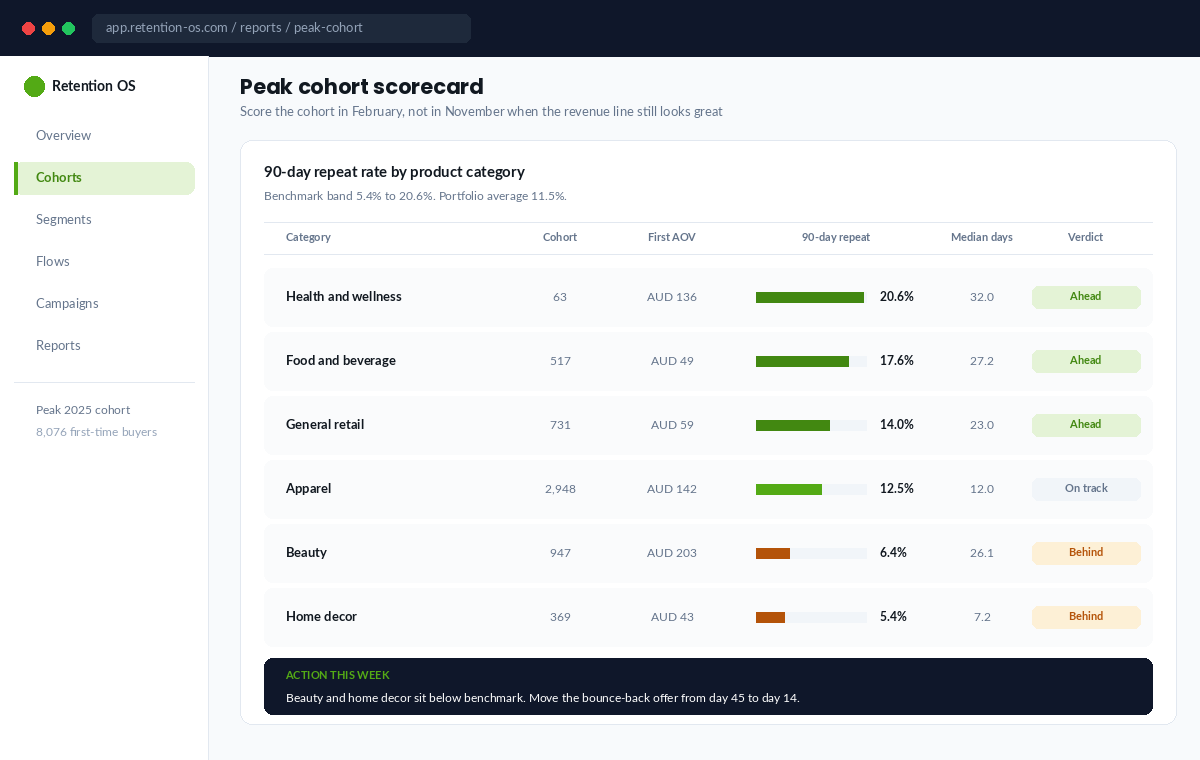
- 90-day repeat rate for the cohort. Benchmark is 11.5%. Above that you are outperforming. Below it, the post-purchase system is the first place to look, not the offer.
- Median days to second order. If yours is materially longer than 19 days, your flow timing is wrong for your category. Apparel brands see medians as tight as 12 days.
- Reorder share versus cross-sell share. Compare it to the 77% benchmark. If your reorder share is low and you sell consumables, your emails are pushing the wrong products.
- Repeat rate by acquisition source. This is the one that changes budget decisions. If your paid social peak cohort retains at 6% and your email and organic peak cohort retains at 16%, you have just learned something about next year’s peak media plan that no ROAS report will tell you.
Do not compare the peak cohort to your all-year number. That comparison is unfair and it will push you to the wrong conclusion, usually “retention is broken” when the real answer is “this cohort was always going to behave differently”. Our 90-day cohort LTV framework covers how to build the reporting view properly.
What a Few Points of Lift Is Actually Worth
Here is where the six steps stop being a list and start being a system. Run the maths on a mid-sized Aussie brand.
Say you acquire 3,000 first-time buyers across the peak window at an average first order of 140 dollars. At the 11.5% benchmark, 345 of them come back. Move that to 15.5% through cohort tagging, a compressed flow, a reorder-led offer and a bounce-back card, and 465 come back. That is 120 additional second orders.
At 140 dollars a second order that is roughly 16,800 dollars in extra revenue, and it costs you close to nothing in media because these people are already yours. But the real number is downstream. A customer who places a second order is dramatically more likely to place a third. You have not just booked 120 orders, you have moved 120 people from a one-time cohort into your repeat base, and that shows up in every quarter that follows.
Now flip it. The same brand at 11.5% is watching 2,655 customers walk away after one order. If your blended acquisition cost sat anywhere near 45 dollars during peak, you spent something in the order of 119,000 dollars acquiring people you will never see again. That is the actual cost of a post-purchase system built for the wrong clock.
The compounding matters more than any single tactic. The segment makes the flow possible. The flow makes the timing right. The reorder framing makes the emails relevant. The insert covers the deliverability gap. The February review tells you which of those four to sharpen next year. Pull any one out and the other four get weaker. This is also why win-back campaigns should be your safety net rather than your strategy: by day 60, 94% of the peak buyers who were ever going to come back already have.
Your September Build Checklist
You have roughly twelve weeks. Work through this in order and the whole system is live and tested well before the first peak order lands.
- Week 1, measure last year. Build the 2025 peak cohort retrospectively and pull its 90-day repeat rate. That is your baseline and your argument for doing any of this.
- Week 2, build the segments. The cohort segment, the chase segment, and the Shopify Flow tag automation. Test them against last year’s dates so you know they populate correctly.
- Week 3 and 4, write the flow. Seven emails, day 0 through day 30, reorder-led. Write them all before you build any of them so the arc holds together.
- Week 5, fix the suppression rules. Audit every campaign exclusion and carve out the peak cohort.
- Week 6, design and order the insert. One card, dated offer, unique code, ordered early enough to beat the November print queue.
- Week 7, upgrade the tracking page. Put the same offer where WISMO traffic actually goes.
- Week 8, dry run. Push a test order through the tagged path and confirm every email fires on the right day with the right product.
- Weeks 9 to 12, leave it alone and go sell. The retention system is built. Now go and fill it.
- Last week of February 2027, score it. Four numbers, one hour, and you will know exactly what to change for peak 2027.
Most Australian brands will spend the next twelve weeks arguing about offer depth and creative angles. Both matter. Neither changes what happens to the customer on day 19, and day 19 is where next year’s revenue is decided.
The brands that pull away are not the ones that discount harder in November. They are the ones that treat peak as an acquisition event with a retention plan attached, built in September while everyone else is still designing banners.
Inside eCommerce Circle, post-peak retention is one of the core pillars we work on with every member heading into November. If you want a second opinion on yours before the window opens, let’s talk.