Most Shopify store owners think of customer loyalty as something that happens after the sale — a points programme, a discount code, maybe a birthday email. But the brands that build genuine loyalty — the kind where customers actively choose you over cheaper alternatives — are doing something fundamentally different. They are building loyalty into every touchpoint of the customer experience, from the first ad they see to the tenth order they place.
What’s in This Article
Here is the uncomfortable truth: acquiring a new customer costs 5-7x more than retaining an existing one. Yet most Shopify stores spend 80% of their marketing budget on acquisition and less than 20% on retention. That imbalance is why so many stores grow revenue but never grow profit — they are on a treadmill, constantly replacing churned customers with expensive new ones.
The stores that break through this cycle have loyalty programmes that go beyond points and discounts. They create genuine emotional connections that make customers feel valued, understood, and part of something bigger than a transaction. And the data proves it works: a 5% increase in customer retention can increase profits by 25-95%.
Why Points-Only Programmes Are Dying
Traditional points programmes — earn 1 point per dollar, redeem 100 points for $5 off — are becoming white noise. Every brand has one, and customers have learned to game them. They earn points across 15 different brands, feel loyal to none of them, and simply redeem wherever the math works best at any given moment. That is not loyalty — it is price optimisation.
The programmes that actually drive retention combine transactional rewards (points and discounts) with experiential rewards (exclusive access, early launches, VIP treatment) and emotional rewards (community, identity, belonging). When a customer feels like a valued member of your brand community, they do not shop around based on price. They buy from you because they identify with your brand.
Look at the brands with the most loyal customers — Apple, Lululemon, Aesop. Their “loyalty programmes” are not built on points. They are built on exclusive experiences, community events, consistent quality, and a brand identity that customers want to be associated with. You do not need to be a billion-dollar brand to apply these principles to your Shopify store.
Designing a Multi-Layer Loyalty Programme
The most effective loyalty programmes for Shopify stores have three distinct layers that work together to drive different types of retention behaviour.
Layer 1: Transactional rewards (the foundation). Points, cashback, or discounts for purchases. This is the basic layer that incentivises repeat purchasing. Keep the earn-and-burn ratio simple and generous enough to feel worthwhile. A good benchmark: customers should be able to earn a meaningful reward ($10-$15 off) after 2-3 purchases. If it takes 10 purchases to earn anything, nobody will bother.
Layer 2: Status tiers (the motivator). Create 3-4 tiers based on annual spend or purchase frequency: Bronze, Silver, Gold, Platinum (or whatever naming fits your brand). Each tier unlocks progressively better benefits: free shipping, birthday gifts, early access to sales, exclusive products, and higher point multipliers. Tiers create a goal that keeps customers engaged and spending to reach the next level.
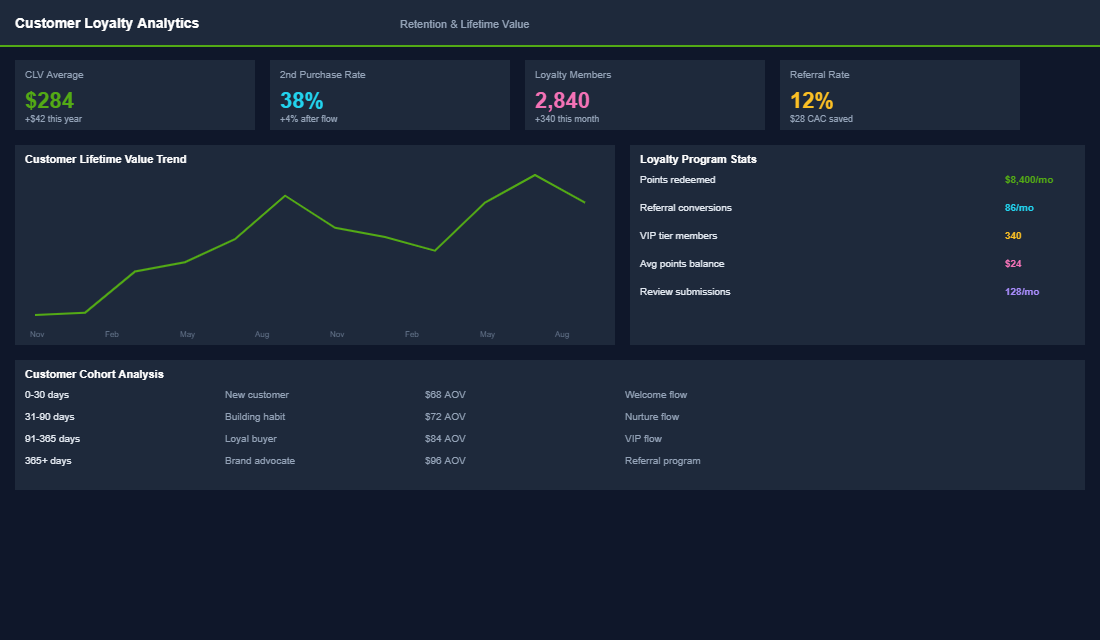
Layer 3: Experiential rewards (the differentiator). This is where you separate yourself from every other points programme. Experiential rewards include: early access to new products (24-48 hours before public launch), VIP-only products or colourways, invitations to virtual or in-person events, behind-the-scenes content, personal shopping or styling consultations, and surprise gifts on their loyalty anniversary. These rewards cost relatively little to provide but create outsized emotional impact.
Setting Up Your Loyalty Programme on Shopify
The two best loyalty apps for Shopify stores are Smile.io and LoyaltyLion. Here is how to choose between them and set up effectively.
Smile.io is the better choice for most stores under $500K per year. It is easier to set up, has a clean customer-facing interface, and covers points, referrals, and VIP tiers. The free plan supports up to 200 orders per month. Paid plans start at $49 per month and scale with features. Smile integrates natively with Klaviyo, Judge.me, and most major Shopify apps.
LoyaltyLion is the premium option for stores above $500K per year or those wanting deep customisation. It offers more flexible tier structures, advanced analytics, and custom reward types. Pricing starts at $199 per month and goes up based on order volume. LoyaltyLion also integrates with Klaviyo, Recharge, and Gorgias for a fully connected retention stack.
Implementation tips: Launch with a simple structure and add complexity over time. Start with points for purchases and a basic referral reward. Add tiers after 3-6 months once you have data on spending patterns. Add experiential rewards after you have established tier behaviour. This staged approach lets you learn what your customers respond to before investing in advanced features.
Referral Programmes: Your Cheapest Acquisition Channel
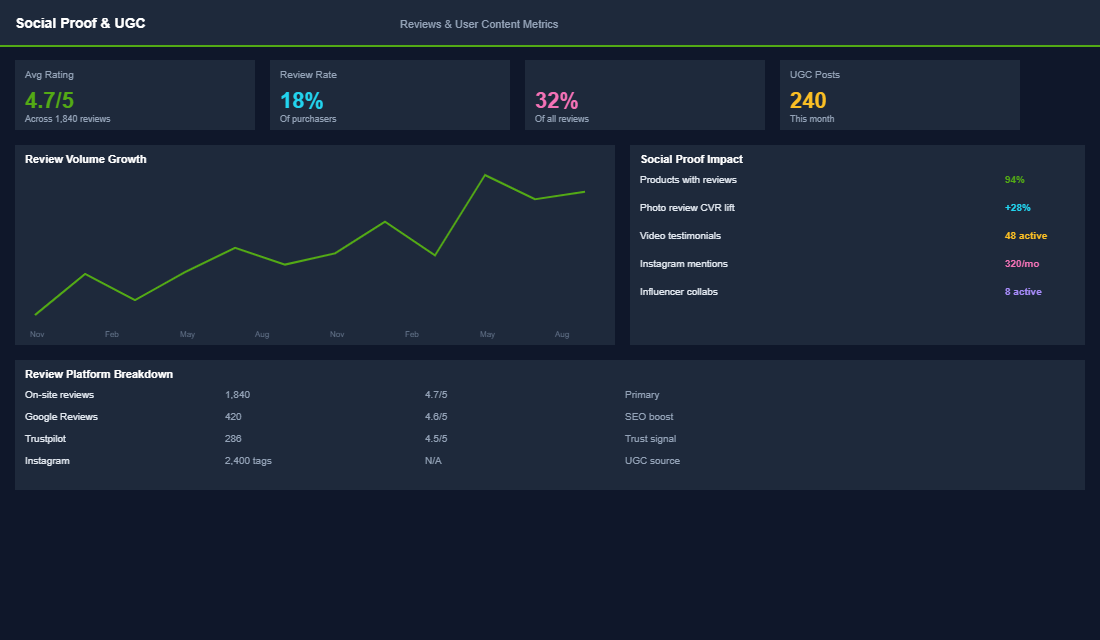
A well-designed referral programme turns your loyal customers into your most effective (and cheapest) sales team. Referred customers have 16% higher lifetime value than non-referred customers, and their acquisition cost is typically 60-70% lower than paid channels.
The dual-sided incentive. Offer a reward to both the referrer and the referred friend. “Give your friend $15 off their first order, and you will get $15 in store credit when they purchase.” This structure works because both parties get something — the referrer feels rewarded for sharing, and the friend gets a genuine incentive to buy.
Make it easy to share. Your referral link should be accessible from the customer’s account page, in post-purchase emails, and in the loyalty widget. Provide pre-written social media messages and email templates that customers can share with one click. Every barrier to sharing reduces referral volume.
Promote referrals at peak satisfaction. The best time to ask for a referral is immediately after a positive experience — right after delivery, after a 5-star review, or after a loyalty milestone. Trigger referral prompts in your Klaviyo flows at these moments for maximum conversion.
Measuring Loyalty Programme Success
- Member vs non-member AOV. Loyalty members should have 15-25% higher AOV than non-members. If the gap is smaller, your rewards are not incentivising enough.
- Repeat purchase rate. Track the percentage of customers who make a second purchase within 90 days. Loyalty members should be 2-3x more likely to repurchase than non-members.
- Programme participation rate. What percentage of your customers are active loyalty members? Aim for 30-40% of repeat customers actively engaged in the programme.
- Referral conversion rate. Track referral links shared, clicks, and conversions. A healthy programme converts 5-10% of referral clicks into purchases.
- Reward redemption rate. If customers are earning but not redeeming, your rewards are not compelling enough or the redemption process is too complicated. Target a 60-70% redemption rate.
Win-Back Flows: Reactivating Lapsed Customers Before They Churn for Good
A loyalty programme keeps your best customers close, but it does nothing for the ones quietly slipping away. The average Shopify store loses 60 to 70% of first-time buyers who never come back, and most owners never notice because the topline still looks healthy. A win-back flow is the safety net that catches those customers while they are still reachable.
Start by defining what “lapsed” actually means for your store. If your average repeat purchase window is 45 days, a customer who has not ordered in 90 is drifting. Build the trigger in Klaviyo or Omnisend off your real purchase cadence, not a generic 30-day rule. Tools like Smile.io and LoyaltyLion can fire a bonus-points reminder at the same moment, so the win-back email and the loyalty nudge land together.
- Email 1 (Day 0): The check-in. No discount. Remind them what they bought and show the products repeat buyers reach for next. Reactivation emails see roughly a 12% open-rate lift over standard campaigns when they lead with relevance instead of a coupon.
- Email 2 (Day 4): The proof. Lead with reviews and customer photos. A lapsed buyer needs reminding why they trusted you the first time.
- Email 3 (Day 8): The offer. Now the incentive. Bonus loyalty points convert better than a flat percentage off, because they pull the customer back into your programme rather than training them to wait for sales.
Win-back flows routinely recover 3 to 5% of lapsed customers, and because the cost is a handful of automated emails, the return on that recovered revenue is enormous. Pair this with a strong repeat purchase system and a tuned welcome sequence and you close the loop on the entire customer lifecycle, not just the loyal middle.
Tie Every Reward Back to Lifetime Value, Not Discounts
The fastest way to wreck a loyalty programme is to fund it with margin you cannot spare. Before you set point values or tier thresholds, calculate your customer lifetime value so every reward is priced against what a loyal customer is worth over 12 to 24 months, not what a single order earns.
Here is a practical benchmark. If your average customer is worth $280 AUD over two years and your gross margin is 60%, you can comfortably reinvest 5 to 8% of that, around $14 to $22, into rewards, experiences and bonus points without touching profit. Aussie brands that get this right routinely lift repeat purchase rates from the typical 20 to 25% baseline toward 40% or higher. When your numbers support a deeper structure, the 5-part points system walks through exactly how to build it on Shopify.
One quick win to start today: export your customers who have ordered twice or more but not in the last 90 days. That list is your warmest untapped revenue. A single win-back email to that segment, sent before you spend another dollar on ads, often covers a month of your retention tooling on its own.
Loyalty Is Built, Not Bought
The best loyalty programmes are not about bribing customers with discounts — they are about making customers feel so valued that shopping elsewhere feels like a downgrade. Points and tiers get people in the door. Exclusive experiences, genuine community, and consistent quality keep them there. Start with the transactional foundation, layer in status tiers, and build toward experiential rewards as your programme matures.
Inside the eCommerce Circle, customer loyalty and retention strategy is at the heart of our Patrons pillar. We help members design and launch loyalty programmes that go beyond points to build genuine brand communities. If your repeat purchase rate is stuck and you know your customers should be buying more often, our coaching helps you build the systems that make retention automatic.
If your repeat purchase rate is stuck and you know your customers should be buying more often, let’s talk.