Most Shopify brands treat email marketing like an afterthought.
What’s in This Article
They send a monthly newsletter. Maybe a sale announcement. And that’s about it.
Meanwhile, the stores scaling past $50K, $100K, and beyond? Email is often their single biggest revenue channel, driving 30-40% of total sales on autopilot.
The difference isn’t volume. It’s architecture.
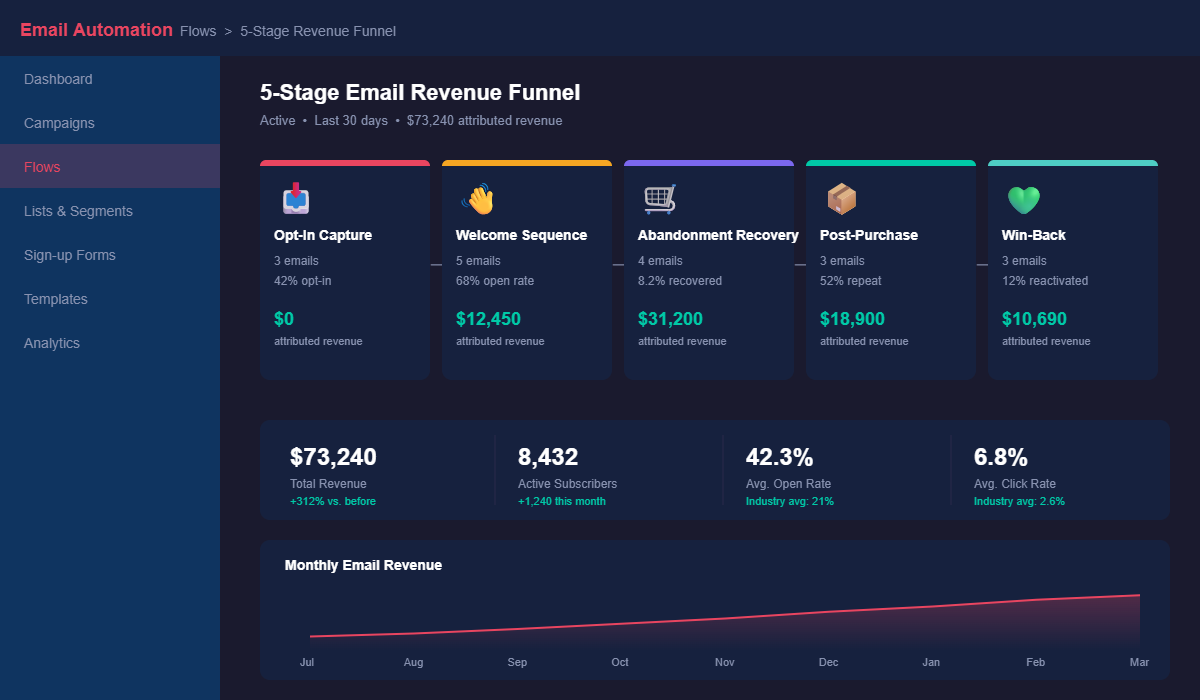
The brands winning at email have built a 5-stage funnel that nurtures every customer from first visit to repeat buyer, without manually writing a single email each day.
Here’s the exact funnel structure we build with our eCommerce Circle members. And how one Australian skincare brand used it to go from $18K to $73K months in under six months.
Stage 1: The Opt-In (Capture the Right People)
Before you can sell via email, you need subscribers. And not just any subscribers, you want people who are genuinely interested in what you sell.
The days of generic “Sign up for our newsletter” pop-ups generating quality leads are long gone. That phrase is invisible to modern shoppers. They’ve seen it ten thousand times.
What actually works in 2026:
Offer something specific and valuable in exchange for an email. The more relevant the offer is to your ideal customer, the higher quality your list will be.
- A product quiz that recommends the right item for them. “Find your perfect moisturiser in 60 seconds.” Quizzes convert at 2-3x the rate of standard pop-ups because they provide immediate value.
- A first-purchase discount (10-15% still works). But frame it as exclusive: “Get your insider welcome offer” hits different than “10% off.”
- Early access or VIP drops. “Be first to shop our winter collection, 48 hours before anyone else.” This works exceptionally well for fashion and lifestyle brands.
- A genuinely useful guide. If you sell outdoor gear, “The Complete Camping Checklist for Australian Families” is worth an email address.
Timing matters too. Trigger your pop-up after 5-8 seconds or on exit intent, not the millisecond someone arrives. Let them see your store first. Tools like Klaviyo and Omnisend integrate cleanly with Shopify and make this straightforward to set up.
Also, don’t just rely on pop-ups. Embed sign-up forms on your homepage, collection pages, and blog posts. The more touchpoints, the more captures.
Stage 2: The Welcome Sequence (Your Highest-Converting Emails)
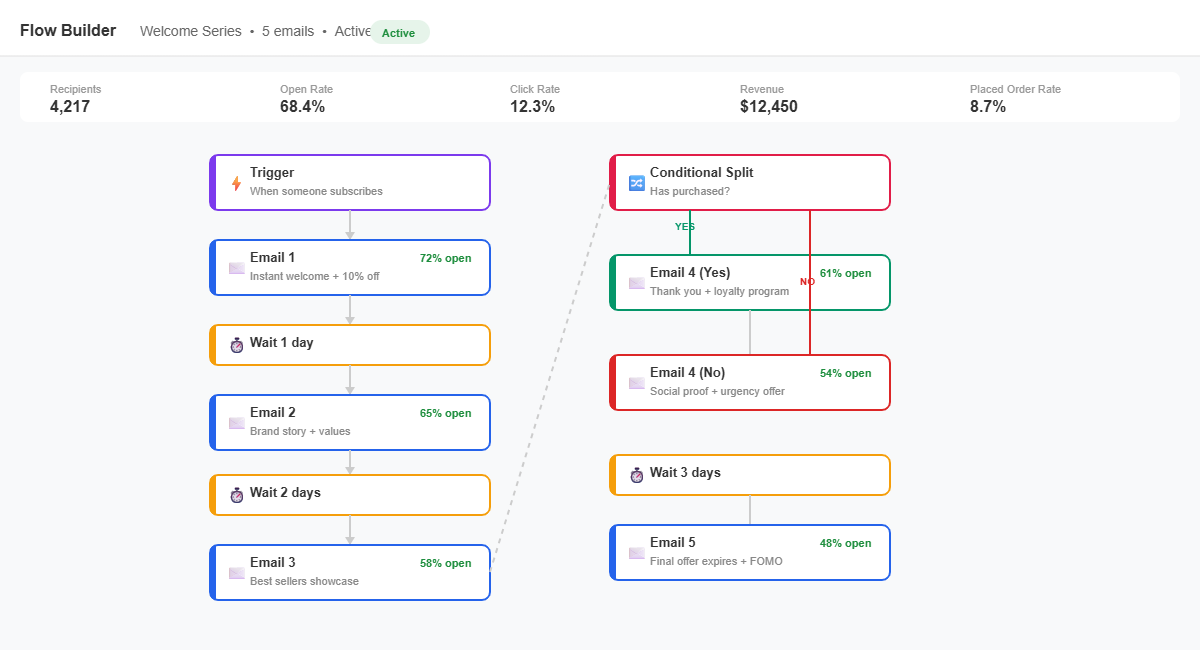
Your welcome sequence is the single most important automated flow in your entire email setup.
Why? Because new subscribers are at peak interest. They just engaged with your brand. They’re curious. They’re warm.
This is your window to build trust and drive that crucial first purchase.
Yet most Shopify stores either send one lonely “thanks for subscribing” email or, worse, nothing at all.
The ideal welcome flow (4-5 emails over 7 days):
Email 1. Immediate: Deliver the promised offer. Introduce your brand in 2-3 sentences. Set expectations for what they’ll receive. Keep it warm, personal, and short. The goal is to get them to open email #2.
Email 2. Day 2: Tell your brand story. Why does your business exist? What problem are you solving? This isn’t corporate waffle, it’s connection. Australian consumers increasingly buy from brands whose values align with their own. A family-founded skincare brand sharing their “why” will outsell a faceless company every time.
Email 3. Day 3-4: Social proof. Share your best customer reviews, before-and-after photos, or user-generated content. Let your happy customers do the selling. Include a specific product recommendation with a direct link to buy.
Email 4. Day 5-6: Address the objections you know people have. If shipping time, returns policy, or product ingredients are common concerns, tackle them head-on. “We offer free returns within 30 days, no questions asked” removes a massive barrier to first purchase.
Email 5. Day 7: The final nudge. If they haven’t purchased yet, remind them of the discount with urgency. “Your 15% welcome offer expires at midnight” is simple but effective. This email alone often accounts for 20-30% of the entire welcome flow’s revenue.
A well-built welcome sequence should convert 5-10% of new subscribers into first-time buyers. If yours is below 3%, there’s significant room to improve.
Stage 3: Cart and Browse Abandonment (Catch the Ones That Got Away)

Around 70% of online shopping carts are abandoned before checkout.
That’s not a depressing statistic. It’s a massive opportunity, and the full mechanics of it are in the abandoned cart recovery playbook.
Abandoned cart emails recover, on average, 5-10% of lost revenue. For a store doing $30K per month, that’s an extra $1,500-$3,000 recovered every month from a single automated flow you set up once.
Your abandoned cart flow (3 emails):
Email 1, 1 hour after abandonment: A gentle reminder. “You left something behind.” Include an image of the product and a direct link back to their cart. No discount. Just a nudge.
Email 2, 24 hours: Add social proof. Include a customer review about the specific product they left behind. “312 customers gave this 5 stars, here’s what they’re saying.” This builds confidence without discounting.
Email 3, 48-72 hours: Now you can offer a small incentive if needed. Free shipping or 5-10% off can push fence-sitters over the line. But use this strategically, if you offer a discount too early, you train customers to always abandon their cart and wait for the deal.
Don’t forget browse abandonment. This is the flow most brands miss entirely. If someone views a product page 2+ times without adding to cart, trigger an email showing that product with a review or two. “Still thinking about the Alpine Hiking Boot? Here’s what 200+ hikers say about it.”
Browse abandonment flows typically generate 40-60% of the revenue that cart abandonment flows do. That’s free money most stores are leaving on the table.
Stage 4: Post-Purchase (Turn Buyers Into Repeat Customers)
This is where the real money is. And it’s where almost every Shopify brand drops the ball.
Most stores go silent after the order confirmation email. The customer gets their product, and… nothing. No follow-up. No relationship building. No reason to come back.
Meanwhile, acquiring a new customer costs 5-7x more than retaining an existing one. Your post-purchase flow is the most efficient revenue driver in your entire marketing stack, and the post-purchase sequence breaks down every email in it.
Build a post-purchase flow that includes:
Thank-you email (immediate): Not just a receipt. A genuine thank-you that makes the customer feel good about their purchase. Include usage tips, expected delivery timelines for Australian shipping, and an invitation to follow your socials.
Review request (7-10 days after delivery): Ask for a product review. Make it dead simple, one click to a review form. Most customers are happy to leave one if you simply ask. These reviews then fuel your social proof across your entire store. Every review you collect makes your next sale easier.
Cross-sell email (14-21 days post-purchase): Recommend complementary products based on what they bought. “You bought our face serum, here’s the moisturiser that 80% of serum customers also love.” This is infinitely more compelling than a generic product blast.
Replenishment reminder (product-dependent): If you sell consumables, supplements, skincare, coffee, pet food, you know roughly how long each product lasts. Send a “time to restock?” email a few days before they’re likely to run out. This single email can drive recurring revenue without any discounting.
Brands that nail post-purchase typically see 25-40% of customers making a second purchase within 90 days. If your repeat purchase rate is below 15%, your post-purchase flow needs serious work.
Stage 5: Win-Back (Re-Engage Before You Lose Them)
Customers go quiet. It happens to every brand.
But before you write them off, a well-crafted win-back sequence can pull lapsed buyers back into your ecosystem. And it’s significantly cheaper than acquiring a brand-new customer. We go deeper on timing and offer design in the win-back campaign guide.
Trigger a win-back flow for customers who haven’t purchased in 60-90 days:
Email 1, “We miss you”: Remind them what makes your brand special. Show them what’s new or what’s been popular since they last purchased. Keep it warm and personal, not corporate. “Hey Sarah, it’s been a while, here’s what’s been happening at [Brand].”
Email 2. The incentive: Offer something meaningful. A percentage discount, a free gift with purchase, or exclusive early access to a new product. Make it feel exclusive: “This one’s just for you, we’re not running this offer anywhere else.”
Email 3, “Last chance”: If they still haven’t re-engaged, let them know you’ll reduce email frequency to respect their inbox. This often triggers action from people who do want to stay connected but needed a push. It also keeps your list clean, which improves deliverability across all your flows.
A good win-back flow recovers 3-5% of lapsed customers. That might sound small, but over 12 months it adds up to thousands of dollars in revenue you would have otherwise lost entirely.
The Benchmarks That Tell You Whether Your Funnel Is Actually Working
Most owners build the five flows, watch revenue tick up, and never check whether each stage is pulling its weight. That is how you end up with a welcome flow doing 1% when it should be doing 8%, quietly costing you thousands a month.
Here are the numbers to hold each stage against. These are the ranges we see across Australian Shopify stores turning over between $30K and $500K a month.
- Email as a share of total revenue: 25 to 35%. Under 15% and your flows are either missing or misfiring. Over 45% usually means your paid acquisition has stalled, not that email is winning.
- List growth rate: 3 to 5% of your monthly sessions should convert to a subscriber. A 2% opt-in rate on 40,000 sessions is 800 new subscribers a month. At 1% you are leaving 400 behind.
- Welcome flow conversion: 5 to 10% of subscribers should place a first order inside 30 days. Best-in-class Aussie brands hit 12%.
- Cart abandonment recovery: 5 to 11% of abandoned carts recovered. Average cart abandonment sits near 70%, so on 1,000 carts a month you are chasing 700 and should be closing 35 to 77 of them.
- Browse abandonment: 1 to 3% conversion. Lower than cart, but the volume is 10 times bigger, so it usually out-earns cart recovery in absolute dollars.
- Post-purchase repeat rate: 20 to 30% of first-time buyers should order again within 90 days. Under 15% and you have a product or expectation problem, not an email problem.
- Win-back reactivation: 1 to 3% of lapsed customers. Small, but these are customers you already paid to acquire, so the margin is close to pure.
- Flow revenue versus campaign revenue: roughly 60/40 in favour of flows. If campaigns are carrying 70% of your email revenue, your automation is undercooked and you are working far harder than you need to.
Pull these eight numbers once a month. Not weekly, because email data is noisy at small volumes and you will chase ghosts. Monthly is enough to spot a flow that has quietly broken after a theme update or an app change.
One caveat worth knowing. Attributed revenue in Klaviyo uses a 5-day click and 5-day open window by default, which overstates email against your Shopify numbers. Tighten it to a 3-day click, 1-day open window before you benchmark yourself, or you will think you are winning when you are not.
The Tool Stack You Actually Need (and What You Can Skip)
You do not need a marketing department. You need one email platform that talks properly to Shopify, and a couple of things around it.
The email platform. Klaviyo is the default for a reason. The Shopify integration is deep, the flow builder handles the conditional splits you need for post-purchase logic, and the segmentation engine is genuinely good. Pricing starts around $65 AUD a month at 5,000 profiles and climbs quickly, so watch it. Omnisend is the value pick if you are under 3,000 subscribers and want SMS bundled in. Shopify Email is fine for campaigns and weak for flows, so treat it as a stepping stone rather than a destination.
The pop-up. Use whatever is native to your email platform first. Klaviyo forms and Omnisend forms are both good enough that a separate tool like Privy is usually a wasted $50 a month. Spend the effort on the offer and the trigger timing instead of the software.
SMS. Only once email is running properly. Postscript and Klaviyo SMS both work well in Australia. Cart abandonment and shipping notifications are where SMS earns its keep. Everything else annoys people at 9pm.
The measurement layer. GA4 for session and channel truth, and your Shopify reports for order truth. If you are spending over $20K a month on ads, a tool like Triple Whale is worth the subscription because it reconciles email revenue against paid without you exporting spreadsheets every Monday.
What you can skip: dedicated deliverability monitors, AI subject line generators, and any app promising to “clean” your list before you have 10,000 subscribers. None of them move the needle at your stage. Sending relevant emails to people who asked for them does.
One thing that is not optional: authenticate your sending domain with SPF, DKIM and DMARC. Gmail and Yahoo both enforce DMARC for bulk senders now, and an unauthenticated domain will land you in spam no matter how good the copy is. Your email platform will walk you through it in about 20 minutes.
The 30-Day Build Order: Ship It in This Sequence
The most common way this goes wrong is trying to build all five stages at once, getting three-quarters through each, and shipping nothing. Build them in revenue order instead.
Week 1: Cart abandonment. Highest intent, fastest payback, three emails. If you launch nothing else this month, launch this. On a store doing 1,000 carts a month with a $95 average order value, recovering an extra 4% is roughly $2,660 a month you were not collecting.
Week 2: The welcome sequence. Five emails, written once, working forever. Pair it with a pop-up that actually offers something worth an email address. Free shipping over a threshold converts better in Australia than a 10% discount, and it protects your margin at the same time.
Week 3: Post-purchase. Four emails across 30 days. Shipping confidence, product usage, review request, then the cross-sell. This is where repeat rate is made, and repeat rate is what makes your paid acquisition affordable.
Week 4: Browse abandonment and win-back. Both are lower conversion and higher volume, so they belong last. Set win-back to trigger at 1.5 times your average repurchase interval, not an arbitrary 90 days. If your customers reorder every 45 days, chase them at day 68, not day 90.
Then stop building and start segmenting. The single biggest lift after the flows are live comes from sending the same emails to fewer, better-chosen people. Suppress your 90-day non-openers, split your VIPs out of the general promotional list using the seven Klaviyo segments that matter, and watch both your open rate and your deliverability improve inside two sends.
The Compound Effect
Here’s what happens when you have all five stages running together.
Your opt-in captures interested visitors. Your welcome flow converts them into first-time buyers. Your cart recovery catches the ones who hesitated. Your post-purchase flow turns one-time buyers into repeat customers. And your win-back flow keeps lapsed customers in the loop.
Each stage works independently. But together, they create a revenue engine that compounds over time.
The skincare brand I mentioned at the top? Their breakdown after six months looked like this: welcome flow driving 15% of email revenue, cart abandonment recovering 22%, post-purchase cross-sells contributing 18%, and the rest from campaigns and win-backs.
Total email revenue: 34% of their monthly sales. All automated. All running while they slept.
The brands that nail email marketing aren’t sending more emails. They’re sending the right emails, to the right people, at the right time.
With platforms like Klaviyo making this increasingly accessible for Shopify brands of all sizes, there’s no reason not to have this funnel running in your store today.
Inside the eCommerce Circle, email marketing strategy is one of the core pillars we work on with every member. Our coaching team will build this entire funnel with you, from opt-in to win-back, tailored to your brand, your products, and your customers.
Ready to turn email into your highest-ROI channel? let’s talk.