You spent good money acquiring that customer. Meta Ads, Google Shopping, maybe an influencer deal, whatever it cost, they bought once. Then they disappeared.
What’s in This Article
You’re not alone. The average ecommerce store loses roughly 75% of first-time buyers, they never come back for a second order. That’s three out of every four customers gone. And most Shopify brands do absolutely nothing about it. They keep pouring budget into cold traffic while a database full of warm, proven buyers quietly gathers dust.
The brands that grow profitably? They treat lapsed customers like a goldmine, because that’s exactly what they are. A well-built win-back campaign can reactivate 10-15% of dormant buyers, and those reactivated customers spend 67% more per order than first-timers. The maths is simple: winning back an old customer costs 6-7x less than acquiring a new one.
This guide walks you through the complete win-back system, from defining who’s actually “lapsed” in your store, to building the multi-channel sequences that pull them back, to measuring what’s working. No fluffy theory. Just the framework that coaching clients inside the eCommerce Circle use to recover thousands in lost revenue every month.
What Makes a Customer “Lapsed” (And Why the Definition Matters)
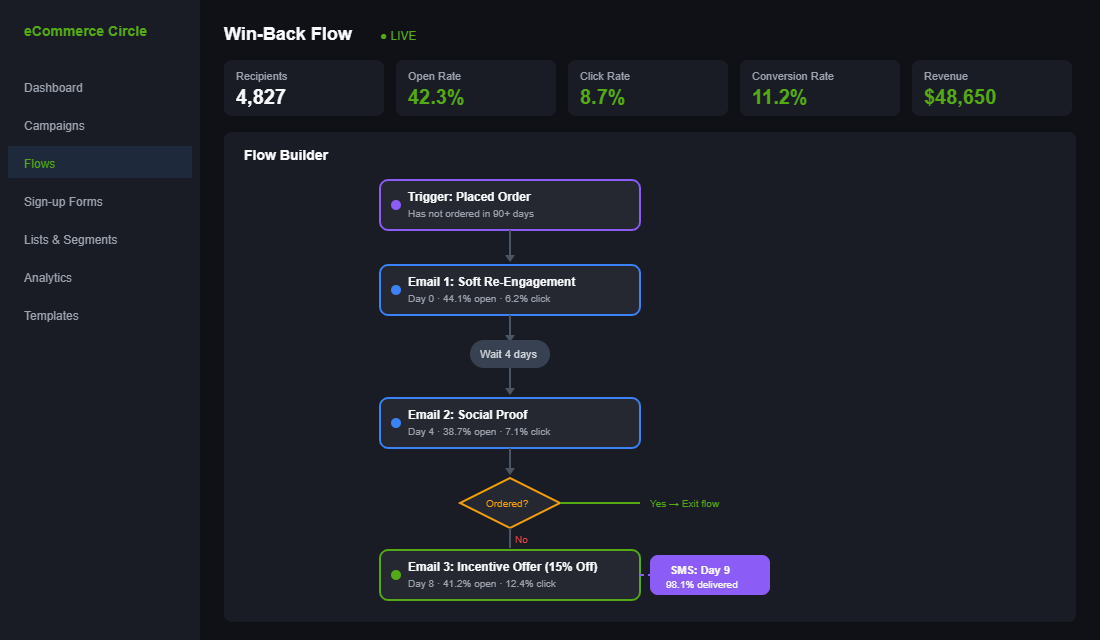
Before you send a single win-back email, you need a clear definition of what “lapsed” means for your store. Get this wrong and you’ll either annoy active customers with desperate-sounding messages, or wait so long that dormant buyers have completely forgotten you exist.
The standard approach is to use 1.5x your average repurchase cycle as the trigger point. If your typical customer reorders every 60 days, a buyer who hasn’t purchased in 90 days is lapsed. If you sell seasonal products where the natural buying cycle is 6 months, your window is 9 months.
Here’s how to find your number in Shopify:
- Check your average time between orders. Go to Analytics > Reports > Returning customer rate. Cross-reference with Klaviyo or Omnisend’s cohort data if you have it. For most Shopify stores selling consumables or fashion, the sweet spot is 60-90 days. For home goods or higher-ticket items, it’s 120-180 days.
- Segment by product category. A customer who bought skincare (replenishable) has a very different natural cycle than one who bought a piece of furniture. You may need multiple lapsed definitions for different product lines.
- Factor in engagement, not just purchases. A customer who hasn’t bought in 90 days but still opens your emails every week is different from one who’s gone completely silent. Your win-back sequences should treat these groups differently.
Most Shopify brands set a blanket “hasn’t purchased in 6 months” rule and call it a day. That’s leaving money on the table. The earlier you catch a lapsing customer, while they still remember your brand, the higher your reactivation rate.
The Win-Back Email Sequence: 4 Emails That Pull Customers Back
Win-back emails aren’t just “hey, we miss you” messages with a discount code slapped on. The brands getting 10%+ conversion rates from their win-back flows are running structured sequences where each email serves a specific purpose in the re-engagement arc.
Automated win-back emails achieve 42.51% open rates, well above the 15-25% range most promotional campaigns see. That tells you something important: lapsed customers are receptive. They recognise your brand name. They just need the right nudge at the right time.
Here’s the four-email framework that consistently performs across Shopify stores:
Email 1: The Soft Re-Engagement (Day 0 of the flow)
This is not a sales email. It’s a “checking in” message that reminds the customer why they bought from you in the first place. Lead with what’s new, new products, new packaging, a brand milestone, a piece of customer feedback you’re proud of. The goal is to re-establish the relationship without asking for anything.
Subject line examples: “A lot has changed since your last order” or “Quick update from [Brand Name]” or “You might not recognise us anymore”
Keep it short, 100-150 words max. One clear CTA to browse new arrivals or your best sellers. No discount. Not yet.
Email 2: The Social Proof Email (Day 4)
Now you’re building credibility. Share what other customers are saying, real reviews, UGC photos, star ratings for your top products. If you’ve been featured in media or hit a milestone (“Over 50,000 orders shipped across Australia”), include that.
This email answers the subconscious question every lapsed customer has: “Is this brand still worth buying from?” Show them the answer through other people’s words, not yours.
Subject line examples: “See what 4,200+ customers are saying” or “Our most-reviewed product right now” or “Why customers keep coming back”
Email 3: The Incentive (Day 8)
Now you bring the offer. But be strategic about it. A flat 10-15% discount works for most brands, but consider these alternatives that protect your margins:
- Free shipping. For Australian stores where shipping costs are a real barrier, this can outperform a percentage discount. Standard shipping from Sydney to Perth can run $12-15, so free shipping feels like a meaningful saving.
- Gift with purchase. Include a sample, a bonus product, or exclusive packaging. This feels more premium than a discount and doesn’t devalue your brand.
- Tiered offer. “Spend $80, get $15 off. Spend $120, get $30 off.” This increases your average order value while still giving the customer a reason to return.
- Early access. Let lapsed customers shop a new collection or restock before the general public. Exclusivity can be more motivating than discounts for the right audience.
Subject line examples: “Something just for you (expires Friday)” or “We saved you a spot” or “A thank-you for being a customer”
Email 4: The Last Chance (Day 12)
This is the urgency email. The offer from Email 3 is expiring. Be direct: “Your [discount/free shipping/gift] expires in 48 hours.” This email typically drives the highest single-email conversion rate in the sequence because of the deadline.
If the customer still doesn’t engage after Email 4, suppress them from your main marketing list for 60-90 days. Continuing to email unengaged contacts hurts your sender reputation and deliverability, which affects every email you send to everyone.
Subject line examples: “Last call, your offer expires tomorrow” or “Closing the loop” or “Before we go quiet”
Adding SMS to Your Win-Back Flow (The 54% Conversion Lift)
If you’re only using email for win-backs, you’re leaving a massive performance gap on the table. Multi-channel win-back campaigns, combining email and SMS in the same workflow, lift conversion by 54% compared to email alone.
The reason is simple: some customers have email fatigue. Their inbox is flooded with 50+ promotional emails a day. But their text messages? That’s still a relatively uncrowded channel. SMS open rates sit around 98%, and most texts are read within 3 minutes of delivery.
Here’s how to layer SMS into your existing win-back flow without being annoying:
- Send SMS only to customers who have opted in. This is non-negotiable in Australia under the Spam Act 2003. Make sure your SMS consent is separate from email consent and clearly documented.
- Use SMS for the incentive and urgency messages only. Don’t duplicate every email as a text. Send Email 1 and 2 as email-only, then use SMS for Email 3 (the offer) and Email 4 (the deadline). This keeps your text frequency low while hitting them on the highest-converting messages.
- Keep texts under 160 characters. No paragraphs. Something like: “Hey [Name], we set aside 15% off for you. Grab it before Friday: [link], [Brand Name]. Reply STOP to opt out.”
- Time SMS strategically. Send texts between 10am and 7pm in the customer’s local timezone. A win-back text at 11pm is a great way to get unsubscribed.
Both Klaviyo and Omnisend support combined email/SMS flows natively, so you can build this as one unified automation rather than managing two separate systems.
Segment Your Lapsed Customers for Better Results
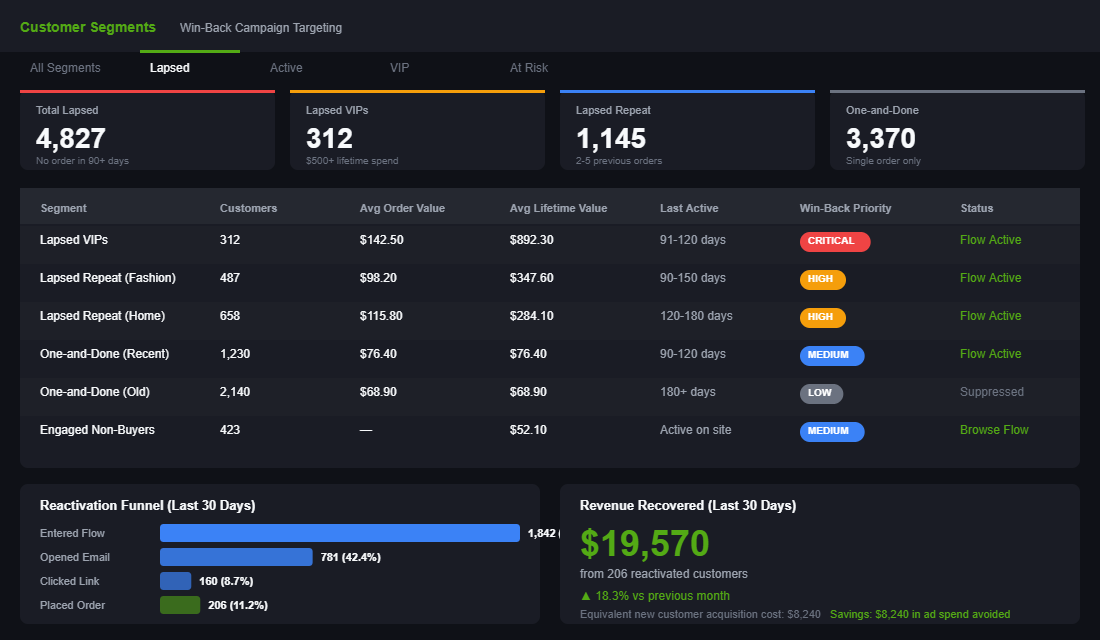
Treating all lapsed customers the same is one of the biggest mistakes brands make with win-backs. A customer who placed 12 orders over two years and then went quiet is fundamentally different from someone who bought once six months ago and never came back.
Here are the segments you should build in Klaviyo, Omnisend, or directly in Shopify’s customer segments:
- Lapsed VIPs (high spend, multiple orders). These are your most valuable reactivation targets. They already trust your brand and have a proven purchase history. Win-back approach: personal, high-touch. Consider a handwritten-style email from the founder, exclusive early access, or a genuinely generous offer. A 15-20% discount to a customer with a $800+ lifetime value is a no-brainer investment.
- Lapsed repeat buyers (2-5 orders, then gone). They liked you enough to come back but something changed. Win-back approach: lead with what’s new. Show them products similar to what they previously bought, or new collections in their preferred category. A moderate incentive (10-15% or free shipping) is usually enough.
- One-and-done buyers (single purchase, never returned). This is your largest segment, and your hardest to win back. They may not even remember your brand. Win-back approach: lead heavy with social proof and best-sellers. Give them a reason to believe your store is worth a second look. A product recommendation based on their original purchase category helps personalise without feeling creepy.
- Engaged-but-not-buying (opens emails, visits site, no purchase). These customers are still interested, something else is blocking the purchase. Win-back approach: this is less about re-engagement and more about removing friction. Are prices a concern? Offer a bundle deal. Is shipping a barrier? Lead with free shipping. Use their browsing data to understand what they’re looking at but not buying.
In Shopify, you can create these segments directly under Customers > Segments using filters like “Number of orders,” “Amount spent,” “Last order date,” and email engagement metrics (if connected to Klaviyo). These segments update dynamically, so your win-back automations always target the right people.
Setting Up Win-Back Flows in Klaviyo: Step-by-Step
Klaviyo is the go-to email platform for most Shopify stores, and its win-back flow builder is one of the most straightforward automations to set up. Here’s exactly how to build it:
Step 1: Create the flow trigger. In Klaviyo, go to Flows > Create Flow > Start from Scratch. Set the trigger to “Metric” and choose “Placed Order.” Then add a flow filter: “Has Placed Order zero times in the last 90 days” (adjust this number to your lapsed window from earlier). This means the flow only triggers for customers who have bought before but haven’t bought recently.
Step 2: Add a trigger filter for recency. You don’t want this flow firing for someone who placed their first order 91 days ago and might still be in your welcome or post-purchase sequence. Add a condition: “Has Placed Order at least once over all time” and “Has not been in this flow in the last 180 days” to prevent overlap and repeat messaging.
Step 3: Build the email sequence. Add your four emails with time delays between them (Day 0, Day 4, Day 8, Day 12). For each email, add a conditional split: “Has Placed Order since starting this flow = Yes.” If they convert at any point, pull them out of the flow automatically. No one wants a “we miss you” email after they’ve already reordered.
Step 4: Add SMS touchpoints. If you have SMS enabled in Klaviyo, add text messages after Email 3 and Email 4 with short delays (e.g., 1 day after the email). Use the conditional split to only send texts to contacts with SMS consent. Keep the message tight and include a direct link to a curated collection or the offer landing page.
Step 5: Set the exit condition. Add a flow filter that removes anyone who places an order or who has been suppressed. Also add a sunset condition: if the customer completes the full sequence without engaging (no opens, no clicks), move them to a suppressed segment. This protects your deliverability.
The whole setup takes about 45-60 minutes. Once it’s live, it runs automatically, every customer who crosses the lapsed threshold gets pulled into the flow without you touching a thing.
Beyond Email: Retargeting Lapsed Customers With Paid Ads
Email and SMS are your highest-ROI channels for win-backs, but they only reach customers who are opening messages. For the ones who have gone completely dark on email, paid retargeting picks up the slack.
Here’s the playbook:
- Sync your lapsed segment to Meta Ads. Klaviyo and Omnisend both let you push customer segments directly into Meta Custom Audiences. Create an audience of lapsed customers and run specific ad creative targeting them, not your standard prospecting ads. Messaging like “Still thinking about us?” or “New arrivals since your last visit” speaks directly to their situation.
- Use Google Customer Match. Upload your lapsed customer email list to Google Ads and target them across Search, YouTube, and Display. These customers already know your brand, so your cost per click will be lower and your conversion rate higher than cold traffic.
- Set a budget cap. Win-back retargeting shouldn’t eat into your prospecting budget. Allocate 5-10% of your total ad spend to lapsed customer campaigns. The audience size is smaller but the efficiency is dramatically higher, you’re targeting people who have already given you their credit card once.
- Coordinate with your email sequence. If a customer enters your email win-back flow, start showing them retargeting ads simultaneously. The combination of seeing your brand in their inbox AND their social feed creates a surround-sound effect that significantly increases the odds of reactivation.
One Australian fashion brand we’ve worked with inside the eCommerce Circle saw a 23% lift in win-back conversion when they added Meta retargeting on top of their email flow. The ads weren’t doing the heavy lifting alone, they were reinforcing the email message at every scroll.
Measuring Your Win-Back Performance: The Metrics That Matter
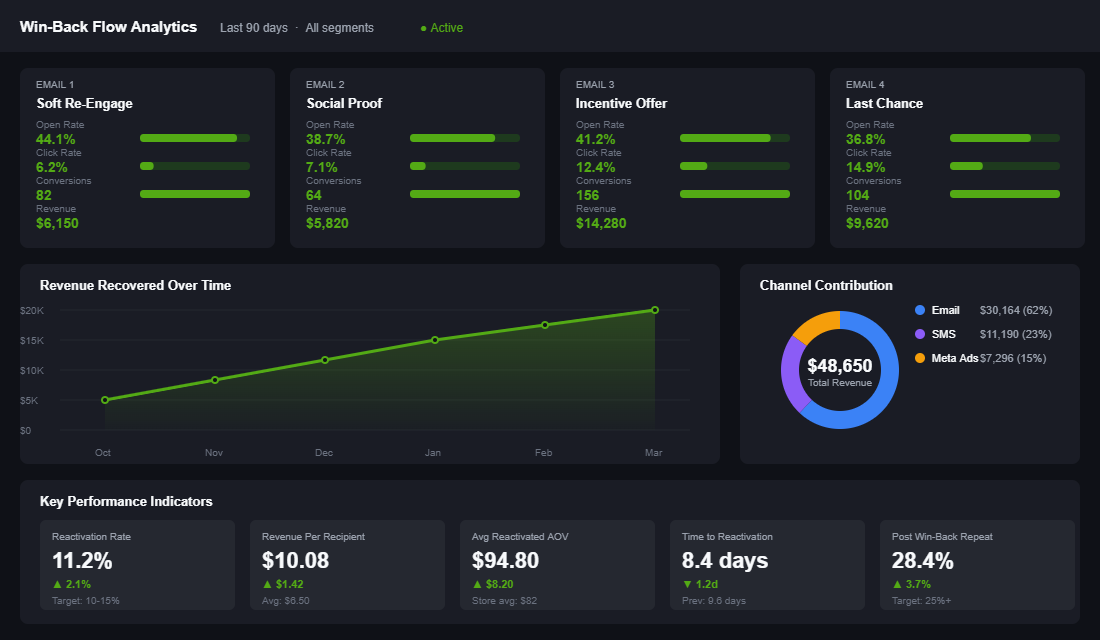
You can’t improve what you don’t measure. Here are the specific KPIs to track for your win-back campaigns:
- Reactivation rate. The percentage of lapsed customers who place a new order after entering your win-back flow. A 10-15% reactivation rate is considered excellent for ecommerce. Below 5% means your messaging, timing, or offer needs work.
- Revenue per recipient. Total revenue generated by the win-back flow divided by the number of people who entered it. This is more useful than conversion rate alone because it accounts for order value. Track this monthly to spot trends.
- Email engagement by position. Which email in your sequence drives the most conversions? For most stores, Email 3 (the incentive) is the top performer, but if Email 1 is converting well, that tells you your customers don’t need a discount, they just need a reminder.
- Time to reactivation. How many days after entering the flow does the average customer convert? If most conversions happen on Email 4 (the deadline), your earlier emails might need stronger hooks. If they convert on Email 1, your lapsed window might be set too conservatively.
- Repeat purchase rate post-reactivation. This is the metric most brands ignore. Of the customers you win back, how many buy again within 90 days? If your reactivated customers are still churning after the win-back purchase, you have a bigger retention problem that discounts alone won’t fix.
Set up a dedicated dashboard in Klaviyo or your analytics tool that tracks these five metrics weekly. The win-back flow is not a “set and forget” automation, it’s a living system that should be optimised quarterly based on performance data.
The Win-Back Checklist: Your 30-Minute Implementation Plan
Here’s the exact checklist to get your win-back system live. You can do the first version in a single afternoon:
- Define your lapsed window. Pull your average time between repeat orders. Multiply by 1.5. That’s your trigger point.
- Build your lapsed customer segments. Create at least three segments in Klaviyo or Shopify: Lapsed VIPs, Lapsed Repeat Buyers, and One-and-Done buyers.
- Draft your 4-email sequence. Email 1: soft re-engagement. Email 2: social proof. Email 3: incentive offer. Email 4: last chance deadline. Write the copy, design the templates, set the time delays.
- Add SMS touchpoints. If you have SMS consent, add text messages after Email 3 and Email 4. Keep them under 160 characters with a clear link.
- Set exit conditions. Auto-remove anyone who purchases. Suppress anyone who completes the full flow without engaging.
- Sync your lapsed segment to Meta Ads. Push the audience to Meta Custom Audiences and set up a retargeting campaign with win-back-specific creative.
- Activate and monitor. Turn the flow live. Check performance after 14 days to confirm emails are sending, open rates are healthy (target 40%+), and the first conversions are coming through.
- Optimise quarterly. Review your five KPIs. A/B test subject lines, offers, and timing. Adjust your lapsed window based on actual data.
Print this checklist. Pin it next to your screen. A complete win-back system is one of the highest-ROI automations you can build in your Shopify store, and it keeps working while you sleep.
How It All Compounds: The Revenue You’re Currently Losing
Let’s do some quick maths. Say your Shopify store has 5,000 customers who haven’t ordered in over 90 days. Your average order value is $95 AUD.
If your win-back flow reactivates just 10% of those lapsed customers, that’s 500 orders. At $95 average order value, that’s $47,500 in recovered revenue, from customers you’d already paid to acquire. Factor in that reactivated customers are more likely to buy again (their second reactivation rate is typically higher than their first), and you’re looking at compounding returns over the next 6-12 months.
Now compare that to the cost of acquiring 500 new customers through Meta Ads. At an average customer acquisition cost of $35-50 AUD for Australian ecommerce, that’s $17,500-$25,000 in ad spend, for customers who haven’t been proven to buy from you yet.
The win-back flow costs essentially nothing to run once it’s built. A few hours to set up, a couple of dollars in SMS credits, and whatever you offer as an incentive. The post-purchase sequence keeps first-time buyers coming back. The win-back sequence catches the ones who slip through. Together, they form the backbone of a retention system that compounds month after month.
And here’s what most brands miss: win-back campaigns don’t just recover revenue, they clean your list. By identifying who re-engages and who doesn’t, you build a healthier, more engaged email list that performs better across every campaign you send. Your email marketing funnel gets sharper because you’re no longer dragging dead weight through every send.
Stop Ignoring Your Best Growth Channel
Every Shopify store has a list of lapsed customers sitting right there in the admin. Most brands look at that list and see dead data. The ones growing profitably see it for what it is, a pre-qualified audience that already trusts them enough to have handed over their credit card once.
Your win-back system doesn’t need to be complicated. Four emails, a couple of text messages, and a retargeting campaign. Build it once, optimise it quarterly, and let it run. The revenue it recovers is revenue you’ve already earned the right to, you just need to go collect it.
The Win-Back Maths: What a 12% Reactivation Rate Is Worth to Your Store
Before you build any of this, put a dollar figure on it. The number is usually large enough to move win-back to the top of the list.
Imagine you run an Aussie skincare brand with 18,000 customers who have bought at least once. Your typical repeat window is 60 days, so anyone silent for 120 days is lapsed. On most Shopify stores that is 55 to 70% of the customer file, so call it 11,000 lapsed customers. A four-email flow with SMS layered in reactivates 10 to 15% of them over 90 days. At 12% that is 1,320 recovered customers. With an $85 AOV and a 40% contribution margin, that is $112,000 in revenue and roughly $45,000 in contribution, from an audience that cost nothing new to acquire.
Compare that to paid acquisition. At a $45 blended CAC, buying 1,320 new customers costs $59,400 and most of them will only buy once. The win-back flow costs your Klaviyo send volume plus a discount on the incentive email that only 30 to 40% of reactivations even redeem. Put both numbers side by side in your next planning session and the priority sorts itself out.
Track it monthly with three figures: lapsed pool size, reactivation rate, and recovered contribution. If the pool keeps growing faster than the flow reactivates, your problem is upstream in the post-purchase experience, not the win-back copy.
Predict the Lapse Before It Happens: The 3 Early-Warning Signals
The cheapest customer to win back is the one who never fully leaves. Most stores wait until day 120 to act. The better play is to watch for the signals at day 45 to 60 and intervene while the relationship is still warm.
Signal 1: the missed reorder window. If a customer’s own purchase gap was 35 days and they are now at day 50, they are 40% past their pattern. Klaviyo’s predicted next order date handles this automatically once you have enough history. Trigger a soft “running low?” email at 120% of their personal interval, well before the generic lapsed flow fires.
Signal 2: engagement drop. A customer who opened 6 of your last 8 campaigns and has now opened none of the last 5 is drifting. Build a segment for “purchased in last 90 days AND zero opens in 30 days” and send a one-question survey instead of a promotion. Response rates on a single-click survey run 8 to 15%, and the answers tell you why they are drifting.
Signal 3: a support ticket or return with no follow-up. Customers who return an item and hear nothing afterwards lapse at nearly twice the rate of those who get a “did the replacement work out?” message. Wire your helpdesk (Gorgias or Re:amaze) to tag the Klaviyo profile so the follow-up fires automatically.
If you want to formalise this, the 5-signal churn health score turns these into one number per customer you can act on weekly.
Protect Your Margin: Incentive Rules That Stop Win-Back Training Discount Hunters
The biggest risk in a win-back flow is not that it fails. It is that it works too well at teaching customers to wait for the discount. Four rules keep it honest.
First, never lead with the offer. Emails 1 and 2 earn 30 to 40% of total flow revenue with no discount at all. If you front-load the incentive you give margin to people who would have come back anyway. Second, tier the incentive by customer value. Use your RFM scores: a lapsed customer with three past orders gets free shipping or a gift with purchase, a one-time buyer gets a percentage off. The high-value group is more likely to respond to recognition than to a coupon.
Third, cap redemptions and expire them hard. Single-use Shopify discount codes generated per profile, 7-day expiry, no stacking. Fourth, watch the repeat-redemption rate. If more than 20% of customers reactivated by an incentive go quiet again and reappear only when the next incentive lands, you have built a discount cycle. Move those profiles to a no-offer track and let the content emails do the work.
Measured this way, a healthy win-back flow should recover contribution at 3 to 5 times the discount cost. If yours is under 2x, the offer is too generous or firing too early.
Inside the eCommerce Circle, customer retention, including win-back flows, post-purchase sequences, and loyalty systems, is one of the core pillars we work on with every member under the Patrons framework. If your store is leaking customers and you want a proven system to bring them back, let’s talk.