You spent $32 to acquire that customer. They bought once. And then… silence. No second order. No engagement. Just another name sitting in your Klaviyo list, slowly going cold.
What’s in This Article
Here’s the brutal reality: the average Shopify store has a repeat purchase rate of just 22%. That means 78% of your customers buy once and never come back. You’re essentially renting customers instead of building a business on them.
The brands that scale profitably — the ones doing $50K, $100K, $200K/month — have figured out something crucial: retention is cheaper and more profitable than acquisition. It costs 5-7x more to win a new customer than to get an existing one to buy again. And the secret weapon? A properly built post-purchase email and SMS sequence that nurtures every buyer toward their second, third, and fourth order — on autopilot.
Why the Second Purchase Is the Most Important Sale You’ll Ever Make
First-time buyers are fragile. They don’t know you yet. They’re not loyal. They might have bought on impulse or during a sale. But a customer who makes a second purchase is 3x more likely to make a third. And a customer who makes three purchases? They’re 5x more likely to become a long-term repeat buyer.
The gap between first purchase and second purchase is where most brands lose their customers. Not because the product was bad, but because they did nothing to nurture the relationship after the transaction. The order confirmation email goes out, maybe a shipping notification, and then… radio silence until the next promotional blast.
That silence is costing you a fortune. Let’s fix it.
The 7-Email Post-Purchase Flow That Drives Repeat Sales
This is the exact flow structure we build with brands inside eCommerce Circle. It runs through Klaviyo (our recommended platform for Shopify stores), though the principles work in Omnisend, Drip, or any decent email platform.
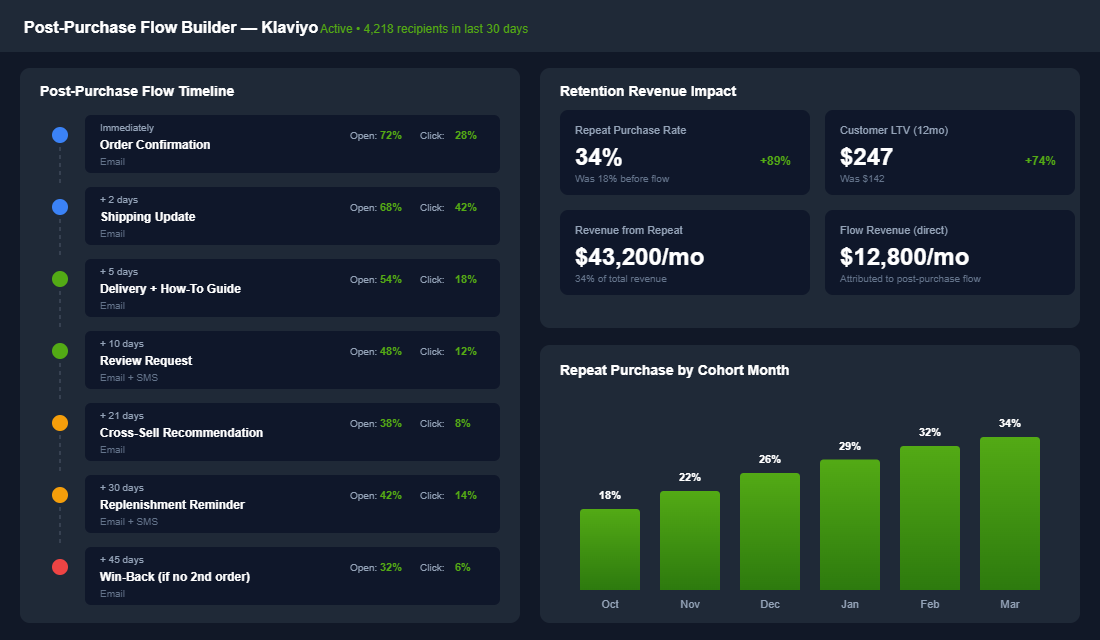
Email 1: Order Confirmation (Immediately) — Most brands waste this email with a generic receipt. It’s actually your highest-opened email (70%+ open rates). Use it to reinforce their purchase decision, set delivery expectations, and start building the relationship. Include a personal thank-you from the founder and a “what to expect next” section.
Email 2: Shipping Update (Day 2) — Another high-engagement touchpoint. Beyond tracking info, include a quick product tip or care instruction. “While you wait — here’s how to get the best results from your [product].”
Email 3: Delivery + How-To Guide (Day 5) — Timed for when the product arrives. Send a genuine “how to use this” guide with tips, photos, or even a short video. This isn’t a sell — it’s helping them get maximum value from what they’ve already bought. Happy customers buy again.
Email 4: Review Request (Day 10) — They’ve had time to use the product. Ask for a review. Use Judge.me or Loox to make it one-click easy. Offer a small incentive — a 10% code on next purchase — which serves double duty: getting the review AND seeding the second purchase.
Email 5: Cross-Sell (Day 21) — Now you can sell. Recommend products that complement their first purchase. “People who bought [X] also love [Y].” Be specific and relevant — generic “you might also like” emails get ignored.
Email 6: Replenishment Reminder (Day 30) — If you sell consumable products, this is pure gold. Time it based on your product’s typical usage cycle. “Running low on your [product]? Reorder before you run out.” Add an SMS touchpoint here for urgency.
Email 7: Win-Back (Day 45) — If they haven’t purchased again, this is your last automated push. Acknowledge the gap: “We haven’t seen you in a while.” Offer a meaningful incentive — free shipping, a gift with purchase, or a percentage off. Make it feel personal, not desperate.
Building a Loyalty Program That Actually Works
Post-purchase emails get the second sale. A loyalty program gets the third, fourth, and fifth. But most loyalty programs fail because they’re too complicated, the rewards aren’t motivating, or customers don’t even know they exist.
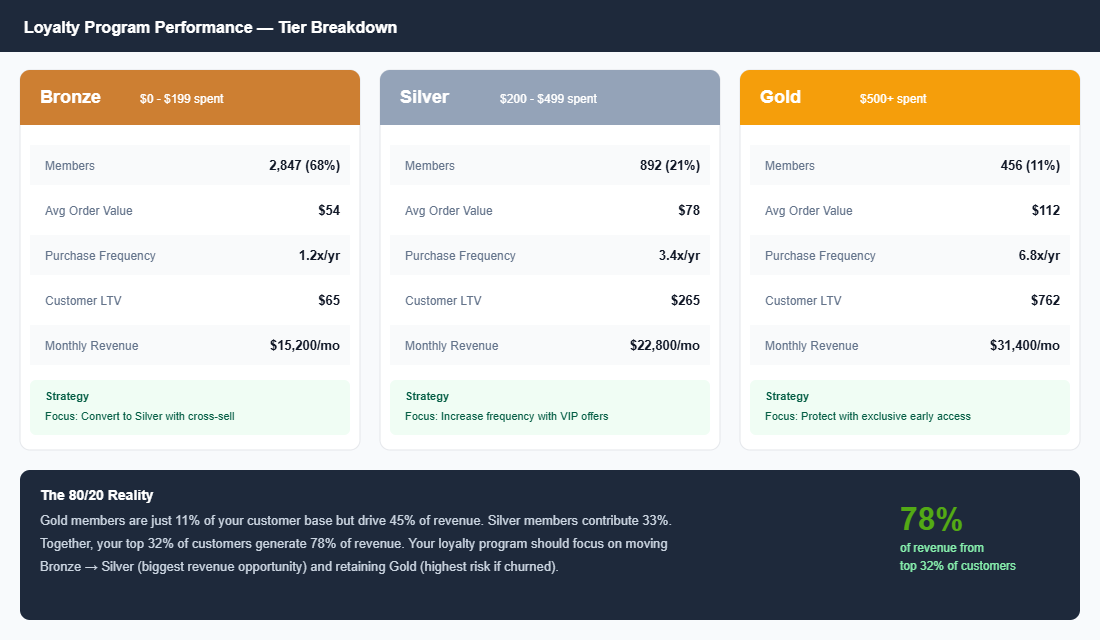
The best Shopify loyalty programs follow three rules: simple to understand (earn points, redeem for dollars off — don’t overcomplicate it), visible everywhere (points balance on account page, in emails, at checkout), and tiered (Bronze/Silver/Gold creates aspiration and rewards your best customers disproportionately).
Apps like Smile.io, LoyaltyLion, or Yotpo Loyalty integrate directly with Shopify and Klaviyo. The setup takes a day. The revenue impact compounds over months and years.
The Referral Loop: Turning Customers Into Acquisition Channels
Your happiest customers are your cheapest acquisition channel. A referred customer has a 37% higher retention rate and a 25% higher lifetime value than one acquired through ads. Yet most brands don’t have a referral program at all.
The structure that works: “Give $15, Get $15” — your customer shares a unique link, their friend gets $15 off their first order, and your customer gets $15 credit when the friend buys. It’s simple, generous enough to motivate sharing, and the economics work because you’re paying $15 for a customer acquisition instead of $30+ on Meta ads.
Understanding Your Customer Lifecycle
To build a real retention strategy, you need to see your customers as being in specific lifecycle stages — and tailor your approach to each stage.
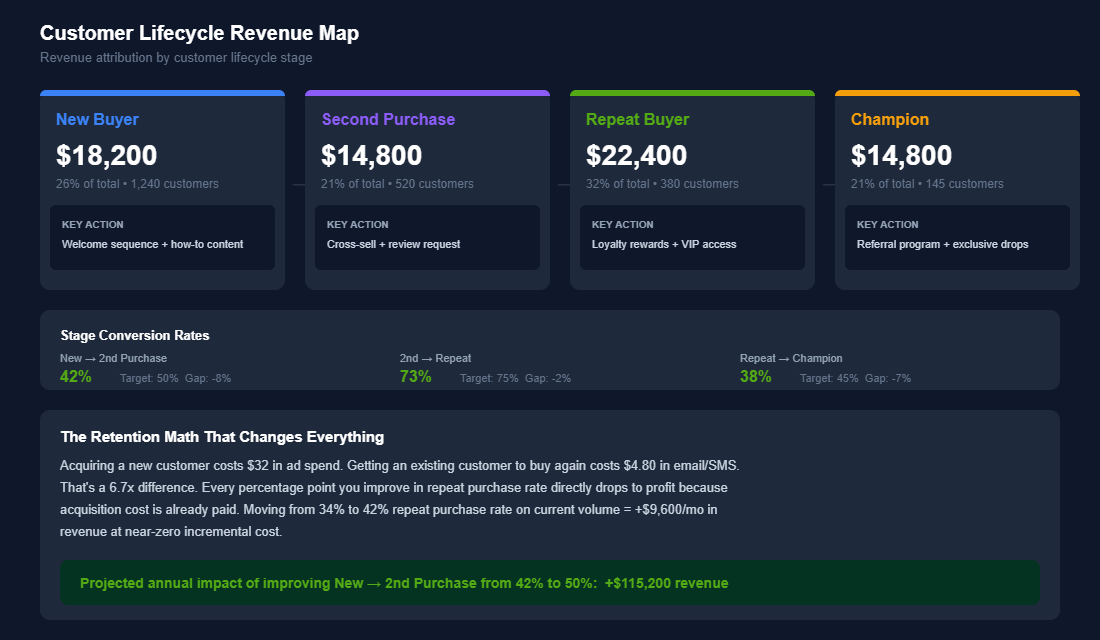
The biggest lever for most brands? Improving the New Buyer → Second Purchase conversion rate. If you can move that from 42% to 50%, the revenue impact cascades through every subsequent stage. On a store doing $70K/month, that single improvement is worth an extra $9,600/month — or $115,200 annually.
The Compound Effect: Retention as a Growth Engine
Here’s where it all comes together. Your post-purchase flow drives the second sale. Your loyalty program drives the third and fourth. Your referral program brings in new customers at a fraction of ad cost. And each new customer enters the same post-purchase flow, creating a self-reinforcing growth engine.
The maths: a brand doing $70K/month with a 22% repeat rate moves to 34% repeat rate. That’s an extra $18,000-$25,000 per month in revenue — with almost no additional ad spend. The customer acquisition cost is already paid. Every repeat purchase drops almost entirely to profit.
The Retention Numbers That Tell You Whether Any of This Is Working
A post-purchase sequence that nobody measures is just email you send to feel productive. Four numbers tell you whether the flow is earning its place.
Repeat purchase rate. This is the share of customers who buy a second time. Most Australian Shopify stores sit between 20% and 30%. A store with a working post-purchase flow should be pushing 35% or better within two quarters. Anything under 20% means you are running an acquisition business, not a brand.
Time to second purchase. Track the median gap between first and second order. If your consumables brand has a 90-day median and your product lasts 30 days, you have a reminder problem, not a product problem. Shortening that median by even two weeks compounds hard across a year.
Flow-attributed revenue. In Klaviyo, your post-purchase flow should be generating 5% to 10% of total email revenue on its own. Your whole email program should be doing 25% to 35% of store revenue. If email is under 15%, the flows are the fastest fix available to you.
Cohort retention curve. Group customers by the month they first bought and watch what percentage buy again at 30, 60, 90 and 180 days. A healthy curve flattens rather than falling to zero. Klaviyo covers the flow-level numbers, Lifetimely or Triple Whale give you the cohort view, and GA4 handles the on-site behaviour. Pick one source of truth and stop arguing with yourself about which dashboard is right.
Review these monthly, not daily. Retention moves in quarters, and reacting to a bad week is how good flows get switched off before they mature.
Where Post-Purchase Flows Break, and How to Fix Each One
The emails never arrive
You can write the best sequence in the world and still lose to the spam folder. Order-adjacent emails usually enjoy strong inbox placement, but the moment you add a promotional email to the flow, the whole sequence gets re-graded. Authenticate your sending domain properly and keep an eye on placement — the Shopify email deliverability playbook walks through the DNS setup most Aussie stores get half-right.
The timing ignores the product
A generic 1-3-7-14-30 day cadence works for nobody in particular. Anchor timing to delivery date, not order date, and to the real consumption cycle of the product. A skincare brand with a 60-day jar should be prompting reorder at day 45. A furniture brand should not be asking for a review three days after purchase when the item is still on a truck.
Every customer gets the same sequence
A first-time $40 buyer and a returning $400 buyer should not receive identical emails. At minimum, split the flow on order value and purchase count. Segmenting properly is where most of the upside hides — the customer segmentation playbook covers how to build those splits without turning your account into spaghetti.
There is no SMS layer
Email open rates sit around 25% to 40% for post-purchase. SMS clears 90%+ open rates within three minutes. You do not need to duplicate the sequence — just add SMS for the two moments that matter most: shipping confirmation and the reorder nudge. Keep it compliant, keep it short, and always give a genuine opt-out.
The flow stops after 30 days
Most sequences end just before the customer actually lapses. Extend the thinking past the flow with a proper reactivation path for the people who go quiet at 90 and 180 days — the win-back playbook covers the offer ladder that recovers revenue you have already paid to acquire.
Fix these five and the second purchase stops being luck. It becomes a system you can forecast, staff and scale.
The Retention Tool Stack, and What Each Layer Is Actually For
You can run every flow in this article on tools most Shopify stores already have. The mistake is buying a platform before you know which job you are hiring it to do.
Email and SMS. Klaviyo is the default for a reason — the Shopify data sync means you can segment on order count, days since last order, product purchased and predicted next order date without exporting anything. Omnisend is the cheaper alternative and handles the seven-email flow perfectly well if your list is under about 20,000. Whichever you pick, the non-negotiable is that the post-purchase flow is a flow, not a campaign. Campaigns go to everyone on a date. Flows go to one person on their day.
Reviews. Judge.me and Okendo both trigger review requests off fulfilment rather than order date, which matters — asking for a review before the parcel lands is the fastest way to get a two-star answer to the wrong question. Time the request to delivery plus 7 to 14 days depending on how long your product takes to use properly.
Loyalty. Smile.io and LoyaltyLion are the common picks. Do not install one until you have the seven-email flow live and converting, because a loyalty program layered on top of a broken post-purchase experience just adds another thing customers ignore.
Subscriptions. If your product has any natural replenishment cycle, Recharge or Shopify’s native subscriptions convert repeat intent into contracted revenue. A consumable at a 60-day cycle is the obvious case, but plenty of brands miss that gifting, refills and consumable accessories all subscribe well.
Measurement. GA4 will not tell you retention properly. Your ecommerce platform’s cohort report or a purpose-built tool like Lifetimely or Triple Whale will. You need to see revenue by acquisition cohort over time, not aggregate revenue by month, or you will never know whether retention is improving or you just bought more customers.
Segment the Sequence, Because Not Every Buyer Deserves the Same Emails
A single post-purchase flow sent to every customer is better than nothing. It is nowhere near as good as four flows sent to four kinds of buyer.
First-time buyer, full price. This is your highest-intent new customer. They bought without a discount, which means the product sold itself. Push education and a genuine cross-sell. These buyers convert to a second purchase at the highest rate of any segment, so give them the full seven emails.
First-time buyer, heavy discount. Different animal. They bought the offer, not necessarily the brand. Do not lead with another discount or you train them to wait for one. Lead with the product doing its job — how to use it, what to expect, why the full price is the price. Shorten the flow and delay the second-purchase offer.
Repeat buyer. Skip the brand-story email. They know who you are. Move straight to replenishment timing, category expansion and referral. The single most under-used email in Australian ecommerce is the one that says “you bought this 47 days ago, most people reorder around day 60” — sent on day 52.
Gift purchaser. Different address to billing, single item, often first order. The product is not for them, so a usage-education email is wasted. What works instead is a reason to come back for themselves, and a nudge to remember you next occasion. Gift buyers are one of the biggest untapped repeat segments on most stores because everyone treats them like normal customers.
A Realistic 90-Day Rollout
Nobody builds all of this in a week, and trying is how it ends up half-finished. Here is the order that works.
Days 1 to 14. Baseline first. Pull your repeat purchase rate, time between first and second order, and 12-month revenue per customer. Write the three numbers down somewhere you will see them again. You cannot claim an improvement you never measured. Then build emails 1 through 3 — order confirmation done properly, dispatch with real tracking, and the delivery-day usage email.
Days 15 to 45. Build emails 4 through 7 and get the review request timing right. Turn on the segmentation split between full-price and discounted first-time buyers. This is where most of the lift comes from, and it is the least glamorous fortnight of the project.
Days 46 to 75. Add the replenishment trigger based on your actual median reorder gap, not a guess. Layer in the win-back flow for anyone past 1.5 times that gap. If subscriptions make sense for your product, this is when to test them on your top three SKUs rather than the whole catalogue.
Days 76 to 90. Re-measure the three baseline numbers. Read the flow-level revenue in Klaviyo and kill anything earning less than it costs in list fatigue. Only now consider a loyalty program, because now you have a working system for it to sit on top of.
Do it in that order and by day 90 you will have moved the metric that actually compounds. Do it out of order and you will have a loyalty program nobody joins, sitting on top of a confirmation email nobody reads. If you want to sharpen who these emails are speaking to before you write a word, build the customer avatar first — the sequence writes itself once you know who is on the other end. And if the first purchase is where you are losing people rather than the second, start with a funnel audit instead.
Your Next Step
Start with the post-purchase email flow. If you’re on Klaviyo, you can build the 7-email sequence in an afternoon. That single flow will do more for your repeat purchase rate than any other initiative you could launch this quarter.
Inside the eCommerce Circle, retention strategy is one of the core pillars we build with every member — because the fastest path to profitable growth is getting more from the customers you already have. If you want help building a post-purchase system that turns one-time buyers into lifelong customers, let’s talk.