Most Shopify store owners are stuck on a treadmill. Every month starts at zero. You spend on ads, drive traffic, make sales — and then do it all over again. Miss a week of ad spend, and revenue drops off a cliff.
What’s in This Article
Meanwhile, a growing number of brands have figured out a different model entirely. They wake up on the first of the month with thousands of dollars in revenue already locked in — before a single ad runs, before a single email goes out. The difference? Subscriptions.
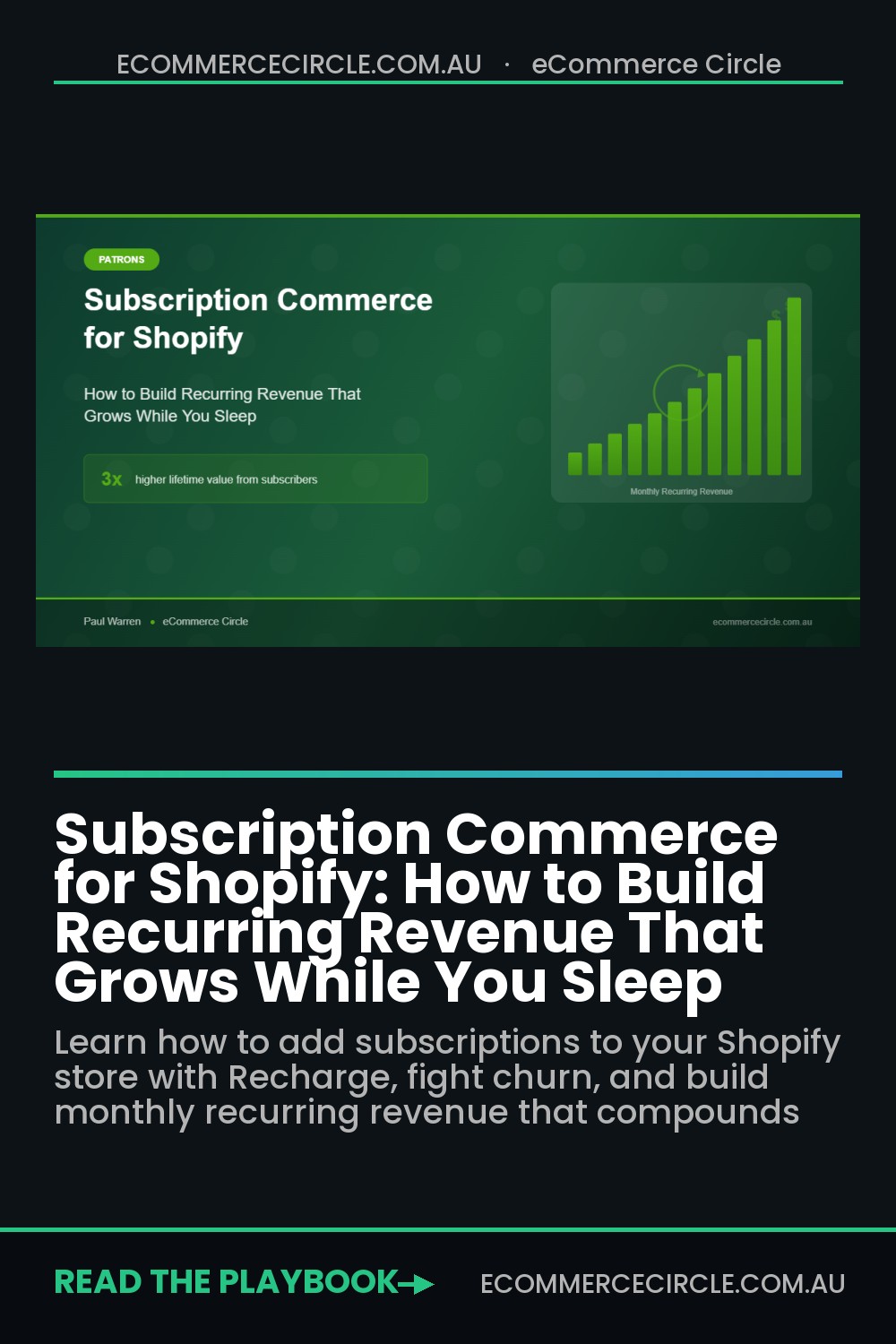
The subscription economy is projected to hit $330 billion globally, growing at 12% year on year. And the numbers at the store level are just as compelling: subscribers are worth 3x more than one-time shoppers over their lifetime. Healthy subscription programs reach 20–30% of total store revenue within 12 months of launch. That is not a side project. That is a second business inside your business — one that compounds every single month.
Why Subscriptions Change Everything for Shopify Stores
The fundamental problem with a pure transactional ecommerce model is that you are renting your customers. Every sale requires you to re-acquire attention — through ads, emails, SEO, or social. Your customer acquisition cost (CAC) resets with every order.
Subscriptions flip that equation. You acquire a customer once, and they keep paying you month after month. Your CAC is amortised across multiple orders instead of one. Your revenue becomes predictable. Your cash flow stabilises. And your business valuation increases dramatically — because buyers and investors pay a premium for recurring revenue.
Here is the maths that matters. If your average one-time customer is worth $80, and your average subscriber stays for eight months at $45 per month, that subscriber is worth $360. Same customer. Same product. Completely different lifetime value — all because you built a mechanism to keep them coming back automatically.
Research from Bain & Company found that a 5% increase in customer retention can boost profits by 25–95%. Subscriptions are the most direct path to that retention lift because they remove the friction of repeat purchasing entirely. Your customer does not need to remember to reorder. They do not need to see your retargeting ad. The next order just happens.
The Three Subscription Models That Work for Ecommerce
Not every subscription model is created equal. The right one for your store depends on your product type, your margins, and how your customers actually use what you sell. Here are the three models that work in ecommerce — and the benchmarks you should know for each.
1. Replenishment (Subscribe and Save)
This is the strongest model for most Shopify stores. If your product gets used up and needs replacing on a predictable schedule — coffee, supplements, skincare, pet food, cleaning products, baby essentials — replenishment subscriptions are your best bet.
The data backs this up. Replenishment subscriptions have the lowest churn in ecommerce — below 4% monthly — because the customer genuinely needs the product again. They are not subscribing for novelty or surprise. They are subscribing for convenience.
The typical offer is a 10–15% discount for subscribing, and this converts 18–25% of eligible one-time customers into subscribers when displayed prominently on your product page. That means if you are getting 1,000 one-time orders a month on a replenishment product, you could be adding 180–250 new subscribers every month. After 12 months, that compounds into a serious revenue base.
2. Curation (Subscription Boxes)
Subscription boxes — where customers receive a curated selection of products each month — are the flashiest model but also the hardest to sustain. Monthly churn for subscription boxes averages 10–12%, roughly three times higher than replenishment.
The reason is simple: novelty fades. After three or four boxes, many customers feel they have “seen enough” and cancel. If you go down this path, you need a relentless content and community strategy to keep the excitement alive. Surprise-and-delight only works if you keep genuinely surprising and delighting — which is expensive and operationally complex.
Curation boxes work best when the product category has high variety (think beauty, snacks, or specialty food) and when the perceived value of the box significantly exceeds the price paid.
3. Access (Members-Only Pricing or Perks)
The access model charges a recurring fee in exchange for exclusive benefits — member pricing, early access to new products, free shipping, or VIP support. Think of it as a paid loyalty program.
This model works well for stores with a broad catalogue and frequent repeat purchasers. The subscription fee itself may be modest ($9.99–$29.99 per month), but it locks in buying behaviour because the customer wants to “get their money’s worth” from the membership. Amazon Prime is the most obvious example, but plenty of smaller brands run this model profitably.
The key metric for access models is the ratio of membership fee to additional spending. A well-designed access program should drive members to spend 2–3x more than non-members annually.
How to Set Up Subscriptions on Shopify (Step by Step)
Shopify does not have complete native subscription functionality. You need a dedicated app — and the one most Shopify brands rely on is Recharge. It powers subscriptions for thousands of stores, integrates deeply with Klaviyo, Gorgias, and other tools in your stack, and most setups take one to three days.
Here is how to get it running:
Step 1: Install Recharge from the Shopify App Store. Connect it to your Shopify admin. Recharge will sync your product catalogue automatically.
Step 2: Choose which products to offer as subscriptions. Start with your highest-volume replenishment products — the ones customers already reorder most frequently. Check your Shopify order data and look for products with repeat purchase rates above 20%. Those are your subscription candidates.
Step 3: Set your subscription pricing and frequency options. Offer a 10–15% subscribe-and-save discount. Provide frequency options that match real usage patterns — every 2 weeks, every 4 weeks, every 6 weeks, every 8 weeks. Do not offer so many options that it creates decision fatigue. Three to four frequency choices is the sweet spot.
Step 4: Configure the customer portal. This is critical. Recharge provides a no-code customer portal where subscribers can skip a shipment, swap products, change frequency, or update payment details. Every one of these self-service options reduces cancellations. A customer who can pause is far less likely to cancel outright.
Step 5: Build your cancellation flow. When a subscriber does hit “cancel,” do not just let them leave. Recharge lets you build a cancellation flow that offers alternatives — pause for a month, skip the next order, switch to a different product, or get a one-time discount to stay. Data shows that auto-ship discount offers increase retention by 29% at this stage.
Step 6: Set up failed payment recovery. Involuntary churn — cancellations caused by expired credit cards or failed payments — accounts for a significant chunk of subscription losses. Configure Recharge’s dunning management to automatically retry failed payments and send customer notifications prompting them to update their card details.
If you want a more modern alternative to Recharge, Skio is gaining traction quickly. It offers a cleaner UI, simpler migration tools, and strong passwordless login for the customer portal. Both are solid choices — pick the one that integrates best with your existing tech stack.
The Subscription Product Page: How to Convert One-Time Buyers
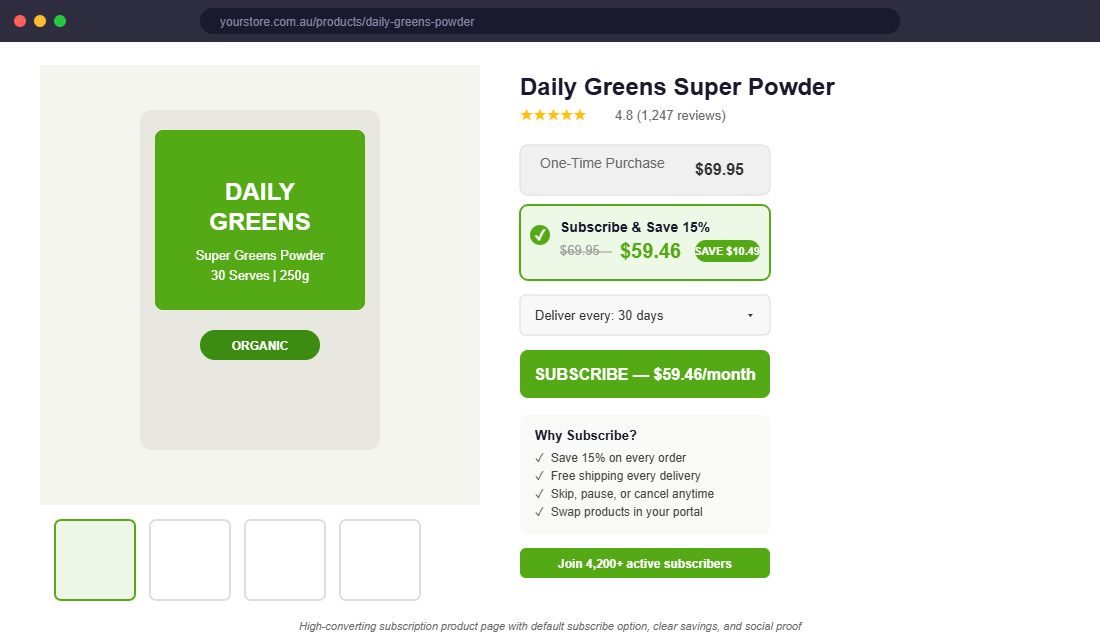
Your subscription will only grow if your product page actually sells it. Most stores bury the subscription option below the fold or make it look like an afterthought. That is leaving money on the table.
Here is what high-converting subscription product pages do differently:
Default to the subscription option. When a customer lands on the product page, the “Subscribe & Save” tab should be pre-selected — not the one-time purchase. This simple change alone can lift subscription opt-in rates by 15–20%. People go with defaults.
Show the savings clearly. Do not just say “10% off.” Show the one-time price crossed out next to the subscription price. Make the dollar savings obvious: “You save $7.50 every order.” Concrete numbers beat percentages every time.
Add a “Why Subscribe?” section. Below the add-to-cart button, include three or four bullet points: free shipping on every order, change or cancel anytime, never run out again, save 15% on every delivery. Address the objections before they form.
Use social proof. “Join 4,200+ subscribers” or “Rated 4.8 stars by our subscribers” builds trust. If you have subscriber-specific reviews, feature them. Retention starts at the point of first purchase — the more confident a customer feels about subscribing, the longer they will stay.
Fighting Churn: How to Keep Subscribers Beyond Month Three
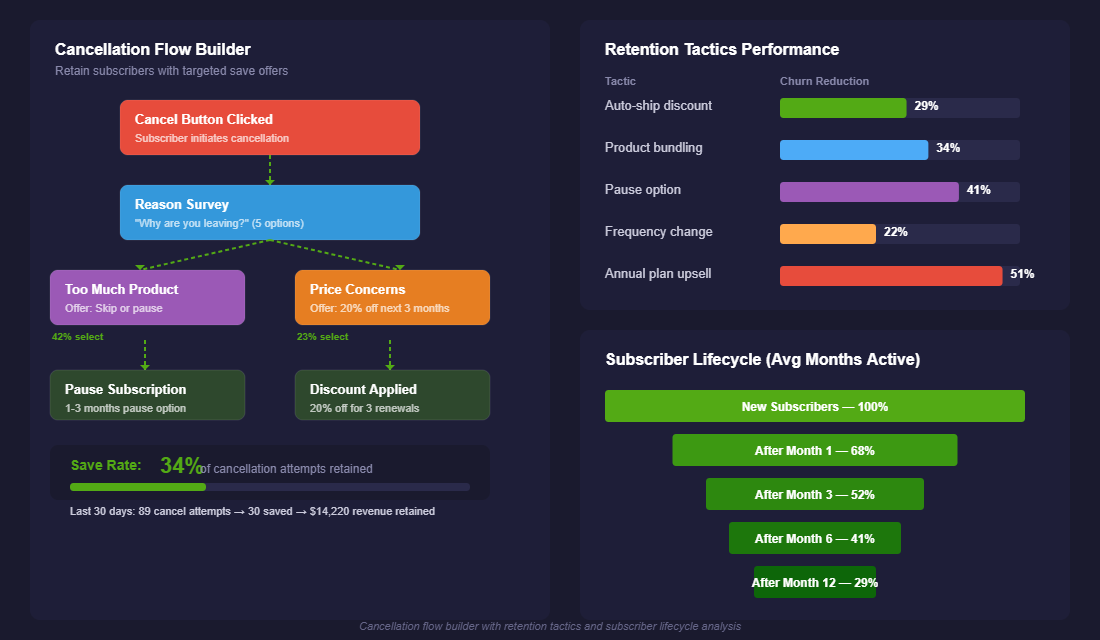
Here is the uncomfortable truth about subscriptions: 25–35% of new subscribers cancel within the first month. Another 15–20% leave in month two, and 10–15% more in month three. If you do nothing to address early churn, you are filling a leaky bucket.
The average monthly churn rate across subscription ecommerce is 5.3%. Top-performing brands keep it below 3%. The gap between average and excellent represents an enormous revenue difference when compounded over 12 months.
Here is your churn-fighting playbook:
Nail the first delivery experience. Your first subscription box or shipment needs to over-deliver. Include a handwritten thank-you note, a free sample, or a small bonus item. First impressions set the tone for the entire subscription relationship. If the first delivery feels like a generic transaction, cancellation becomes easy to justify.
Send a dedicated onboarding sequence. Do not just drop subscribers into your regular email flow. Build a post-purchase sequence specifically for new subscribers. Emails should cover: what to expect from their subscription, how to use the customer portal, tips for getting the most from the product, and a “meet the founder” story that builds emotional connection.
Offer flexibility before they cancel. The number one reason subscribers cancel is that they have “too much product.” If your cancellation flow offers a pause option, a skip option, or a frequency change, you will save a significant percentage of would-be cancellers. Research shows that bundling and flexible scheduling reduce churn by up to 34%.
Surprise them between shipments. Send a mid-cycle email with a usage tip, an exclusive recipe, or a subscriber-only discount on a complementary product. The worst thing that can happen between deliveries is silence — because silence lets buyers’ remorse creep in.
Incentivise annual commitments. Offer a meaningful discount (20–25% off) for customers who prepay annually. Annual plans reduce churn by 51% compared to monthly billing. Even if only 10–15% of your subscribers choose the annual option, those customers become your most valuable and most predictable revenue.
What Australian Brands Are Getting Right With Subscriptions
Who Gives A Crap is one of Australia’s most recognisable subscription brands — and they built the entire business around a replenishment model. Toilet paper is the ultimate consumable: everyone needs it, nobody wants to think about buying it, and running out is a genuine inconvenience. They offer boxes of 24 or 48 rolls delivered every 8, 12, or 16 weeks, powered by Recharge on Shopify.
What makes their model work is not just the product — it is the experience. Colourful packaging, a brand voice that makes you smile, and a social mission (50% of profits go to building toilets in developing countries) all create emotional stickiness that pure convenience alone cannot match. Their customers do not just subscribe for the toilet paper. They subscribe because they feel good about it.
Go-To Skin Care, founded by Zoë Foster Blake, has built a loyal subscriber base around their skincare essentials. Skincare is another natural fit for replenishment subscriptions — products run out on a predictable schedule, and customers want consistency in their routine. Go-To makes it easy by offering subscribe-and-save on their hero products with flexible delivery schedules.
The lesson from both brands: subscriptions work best when you are solving a real replenishment need, wrapping it in a brand experience that creates genuine emotional loyalty, and making the mechanics (ordering, skipping, swapping) completely frictionless.
The Metrics That Matter: Your Subscription Dashboard
Once your subscription program is live, you need to track the right numbers. Vanity metrics like “total subscribers” can mask serious problems. Here are the metrics that actually tell you whether your subscription business is healthy:
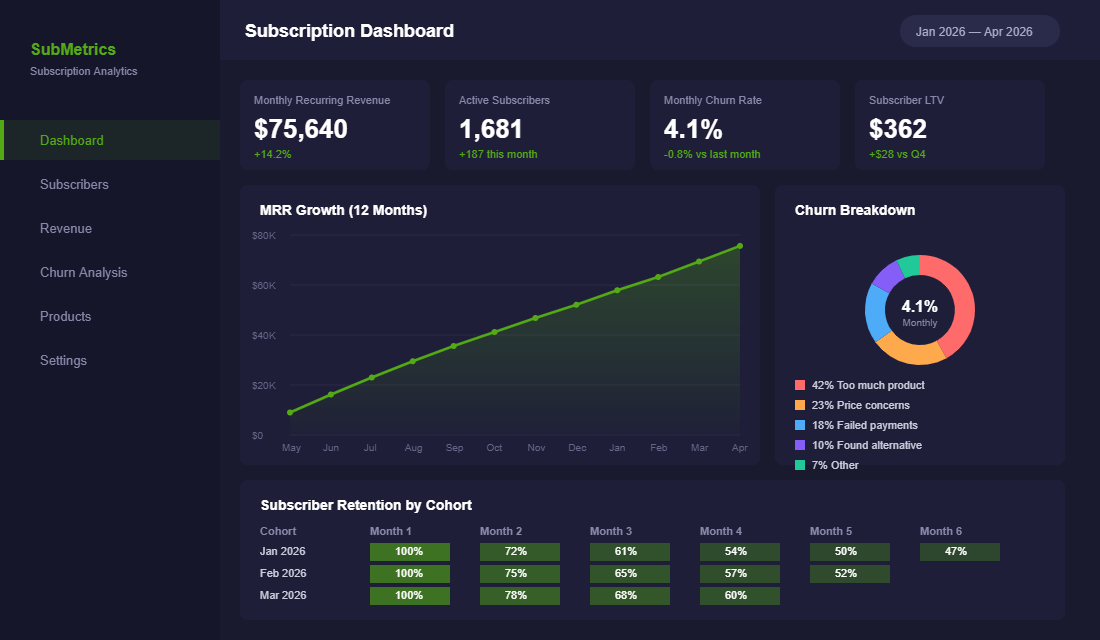
Monthly Recurring Revenue (MRR): The total predictable revenue from active subscriptions each month. This is your north star metric. Track month-on-month growth — healthy programs grow MRR by 8–15% monthly in their first year.
Churn Rate: The percentage of subscribers who cancel each month. Below 5% is acceptable. Below 3% is excellent. Split this into voluntary churn (customer-initiated cancellations) and involuntary churn (failed payments) — the fixes for each are completely different.
Subscriber Lifetime Value (LTV): The total revenue a subscriber generates before they cancel. Calculate this as average order value × average number of orders before cancellation. Compare this to your one-time customer LTV — the gap should be at least 2x for the subscription program to be worth the operational complexity.
Subscription Conversion Rate: Of customers who view a subscription-eligible product page, what percentage choose the subscription option? Benchmark is 8–15%. If you are below 8%, your product page is not selling the subscription effectively.
Net Subscriber Growth: New subscribers minus cancellations. This number needs to stay positive every month. If cancellations start exceeding new sign-ups, you have a retention problem that needs urgent attention — no amount of acquisition will fix a leaky bucket.
The Fulfilment Reality: What Recurring Orders Do to Your Warehouse
Subscriptions look like a marketing project right up until the first billing day, when three hundred orders drop into your fulfilment queue inside the same hour. One-time sales arrive smoothly across a week. Subscription orders arrive in a spike, on a date you chose, and if your pick-and-pack cannot absorb it you have just turned your most loyal customers into your most disappointed ones.
The single highest-value fix is also the simplest: stagger your billing dates. Do not bill everyone on the 1st. Split the base across four anchor dates, or bill on the anniversary of each customer’s signup. Recharge, Skio and Loop all support both models. Spreading three hundred orders across a fortnight instead of an afternoon is the difference between a normal week and an emergency.
The stock side deserves the same discipline. Subscription demand is the most forecastable revenue in your business, which is exactly why founders take it for granted and then run out. Work to a simple rule: hold at least 1.3x your known subscription volume for the next cycle, on top of whatever your one-time sales forecast calls for. The 30% buffer covers new signups between now and the billing date, plus the reships you will inevitably need for damaged or lost parcels.
A stockout on a one-time order is an annoyance. A stockout on a subscription order is a cancellation event. Subscribers who receive a delayed or substituted delivery churn at roughly double the rate of subscribers whose deliveries arrive as promised, and that damage does not undo itself when the stock lands.
Questions to Ask Your 3PL Before You Launch
- Can you handle a batched order drop, and what daily volume ceiling do you hold us to?
- Do you charge differently for recurring orders, and is there a per-order handling fee that changes at volume?
- Can you insert different collateral for subscriber orders than for one-time orders?
- What is your cut-off time, and what happens to orders that land after it on a billing day?
- How do you handle a subscriber address change that arrives after the order has been generated but before it ships?
That last question catches more brands than any of the others. Address changes are far more common on subscriptions than on one-off purchases, because people move house and their subscription follows them. If there is no process for it, parcels go to the old address and you pay twice. Our 3PL playbook covers how to run this evaluation properly with Australian providers.
The Support Load Nobody Budgets For
Subscribers generate more support tickets than one-time buyers. Not because they are difficult, but because they have an ongoing relationship with your business and ongoing relationships generate admin. Plan on roughly 2x to 3x the ticket volume per customer compared to a one-time buyer over the same period.
The good news is that the tickets are extremely predictable. Five categories cover the overwhelming majority of them:
- “I want to skip this month.” The most common request by a wide margin, and completely avoidable as a ticket.
- “Can I change the delivery date or frequency?” Second most common, same story.
- “How do I update my card?” Every one of these is a subscriber you are about to lose to a failed payment.
- “Can I swap the product or flavour?” Often a save opportunity disguised as an admin request.
- “Cancel my subscription.” The one you actually want a human involved in.
Four of those five should never reach your inbox. Put skip, pause, reschedule, swap and card update into a self-service customer portal and you will deflect 60% to 70% of subscription support volume. Every subscription app on Shopify ships a portal. The mistake is burying the link, so it appears once in a welcome email and nowhere else. Put it in the footer of every subscription email, in your order confirmations, and in your shipping notifications.
There is a real fear here that making cancellation easy increases cancellations. The data says the opposite. Brands that make skip and pause genuinely frictionless see lower net churn, because a subscriber who can skip a month stays a subscriber, while a subscriber who cannot skip cancels outright. You are choosing between one skipped delivery and losing the customer entirely. It is not a close call.
Write five macros for the cancellation conversation and keep them short. One acknowledging the reason, then one each for the four most common causes: too much product (offer a longer interval), too expensive (offer a smaller size or a pause), product not right (offer a swap), and just not needed anymore (accept gracefully and put them in a win-back segment). A well-run cancellation flow saves 20% to 30% of the people who start it. Our support deflection playbook covers the portal and macro setup in detail.
Budget for this honestly. A thousand active subscribers will generate somewhere around 150 to 250 tickets a month before deflection, and 50 to 90 after it. That is a real part-time role, or a meaningful chunk of an existing one. Costing it in from the start is the difference between subscriptions being a profit line and subscriptions being a stress line.
The Compounding Effect: How Subscriptions Transform Your Business
Here is where subscriptions get genuinely exciting. Unlike one-time sales, subscription revenue compounds. Every new subscriber you add this month keeps paying next month, and the month after that. Even with churn, your total subscriber base grows over time — and so does your baseline revenue.
Let us say you add 200 new subscribers per month at $45 each, with a 5% monthly churn rate. After month one, you have 200 subscribers generating $9,000 in MRR. After month six, you have roughly 1,030 active subscribers and $46,350 in MRR. After 12 months, you are approaching 1,680 active subscribers and $75,600 in monthly recurring revenue.
That is $75,600 per month that shows up whether you run ads or not. Whether you post on Instagram or not. Whether you send an email campaign or not. It is revenue that has already been earned — you just need to fulfil it.
This compounding effect also makes your business dramatically more valuable. Buyers and investors apply higher multiples to businesses with recurring revenue because it is more predictable, more defensible, and less dependent on any single marketing channel. A Shopify store doing $2 million in one-time sales is worth significantly less than a store doing $2 million with 30% of that revenue coming from subscriptions.
And the operational benefits compound too. When you know how many subscribers you have and when their next order ships, you can forecast inventory with far greater accuracy. You can negotiate better supplier terms because you are placing consistent, predictable orders. You can plan your cash flow with confidence instead of hope.
Your Subscription Launch Checklist
Ready to add subscriptions to your Shopify store? Here is the sequence that works:
Week 1: Foundation. Install Recharge (or Skio). Select your top 3–5 replenishment products based on repeat purchase data. Set subscribe-and-save pricing at 10–15% off. Configure 3–4 delivery frequency options.
Week 2: Experience. Update product pages to default to subscription. Build the “Why Subscribe?” section with benefits and social proof. Set up the customer portal with skip, swap, pause, and frequency change options. Design your cancellation flow with save offers.
Week 3: Retention. Build a subscriber-specific onboarding email sequence (5–7 emails over 30 days). Create a mid-cycle engagement email. Set up failed payment recovery with dunning management. Plan your first-delivery “surprise and delight” insert.
Week 4: Growth. Announce subscriptions to your email list with a launch offer (first month 25% off). Add a subscription upsell to your post-purchase page. Create a “Subscribe & Save” collection page. Set up subscription-specific reporting in Recharge analytics.
Within 90 days, you should have clear data on your subscription conversion rate, early churn patterns, and MRR trajectory. From there, you can optimise — testing different discount levels, frequency options, and retention tactics to push churn down and lifetime value up.
Stop Starting Every Month at Zero
The difference between a store that relies entirely on one-time sales and a store with a healthy subscription program is not just revenue. It is peace of mind. It is knowing that a portion of this month’s revenue is already secured before you spend a dollar on ads. It is having the predictability to plan, hire, invest, and grow with confidence.
Subscriptions are not a nice-to-have. For any Shopify store selling consumable or replenishable products, they are the single highest-return thing you can build. One subscriber today is worth dozens of one-time buyers over the next year.
Inside the eCommerce Circle, recurring revenue strategy is one of the core pillars we work on with members. From choosing the right model and pricing structure to building retention systems that keep churn low, it is one of those areas where small improvements compound into massive results. If you want help building your subscription engine, let’s talk.