You’re spending thousands on ads. You’re testing new products. You’re tweaking your homepage layout every other week. But there’s a goldmine of growth intelligence sitting right under your nose that most ecommerce brands completely ignore — the words your customers are already telling you.
What’s in This Article
Not your assumptions about what customers want. Not what your competitor’s audience says. The actual, unfiltered feedback from the people who have already bought from you — or tried to and gave up.
That’s what a Voice of Customer (VoC) program gives you. And the brands that build one properly don’t just “get more reviews.” They make better product decisions, write copy that converts harder, and fix the friction points that are silently costing them thousands in lost revenue every month. Companies that frequently act on customer feedback score 25% higher on business success metrics than those that don’t, according to MarketingSherpa research. Products with just five reviews are 270% more likely to be purchased than products with none.
This isn’t about slapping a “How did we do?” survey on your thank-you page and calling it a day. This is about building a systematic feedback engine that feeds directly into your product roadmap, your marketing strategy, and your customer experience — and keeps compounding over time.
What a Voice of Customer Program Actually Is (and Isn’t)
A Voice of Customer program is a structured system for collecting, analysing, and acting on customer feedback across every touchpoint in your business. It’s not a single survey. It’s not your review widget. It’s the combination of every channel where customers tell you what they think — and a process for turning that noise into signal.
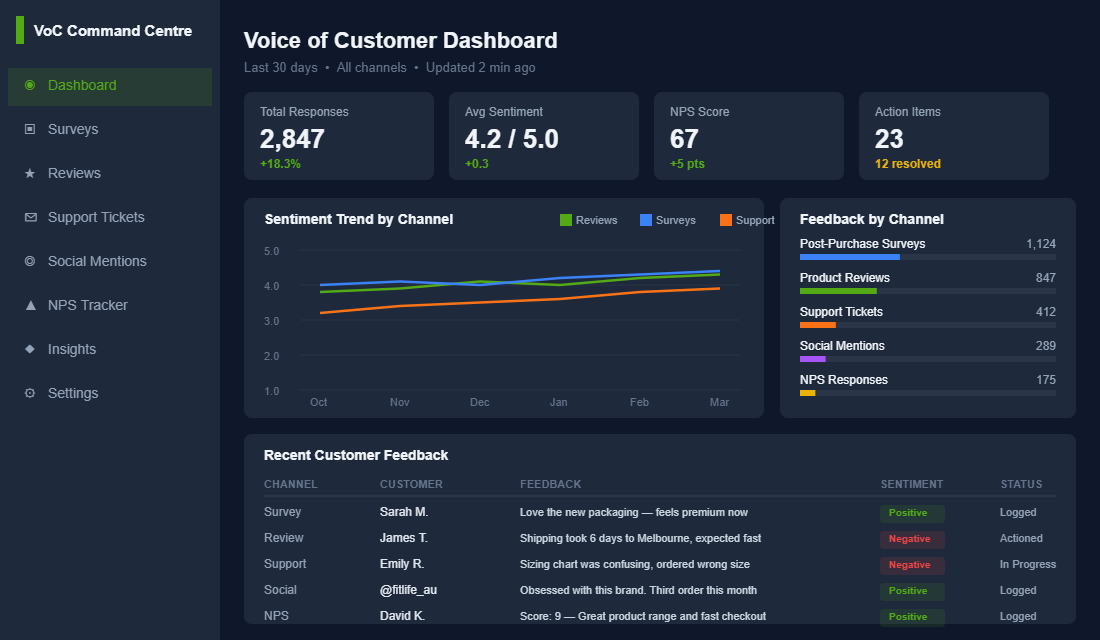
Most Shopify store owners collect feedback accidentally. A review comes in here, a support ticket lands there, someone DMs on Instagram with a complaint. None of it connects. None of it gets systematically reviewed. And none of it changes how the business operates.
A proper VoC program has four parts: collection (gathering feedback from multiple channels), analysis (identifying themes and patterns), action (making changes based on what you learn), and closing the loop (telling customers what you changed because of their feedback). Skip any one of these and the whole system breaks down.
The VoC platform market is projected to grow from $9.5 billion in 2025 to $22.5 billion by 2034. That growth isn’t happening because collecting feedback is trendy — it’s happening because brands that listen to their customers systematically outperform those that don’t.
The 5 Feedback Channels Every Ecommerce Store Should Be Monitoring
Your customers are already talking to you. The question is whether you’re listening in the right places. Here are the five channels that matter most for ecommerce brands — and how to extract real insights from each one.
1. Post-Purchase Surveys
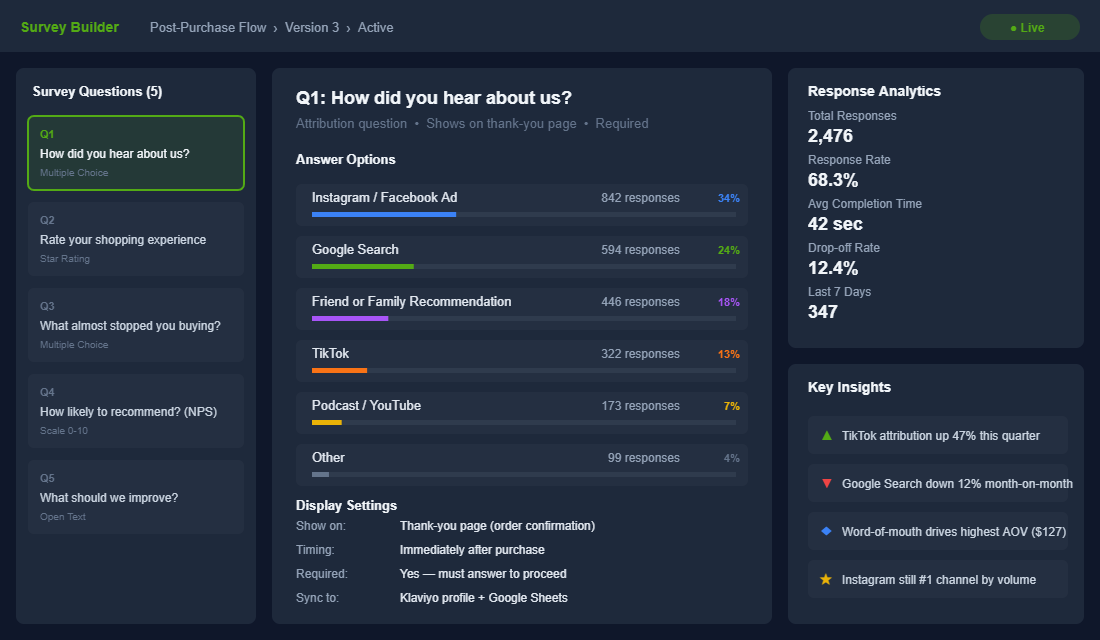
This is your highest-value feedback channel, period. A customer who just bought from you is in the perfect mindset to tell you exactly how they found you, what almost stopped them buying, and what would make them come back.
The key questions every Shopify store should ask post-purchase:
- “How did you first hear about us?” — This is attribution gold. It tells you which channels are actually driving purchases, not just clicks. You’ll often find that word-of-mouth or podcasts are driving far more sales than your analytics show.
- “What almost stopped you from buying today?” — This reveals the objections your product pages aren’t overcoming. Common answers like “shipping cost,” “wasn’t sure about sizing,” or “couldn’t find enough reviews” are direct instructions for what to fix.
- “On a scale of 0-10, how likely are you to recommend us?” — This is your Net Promoter Score. Aim for 50+ in ecommerce. Anything below 30 means you have systemic experience problems.
A well-optimised post-purchase survey should hit a 60-70% response rate. If yours is below 40%, you’re either asking too many questions or showing the survey at the wrong moment. The sweet spot is 3-5 questions, displayed immediately on the thank-you page — not buried in a follow-up email three days later.
2. Product Reviews
Reviews aren’t just social proof for your product pages — they’re a direct line into what customers love and hate about your products. The difference between a brand that treats reviews as passive decoration and one that mines them for insights is massive.
Read every single review that comes in. Not just the one-star disasters — the three and four-star reviews are where the real gold lives. A four-star review that says “Great product but the colour was slightly different from the photos” is telling you exactly how to prevent returns. Around 90% of customers read online reviews before making a purchase decision, and 88% trust them as much as personal recommendations. That means your reviews aren’t just feedback — they’re your most powerful sales copy, written by real people.
3. Support Tickets and Live Chat Transcripts
Your support team hears the same questions and complaints on repeat. That repetition is data. If 30% of your pre-purchase chats ask about your returns policy, that’s a clear signal your returns policy isn’t visible enough on your product pages. If a quarter of your post-purchase tickets are about sizing, you need a better size guide — not more customer service reps.
Research shows 73% of consumers find live chat the most satisfying way to communicate with a business, and 64% of shoppers expect a response within one hour. Every one of those interactions is feedback waiting to be captured and categorised.
4. Social Media Mentions and DMs
Customers say things on social media they’d never write in a formal survey. They’ll tag your brand in an Instagram story showing your packaging. They’ll tweet about a delivery delay. They’ll comment on a TikTok ad about what they wish you’d stock next. This unfiltered, unsolicited feedback is incredibly valuable because it reflects how customers genuinely feel — without the framing bias of a structured survey.
Set up keyword alerts for your brand name, product names, and common misspellings. Tools like Mention or even basic social media search will surface conversations you’d otherwise miss entirely.
5. Customer Interviews (Yes, Actually Talking to People)
Surveys give you scale. Reviews give you context. But nothing beats a 20-minute conversation with a real customer for depth of understanding. Schedule one customer interview per week — that’s it. Call your best customers (high LTV, multiple orders) and ask them why they keep coming back. Call customers who bought once and never returned and ask them what happened. The insights from these conversations will reshape how you think about your business.
You don’t need fancy software for this. A Zoom call, a simple script of 5-6 open-ended questions, and a $20 gift card as a thank-you is all it takes. The ROI on one good customer interview often exceeds the ROI on a month of A/B testing.
How to Set Up Your VoC Tech Stack on Shopify
You don’t need enterprise software to build a world-class VoC program. Here’s the exact tech stack I’d recommend for any Shopify store doing $500K-$5M in annual revenue.
For post-purchase surveys: Fairing — This is the gold standard for Shopify post-purchase surveys. It integrates directly into the checkout flow, supports attribution questions, NPS, and custom questions, and syncs data to Klaviyo, Google Sheets, and your ad platforms. The response rates are significantly higher than email-based surveys because the question appears at the exact moment the customer is most engaged.
Here’s how to set it up in under 30 minutes:
- Step 1: Install Fairing from the Shopify App Store and connect it to your store.
- Step 2: Create your first survey with 3-4 questions. Start with “How did you hear about us?” (multiple choice), “What almost stopped you buying?” (multiple choice), and “How likely are you to recommend us?” (NPS scale).
- Step 3: Set the display to “Thank-you page” with the trigger set to “All orders.”
- Step 4: Connect the Klaviyo integration so every response gets tagged on the customer’s profile. This lets you segment your email list by attribution source, satisfaction level, or objection type.
- Step 5: Set up a weekly Google Sheets export so you can analyse trends over time without logging into the dashboard constantly.
For product reviews: Okendo or Judge.me — Both integrate natively with Shopify and Klaviyo. Okendo is the premium option with better customisation and UGC capabilities. Judge.me is the budget-friendly choice that still does the job well for stores under $1M revenue.
For support insights: Gorgias — If you’re not already using Gorgias for customer support, you’re making things harder than they need to be. Beyond being a great helpdesk, Gorgias lets you tag tickets by theme, track resolution metrics, and identify your most common customer pain points at a glance. The Shopify integration means every support interaction is tied to a real order with real revenue data attached.
For centralising everything: A simple Google Sheet — Before you invest in expensive VoC platforms, start with a shared Google Sheet where you log the top 10 customer insights each week. Columns: date, channel (survey/review/support/social), theme (shipping/product/pricing/UX), sentiment (positive/negative/neutral), verbatim quote, and action taken. It’s not glamorous, but it works. Most brands skip this step and wonder why their feedback never leads to action.
Turning Raw Feedback Into Actionable Themes
Collecting feedback is the easy part. The hard part — and where 90% of ecommerce brands fall short — is turning hundreds of individual responses into clear, prioritised themes that drive real business decisions.
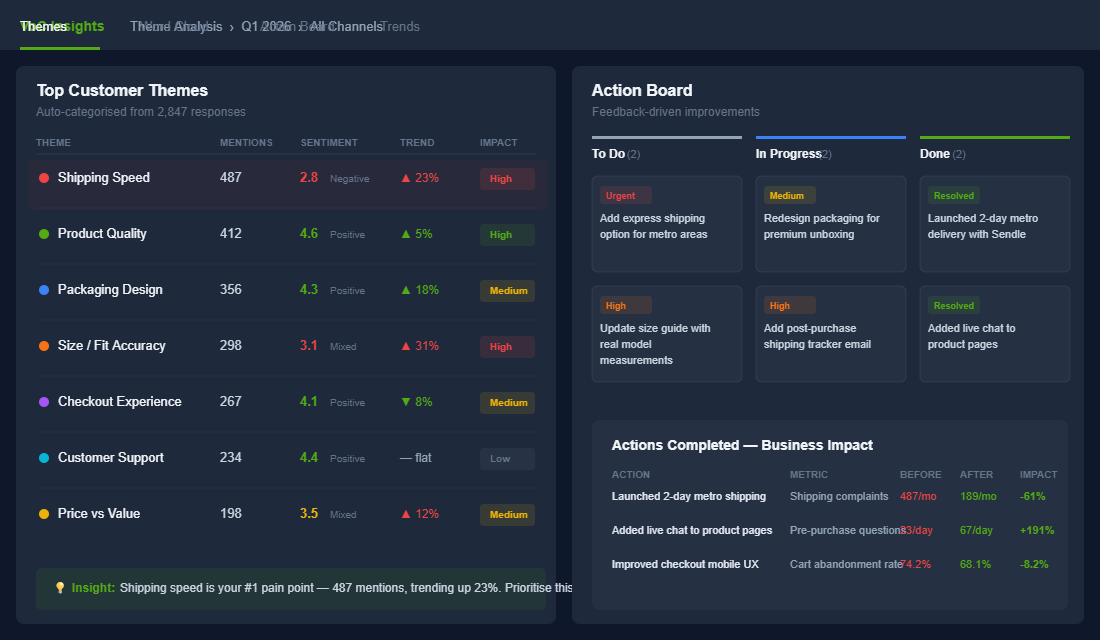
Here’s the weekly VoC review process I recommend:
- Every Friday, spend 60 minutes reviewing the week’s feedback. Pull data from all five channels. Read the verbatim quotes — don’t just skim the summary stats.
- Categorise every piece of feedback into one of 8-10 themes. Common themes for ecommerce: shipping speed, product quality, sizing/fit, packaging, website UX, pricing/value, customer support, returns process. Don’t create more than 10 themes or you’ll lose the ability to spot patterns.
- Track sentiment by theme over time. A theme with 50 mentions and improving sentiment is a win. A theme with 50 mentions and declining sentiment is a fire to put out. The trend matters more than the snapshot.
- Identify one “quick win” and one “strategic fix” each week. A quick win is something you can action within 48 hours — updating a product description, adding a FAQ answer, adjusting a shipping threshold. A strategic fix is a bigger project that needs planning — reformulating a product, redesigning your size guide, switching fulfilment partners.
The single most important rule: never let feedback sit without a response for more than 7 days. If you log an insight but don’t assign an owner and a deadline, it dies. Your VoC program lives or dies on the speed of your feedback-to-action loop.
How Australian Brands Are Using VoC to Win
Let’s look at two Australian brands that have built customer feedback into the DNA of their business — and the results speak for themselves.
Frank Body — The Melbourne-based skincare brand didn’t just collect customer feedback. They built their entire marketing engine around it. Every Frank Body package includes a note encouraging customers to share their experience using the hashtag #frankeffect. The result? Over 50,000 user-generated posts on Instagram, creating a self-reinforcing feedback loop where customers simultaneously provide product insights AND create marketing content. By actively sharing unedited customer photos, reviews, and stories, Frank Body turned their VoC program into a growth channel. Their gamified loyalty program further incentivises feedback — customers earn points for reviews, social shares, and referrals, creating a continuous stream of insights about what’s working and what’s not.
Culture Kings — The Australian streetwear retailer has built a reputation for customer experience that’s reflected in their 5,954 collected reviews with an average rating of 4.48 out of 5. What makes Culture Kings stand out isn’t just the volume of reviews — it’s how they act on them. Their customer service team consistently responds to feedback, and the insights from their reviews have shaped everything from their product curation to their in-store experience. Reviewers frequently mention fast, efficient service and a premium shopping experience — signals that the brand has systematically addressed the friction points that plague most fashion ecommerce.
Both brands share a common thread: they don’t treat customer feedback as a metric to report on. They treat it as a competitive advantage to build on.
The VoC-to-Revenue Framework: Where Feedback Becomes Profit
Here’s where most “listen to your customers” advice falls apart. It’s all warm and fuzzy but nobody tells you how feedback actually translates into more revenue. Let me break it down into five concrete revenue levers.
Lever 1: Fix the conversion killers. Your post-purchase survey question “What almost stopped you buying?” gives you a prioritised list of objections to address on your product pages. If 35% of respondents say “shipping cost,” you know that a free shipping threshold or clearer shipping messaging will move the needle. Understanding your customer avatar makes this feedback even more powerful — you’ll know which objections matter most for your core buyer segments.
Lever 2: Improve product-market fit. Review analysis tells you which products are loved, which are returned, and why. One consistent complaint about a product — “runs small,” “colour doesn’t match photos,” “broke after two weeks” — is worth more than a month of sales data. Fix the underlying issue and you reduce returns, increase repeat purchases, and generate better reviews that drive more first-time buyers.
Lever 3: Sharpen your ad copy and creative. The exact words your customers use to describe why they love your product are the best ad copy you’ll ever write. When a customer says “finally found a moisturiser that doesn’t make my skin feel greasy,” that’s a headline. When they say “I bought this for my mum and now she wants three more,” that’s a gifting angle you didn’t know you had. Segmenting your customers by feedback themes lets you create targeted campaigns that speak to each group’s specific pain points and desires.
Lever 4: Reduce support costs. Every support ticket is a failure of communication, UX, or product quality somewhere upstream. Track your top 5 support themes by volume. If “where’s my order?” makes up 30% of your tickets, invest in better shipping notifications. If “how do I return this?” is a top theme, your returns process isn’t clear enough. Solving these upstream problems reduces support volume while simultaneously improving customer experience.
Lever 5: Build a referral engine. Your NPS data tells you exactly who your promoters are (score 9-10). These customers are ready to refer you to their friends — they just need a nudge. Set up a Klaviyo flow that triggers a referral offer specifically for NPS promoters. A customer who just told you they’d recommend you is 3-4x more likely to actually follow through on a referral incentive than a random customer on your list.
Closing the Loop: The Step Most Brands Skip
When customers give you feedback and see nothing change, they stop giving feedback. Worse, they start feeling like the brand doesn’t actually care — which is exactly the perception you’re trying to avoid.
Closing the feedback loop means proactively communicating back to customers about what you changed based on their input. This doesn’t need to be complicated. Here are three ways to do it:
- Monthly “You Told Us” email. Send a dedicated email to your list highlighting 2-3 changes you made based on customer feedback. “Last month, many of you told us shipping to regional areas was taking too long. We’ve partnered with a new logistics provider and you should now receive your order 1-2 days faster.” This builds enormous trust and encourages more people to share feedback in the future.
- Social media callouts. When you make a change based on feedback, shout about it on Instagram or TikTok. “You asked, we listened — our new sizing guide now includes real model measurements and a fit quiz.” This turns a backend improvement into public-facing content.
- Personal follow-ups for negative feedback. When a customer leaves a 1-2 star review or a negative NPS score, have someone reach out personally within 48 hours. Not with a canned response — with a genuine conversation about what went wrong and how you’re fixing it. Research from building a great support system shows that customers who have a negative experience resolved well often become more loyal than customers who never had a problem at all.
Your VoC Quick-Start Checklist
You don’t need to build a perfect VoC program overnight. Start with this 30-day checklist and iterate from there.
Week 1 — Set up collection:
- Install Fairing (or Zigpoll/Grapevine) for post-purchase surveys with 3-4 questions
- Ensure your review app (Okendo or Judge.me) sends automated review request emails at day 7 and day 14 post-delivery
- Create a shared Google Sheet with columns: Date, Channel, Theme, Sentiment, Quote, Owner, Action, Status
Week 2 — Start monitoring:
- Set up social mention alerts for your brand name
- Ask your support team to tag every ticket with one of your 8-10 themes
- Schedule your first customer interview (call a high-LTV customer and offer a $20 gift card)
Week 3 — Analyse and prioritise:
- Run your first weekly VoC review (60 minutes, all channels)
- Identify your top 3 feedback themes by volume
- Choose one quick win to action this week and one strategic fix to plan
Week 4 — Close the loop:
- Send your first “You Told Us” email or social post highlighting a change you made
- Personally follow up with your 3 lowest NPS respondents
- Review your survey response rate and optimise question placement if below 50%
The Compound Effect of Listening
A VoC program doesn’t deliver overnight results. It compounds. In month one, you fix a confusing size guide and reduce returns by 15%. In month two, you update your ad copy with actual customer language and click-through rates jump. In month three, you launch a referral program targeting NPS promoters and acquisition costs drop. In month six, you’ve built such a deep understanding of your customer that every decision — from product development to email campaigns to homepage design — is informed by real data, not guesswork.
The brands that win in ecommerce over the next five years won’t be the ones with the biggest ad budgets or the flashiest websites. They’ll be the ones who listen to their customers more systematically than anyone else — and act on what they hear faster than the competition.
Your customers are already telling you exactly how to grow your business. The only question is whether you’re building the systems to hear them.
Inside the eCommerce Circle, Voice of Customer is one of the core pillars we work on under Prospects — because understanding your buyer at a deep level changes everything downstream. If you want help building a VoC program that actually moves the needle for your store, let’s talk.