Here’s something most Shopify store owners don’t want to hear: the ATO is watching your online sales more closely than ever.
What’s in This Article
In 2024–25, the Australian Taxation Office raised $385 million in GST liabilities alone — and a growing chunk of that came from ecommerce businesses that got their tax obligations wrong. Not because they were trying to cheat the system, but because nobody ever sat them down and explained what they actually need to do.
If you’re running a Shopify store and you’re still guessing your way through GST, BAS lodgements, and tax deductions, you’re sitting on a ticking clock. The gap between “I’ll sort it out later” and an ATO audit with a 75% penalty on top isn’t as wide as you think.
This guide breaks down exactly how Australian ecommerce tax works — in plain English, without the accounting jargon. You’ll know what to charge, what to claim, what to lodge, and how to set up your Shopify store so the numbers actually line up when tax time hits.
Do You Actually Need to Register for GST?
Let’s start with the question that trips up half the store owners we coach: when do you actually need to register for GST?
The rule is straightforward. If your business turns over $75,000 or more per year, you must register for GST with the ATO. That’s gross revenue — not profit. Every dollar that comes through your Shopify checkout counts toward that threshold.
Here’s where it gets tricky. Once you cross that $75,000 line, you’ve got 21 days to register. Miss that window and you’re looking at backdated liabilities — meaning the ATO will expect you to pay GST on everything you sold from the day you should have registered, not from the day you actually did. That’s money you collected but never set aside.
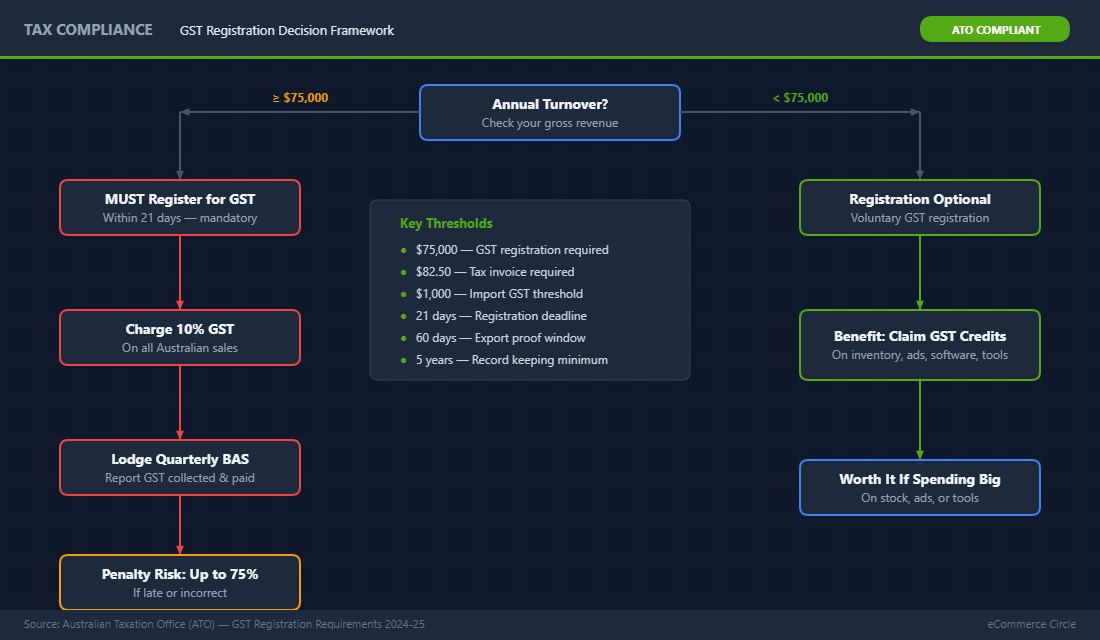
What about voluntary registration? If you’re under $75,000, you can still register voluntarily. Why would you? Because it lets you claim GST credits on business purchases — everything from your Shopify subscription to your packaging suppliers. For stores spending heavily on inventory and ads while scaling up, voluntary registration can put real money back in your pocket.
The Shopify subscription trap. Here’s one most people miss: if you’re in Australia and you’re registered for GST, add your ABN to your Shopify account (Settings → Billing → enter your ABN). If you don’t, Shopify charges you 10% GST on your subscription and shipping labels — a cost you can avoid entirely.
Quick decision framework:
- Turning over $75K+? You must register. No exceptions. Do it within 21 days.
- Under $75K but spending big on stock, ads, or tools? Voluntary registration probably saves you money.
- Under $75K with minimal business expenses? Wait until you hit the threshold.
How GST Actually Works on Your Shopify Store
GST is a 10% tax on most goods and services sold in Australia. When a customer in Sydney buys a $100 product from your store, $9.09 of that is GST (it’s included in the price, not added on top). You collect it, hold it, and hand it over to the ATO when you lodge your BAS.
Setting up GST in Shopify takes five minutes:
- Go to Settings → Taxes and Duties
- Select your Australia region
- Enter your ABN
- Enable “Charge GST on this region”
- Make sure “All prices include tax” is ticked (standard in Australia)
That last point matters. In Australia, consumer prices must include GST. If you’re listing a product at $99.95, that price already contains $9.09 in GST. Your Shopify tax settings need to reflect this — otherwise your prices will look wrong to Australian customers and your GST calculations will be off.
What about international sales? If you’re selling to customers outside Australia and you export the goods within 60 days of payment, those sales are GST-free. You don’t charge it, and you don’t owe it. But you need to keep proof — shipping documentation, tracking numbers, customs declarations — because the ATO will ask if they audit you.
The import side. If you’re importing products to sell (which most Shopify stores are), you’ll pay GST on imported goods where the customs value exceeds $1,000 AUD. Below that threshold, goods generally enter GST-free. The customs value includes cost, insurance, and freight — not just the product price.
BAS Lodgement — The Quarterly Rhythm You Can’t Ignore
BAS stands for Business Activity Statement. If you’re registered for GST, you need to lodge one — and for most ecommerce businesses, that’s every quarter.
Your BAS reports two key numbers:
- GST collected: The total GST you charged customers on sales
- GST paid (input tax credits): The GST you paid on business purchases
The difference is what you owe the ATO. If you collected $12,000 in GST from customers but paid $4,000 in GST on inventory, shipping, and software, you owe $8,000.
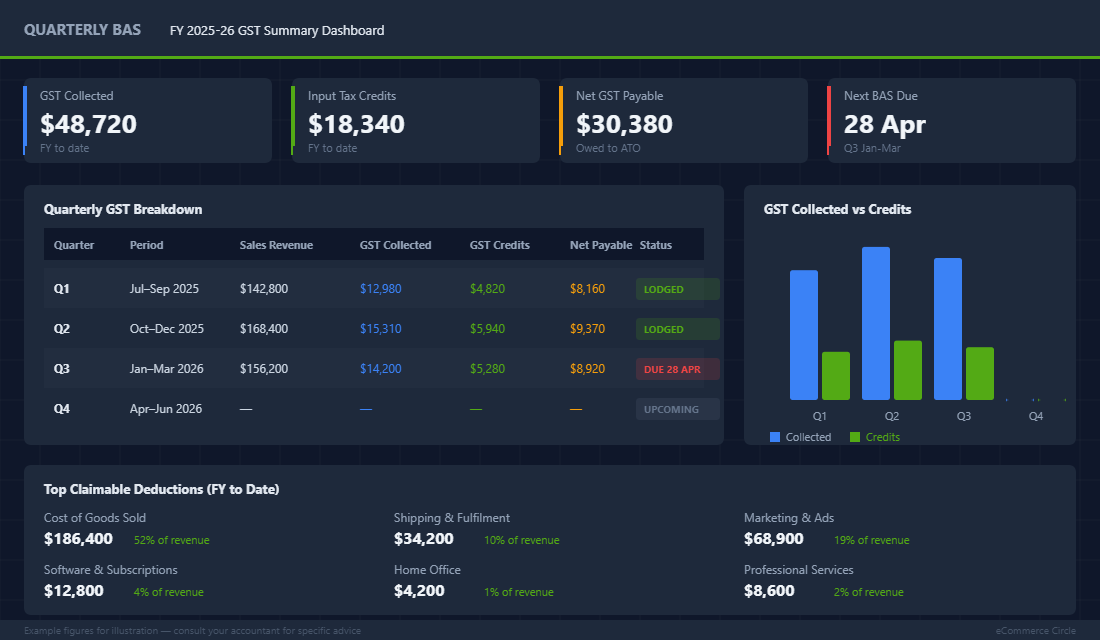
BAS due dates (quarterly):
- Q1 (Jul–Sep): Due 28 October
- Q2 (Oct–Dec): Due 28 February
- Q3 (Jan–Mar): Due 28 April
- Q4 (Apr–Jun): Due 28 July
Miss a BAS deadline and you’ll cop a failure-to-lodge penalty, plus general interest charges on any GST you owe. The ATO’s general interest charge sits around 11% per annum — that compounds fast.
The reconciliation problem. Here’s where most Shopify stores come unstuck. Your Shopify payouts don’t match your GST obligations dollar for dollar. Shopify takes fees, processes refunds, holds reserves, and batches payments. If you’re trying to reconcile your BAS against your bank statements manually, you’re going to get it wrong.
This is exactly why tools like A2X exist (more on that in the tools section). The gap between what lands in your bank account and what you actually owe in GST is where errors hide — and where the ATO finds them. If you’re not already tracking your contribution margin, this is where it starts to matter.
The Tax Deductions Most Ecommerce Owners Miss
You’re probably claiming cost of goods sold and shipping. Good. But most Shopify store owners leave thousands of dollars on the table because they don’t know what else qualifies.
Inventory and COGS. Everything you spend to acquire the products you sell — wholesale costs, manufacturing, import duties, freight to your warehouse. If it costs money to get a product ready to sell, it’s deductible.
Shipping and fulfilment. Postage, packaging materials, boxes, tape, labels, bubble wrap, warehouse rent if you use a 3PL, and fulfilment software subscriptions. Both domestic and international shipping costs count.
Marketing and advertising. Every dollar you spend on Meta Ads, Google Ads, TikTok campaigns, influencer fees, email marketing software (Klaviyo, Omnisend), SEO tools, content creation, and even photography for your product pages. If it promotes your business, claim it.
Software and subscriptions. Your Shopify plan, apps from the Shopify App Store, accounting software (Xero, MYOB), project management tools, design software, inventory management platforms — all deductible.
Home office expenses. If you run your store from home (and most founders do in the early stages), you can claim a portion of rent, electricity, internet, and phone costs. The ATO’s fixed rate method is 70 cents per hour for the 2024–25 financial year. Track your hours and claim it.
Professional services. Accountant fees, bookkeeper fees, legal advice, business coaching, and consulting costs. All deductible.
The record-keeping rule. The ATO requires you to keep receipts, invoices, and bank statements for at least five years. Not “until tax time.” Not “until I clean out my inbox.” Five years from when you lodge your return. Use a cloud accounting tool and keep everything digital.
Every deduction you miss inflates your taxable income and eats into the cash you could be reinvesting. We broke down exactly how this feeds into your overall profitability in our cash flow management guide — it’s worth reading alongside this article.
International Sales, Exports, and the Rules Most Stores Get Wrong
Selling internationally from Australia? The GST rules change — and most store owners either overcomplicate it or ignore it entirely.
Exports are GST-free. When you ship a physical product to an overseas customer, you don’t charge GST. Full stop. But (and this is the part people miss) you need to export the goods within 60 days of receiving payment or issuing the invoice. If you don’t, the sale becomes taxable.
What counts as proof? Keep your shipping receipts, tracking numbers, customs documentation, and any carrier confirmation that the goods left Australia. The ATO won’t take “I’m pretty sure I shipped it” as evidence.
DDP vs DDU shipping. For international orders over $1,000, shipping DDP (Delivered Duty Paid) gives your customer a better experience because they won’t get hit with unexpected charges at customs. DDU (Delivered Duty Unpaid) is cheaper for you but can lead to unhappy customers who refuse delivery when they see the duty bill. For brands serious about international growth, DDP is worth the extra cost.
Currency and exchange rates. If you sell in multiple currencies, you’ll need to convert international sales back to AUD for your BAS. The ATO accepts daily exchange rates published by the Reserve Bank of Australia. Use the rate on the date of the transaction.
If you’re managing returns across borders, the complexity multiplies. Getting your returns and refunds policy right becomes just as much a tax issue as a customer service issue.
Setting Up Your Tax Stack (Tools That Actually Save You Time)
Manual tax tracking for an ecommerce store is a disaster waiting to happen. Here are the tools that make compliance automatic:
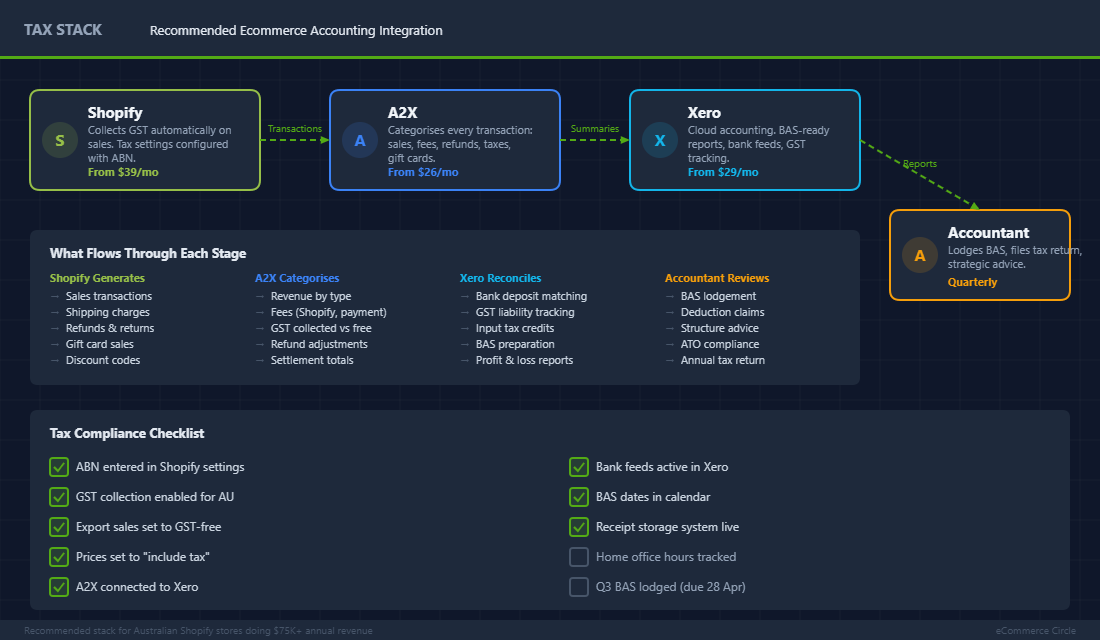
A2X (from $26 AUD/month) — This is the gold standard for Shopify-to-Xero (or QuickBooks) integration. A2X automatically categorises every Shopify transaction — sales, fees, refunds, gift cards, taxes — into accurate summaries that reconcile perfectly with your bank deposits. Instead of trying to match Shopify payouts to your accounting software manually, A2X does it in the background. Free onboarding is included on all plans.
How to set up A2X:
- Install A2X from the Shopify App Store
- Connect your Xero or QuickBooks account
- Map your Shopify transaction types to your chart of accounts
- Set your GST tax rates (10% for domestic, 0% for exports)
- Enable auto-posting so settlements sync daily
- Reconcile in Xero — the numbers should match your bank deposits exactly
Xero (from $29 AUD/month) — The go-to cloud accounting platform for Australian small businesses. It handles BAS preparation, GST tracking, bank feeds, invoicing, and reporting. The BAS-ready reports make lodging with the ATO straightforward.
Shopify Tax Settings — Don’t overlook the built-in. Shopify’s tax engine handles automatic GST calculation for Australian sales, GST-free rates for exports, and tax reports you can pull for BAS prep. Make sure your ABN is entered and your tax settings are configured correctly.
LinkMyBooks (alternative to A2X, from $19 AUD/month) — Another solid Shopify-to-Xero connector. Slightly cheaper, with similar functionality. Good for stores with simpler transaction patterns.
The stack that works for most Shopify stores: Shopify (tax settings configured) → A2X (automated reconciliation) → Xero (BAS-ready reports) → Your accountant (lodges the BAS). This removes you from the middle of the process and means your numbers are always up to date.
The Compliance Calendar Every Ecommerce Owner Needs
Tax compliance isn’t something you do once a year. For ecommerce, it’s a rhythm — and if you miss a beat, the penalties stack up fast.
Monthly tasks:
- Review your Shopify tax reports
- Reconcile A2X settlements in Xero
- Check that GST on international sales is correctly set to zero
- File away receipts and invoices for business expenses
Quarterly tasks:
- Lodge your BAS (due 28 days after quarter ends)
- Review your GST position — are you collecting the right amount?
- Check for any threshold changes (did you cross $75K?)
- Reconcile your Shopify payouts against your bank account
Annual tasks:
- Lodge your income tax return (due by 31 October for self-lodgers, later with a tax agent)
- Review your business structure — is sole trader still right, or is it time for a company structure?
- Audit your deductions — are you claiming everything you’re entitled to?
- Review your pricing — are your margins absorbing GST correctly?
- Get a health check from an ecommerce-specialist accountant
The compound effect. When you layer these rhythms together — daily tracking through Shopify, weekly reconciliation through A2X, quarterly BAS through Xero, and annual strategy with your accountant — tax compliance stops being a stressful scramble and becomes a background system. And like every system in your ecommerce business, when it runs smoothly, it protects your cash flow and frees up your attention for growth.
The Tax Compliance Checklist for Australian Shopify Stores
Here’s your action list. Bookmark this page, work through it, and make sure every box gets ticked:
GST Setup:
- Registered for GST (if turnover exceeds $75K)
- ABN entered in Shopify settings
- GST collection enabled for Australian customers
- Export sales set to GST-free
- Prices set to “include tax” (Australian standard)
Accounting Stack:
- Cloud accounting software connected (Xero or QuickBooks)
- A2X or LinkMyBooks installed and mapped
- Bank feeds connected in Xero
- Chart of accounts set up with ecommerce-specific categories
Record Keeping:
- Digital receipt storage system in place
- 5-year retention policy understood and implemented
- Business vs personal expenses clearly separated
- Home office hours tracked (if applicable)
BAS & Lodgement:
- BAS lodgement dates in your calendar
- Quarterly reconciliation process documented
- Tax agent engaged (if not self-lodging)
Deductions:
- COGS and shipping costs tracked
- Marketing spend categorised
- Software subscriptions logged
- Home office expenses calculated
- Professional services invoices filed
Get Your Tax Right — So You Can Focus on Growth
Tax isn’t the part of running a Shopify store that gets you fired up in the morning. But it’s the part that can quietly drain your cash, expose you to penalties, and create a mess that takes months to untangle if you ignore it.
The good news? Once the system is set up — GST configured in Shopify, A2X syncing to Xero, BAS dates in your calendar — it runs in the background. You spend an hour a month on it instead of a panicked week at the end of each quarter.
The Monthly Bookkeeping Rhythm That Makes BAS a Non-Event
Quarterly BAS is only painful because three months of mess arrives at once. Founders who find it easy are not better at tax. They just do ninety minutes of work each month instead of two panicked days each quarter.
Block the first Tuesday of every month and work the same four steps in the same order.
- Reconcile the payout, not the order. Shopify Payments pays you net of fees, so the deposit never matches your sales figure. A2X or Link My Books splits each payout into sales, fees, refunds, and GST so Xero matches to the cent.
- Clear the uncategorised bucket to zero. Anything sitting unreconciled at month end will still be there at quarter end, except you will have forgotten what it was.
- Check your GST-free and export sales are coded correctly. This is where most Shopify stores get it wrong, because overseas orders and GST-free products need different tax codes and the default is rarely right.
- Move the GST out of your operating account. Sweep your estimated GST liability into a separate holding account the same day. Money you never see is money you never spend.
That last one is the single highest-value habit in this whole article. The GST you collect was never your money. Treating it as working capital is how otherwise profitable stores end up on an ATO payment plan.
Imagine you turn over $80,000 a month with most sales GST-inclusive. You are holding roughly $7,200 of GST every month that belongs to the ATO. Across a quarter that is over $21,000 sitting in your account looking like cash. Spend it on stock and you will feel the gap the moment the BAS falls due.
When to Stop Doing This Yourself
Doing your own books is sensible early. There is a point where it stops being thrift and starts being risk, and most founders pass it without noticing.
- You sell overseas. Export rules, overseas marketplace obligations, and foreign consumption taxes are not something to work out from a forum thread.
- You hold stock across multiple locations or a 3PL. Inventory valuation starts materially affecting your tax position.
- You have employees. PAYG withholding, super guarantee, and payroll tax thresholds each carry their own deadlines and penalties.
- You are turning over more than roughly $1M. The cost of a good ecommerce-literate accountant is now smaller than the cost of one avoidable mistake.
Look for a registered tax agent who has other Shopify clients and understands payout reconciliation. An accountant who has never seen a Shopify settlement report will spend your money learning on your file.
One thing to be clear about: this article is general information about how to run the process, not tax advice for your situation. Thresholds, rates, and concessions change between financial years. Confirm anything that affects what you lodge with your registered tax agent or directly with the ATO before you act on it.
Inside the eCommerce Circle, tax and financial protection is one of the core pillars we work on with every member. Because scaling a store without your numbers sorted isn’t growth — it’s gambling.
If your tax setup needs work, or you’re not sure whether your margins are accounting for GST properly, that’s exactly the kind of thing we help you fix.