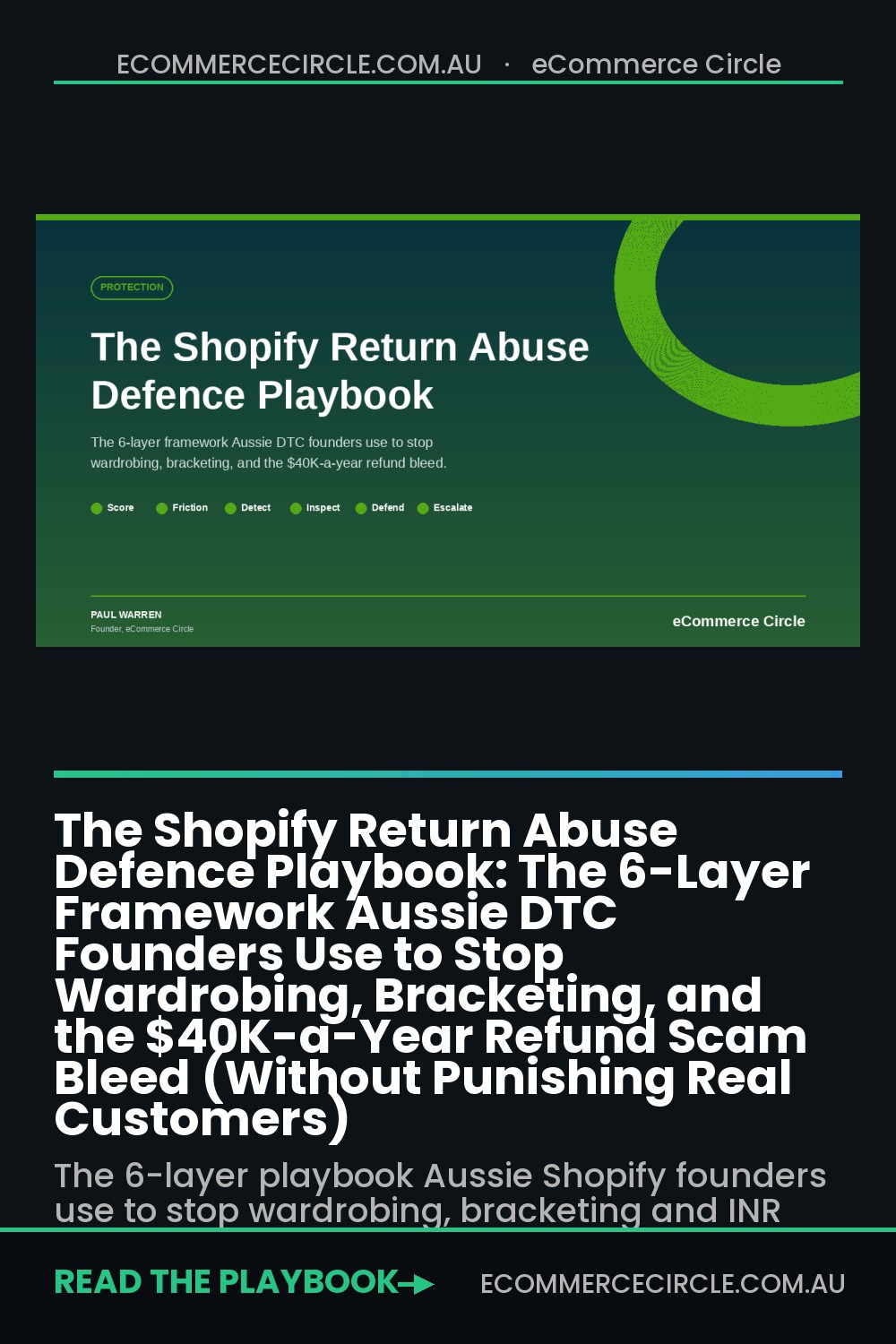
Last quarter, an Aussie activewear brand on a $2.4M annual run rate quietly lost $41,000 to return abuse. Not legitimate returns. Abuse. Worn leggings sent back with the tags reattached. Box of rocks instead of a $180 jacket. Three sizes ordered, three returned, all three with the lint roller marks of two weekends of wear. Plus a steady drip of “I never received it” claims on orders the courier had photo evidence of delivering.
What’s in This Article
Here is the problem. Most Aussie Shopify founders write a returns policy designed to delight 100% of customers, then absorb the 9% that abuse it as a cost of doing business. That math used to work when CAC was cheap and margins were fat. In 2026 it does not. The NRF puts global retail returns at $849.9 billion in 2025, with 19.3% of online sales sent back and 9% of all returns flagged as fraudulent. That is roughly $76 billion in pure return fraud sitting on top of legitimate reverse logistics costs.
For every $100 of merchandise returned, retailers lose $10.30 to return fraud. On a $2M Aussie Shopify store running a 20% return rate, that is $41,200 a year leaving the bank account through one specific leak. The good news: return abuse is the most patterned form of fraud in ecommerce. The same six layers stop the abuse before it reaches your inspection bench. This is the playbook we run with eCommerce Circle members the moment their AOV crosses $80 and return rates pass 15%.
Why Your Returns Policy Is the Bleed (And Not the Customers)
The post-2020 returns era trained consumers to expect the impossible. Free shipping both ways. No questions asked. Tags-on, tags-off, “I changed my mind in the carpark”, all approved. Then we wondered why 65% of consumers admit to at least one costly return behaviour and 45% say bending the truth is acceptable when they are unhappy with a purchase. Behaviour follows policy. If the policy says “no friction, no questions, full refund”, the behaviour will rise to fill the space the policy creates.
The four abuse patterns that account for most of the bleed:
- Bracketing. Customer orders three sizes intending to keep one. 53 to 58% of online shoppers admit to this. Footwear hits 35% return rate, swimwear and lingerie 30 to 35%, apparel 24 to 26%. The intent is built into the purchase.
- Wardrobing. Garment worn once for an event, tags carefully reattached, returned as new. Common with formalwear, occasion dresses, and resort sets. Often impossible to detect with a 30-second visual check.
- Empty box and decoy returns. 65% of retailers who track these report seeing them rising. Decoy returns (counterfeit item inside the original box) sit at 64%. Both require a process change, not a policy change.
- INR (Item Not Received) claims. 55% of merchants rank this as their single biggest policy abuse concern. 93% cite INR as the primary driver of abuse write-offs. 47% of merchants now report refund abuse as their most common attack type.
Notice the common thread. Every one of these is a behaviour, not a one-time mistake. The customer either planned the abuse before placing the order or repeated the same pattern across multiple orders. That is the opening. You can score the pattern before you ever ship a parcel.
Layer 1: Score the Returner (Stop Treating All Customers the Same)
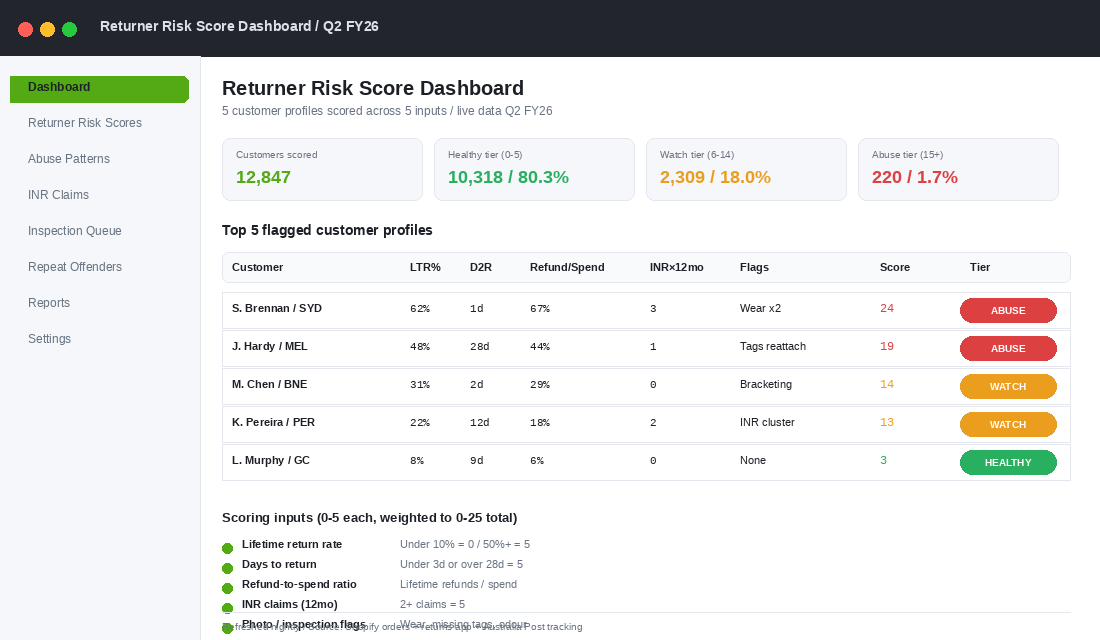
Most Shopify stores treat every return request identically. First-time buyer with one return on a $90 jacket gets the same flow as the four-time bracketer who returned 11 of her last 14 orders. That is operationally lazy and financially expensive. The first layer of the playbook is a per-customer Returner Risk Score, refreshed every time an order is placed and every time a return is opened.
Five inputs, scored 0 to 5 each, weighted to a single 0 to 25 score:
- Lifetime return rate. Under 10% scores 0. 10 to 20% scores 2. 20 to 35% scores 3. 35 to 50% scores 4. Over 50% scores 5. The serial bracketers reveal themselves inside three orders.
- Days-to-return. Average gap between delivery and return request. Under 3 days suggests bracketing (the customer never intended to keep multiple items). 3 to 14 days is normal. 28 to 30 days suggests wardrobing (the event has passed). Both extremes score high.
- Refund-to-spend ratio. Lifetime refunds as a percent of lifetime gross spend. A customer who has spent $1,200 and refunded $800 is a different commercial profile to one who has spent $1,200 and refunded $90.
- INR claim count. Any customer with two or more “did not arrive” claims in 12 months scores 5. The base rate is so low that two claims is a statistical signal, not a coincidence.
- Photo and inspection flags. Any prior return that came back with visible wear, missing tags, wrong item swapped, or perfume/deodorant odour scores 4 to 5.
Score 0 to 5 is your healthy 80% of customers. Frictionless self-service portal, instant approval, fast refund. Score 6 to 14 is the watch tier. Standard returns flow but flagged for inspection. Score 15+ is the abuse tier. Manual review required, exchange or store credit only, no refund to original payment. Loop Returns (the highest-rated Aussie-relevant returns app, 5,000+ merchants) handles this via Custom Rules and Blocklists. ReturnGo (5-star average across 293 reviews) does the same through workflow conditions. Both apps will export the customer-level data so you can build the score in a Google Sheet first to confirm the cutoffs match your real distribution before you turn the rules on.
Layer 2: The Pre-Approval Friction Stack (Verify Before You Approve)
The single biggest mistake in returns operations is approving the return before the parcel is in your warehouse. The friction stack is the set of steps the customer must complete before a return label issues and refund expectations are set. Done right, it filters 30 to 50% of abusive requests at the request stage. Done wrong (as a wall of pop-ups for every customer) it punishes the good 80%.
Five friction layers, applied conditionally based on the Returner Risk Score:
- Reason code with sub-reason. Not just “did not fit”. “Did not fit: too tight / too loose / sizing inconsistent / wrong style for body”. Granular reasons reveal patterns and reduce vague claims that cannot be verified.
- Photo upload (mandatory for score 6+). A photo of the item, tags, and original packaging from three angles. Bracketers will not upload because the photo shows wear. Wardrobers will not upload because it shows reattached tags. The drop-off rate at the photo gate is roughly 18 to 25% in Loop and ReturnGo benchmarks.
- Tag and packaging confirmation tick-boxes. “I confirm the item has all original tags, hygiene seals (if applicable), and original packaging. I understand returns sent back without these will be refused and returned to me at my expense.”
- Restocking fee on score 15+ profiles. 10 to 15% restocking fee for high-risk customers on items where the abuse pattern is clear. Yes, you will lose some sales. The customers you lose are the ones costing you 10x in margin.
- Final-sale tagging for known-abuse categories. Swimwear, lingerie, formalwear over $200, sale items past 30 days. “Final sale, no returns” needs to live on the PDP, in the cart drawer, on the order confirmation, and on the dispatch email. Four touchpoints. Any less and the customer will claim they never saw it.
The combined effect: at a brand running a 24% return rate with a healthy customer mix, the friction stack typically drops return requests by 14 to 22% inside 60 days. Not because legitimate returns are blocked, but because the marginal bracketer and the casual wardrober self-deselect at the photo gate. Pair this with the structured returns policy framework we have published previously, and the policy and the operational stack reinforce each other.
Layer 3: Detect the Patterns Before You Refund
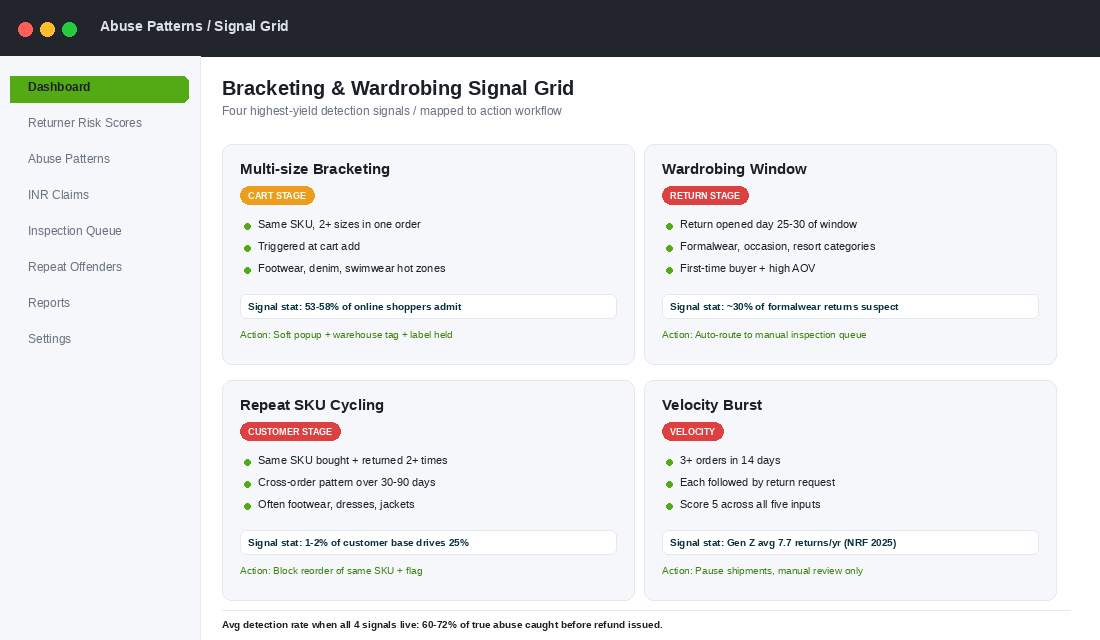
The third layer is pattern recognition at the order and return level. Bracketing and wardrobing are not random. They leave fingerprints across the data. Your job is to know what those fingerprints look like and build the alert into the workflow.
The four highest-yield detection signals:
- Multi-size bracketing signal. Single order containing two or more sizes of the same SKU. Auto-flag at the cart stage. The friction can be soft (a popup explaining your sizing tool and asking the customer to commit to one size) or hard (an order tag for the warehouse team to ship in a way that makes “keep the best fit and return the rest” easier for the customer to handle, with the return label pre-printed but no refund issued until all returns are received).
- Wardrobing window signal. Return request opened between day 25 and day 30 of the return window. Combine with item category (formalwear, occasion dresses, resort wear, holiday swimwear) for the highest-yield filter. Auto-route to manual inspection.
- Repeat SKU signal. Same SKU bought, returned, bought again, returned again across multiple orders by the same customer. Particularly common with footwear and dresses. Sometimes legitimate. Often a sign of pre-meditated wardrobing across multiple “occasions”.
- Velocity signal. Customer placing three or more orders in 14 days, each followed by a return request. Score 5 across the board. Pause new shipments and route to a manual review queue. Gen Z customers average 7.7 returns per year across the population (NRF, 2025), but a single customer hitting that volume on your store inside 30 days is a different signal entirely.
This layer is where the abuse detection moves from policy to data. Most Shopify stores have the signal in the data already, they just have nothing reading it. Loop’s Workflows reads order tags and customer tags and can auto-route into a queue. If you are not on a returns app yet, the lo-fi version is a Shopify Flow trigger that adds an “inspect-on-arrival” customer tag the moment any of these four signals fires. Cost: zero. Implementation time: about 90 minutes if you have used Flow before.
Layer 4: The 4-Point Returns Inspection Protocol
When the parcel hits your warehouse, the inspection determines whether the refund goes through. 71% of retailers who track return abuse cite “overstated quantity of returns” as a rising problem. 65% cite empty box / box of rocks. Both of these get past a 30-second visual check. Both get caught by a documented four-point protocol that takes 90 seconds and gets done the same way every time, regardless of who is on inspection duty that day.
The four points:
- Weight on arrival. Weigh every return parcel before opening. If the item is a $200 jacket that ships at 740g, a returned parcel weighing 420g triggers an immediate hold. Compare to the original dispatch weight in your shipping platform. Variance over 12% gets photographed before opening.
- Photo before unpacking. Photo of the sealed parcel, photo of the open parcel, photo of the item laid flat with tags visible. Three photos, named by order number, stored against the return record. If the customer disputes later, you have the evidence.
- Tag, hygiene seal, and packaging integrity check. Tags must be attached, not reattached. Look for puncture re-insertions in the fabric, re-tied plastic, or substituted tags from a different SKU. Hygiene seals on swimwear and lingerie must be intact. Original packaging (shoe boxes, cosmetics outer boxes) must be present and undamaged.
- Wear, odour, and damage check. Fabric pilling, deodorant marks, perfume/cologne residue, makeup transfer, foundation marks at collar, hairs on the inside. These are the wardrobing tells. The inspection lead needs explicit permission to refuse the refund and document the reason. Without that mandate, the team will approve to avoid the awkward customer email.
The protocol needs to be a printed laminated card on the inspection bench. Not an SOP buried in Notion. The card is the SOP. Anyone on shift can run the check. This connects directly to the broader operational rigour we cover in the supplier risk playbook and the principle that documented operational standards beat tribal knowledge every time.
Layer 5: The INR (Item Not Received) Defence System
“It never arrived.” Four words that drain more margin than any other phrase in ecommerce. 32% of all friendly fraud cases cite INR. 93% of merchants report INR as the primary driver of abuse-related write-offs. And because the claim originates on the customer side and the proof lives with the courier, most Shopify stores default to the refund, eat the loss, and move on.
The defence system has five components and most of them cost nothing beyond setup time:
- Photo-on-delivery as standard. Australia Post, StarTrack, Aramex, Couriers Please all support photo-on-delivery for ATL (authority to leave) parcels at no extra cost. Make sure it is switched on for every shipment over $80. The photo is timestamped, geo-tagged, and lives on the courier’s manifest for 90 days. That is your first-line evidence.
- Signature on delivery threshold. Orders over $250 (you set the number based on your AOV and basket profile) require signature. Costs an extra $3 to $5 per parcel. Eliminates almost every INR claim because the customer cannot dispute their own signature. The economics work the moment your INR claim rate climbs above 0.6%.
- The “three questions” reply template. When an INR claim comes in, the first response is never “we will refund you immediately”. It is three structured questions: (1) Have you checked with neighbours, building manager, or family members at the address? (2) What is the delivery address as it appears on your order confirmation, verified? (3) Are you willing to file a formal statutory declaration of non-receipt? Question three alone deters roughly 40% of friendly INR claims in our member benchmarks.
- Courier escalation before refund. Lodge a formal investigation with the courier before issuing any refund. Australia Post investigations close in 5 to 10 business days. Most legitimate claims will be resolved through the courier. Most friendly fraud claims will be withdrawn the moment the customer is told a formal investigation has been opened.
- The repeat-INR tag. Any customer with two INR claims in 12 months gets a permanent customer tag. All future orders ship signature-required at the customer’s cost or the customer is moved to manual review. Yes, a small number of legitimate-but-unlucky customers will be inconvenienced. The math on the friendly fraud savings makes this worth it every time.
This connects to the broader chargeback and payment fraud playbook we have already published, because INR claims that get rejected often escalate to credit card chargebacks. The defence is the same defence either way: documented evidence, structured response, never the silent refund.
Layer 6: The Repeat Offender Escalation Playbook
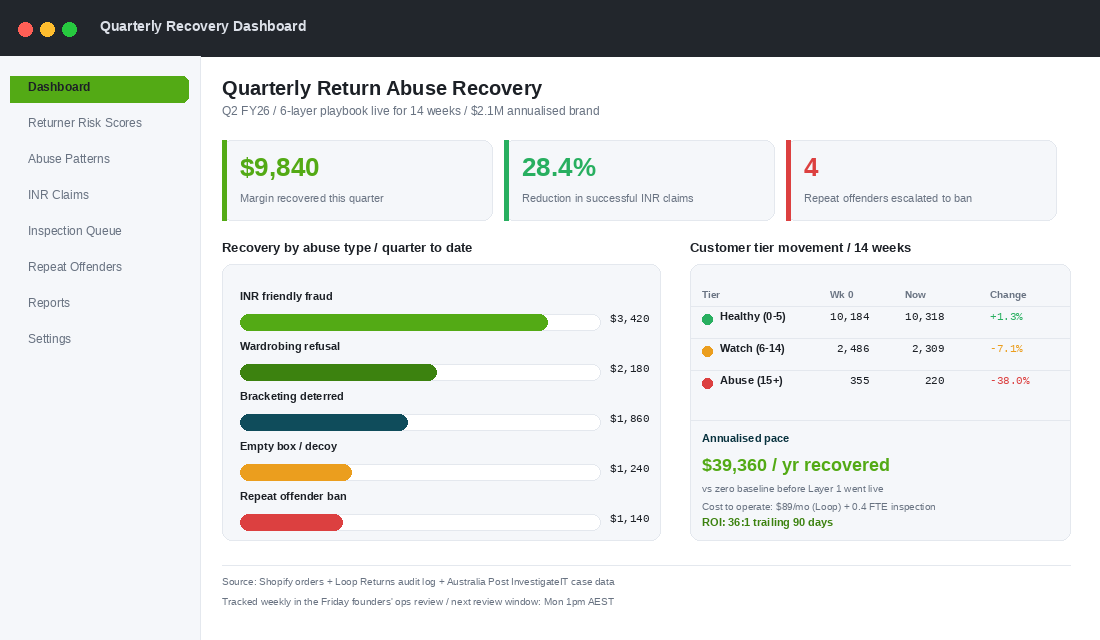
The hardest conversation in returns operations is the one where you tell a paying customer they are no longer welcome. Most Aussie founders avoid it. The data says they should not. The top 1 to 2% of return-abuse offenders typically generate 20 to 30% of your total return-fraud losses. Cutting that customer off is one of the single highest-ROI decisions in the business.
The three-strike escalation playbook:
- Strike one: friendly warning. Triggered when Returner Risk Score crosses 15 for the first time. Email from a real person on your team explaining that you noticed a high return frequency, sharing your sizing guide and fit advice, and offering a one-time gesture of goodwill. Most customers respond well. This is also where you set the documented record that the customer was informed.
- Strike two: store credit only. Score crosses 18 or a second flagged behaviour appears. Customer is moved to store-credit-only refunds on all future returns. Notified by email with a clear explanation and a path back (clean record across the next four orders moves them back to full refund eligibility).
- Strike three: account closure. Score 22+ with documented pattern across three or more orders. Account closed. Email address, shipping address, and payment fingerprint added to the blocklist in Loop or your fraud app of choice. Future orders auto-cancelled. The cancellation note is brief, professional, and never apologetic. Customers who attempted to abuse will not appeal. Customers who were genuinely caught unfairly will appeal, and you reinstate them with full context recorded.
The fear that “they will leave us a one-star review” is real and almost never plays out the way founders worry it will. Public reviews from caught abusers are rare because the review forces them to publish the behaviour that got them banned. When it does happen, a calm public response referencing your published returns policy and your evidence-based process turns the review into an asset.
The Compound Effect: Why 0.4% of Margin Becomes $32K a Year
Each layer in isolation looks modest. Stack them and the math gets interesting. Take a typical Aussie Shopify brand doing $2M revenue, 22% return rate, $440K in annual returns. At the NRF benchmark, $40,700 of that is fraud. The six-layer playbook recovers what we typically see in eCommerce Circle member benchmarks:
- Layer 1 (Scoring): 6 to 9% reduction in return rate through behaviour change once customers know their account is scored.
- Layer 2 (Friction stack): 14 to 22% reduction in request volume through self-deselection at the photo and tag-confirmation gates.
- Layer 3 (Pattern detection): 18 to 25% of flagged returns refused at inspection with documented evidence.
- Layer 4 (Inspection protocol): 8 to 12% additional refusals through systematic weight, photo, and wear checks the team was previously skipping.
- Layer 5 (INR defence): 35 to 50% reduction in successful INR friendly fraud claims through structured response and courier escalation.
- Layer 6 (Escalation): The top-tier 1 to 2% of repeat abusers removed permanently, recovering disproportionate margin.
Total recovery across the six layers in our member set typically lands between $24,000 and $38,000 of annual margin at the $2M revenue level. On an 18% net margin business, that is the equivalent of finding $135,000 to $210,000 of net new revenue without spending a dollar on acquisition. It is the highest-ROI work most Aussie founders are not doing. 85% of retailers say they have deployed AI to detect return fraud, and yet only 45% of them think it is actually working. The reason is the same in every case: tools deployed without the layered playbook around them. Tools without process is theatre.
Your First 14 Days: How to Roll This Out Without Breaking Customer Trust
You do not need to deploy all six layers in week one. You need to deploy them in the right order so the protection compounds and the customer experience holds. The order we run with members:
- Days 1 to 3: Export the last 12 months of returns data from Shopify. Calculate the Returner Risk Score for every customer with three or more orders. This gives you the baseline tier list.
- Days 4 to 7: Document the 4-point inspection protocol on a one-page laminated card and brief the warehouse team. This is the fastest, lowest-risk change. No customer-facing change yet.
- Days 8 to 10: Switch on photo-on-delivery for every parcel over $80 and signature-on-delivery for every parcel over $250. Brief the team on the “three questions” reply template for INR claims.
- Days 11 to 14: Configure the friction stack in Loop or ReturnGo, soft-launch on the top-risk segment only, and watch the data for a week before broader rollout.
By the end of the second week, you will have evidence of which layers are pulling the most weight in your specific brand. From there, scale up.
Inside eCommerce Circle, return-abuse defence is one of the core Protection pillars we work on with every member once they cross $1M revenue. The reason it sits in Protection (not Performance) is that it is risk management, not optimisation. If you want a second opinion on the bleed inside your own returns operation, let’s talk.