You put “Free Shipping Over $X” in your announcement bar because every other Shopify store does it. Seemed like the right move. Customers expect it, competitors offer it, and the Shopify forums told you it would boost your conversion rate.
What’s in This Article
But here’s the question nobody asks: did you actually do the maths before you picked that number?
Most store owners pull their free shipping threshold out of thin air. They pick a round number that “feels right” – $50, $100, whatever – and never calculate whether they can actually afford to absorb that shipping cost on every qualifying order. The result? They’re quietly bleeding margin on 30-40% of their orders and wondering why their bank account doesn’t match their revenue.
The brands that get this right treat their free shipping threshold like a profit lever, not a marketing checkbox. They calculate exactly where the line sits between “encouraging bigger carts” and “giving away margin.” And they test it constantly.
This guide walks you through the exact process for setting, testing, and optimising your free shipping threshold – so it grows your average order value without eating your profit.
Why Free Shipping Isn’t Actually Free
Let’s get the obvious out of the way: free shipping isn’t free. Someone pays for it. And when you offer it without a strategy, that someone is you.
Here’s what a typical Australian Shopify store looks like when free shipping goes wrong.
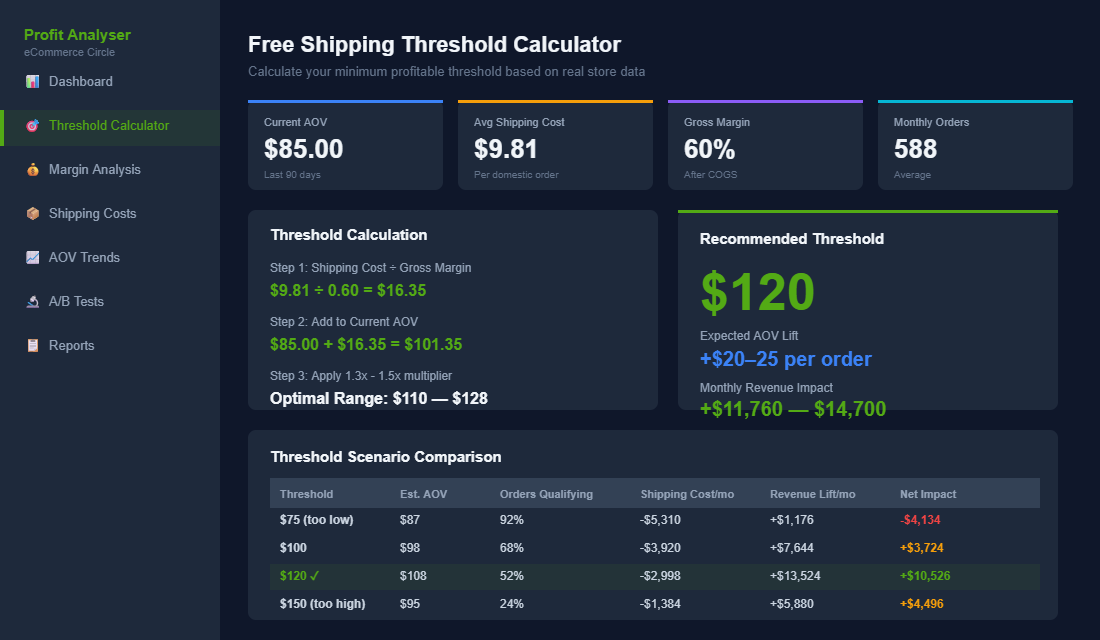
Say your average order value (AOV) is $85. You offer free shipping on all orders over $75. Your average shipping cost is $9.81 (that’s the actual Australian average in 2024, according to Australia Post data). Your product margins sit around 60%.
On an $85 order, your gross profit is $51. Subtract $9.81 in shipping and you’re down to $41.19. That’s an 11.5% margin hit on every single order that qualifies – before you’ve paid for ads, staff, packaging, or your Shopify subscription.
Now multiply that across hundreds of orders a month. If you’re doing $50,000 in monthly revenue and 70% of orders qualify for free shipping, you’re absorbing roughly $3,400 in shipping costs per month. That’s $40,800 a year coming straight out of your profit.
The problem isn’t offering free shipping. The problem is offering it at the wrong threshold with no margin calculation behind it.
The Free Shipping Threshold Formula
There’s a straightforward formula for calculating a profitable free shipping threshold. It’s not complicated, but almost nobody actually does it.
Step 1: Know your current AOV. Pull this from your Shopify analytics. Go to Analytics > Reports > Average order value. Use the last 90 days for a reliable number.
Step 2: Know your average shipping cost. Check your shipping invoices or your carrier account dashboard (Australia Post MyPost Business, Sendle, or whoever you use). Calculate the average cost per domestic shipment over the last 90 days. For most Australian stores shipping standard parcels, this sits between $8 and $14.
Step 3: Know your gross margin percentage. If you’re selling a product for $100 and it costs you $40 (including landed cost, packaging, and fulfilment labour), your gross margin is 60%.
Step 4: Calculate the minimum profitable threshold. The formula is:
Minimum Threshold = Average Shipping Cost ÷ Gross Margin Percentage + AOV
So if your average shipping cost is $10, your gross margin is 60%, and your AOV is $85:
$10 ÷ 0.60 = $16.67
$85 + $16.67 = $101.67
Your free shipping threshold should be at least $102. At this level, the additional margin from the extra items covers the shipping cost.
Step 5: Apply the 1.3x rule. Most ecommerce strategists recommend setting your threshold at 1.3 to 1.5 times your current AOV. This creates enough of a stretch to drive meaningfully larger carts without being so high that customers give up.
For an $85 AOV, that puts your optimal range at $110 to $128. The sweet spot? Round to a clean number that feels achievable. $120 works. $99 works too if you want the psychological trigger of staying under $100 – but only if the maths still holds.
What the Data Says About Thresholds and Customer Behaviour
Setting a threshold isn’t just a margin exercise. It’s a behavioural one. And the data is overwhelmingly in your favour when you get it right.
According to industry benchmarking data, 80% of online shoppers will add items to their cart to meet a free shipping threshold. That’s not a typo – four out of five customers will actively spend more if you give them a clear target.
The average increase in order value when a threshold is introduced? Around 30%. So if your current AOV is $85 and you introduce a $120 threshold, you can realistically expect your AOV to climb to $100-$110 as customers add extra products to qualify.
On the flip side, 47% of shoppers abandon their cart when unexpected costs (including shipping) appear at checkout. This is the number one reason for cart abandonment globally – it’s been the top driver for years running.
What does this tell you? Customers want free shipping. They’ll work to get it. But they need to know the rules upfront.
That means your threshold needs to be visible everywhere: announcement bar, product pages, cart page, and checkout. The brands that bury their shipping policy in a footer link are leaving money on the table.
Australian-specific data adds another layer. Australia Post’s 2025 eCommerce report found that one in four Australian shoppers will increase their cart value specifically to qualify for free delivery. And the number one delivery expectation among Aussie shoppers? Pre-purchase clarity about delivery charges – 66% rated this as their top concern.
The message is clear: show the threshold early, make it achievable, and customers will reward you with bigger orders.
Three Free Shipping Models (And Which One Suits Your Store)
Not every store should use the same model. Here are the three main approaches, with guidance on when each one makes sense.
Model 1: Threshold-Based Free Shipping. This is the most common and most profitable model. You set a minimum order value (say $120) and offer free shipping on all orders above that amount. Orders below the threshold pay a flat rate.
Best for stores with AOV between $50 and $200 and gross margins above 50%. This covers most Australian Shopify stores selling apparel, beauty, homewares, or health products.
How to implement in Shopify: Go to Settings > Shipping and Delivery. Create a shipping profile with two rate tiers – a flat rate for orders under your threshold and a $0 rate for orders at or above it. You can use Shopify’s built-in conditions to set the price threshold.
Model 2: Free Shipping on Everything. Every order ships free, regardless of size. You absorb the cost on all orders.
Best for high-margin products (70%+ gross margin), subscription brands, or stores where the average shipping cost is very low (under $5). Also works for brands competing in categories where free shipping is the absolute baseline expectation.
The risk: if your margins are thin or your products are heavy and bulky, this will destroy your profitability. Run the numbers before committing.
Model 3: Membership or Loyalty-Based Free Shipping. Only members of your loyalty program or subscribers get free shipping. Everyone else pays standard rates.
Best for brands focused on retention and lifetime value. This turns free shipping into a loyalty perk rather than a universal cost. Culture Kings uses a version of this approach, offering free shipping over $100 for standard customers but sweetening the deal for loyalty members.
The hybrid approach works well too. Many successful Australian brands combine models – free shipping on orders over $100 for everyone, and free shipping on all orders for loyalty members. This drives both AOV and program sign-ups.
How to Display Your Threshold for Maximum Impact
Setting the right threshold is only half the battle. How you communicate it determines whether customers actually change their behaviour.
The Announcement Bar. This is your highest-visibility real estate. Your free shipping message should live in your announcement bar across every page of your store. Keep it simple: “Free Shipping on Orders Over $120” or “Spend $120+ for Free Delivery Australia-Wide.”
Don’t rotate this message with promotional banners. Free shipping should be a permanent, always-visible message. It reduces purchase anxiety on every single page view.
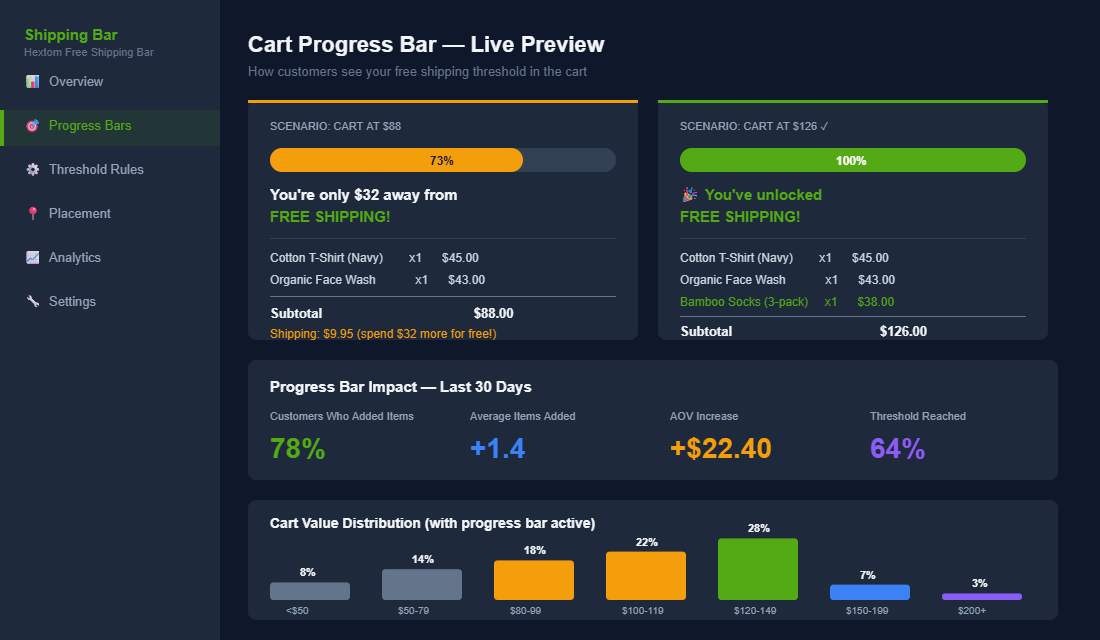
The Cart Progress Bar. This is where the magic happens. A free shipping progress bar in your cart shows customers exactly how close they are to qualifying. “You’re $32 away from free shipping!” is one of the most powerful conversion messages in ecommerce. It creates a micro-goal that customers actively try to hit.
Shopify apps like Hextom Free Shipping Bar (rated 4.9 stars with nearly 3,000 reviews) or Progressify make this dead simple to implement. Most take under 10 minutes to set up. Stores using shipping threshold progress bars see 15-25% higher AOV compared to stores that just mention the threshold in text.
Product Pages. Add a subtle shipping message below the Add to Cart button. Something like “Free shipping on orders over $120” in a muted text style. This removes a purchase objection at the exact moment of decision.
Checkout. Shopify’s checkout will automatically show the shipping cost (or $0 for qualifying orders), but you can reinforce the win with a message like “You’ve qualified for free shipping!” using Shopify checkout customisation or a thank-you page script.
The Threshold Test: How to Find Your Exact Sweet Spot
You’ve done the maths. You’ve picked a starting threshold. Now test it.
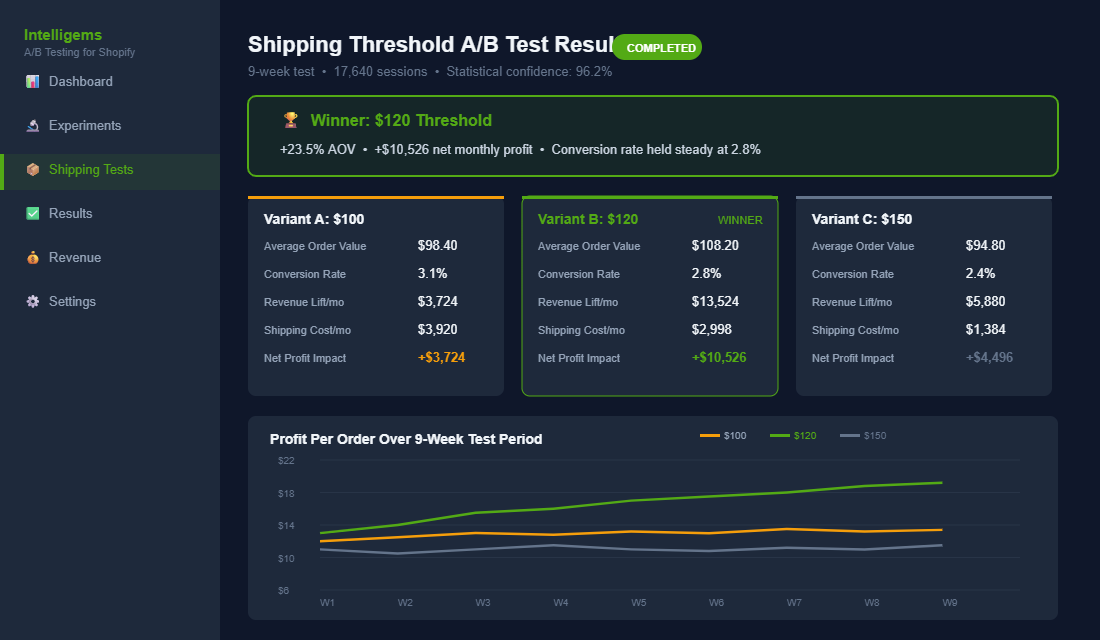
The best Shopify brands don’t set their threshold once and forget about it. They test 2-3 different levels over 4-6 week periods and measure the impact on three key metrics.
Metric 1: Average Order Value. Did AOV increase? By how much? If your threshold is $120 and your AOV moved from $85 to $105, you’ve added $20 per order. On 500 orders a month, that’s $10,000 in additional revenue.
Metric 2: Conversion Rate. Did fewer people complete checkout because the threshold felt too high? A small conversion dip (1-2%) is acceptable if AOV gains more than offset it. A large dip (5%+) means your threshold is too aggressive.
Metric 3: Profit Per Order. This is the one that matters most. Higher AOV means nothing if the extra items customers add are low-margin products. Track your actual gross profit per order, not just revenue.
Here’s a simple test framework:
- Week 1-3: Set threshold at 1.3x your current AOV. Measure all three metrics.
- Week 4-6: Adjust threshold up by 10% (to roughly 1.4x AOV). Measure again.
- Week 7-9: Try 1.5x AOV. Measure again.
Compare the three periods. The threshold that maximises profit per order (not revenue, not AOV) is your winner.
Tools like Intelligems (built specifically for Shopify) let you run proper A/B tests on shipping thresholds, so you can test two levels simultaneously rather than sequentially.
Common Mistakes That Kill Your Margins
After working with hundreds of Shopify stores, these are the threshold mistakes we see most often.
Setting it too low. If your threshold is only 10-15% above your AOV, almost every order qualifies and you’re just absorbing shipping costs without driving any behavioural change. You’re subsidising orders that would have happened anyway.
Setting it too high. If your threshold is more than 2x your AOV, customers won’t even try to reach it. They’ll just pay for shipping or – worse – abandon the cart entirely. The threshold should feel like a stretch, not a leap.
Ignoring product weight variations. If you sell both lightweight accessories ($15 items, $5 shipping) and heavy hardware ($200 items, $25 shipping), a single threshold might not work. Consider different thresholds for different product categories, or use calculated shipping for heavy items while offering free shipping on lightweight orders.
Never testing. The right threshold changes as your product mix, AOV, and shipping costs evolve. Review your threshold quarterly. What worked at $100 AOV won’t work when you’ve grown to $140 AOV.
Hiding shipping costs until checkout. 47% of cart abandonment happens because of unexpected costs at checkout. If you charge shipping on orders under your threshold, make that cost visible early – on product pages and in the cart. Surprise fees at checkout are the fastest way to lose a customer forever.
Putting It All Together: The Compounding Effect
Here’s where free shipping strategy stops being a single tactic and becomes a profit system.
When you set the right threshold, three things happen simultaneously. Your AOV increases by 15-30% as customers add extra items to qualify. Your conversion rate holds steady or improves because customers who see a clear, achievable free shipping offer have less purchase anxiety. And your customer acquisition cost effectively drops – if your AOV goes from $85 to $110, and your cost to acquire that customer stays the same, your ROAS improves by nearly 30% without changing a single ad.
Now layer on the secondary effects. Higher AOV means more products per order, which means customers are exposed to more of your range. That increases the chance of repeat purchases. Repeat customers are 3-5x cheaper to convert than new ones. And loyal customers are less price-sensitive, meaning they’ll hit your threshold naturally over time.
This is the compounding effect of getting your shipping strategy right. It doesn’t just protect your margins today – it builds a more profitable business over time.
One more thing: Australian shipping costs are not getting cheaper. Australia Post, Sendle, and every major carrier have increased rates year-over-year for the past five years. The average delivery cost hit $9.81 in 2024, up from around $8.50 just three years earlier. If your threshold isn’t keeping pace with rising costs, your margins are shrinking silently.
Review your threshold every quarter. Adjust it as shipping costs and your AOV evolve. This isn’t a set-and-forget exercise.
The Australia Factor: Setting Thresholds When Shipping Costs More Here
Most threshold advice is written for the US market, where a domestic parcel can cost the store $4 to $6 USD. You are not playing that game. An Australian store shipping a 1kg satchel is typically paying $9 to $14 with AusPost, and $8 to $12 with couriers like Sendle or CouriersPlease on metro routes. Your threshold maths has to start from Australian costs, not imported blog advice.
Three local realities to build into your model:
- The metro vs regional split. Sydney to Melbourne is cheap. Sydney to regional WA or the NT is not, and remote surcharges of $10 or more per parcel are common. If 15 to 20% of your orders ship regional, price your threshold off your blended average cost per parcel, not your best-case metro rate. Your shipping and fulfilment setup should already be tracking this number.
- The AUD psychology bands. For Aussie DTC stores, thresholds cluster at $75, $99, $100 and $150 AUD. The jump from $99 to $100 is psychological, not financial: “free shipping over $99” reads meaningfully cheaper. If your AOV sits between $60 and $80, a $99 threshold is usually the sweet spot to test first.
- GST sits inside your numbers. Your shipping cost is GST-inclusive when a courier bills you, and your product prices are GST-inclusive to the customer. When you run the threshold formula from earlier in this article, keep everything on a GST-inclusive basis or everything exclusive. Mixing the two is the quiet spreadsheet error that makes a losing threshold look profitable. The same discipline applies to your landed cost model.
One more local note: if you offer international shipping to NZ, never fold it into the same free threshold as domestic. A $120 AUD free-shipping order to Auckland can cost you $25 to $35 in postage and wipe the margin on the whole basket. Run NZ as its own rate table with its own threshold, usually $50 to $80 higher than domestic.
Your Free Shipping Threshold Checklist
Before you set (or reset) your threshold, work through this checklist:
- Pull your 90-day AOV from Shopify Analytics.
- Calculate your average shipping cost per domestic order from your carrier dashboard.
- Know your gross margin after COGS, packaging, and fulfilment.
- Run the formula: (Shipping Cost ÷ Margin %) + AOV = Minimum Threshold.
- Set your threshold at 1.3-1.5x AOV – rounded to a clean, achievable number.
- Install a cart progress bar (Hextom or Progressify) and configure it with your threshold.
- Add the threshold to your announcement bar – make it permanent and visible on every page.
- Add a shipping note on product pages below the Add to Cart button.
- Set a calendar reminder to review quarterly and adjust for shipping cost changes.
- Plan a 9-week A/B test across three threshold levels to find your exact sweet spot.
Your free shipping threshold is one of the highest-impact profit decisions in your entire store. Get it right, and it quietly adds thousands of dollars to your bottom line every month. Get it wrong, and it silently bleeds you dry.
Inside the eCommerce Circle, shipping strategy is one of the first things we audit with every new member – because it’s often the fastest path to improving profit without spending more on ads or acquiring more customers.
If you want help calculating your ideal threshold and building a shipping strategy that actually protects your margins, we’d love to chat.