Here’s a stat that should make you uncomfortable: 82% of online shoppers check your returns policy before they buy anything. And if what they find is confusing, restrictive, or buried three clicks deep in your footer — they leave. No add to cart. No checkout. Just gone.
What’s in This Article
Most Shopify store owners treat their returns policy like an afterthought. They copy a generic template, slap it on a page, and hope for the best. Then they wonder why their refund rate keeps climbing, their margins are getting squeezed, and customers are leaving one-star reviews about “terrible returns experience.”
The brands that get this right — the ones doing seven and eight figures — treat their returns policy as a strategic tool. Not a legal necessity. A well-crafted policy reduces return rates, converts more hesitant buyers, encourages exchanges over refunds, and actually strengthens customer loyalty. The average ecommerce return rate hit 20.8% in 2026. That means roughly one in five orders comes back. You can’t ignore that. But you can build a system that turns it into a competitive advantage.
Why Your Returns Policy Is Actually a Sales Tool
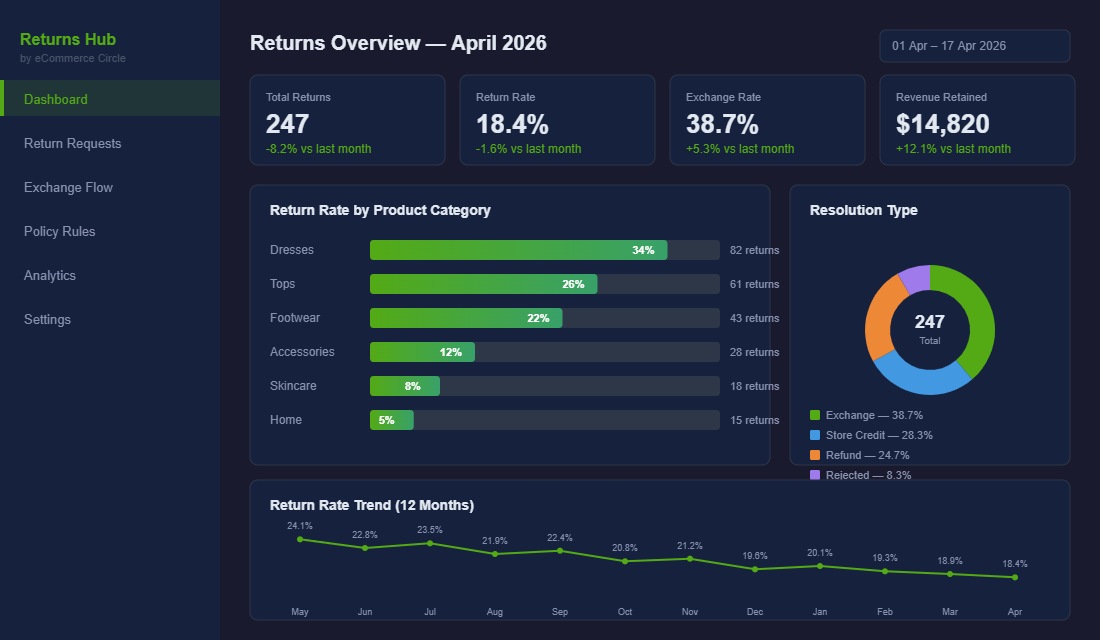
Most store owners think of returns as a cost centre. Something to minimise, restrict, and make slightly painful so fewer people bother. That’s backwards thinking, and it’s costing you sales you’ll never see in your analytics.
When a first-time visitor lands on your store, they’re running a risk calculation in their head. “What if it doesn’t fit? What if the colour looks different in person? What if the quality isn’t what I expected?” Your returns policy is the answer to every one of those objections. A clear, generous policy doesn’t increase returns — it increases conversions. And the maths works in your favour.
Think about it this way. If you’re converting at 2% with a restrictive 14-day, no-questions-asked policy, and a more generous 30-day policy with free exchanges lifts your conversion rate to 2.5%, that’s a 25% increase in revenue. Even if your return rate bumps up a few percentage points, you’re still way ahead.
The best Australian brands understand this. Showpo offers 110% store credit within 21 days of delivery — that extra 10% incentivises customers to exchange rather than refund, keeping the revenue in the business. Culture Kings gives a 30-day window for exchanges and store credit, with free return shipping on full-price footwear over $100. These aren’t generous policies for the sake of being nice. They’re engineered to maximise customer lifetime value.
The Seven Elements Every Shopify Returns Policy Needs
A returns policy that actually works — one that protects your margins while giving customers confidence to buy — needs seven specific elements. Miss any of these and you’ll either haemorrhage money or lose sales.
1. Return Window
This is the number of days a customer has to initiate a return after delivery. The industry standard is 30 days, and that’s a solid starting point for most Shopify stores. Going shorter (14 days) creates urgency but also creates anxiety at the point of purchase. Going longer (60-90 days) signals confidence in your product and can actually reduce returns — customers feel less pressure to decide quickly, and by the time 60 days pass, they’ve often integrated the product into their life.
For Australian stores, factor in shipping times. If a customer in Perth orders from a Sydney-based store, they might not receive the item for 5-7 business days. A 14-day return window effectively becomes a 7-day window. That’s not enough time and it will generate complaints.
2. Condition Requirements
Be specific about what condition items need to be in for a return. “Original condition” is vague and leads to disputes. Instead, spell it out: unworn, unwashed, with all original tags attached, in original packaging. If you sell products where a hygiene seal matters (swimwear, underwear, earrings), state clearly that these items are final sale once the seal is broken.
Pro tip: include photos in your policy showing what “acceptable condition” looks like versus what doesn’t qualify. This reduces back-and-forth with your customer service team by around 30-40%.
3. Refund Method
You have three options here, and the order you present them matters. Lead with exchange, then store credit, then refund to original payment method. This isn’t about being sneaky — it’s about steering customers toward the option that’s best for both parties. An exchange keeps the revenue in your business and the customer wearing your brand. Store credit does the same with more flexibility. A cash refund is money walking out the door.
Showpo’s approach is smart here: 110% store credit versus 100% refund. That extra 10% is a small cost that dramatically shifts customer behaviour toward credit. If your average order value is $120, that $12 bonus costs you far less than losing the entire sale.
4. Return Shipping Costs
This is where most stores either give away too much money or create too much friction. The data shows that offering completely free returns can increase return volume by 20-30%. But charging for returns reduces purchase conversion. The sweet spot? Offer free return shipping for exchanges. Charge a flat fee ($8-12 AUD) for refunds. This creates a financial incentive to exchange rather than refund, without penalising customers for legitimate issues like receiving a faulty product.
Always offer free returns for items that arrive damaged, faulty, or incorrect. Charging a customer to return your mistake is the fastest way to earn a negative review and lose a customer for life.
5. Restocking Fees
Restocking fees are controversial, and for most Shopify stores under $2M in revenue, I’d recommend against them. They create friction, they feel punitive, and they rarely offset the actual cost of processing a return (which averages $13-20 per item when you factor in shipping, handling, inspection, and repackaging). If you do charge a restocking fee, keep it under 15% and clearly disclose it before checkout. Shopify’s native returns system lets you set this as a percentage that’s automatically applied.
6. Non-Returnable Items
Every store has products that shouldn’t be returned. Perishable goods. Personalised or custom items. Sale items below a certain discount threshold. Gift cards. Intimate apparel with broken hygiene seals. List these clearly in a dedicated section — not buried in paragraph three of a wall of text. Use bullet points. Make it scannable. A customer who knows upfront that a personalised item is final sale won’t feel cheated. A customer who discovers this after they’ve already decided to return will feel tricked.
7. Process and Timeline
Tell customers exactly what happens after they initiate a return. How long until they get a shipping label? How many days to process the return once received? When will the refund or credit hit their account? Uncertainty breeds frustration. If your process takes 5-7 business days to process after receiving the item, say so. Underpromise and overdeliver. If you say 7 days and do it in 3, that’s a positive experience. If you say nothing and it takes 7 days, that’s a customer emailing your support team every second day.
How to Set Up Returns in Shopify (Step by Step)
Shopify has built solid native returns functionality directly into the platform. For most stores doing under 200 returns per month, you don’t need a third-party app. Here’s exactly how to set it up.
Step 1: Configure your return rules. Go to Settings → Policies → Return rules in your Shopify admin. Set your return window (I recommend 30 days as your starting point). Choose whether to offer free return shipping, a flat-rate label, or have customers arrange their own shipping. Set your restocking fee percentage if you’re using one.
Step 2: Write your policy page. Go to Settings → Policies → Refund policy. Don’t use the auto-generated template without editing it — it’s generic and doesn’t reflect your brand voice. Write a policy that covers all seven elements above in clear, friendly language. Use headings and bullet points so customers can scan it quickly.
Step 3: Enable self-serve returns. When you configure return rules, Shopify automatically creates a returns portal in your customer account pages. Customers can log into their account, select the order, choose which items to return, and submit a request — all without emailing your team. This alone can cut your customer service workload by 40-60%.
Step 4: Set up return notifications. Go to Settings → Notifications and customise your return-related email templates. You want notifications for: return request received, return approved, return in transit, and refund processed. Each touchpoint reduces “where’s my refund?” emails.
Step 5: Create return rules in Shopify Flow. If you’re on Shopify Plus or Advanced, use Shopify Flow to automate return decisions. For example: auto-approve returns under $50, flag returns over $200 for manual review, or automatically offer a 10% discount code when a customer initiates an exchange instead of a refund. This is where returns management goes from reactive to strategic.
The Exchange-First Strategy: How to Keep Revenue in Your Business
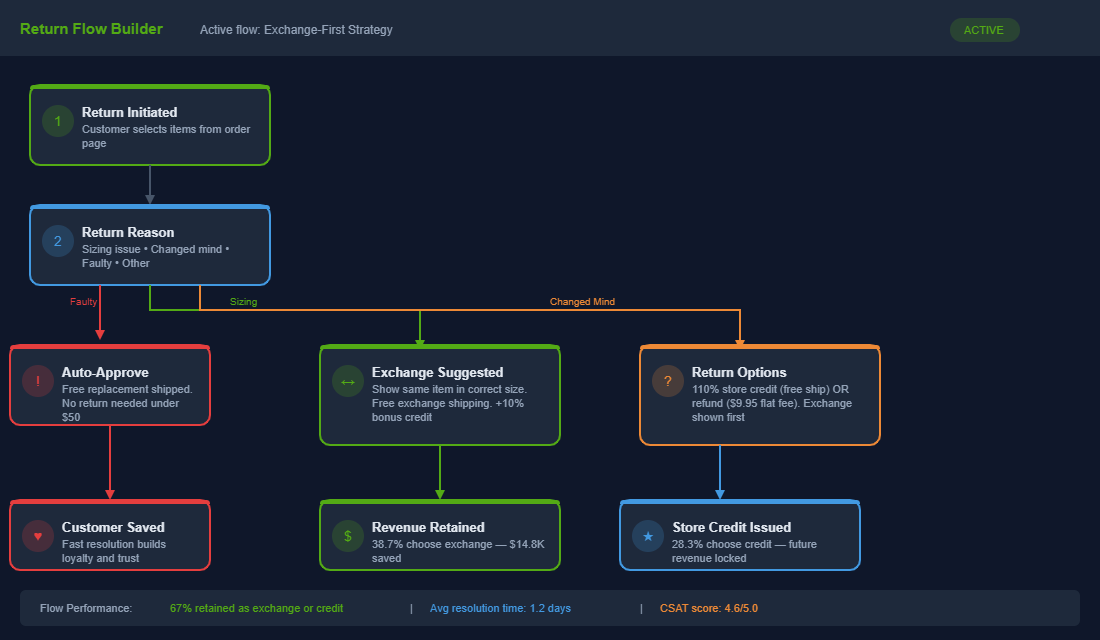
Here’s a number that should change how you think about returns: brands using an exchange-first approach typically retain 30-40% of revenue that would otherwise leave as cash refunds. That’s not a small optimisation. On a $500K store with a 20% return rate, that’s the difference between losing $100K and keeping $30-40K of it.
An exchange-first strategy means your entire returns experience is designed to guide customers toward swapping their item for something else rather than getting their money back. Here’s how to build one:
Make exchanges easier than refunds. Offer free shipping on exchanges but charge for refund returns. Process exchanges within 24 hours but take 5-7 days for refunds. Remove friction from one path and add just enough to the other to nudge behaviour without frustrating anyone.
Offer bonus credit for exchanges. The Showpo model works brilliantly here. If a customer exchanges or takes store credit, give them 105-110% of their purchase value. That $5-10 bonus costs you far less than losing the customer entirely, and it creates a positive association with the returns experience.
Recommend alternatives during the return flow. When a customer initiates a return because of sizing, show them the same product in the right size. When they return because of style, suggest similar items they might prefer. Apps like Loop Returns and ReturnGO do this automatically by displaying product recommendations within the returns portal.
Offer instant exchanges. Don’t wait for the original item to come back before shipping the replacement. Ship the exchange immediately and trust the customer to return the original within your window. This dramatically improves the customer experience and reduces the chance they’ll buy from a competitor while waiting.
Reducing Returns Before They Happen
The cheapest return is the one that never happens. And the data tells us exactly where to focus. 52% of all ecommerce returns are due to sizing and fit issues. Another 14% happen because the product didn’t match the description or photos. That means two-thirds of your returns are preventable with better product information.
Fix your size guides. Generic S/M/L charts are useless. Show actual garment measurements in centimetres. Include a “model is 175cm and wears size M” reference. If you can, integrate a sizing recommendation tool like Kiwi Size Chart or True Fit that asks customers a few questions and suggests their best size. Brands that implement proper sizing tools see return rates drop 15-25%.
Upgrade your product photography. Show every angle. Include close-ups of fabric texture, stitching, and hardware. Use video where possible. If the product is a different shade of blue than it looks on screen, say so in the description. “Please note: this navy appears darker in person than in photos.” That one sentence prevents returns and builds trust. Check out our guide on DIY product photography for a full setup walkthrough.
Write honest product descriptions. If a fabric runs small, say it runs small. If a chair requires assembly, say how long it takes. Customers don’t return products that meet their expectations — they return products that don’t match what they imagined. Your job is to close the gap between imagination and reality before the purchase.
Use post-purchase education. Send a “how to style” or “how to care for” email after purchase. If you sell skincare, explain how long results take. If you sell electronics, send a quick-start guide. These emails reduce “it didn’t work” returns and create a better ownership experience. Our article on unboxing experience design covers how to extend this into your packaging.
When to Upgrade to a Dedicated Returns App
Shopify’s native returns work well for stores processing under 200 returns per month. But once you cross that threshold — or if you’re in a high-return category like fashion — a dedicated returns management app pays for itself quickly.
Here’s when to make the switch:
- You need exchange recommendations. Shopify’s native system handles basic returns but doesn’t suggest alternative products during the return flow. Apps like Loop Returns and ReturnGO display personalised product suggestions that convert 30-40% of would-be refunds into exchanges.
- You want a branded returns portal. Instead of a basic Shopify account page, dedicated apps give you a fully branded self-service portal with your colours, logo, and messaging. This reinforces your brand at a moment when trust matters most.
- You need advanced analytics. Why are customers returning products? Which SKUs have the highest return rate? What’s your return-to-exchange ratio? Dedicated apps surface this data in dashboards that help you make product and marketing decisions.
- You’re processing high volumes. When you’re handling 500+ returns per month, automation becomes critical. Auto-approval rules, automatic label generation, warehouse routing, and integration with your 3PL — these features save hours of manual work every week.
The top three Shopify returns apps in 2026:
- Loop Returns — Best for fashion and apparel brands focused on exchange-first. Manages millions of returns monthly for 5,000+ brands and has helped retain over $2.4 billion in sales. Free plan available; advanced plans from $155/month.
- ReturnGO — Best for stores needing deep customisation. Supports 2,700+ brands including Decathlon and Under Armour. Unlimited customisable return flows, multi-carrier label generation, and excellent analytics. Plans from $23/month. Perfect 5-star rating across 293 reviews.
- AfterShip Returns — Best all-rounder with the largest review base. 4.7-star rating across 1,240+ reviews. Branded portal, automated eligibility checks, 50+ carrier integrations. Great for stores that want reliability without complexity.
Protecting Your Margins: The Numbers Behind Smart Returns
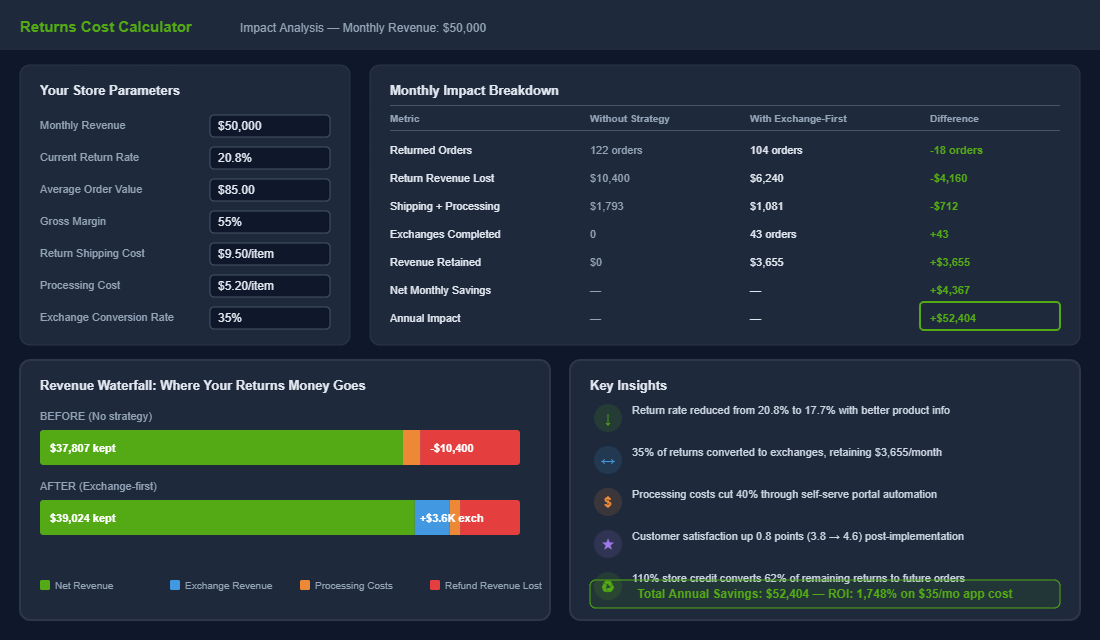
Let’s get specific about what returns actually cost your business, because most store owners underestimate this dramatically.
Each return costs between $13 and $20 to process when you add up return shipping ($8-12), inspection and repackaging ($3-5), and customer service time ($2-3). On a $60 product with a 50% margin, that $30 gross profit is entirely wiped out by the return — and you’ve lost the customer acquisition cost on top of it.
Now multiply that across a 20% return rate. If you’re doing $50K per month in revenue, approximately $10K worth of orders are coming back. At $15 average processing cost, that’s $2,500 per month in return handling alone — $30,000 per year. That’s not including the lost revenue from the returned products themselves.
This is why every percentage point reduction in returns matters. And it’s why converting refunds to exchanges is so powerful. If you can convert just 30% of your refunds into exchanges using the strategies above, on that $50K/month store you’re retaining an extra $3K per month — $36K per year. That’s often enough to fund a full-time team member or a significant ad spend increase.
If you want a deeper look at how to protect and understand your margins at every level, our free shipping strategy guide walks through the exact calculations for balancing customer incentives against margin protection.
Returns Policy Template for Shopify Stores
Here’s a framework you can adapt for your store. Don’t just copy this — rewrite it in your brand voice with your specific details.
Return Window: You have [30] days from delivery to initiate a return or exchange. Items must be unworn, unwashed, and in original condition with all tags attached.
Exchanges: We offer free shipping on all exchanges within Australia. Simply initiate a return through your account page, select “Exchange,” and choose your preferred replacement. We’ll ship your new item within 24 hours of your request.
Store Credit: Prefer store credit? You’ll receive [110]% of your purchase value as store credit, valid for 12 months.
Refunds: Refunds to your original payment method are processed within 5-7 business days of receiving your returned item. A flat return shipping fee of [$9.95] AUD applies for refund returns.
Faulty or Incorrect Items: Received something damaged, faulty, or not what you ordered? Contact us within 48 hours of delivery with photos and we’ll arrange a free replacement or full refund — no return required for items under [$50].
Final Sale Items: The following items cannot be returned: [gift cards, items marked “Final Sale,” personalised/custom products, intimate items with broken hygiene seals, perishable goods].
Australian Consumer Law: Nothing in this policy limits your rights under Australian Consumer Law. If a product has a major fault, you are entitled to a replacement or refund regardless of this policy.
The Australian Consumer Law Angle You Can’t Ignore
If you’re selling in Australia, your returns policy doesn’t exist in a vacuum. Australian Consumer Law (ACL) gives customers automatic rights that override anything you write in your policy. Understanding these rights isn’t optional — it protects you from legal issues and builds genuine trust with customers.
Under the ACL, consumers are entitled to a repair, replacement, or refund if a product has a major failure — regardless of your stated return window. A “major failure” means the product is unsafe, significantly different from its description, substantially unfit for its purpose, or has a defect that wouldn’t have been obvious at the time of purchase.
You cannot override these rights with a “no refunds” or “all sales final” policy. Businesses that try this risk fines from the ACCC. In 2024, the ACCC took action against several retailers for misleading returns signage and policies that didn’t comply with consumer guarantees.
The smart approach: build your policy on top of ACL requirements, not against them. Mention consumer guarantees explicitly in your policy. It shows you know the law, you respect it, and customers can trust you. For more on protecting your business from the legal and financial risks of ecommerce, check our chargeback and fraud protection guide.
Putting It All Together: Your Returns System
A returns policy isn’t a standalone document — it’s part of a system. When every piece works together, returns stop being a cost centre and start being a retention tool. Here’s how the pieces connect:
Your product pages set accurate expectations (reducing preventable returns). Your returns policy removes purchase anxiety (increasing conversion). Your exchange-first flow retains revenue that would otherwise leave (protecting margins). Your returns data feeds back into product development and merchandising (improving the business). And your post-return experience — whether that’s a thoughtful follow-up email or a smooth exchange — determines whether that customer comes back for a second, third, and fourth purchase.
The stores doing $1M+ aren’t just good at selling. They’re good at the unsexy operational stuff that most brands ignore. Returns management is one of those things. Get it right and you’ll protect your margins, reduce your customer service load, and build the kind of trust that turns one-time buyers into loyal customers.
Start with the seven elements. Set up Shopify’s native returns. Then optimise from there based on your data. You don’t need to be perfect on day one — you just need to be intentional.
Inside the eCommerce Circle, returns strategy is one of the Protection pillars we work on with every member. If your returns are eating into your margins or your current policy is costing you sales, let’s talk about building a system that works for your store.
Australian Consumer Law: The Bit You Cannot Write Around
Before you set any returns policy, understand this: Australian Consumer Law (ACL) gives buyers automatic statutory rights that your policy cannot override. If a product has a major fault — broken on arrival, not as described, unsafe, or not fit for purpose — the customer is entitled to a refund, replacement, or repair regardless of what your policy says. You can offer extras (a longer return window, change-of-mind returns, free return shipping) but you cannot strip the basics.
- Major problem: Customer chooses the remedy (refund, replacement, repair). You do not get to insist on store credit.
- Minor problem: You can choose the remedy, but you must offer one within a reasonable time.
- “No refunds” signage or policy lines are illegal in Australia. They expose you to ACCC action. Reframe instead: “Change of mind returns within 30 days, store credit only.”
- Your wording sets customer expectations: Be clear, be plain, and assume the reader is reading on their phone with 15 seconds of attention.
If you sell into NZ, the Consumer Guarantees Act is similar but not identical — write a region block into your policy rather than pretending Australian rules apply across the Tasman.
The Returns Tech Stack That Pays for Itself
The cheapest returns process is a Google Form and a manual refund button. It also leaks 5-10 hours a week and erodes customer trust because it feels DIY. Once you cross 30-50 returns a month, install proper returns software. The good news: most of these tools pay for themselves through the upsell-to-exchange flow alone, which converts 25-40% of would-be refunds into a replacement order.
- Loop Returns: The leader for Shopify Plus brands. Best-in-class exchange flow, instant store credit incentives, and detailed analytics.
- Returnly (now owned by Affirm): Strong “instant credit” experience that turns returns into a second order before the parcel is shipped back.
- AfterShip Returns Center: The pragmatic mid-market choice. Cheaper than Loop, works on every Shopify plan, integrates with most 3PLs.
- Shopify’s native Returns: Free, basic, fine for under 30 returns a month. Add a Klaviyo flow to recover the lost customer.
- Australia Post MyPost Business and Sendle: The cheapest return label generators for Aussie brands shipping domestically. Build them into your returns tool of choice.
Pair your returns tool with a “why” survey at the start of every return. The top three reasons account for 70% of returns in most categories and tell you exactly which product page, sizing chart, or packaging upgrade to fix next. See our guide to ecommerce packaging and unboxing for how to reduce damage-in-transit returns at the source.
Returns Benchmarks for Aussie Shopify Brands
- Apparel and footwear: 15-30% return rate. Anything under 18% is excellent.
- Beauty and skincare: 3-6%. Returns are typically allergy or “wrong shade” issues.
- Homewares and decor: 5-10%. Damaged-in-transit is the largest driver.
- Electronics: 8-12%. Customer expectation vs. product reality drives most returns.
- Exchange rate (returns that become replacements): 25-40% with a proper exchange flow; under 10% with a basic refund-only flow.
- Average cost per return (logistics + processing + restocking): $18-$32 AUD for sub-2kg parcels domestically. Build it into your unit economics, not “marketing”.
Real Tool Stack: What Aussie Brands Actually Use to Run Returns
Policy is half the equation. The other half is the tool stack that executes it without burning your team out. Here is what works for Aussie Shopify operators at three different stages.
- Under $80k AUD/month: Shopify’s built-in returns flow plus a Klaviyo automation for return-status updates. Free, no extra app, and good enough until volume gets serious. Pair with Gorgias on the lowest tier for ticket routing.
- $80k to $300k/month: Add a dedicated returns portal like Loop Returns, ReturnGo, or AfterShip Returns. Exchange-first flows alone typically lift retained revenue by 25 to 40% versus refund-only. Most stores recover the subscription cost inside the first month.
- $300k+/month: Layer in a logistics partner (Australia Post Returns, Shippit, Bonds Couriers) and connect everything into your warehouse system. Build a weekly returns dashboard in Triple Whale or Lifetimely so the return rate sits next to your acquisition metrics, not in a forgotten spreadsheet.
The biggest unlock at every stage is data. If you cannot answer “what is my exchange rate?” in 30 seconds, you do not have a returns system, you have a refund system pretending to be one.
A 60-Minute Returns Policy Tune-Up You Can Run This Week
If your returns policy has not been touched in 12 months, the chances it is leaking margin are extremely high. Block out one hour and run this sequence.
- Minutes 0 to 10: Pull the last 90 days of returns out of Shopify. Calculate return rate by SKU and by category. Anything 3x your category average is a product page or sizing problem, not a policy problem.
- Minutes 10 to 25: Read your live returns policy front to back as if you were a customer. Time how long it takes you to find “How do I start a return?” If it takes more than 15 seconds, rewrite the top of the page.
- Minutes 25 to 45: Map your refund-vs-exchange split. If exchange rate is under 25%, your portal is probably defaulting to refund. Switch the order: lead with “Exchange this item”, make refund the secondary path.
- Minutes 45 to 60: Update your product pages with one paragraph that pre-empts the top 3 return reasons for that SKU (e.g. “Runs true to size, model is 175cm wearing a size 10”). Sizing-related returns drop 20 to 30% when product pages do this honestly.
Returns is the operational lever that most Aussie operators leave on the table because it feels boring. The brands that take it seriously protect margin, lift retention, and end up with cleaner data than 90% of their competitors. For the next layer down on operational protection, our piece on Shopify chargeback and fraud protection pairs directly with the policy you have just rebuilt.
Let’s Talk About Your Returns Policy
A great returns policy quietly increases conversion, reduces support load, and protects margin. A bad one bleeds you in three directions at once. If you would like a second pair of eyes on yours, that is what we do inside eCommerce Circle.