You spent months perfecting your product. Weeks dialling in your Shopify store. Thousands on ads to get people to click “Buy Now.”
What’s in This Article
Then what happens? Your product arrives in a plain brown box with bubble wrap and a packing slip. No branding. No personality. No reason for the customer to remember you exist.
Here’s the thing most Shopify store owners miss: your packaging is the only piece of marketing that reaches 100% of your customers. Every single person who buys from you holds your packaging in their hands. And in a world where 52% of online shoppers say they’re more likely to repurchase from a brand that delivers premium packaging, that plain brown box is costing you serious money.
The brands that get this right — the ones turning first-time buyers into repeat customers and unpaid brand ambassadors — treat packaging as a marketing channel, not a logistics afterthought.
Your Packaging Is Marketing (Not Just a Cost Centre)
Most Shopify brands think about packaging the same way they think about shipping labels — it’s a necessary expense to get the product from A to B. That mindset is leaving revenue on the table.
A 2025 Mondi consumer survey of 6,000 shoppers found that 59% said packaging directly influences whether they’ll buy from a brand again. Not product quality. Not price. Packaging.
And it goes beyond repeat purchases. According to industry research, 40% of consumers share their unboxing experience on social media when the packaging stands out. That’s free user-generated content — the kind of authentic, trust-building marketing that no amount of ad spend can replicate.
Think about what that means for your customer acquisition cost. If you’re spending $30-50 to acquire a customer through Meta Ads, and your packaging convinces them to post about you to their 500 followers, you’ve just earned organic reach that would have cost you hundreds in paid media.
The maths gets even better when you factor in retention. Research consistently shows that a 5% increase in customer retention can boost profits by 25-95%. Your packaging is one of the highest-use tools you have to drive that retention — because it’s the first physical touchpoint after the purchase. It sets the tone for the entire post-purchase experience.
The 6 Elements of a Share-Worthy Unboxing Experience
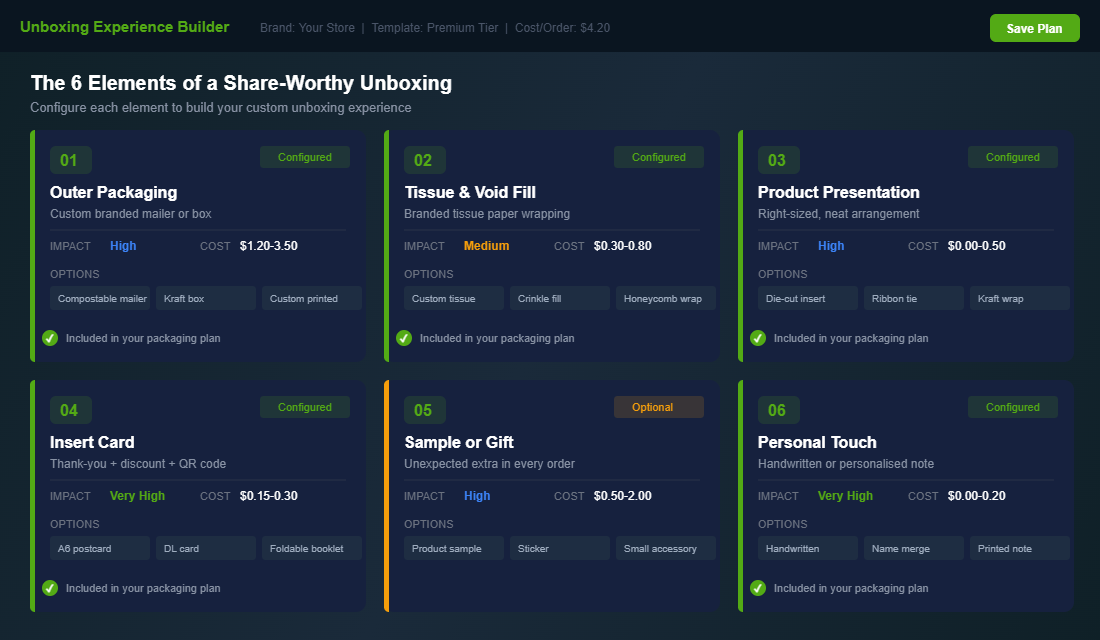
You don’t need to spend a fortune on packaging to make it memorable. You need to be intentional about six key elements that, together, create a moment your customer wants to savour (and share).
1. The Outer Box or Mailer
This is your first impression. A custom-printed mailer box or branded compostable satchel immediately signals that you’re not just another generic online store. Even a simple one-colour logo on a kraft mailer lifts perceived value.
For most Shopify brands doing under $50K/month, a branded compostable mailer (like those from Hero Packaging in Sydney) is the sweet spot — it’s affordable, eco-friendly, and looks premium.
2. Tissue Paper and Void Fill
Wrapping products in custom tissue paper adds anticipation. The customer has to unwrap something before they see the product — and that moment of discovery triggers a small dopamine hit. It’s the same psychology that makes gift-giving feel good.
Choose tissue paper in your brand colours, or go with a custom print from a supplier like noissue, which offers low minimum orders specifically designed for small ecommerce brands.
3. Product Presentation
How the product sits inside the box matters. Is it neatly arranged, or rattling around in an oversized box? Right-sized packaging (where the box fits the product snugly) is a major trend heading into 2026, and for good reason — it reduces waste, lowers shipping costs, and looks far more professional.
4. A Branded Insert Card
This is your secret weapon. A well-designed insert card can include a thank-you message, a discount code for the next purchase, care instructions, or a QR code linking to a how-to video. It’s a tangible piece of your brand that customers often keep on their desk or fridge.
5. A Free Sample or Small Gift
Including a small, unexpected extra — a sample of another product, a branded sticker, or a small accessory — triggers the reciprocity effect. Your customer feels like they got more than they paid for, and that feeling drives loyalty.
Frank Body, the Melbourne-based skincare brand, built a cult following partly by including product samples and playful branded extras in every order. Their packaging is so recognisable that customers photograph it without being asked.
6. A Personal Touch
A handwritten thank-you note (or a printed note that feels personal) creates an emotional connection that digital marketing simply cannot match. It doesn’t need to be long — “Thanks for supporting our small Aussie business, Sarah! We hope you love your order.” is enough.
For stores doing fewer than 50 orders per day, handwritten notes are realistic. Above that, consider printed notes with the customer’s first name merged in through your fulfilment system.
How to Design Custom Packaging Without Blowing Your Budget
Here’s the objection I hear from every Shopify brand owner: “Custom packaging sounds great, but I can’t afford it.”
The truth is, you probably can — you just need to start at the right level.
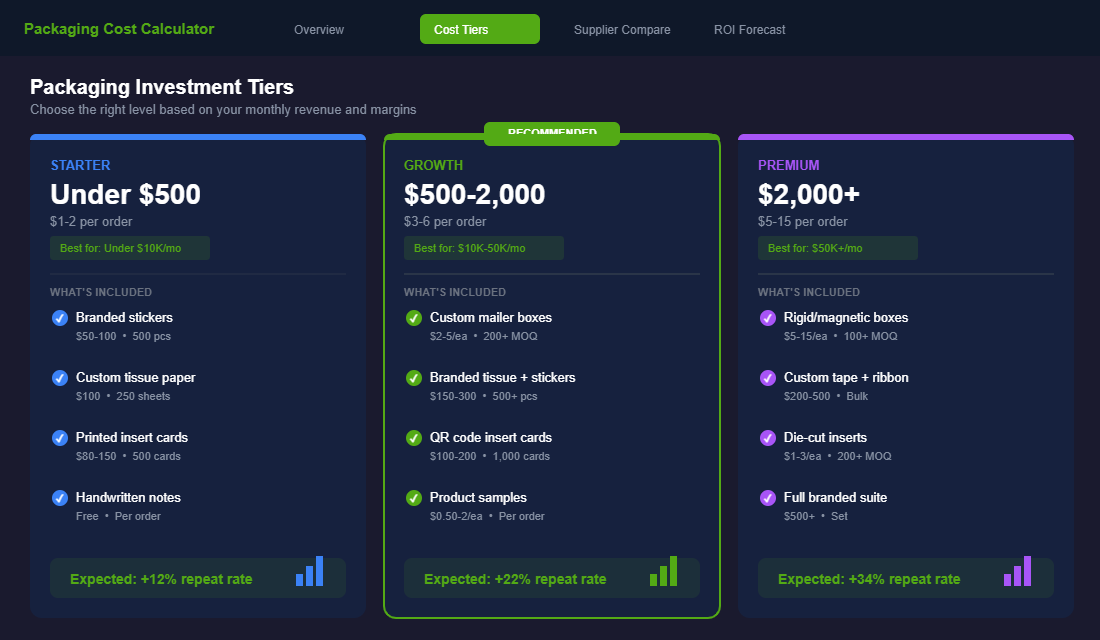
Tier 1: Under $500 (Getting Started)
- Branded stickers on plain kraft mailers. $50-100 for 500 stickers from Sticker Mule or a local print shop.
- Custom tissue paper from noissue. Starting from around $100 for 250 sheets.
- Printed insert cards from Canva + your local printer. $80-150 for 500 cards.
- Handwritten thank-you notes. Free — just costs time.
This tier works for brands doing under $10K/month. You’re spending roughly $1-2 per order on packaging upgrades, and the ROI comes from repeat purchases and organic social shares.
Tier 2: $500-2,000 (Brand Building)
- Custom-printed mailer boxes. From PackQueen or The Packaging People — typically $2-5 per box at 200+ MOQ.
- Branded tissue paper and custom stickers. Complete the visual experience.
- Professional insert cards with QR codes. Drive customers to your digital ecosystem.
- Product samples included in every order. Boost cross-sell and delight.
This tier suits brands doing $10K-50K/month. You’re investing $3-6 per order, but the perceived value increase often justifies higher product pricing.
Tier 3: $2,000+ (Premium Experience)
- Fully custom rigid boxes or magnetic closure boxes. The “luxury” unboxing that stops scrolling.
- Custom-printed tape, ribbon, or wax seals. Every touchpoint branded.
- Product-specific packaging inserts. Moulded or die-cut for a perfect fit.
- Full branded suite. Consistent experience from shipping label to product wrap.
This tier is for brands doing $50K+/month or those selling premium products where packaging is a core part of the brand story. The cost is $5-15+ per order, but for premium products with healthy margins, it’s a competitive differentiator.
Australian Packaging Suppliers Worth Knowing
You don’t need to source packaging from overseas. Australia has a strong lineup of ecommerce packaging suppliers with competitive pricing and fast turnaround.
- Hero Packaging — Based in Sydney, B-Corp certified, specialising in compostable mailers and custom packaging. Great for brands that want sustainability baked in from day one. Their compostable satchels break down in home compost within 90-180 days.
- noissue — Custom tissue paper, stickers, mailers, and tape with low minimum order quantities. Their platform makes it easy to upload your designs and order small runs — perfect for brands just starting out with custom packaging.
- PackQueen — Australian-made custom boxes with competitive pricing. Strong option for brands ready to move into custom mailer boxes at scale.
- The Packaging People — Over 18 years in the Australian market, servicing 30+ sectors. Particularly strong for food, beverage, and specialty ecommerce brands.
Sustainable Packaging That Actually Matters
Here’s a reality check: 95% of consumers in a 2025 Mondi survey said protective packaging is their top priority. But right behind protection, more than 70% of consumers now prioritise packaging that’s easy to recycle or made from paper-based materials.
For Australian ecommerce brands, sustainability isn’t just a nice-to-have anymore — it’s a purchase driver. And the good news is that sustainable packaging doesn’t have to cost more.
Compostable mailers. Hero Packaging’s compostable satchels cost marginally more than standard poly mailers but signal to your customer that you care about the same things they do.
Recycled cardboard. Most Australian packaging suppliers now offer 100% recycled cardboard boxes as their standard option. PackQueen and The Packaging People both default to recycled materials.
Right-sized packaging. Sending a small product in a massive box isn’t just wasteful — it looks lazy. Right-sized packaging reduces material use, lowers shipping costs (especially with Australia Post’s cubic weight pricing), and creates a cleaner unboxing experience.
Ditch the plastic void fill. Replace bubble wrap and plastic air pillows with recycled paper crinkle fill, honeycomb wrap, or corrugated cardboard inserts. They look better, protect just as well, and your customers won’t feel guilty throwing them in the recycling bin.
Don’t just be sustainable — tell your customers about it. A small printed message on your packaging like “This mailer is 100% compostable — pop it in your home compost!” turns your sustainability efforts into a brand story. It gives customers a reason to feel good about buying from you, and a reason to tell their friends.
The Insert Strategy — What Goes in the Box Beyond the Product
Your packaging insert is the most underrated conversion tool in ecommerce. It reaches a customer who has already bought from you, already has your product in their hands, and is in a peak moment of excitement. The insert is your chance to turn that moment into the next sale.
The Must-Have Elements on Your Insert Card
A genuine thank you. Lead with gratitude, not a sales pitch. “Thank you for supporting our small Australian business” hits differently than “Here’s 10% off your next order.”
A next-purchase incentive. After the thank-you, include a discount code or free shipping offer with a 30-day expiry. Urgency matters — “Use code THANKS15 for 15% off your next order (expires in 30 days)” converts far better than an open-ended offer.
A QR code linking to something valuable. This could be a care guide, a how-to video, a recipe (for food products), or a styling guide (for fashion). The QR code bridges your physical packaging to your digital ecosystem.
A social media CTA. “Love your order? Share your unboxing on Instagram and tag us @yourbrand for a chance to be featured.” This single line can generate a steady stream of user-generated content.
A review request. “Leave us a review and help other Aussie shoppers discover [Brand Name].” Pair this with a QR code that links directly to your Shopify review page (using Judge.me or Okendo).
The Insert Card Template
Here’s a simple layout that works for most Shopify brands:
- Front: Brand logo, thank-you message, and a lifestyle image or illustration.
- Back: Discount code with expiry, QR code for care instructions or review, social media handles with sharing CTA.
Print these as postcards (A6 or DL size) on thick card stock (300gsm+). A run of 500 from a local Australian printer will cost $80-150 — or design them yourself in Canva and order through an online printer.
Measuring the ROI of Better Packaging
“That all sounds great, but how do I know it’s actually working?”
Fair question. Here’s how to track the impact of your packaging upgrades.
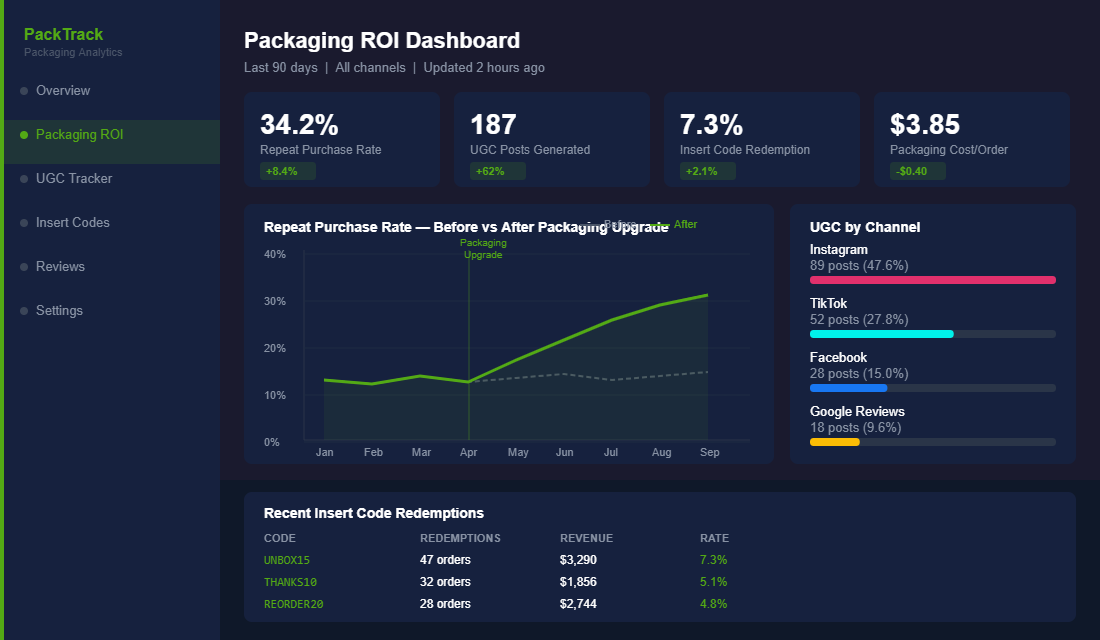
Repeat purchase rate. Track this in Shopify Analytics or Klaviyo before and after your packaging upgrade. If your repeat purchase rate increases even 3-5%, the packaging upgrade is paying for itself many times over.
User-generated content volume. Set up a branded hashtag and monitor Instagram and TikTok mentions. Track how many unboxing posts you receive per month before and after the change.
Discount code redemption rate. If your insert card includes a unique discount code (e.g., UNBOX15), you can track exactly how many customers use it. Redemption rates of 5-8% on insert card codes are solid.
Review volume and sentiment. Customers who have a great unboxing experience leave better reviews. Track your review-per-order rate and look for mentions of packaging in review text.
Customer feedback. Add a post-purchase survey question: “How would you rate your unboxing experience?” This gives you direct signal on whether the investment is landing.
Run your current packaging for 30 days, recording baseline metrics. Then switch to upgraded packaging and measure the same metrics for 30 days. Compare the results. Most brands see measurable improvements within the first month — particularly in repeat purchase rates and social media mentions.
The Unit Economics: What Packaging Should Actually Cost You Per Order
Most founders have no idea what their packaging costs per order. They know the invoice total from the last print run and nothing else. That is how a $2.80 unboxing experience quietly ends up on a $34 product.
Work out the real number. Add every component that goes in or around the box: mailer or carton, tissue, void fill, sticker or seal, insert card, thank you note, any sample. Divide the total print run cost by the number of units, then add it to your contribution margin calculation as a variable cost, not an overhead. It behaves like COGS because it scales with every order you ship.
Here is the range that works for most Aussie DTC brands:
- Under $50 AOV: keep total packaging under $1.50 per order, roughly 3% of order value. At this price point a well-chosen coloured mailer, a branded sticker and a printed insert card gets you 80% of the perceived value at 20% of the cost.
- $50 to $120 AOV: $2.00 to $3.50 per order, about 3 to 4%. This is where custom printed mailers, tissue and a proper insert start paying for themselves.
- $120+ AOV: $4.00 to $8.00 per order, still around 4 to 6%. Rigid boxes, ribbon and a hand-written note are defensible here because the repeat purchase value justifies them.
Once packaging crosses about 6% of AOV you are almost always better off putting that money into product quality or a faster delivery promise. Customers notice both more.
Two costs founders forget. First, dimensional weight. A beautiful oversized rigid box can add $3 to $6 per parcel in Australia Post or courier charges because carriers bill on cubic volume, not just actual weight. Measure the box, run it through your carrier’s cubic calculator, and compare against your current mailer before you commit to a print run. Second, storage. If you use a 3PL, custom packaging usually means a per-pallet storage charge for your materials plus a kitting fee if anything needs assembling. Ask for both numbers in writing before you order 5,000 units of anything.
Order in the smallest run that keeps unit cost sensible. The temptation with custom print is to order 10,000 to get the price down. If you rebrand, change your insert offer, or find a supplier issue at unit 800, you are stuck with 9,200 units of a decision you already regret. Most Australian suppliers will run 500 to 1,000 units digitally at a modest premium over offset. Pay it for the first run.
How to Actually Get Customers to Film the Unboxing
Beautiful packaging does not generate content on its own. Plenty of brands spend $4 a box and get almost no user generated content out of it, because they never asked and never made it easy.
The ask has to be specific, in the box, and worth something. “Tag us on Instagram” is not an ask. It is a hope.
Imagine you sell skincare at a $75 AOV. Your insert card says: “Show us your first week. Post a story with #YourBrandWeekOne, tag @yourbrand, and we will send you a $15 credit.” That is a specific action, a specific hashtag, and a defined reward. Expect roughly 2 to 5% of recipients to actually post. On 1,000 orders a month that is 20 to 50 pieces of content you did not have to shoot, at a cost of $300 to $750 in credit that mostly gets redeemed against another order anyway.
Three things that lift that rate:
- Make the reveal sequential. A box where everything is visible the second the lid opens gives a videographer nothing. Tissue over the product, a sticker seal to break, an insert sitting on top: each of those is a beat in a fifteen second video. That is why tissue and seals outperform their cost.
- Put a QR code on the insert, not just a handle. Typing an Instagram handle from a card is friction. A QR straight to your tagged-posts page or a submission form converts several times better. Free QR generation is built into Canva and most link-in-bio tools.
- Trigger the ask again by email on delivery day. Your post-purchase flow already fires. Add a step timed to the delivery notification asking for the photo, with the same offer as the insert. The insert catches people in the moment; the email catches everyone who threw the card out. Klaviyo’s delivered-event trigger handles this natively if you have shipping notifications connected.
Then actually use what comes in. Content sitting in a folder does nothing. Feed it into your ad creative testing, put it on the product page next to your reviews, and build it into a proper UGC pipeline. Customer-shot unboxing footage regularly outperforms studio creative on Meta because it looks like something a friend sent you, not something a brand paid for. That is the actual return on your packaging spend, and it never shows up on the packaging invoice.
The Compound Effect — Packaging as Part of Your Growth System
Here’s where the real magic happens. Your packaging doesn’t exist in isolation. When you connect it to the rest of your post-purchase experience, the compounding effect is massive.
Packaging + Post-Purchase Email Sequence. Your unboxing experience primes the customer to engage with your follow-up emails. When they open a “How are you loving your order?” email 3 days after receiving beautifully packaged product, they’re far more likely to click, leave a review, or make a second purchase.
Packaging + Loyalty Program. Include a card that introduces your loyalty program and shows how many points the customer earned from their purchase. This drives program sign-ups at the highest-intent moment — when the customer is holding your product and feeling great about their decision.
Packaging + Referral Program. Include a “Give $15, Get $15” referral card in every order. Customers who’ve just had a premium unboxing experience are significantly more likely to hand that card to a friend or share the referral link.
Packaging + Product Bundling. When your packaging is photogenic, customers become content creators. You get free marketing, social proof, and brand awareness without spending a cent on ads.
The brands that win in ecommerce aren’t the ones with the biggest ad budget. They’re the ones who create experiences at every touchpoint — and packaging is the touchpoint that 100% of customers experience. Start treating it that way, and watch what happens to your repeat purchase rate, your organic reach, and your bottom line.
Inside the eCommerce Circle, packaging strategy is part of the Product pillar — one of the 10 P’s we work on with every member to build a brand that customers can’t stop talking about. If you want help dialling in every touchpoint of your customer experience, let’s talk.