Most Shopify store owners have a vague sense of who their competitors are. They’ve browsed a few rival sites. Maybe they’ve screenshot a product page or two. But when you ask them what their competitors are actually doing well – where the traffic comes from, what keywords they rank for, how their pricing stacks up – you get a blank stare.
What’s in This Article
That’s not competitive awareness. That’s guessing. And guessing is expensive.
According to Crayon’s 2025 State of Competitive Intelligence report, 44% of companies have zero competitor visibility in their CRM. They’re making pricing decisions, ad spend decisions, and product development decisions with no structured understanding of the market around them. Meanwhile, McKinsey research shows the top 10% of publicly traded retailers capture 70% of the sector’s economic profit. These brands aren’t just lucky – they’re obsessively studying their competition and exploiting every gap they find.
If you’re running a Shopify store in Australia and you haven’t done a proper competitive analysis in the last 90 days, you’re flying blind. This guide will show you exactly how to fix that – step by step, tool by tool, with a framework you can repeat every quarter.
Why Most Ecommerce Brands Get Competitive Analysis Wrong
The biggest mistake store owners make? They only look at direct competitors. The brand selling the same product in the same category at a similar price point. That’s one slice of the picture – and it’s usually the least useful one.
Your real competitive landscape includes three layers:
- Direct competitors. Same product, same audience, same price range. The brands your customers compare you against before buying. You probably already know these.
- Indirect competitors. Different product, same customer problem. If you sell premium protein powder, your indirect competitor might be a meal prep delivery service. They’re solving the same “I want to eat healthier” problem.
- Aspirational competitors. The brands one or two levels above you. They might be in a different market or at a different scale, but they’ve built something you want to emulate. Study their systems, not just their products.
When you only track direct competitors, you miss the real threats. The indirect competitor stealing your customers with a better positioning angle. The aspirational brand whose content strategy is vacuuming up all the organic traffic in your niche. Broaden your lens and you’ll find opportunities everywhere.
Step 1: Build Your Competitor List (The Right Way)
Start with 5-8 competitors. More than that and your analysis becomes shallow. Fewer and you’re missing context. Here’s where to find them:
Google your own keywords. Search the 10-15 terms your ideal customer would type. “Organic skincare Australia,” “best natural face moisturiser,” “vegan beauty products online.” Write down every brand that shows up in the top 10 results – both organic and paid. If they’re bidding on those keywords or ranking for them, they’re competing for your customer’s attention.
Check Instagram and TikTok. Search relevant hashtags and see which brands consistently appear. Social commerce is growing fast, and 83% of online shoppers compare options across multiple sites before buying. If a brand keeps popping up in your customer’s feed, they’re a competitor whether they sell the same product or not.
Ask your customers. This is the most underrated approach. In your post-purchase survey or email flow, include a simple question: “What other brands did you consider before buying from us?” The answers will surprise you. You’ll discover competitors you’ve never heard of – and that’s precisely the point. If you haven’t set up proper customer segmentation, start there. Understanding who your customers are makes competitive analysis ten times more useful.
Use SimilarWeb’s “Similar Sites” feature. Enter your own domain and it’ll show you the websites your visitors also browse. This reveals competitors you’d never find through search alone – including international brands that Australian shoppers are comparing you against.
Step 2: Analyse Their Traffic and Acquisition Channels
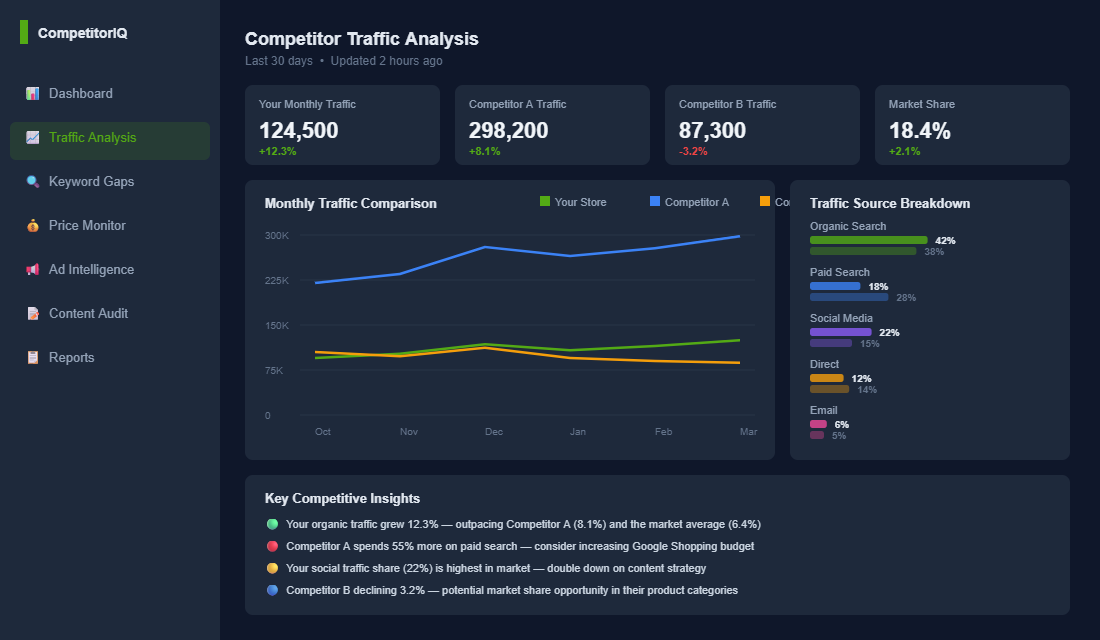
Once you’ve got your competitor list, it’s time to understand where their customers come from. This is where most store owners stop at surface-level observations. Don’t just browse their site – measure it.
SimilarWeb (free tier available) gives you estimated monthly traffic, traffic source breakdown, top referral sites, and geographic distribution. For a deeper dive, SEMrush shows you exactly which keywords drive their organic and paid traffic.
Here’s what to look for:
- Traffic volume trends. Is the competitor growing or declining? A competitor losing traffic is an opportunity – their customers are looking for alternatives. A competitor growing fast means they’ve found a channel that works. Figure out which one.
- Channel mix. If a competitor gets 40% of traffic from paid search and you get 5%, that tells you something. Either they’ve found profitable keywords you haven’t tested, or they’re burning cash trying to buy market share. Both are valuable insights.
- Organic vs. paid split. Brands heavily reliant on paid traffic are vulnerable. When ad costs spike (and they always do), their traffic drops. If you can build organic authority in the same space, you’ll have a structural advantage they can’t easily replicate.
- Social traffic sources. Which platforms drive their social traffic? If a competitor gets 25% of visits from TikTok and you’re not even on the platform, that’s a gap worth investigating.
Make sure your own analytics are solid before comparing. If your GA4 setup is broken, you’ll be comparing their real numbers against your bad data – and making decisions based on a false picture.
Step 3: Run a Keyword Gap Analysis
This is the single most valuable exercise in competitive analysis. A keyword gap analysis shows you every search term your competitors rank for that you don’t. It’s a roadmap of content and SEO opportunities sitting right in front of you.
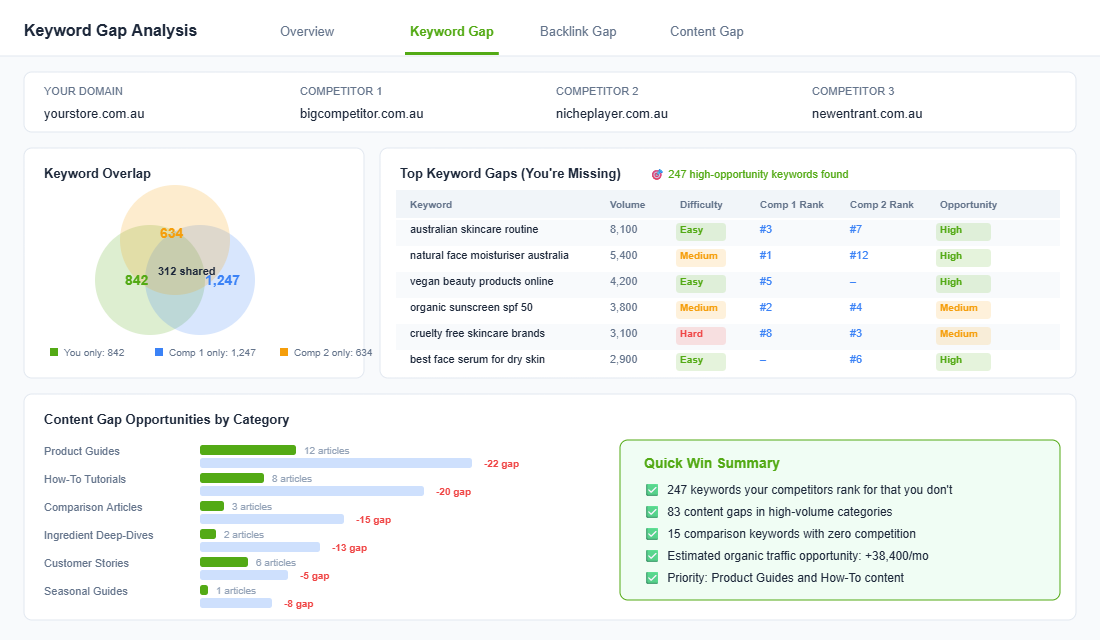
How to run it in SEMrush (step by step):
- Step 1: Go to SEMrush → Keyword Gap tool. Enter your domain and up to 4 competitor domains.
- Step 2: Filter for “Missing” keywords – terms all your competitors rank for but you don’t. This is your biggest opportunity bucket.
- Step 3: Sort by search volume and filter for keywords with a Keyword Difficulty score under 40. These are the low-hanging fruit – decent volume, achievable rankings.
- Step 4: Export the list and group keywords by topic cluster. You’ll typically find 5-10 major content themes your competitors have covered that you haven’t touched.
- Step 5: Create a content plan targeting these gaps. One solid article per keyword cluster, optimised for the primary term, can start ranking within 60-90 days.
SEMrush’s keyword database covers over 27 billion keywords globally. In the Australian market, it’ll surface terms you’d never think to target – long-tail queries like “best natural sunscreen for sensitive skin Australia” that might only get 500 searches per month but convert at 3-4x the rate of broader terms.
The brands that dominate organic search don’t just create content randomly. They systematically fill the gaps their competitors have already proven are worth targeting.
Step 4: Decode Their Pricing Strategy
Price is the most visible competitive lever – and the most misunderstood. Too many store owners set prices based on gut feel or a flat markup over cost. They don’t know if they’re the cheapest, the most expensive, or sitting right at the market average.
Research shows that retailers using dynamic pricing based on competitor data see an average 7.2% increase in cart conversion rates. And over 80% of the top 500 online retailers worldwide now have dedicated pricing analytics teams monitoring competitor prices in real time.
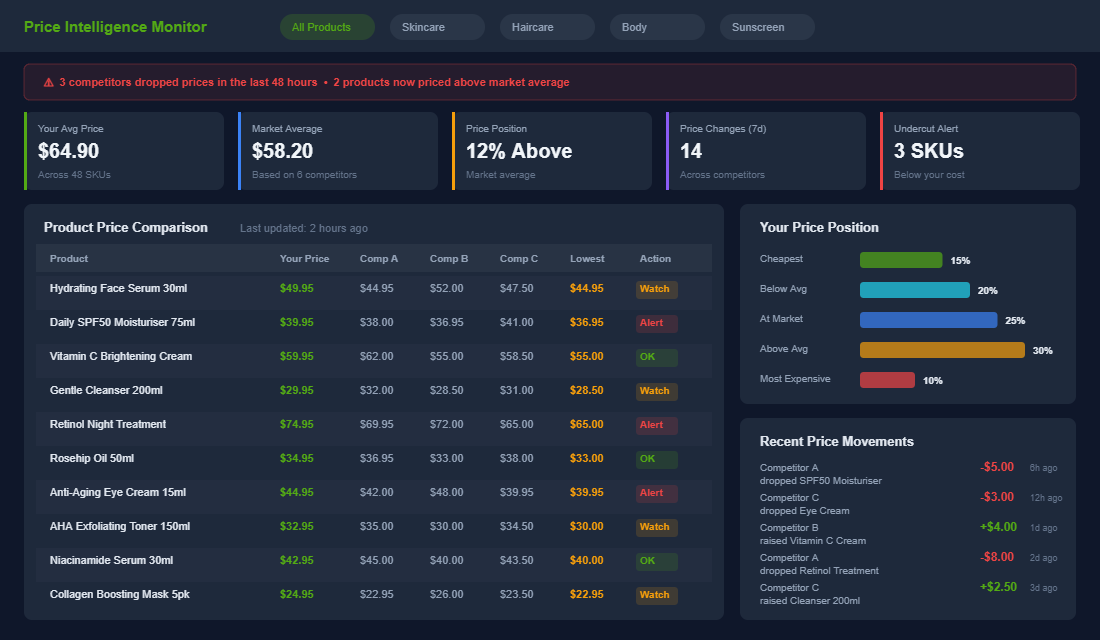
You don’t need an enterprise budget to do this well. Here’s a practical approach:
- Build a pricing spreadsheet. List your top 20 products. For each one, record your price and the prices from 3-5 competitors. Update it monthly. You’ll spot patterns fast – categories where you’re overpriced, products where you could afford to charge more, and competitors who are clearly racing to the bottom.
- Map your price position. For each product, note whether you’re cheapest, mid-range, or premium. If you’re premium, make sure your product pages justify the difference. If you’re cheapest, ask yourself whether you’re actually winning on volume or just leaving margin on the table.
- Watch for price movements. Tools like Prisync or Competera automate this. They track competitor prices daily and alert you when something changes. If a competitor drops their price on your best-selling product by 15%, you want to know about it today – not when your conversion rate tanks next month.
- Consider the full value equation. Price isn’t just the number on the tag. It’s price plus shipping plus returns policy plus loyalty rewards. A competitor might charge $5 more but offer free shipping and a 60-day return window. That’s a different value proposition – and your pricing strategy needs to account for it.
Step 5: Audit Their Customer Experience
Buy from your competitors. Actually place an order. This is the competitive intelligence most brands never bother with – and it’s the most revealing.
When you buy from a competitor, you experience their entire customer journey firsthand. Every touchpoint. Every email. Every moment of friction or delight. Here’s what to document:
- The checkout experience. How many steps? Do they offer guest checkout? What payment methods are available? Do they have Afterpay or Klarna? How’s the mobile experience? Time the entire process from cart to confirmation.
- Post-purchase emails. Sign up for their email list and place an order. Map out every automated email they send – order confirmation, shipping notification, delivery follow-up, review request, cross-sell, re-engagement. Count them. Note the timing. Evaluate the copy. This reveals how sophisticated their retention marketing is.
- Unboxing and delivery. How long does shipping take? What’s the packaging like? Is there a handwritten note, a discount code for the next purchase, or a referral card? The post-purchase experience is where loyalty is built – and most brands neglect it completely.
- Returns process. Try returning the product. Is the policy clearly stated? Is the process painless or frustrating? A clunky returns experience is a competitive weakness you can exploit by making yours seamless.
Australian fashion brand Aje provides a masterclass here. After migrating to Shopify Plus and completely redesigning their online experience, they saw conversion rates increase by 135%. That didn’t happen because they changed their products. It happened because they studied what a premium customer experience should feel like – across every competitor in their space – and built something better.
Step 6: Reverse-Engineer Their Ad Strategy
Your competitors’ ads are public information – you just need to know where to look.
Meta Ad Library (facebook.com/ads/library) shows you every active ad any brand is running on Facebook and Instagram. Search your competitors and you’ll see their creative, copy, landing pages, and how long each ad has been running. An ad that’s been active for 6+ months is almost certainly profitable – study what makes it work.
Google Ads Transparency Center shows Google Search and Display ads. Combined with SEMrush’s advertising research, you can estimate what keywords your competitors are bidding on and how much they’re spending. If you’re running your own Meta Ads campaigns, seeing your competitors’ approach gives you angles to test that you’d never come up with in isolation.
TikTok Creative Center shows top-performing TikTok ads by category. Even if you’re not advertising on TikTok yet, studying the creative style and hooks that work in your niche gives you ideas for every channel.
Here’s the key insight: don’t copy competitor ads. Decode the strategy behind them. Are they leading with price, social proof, product benefits, or urgency? Are they targeting cold audiences or retargeting? What’s the landing page experience? Understanding their approach helps you find angles they haven’t tested yet.
Step 7: Track Their Content and Social Strategy
Content is a long-term competitive moat. The brand that publishes consistently and strategically will eventually dominate organic search in their niche. Track what your competitors are publishing and spot the gaps.
- Blog frequency and topics. How often do they publish? What topics do they cover? Use a tool like Ahrefs Content Explorer or simply browse their blog archive. If they’re publishing 4 articles per month and you’re publishing 1, they’re building authority faster than you.
- Social media cadence. Which platforms are they most active on? What content formats perform best for them (Reels, carousels, stories, UGC)? What’s their engagement rate? Don’t just count followers – a brand with 10,000 engaged followers beats a brand with 100,000 ghost followers every time.
- Email marketing approach. Subscribe to their email list and track every message. How often do they email? What’s the balance between promotional and value-driven content? What subject lines are they using? This is free competitive intelligence that most brands never bother collecting.
- UGC and community. Do they have an active community? Are customers posting about them organically? Brands like Showpo built their competitive edge through social-first strategies, growing to over 3.5 million followers and generating massive organic visibility. That kind of community engagement doesn’t happen by accident – it’s a deliberate strategy you can study and adapt.
The Competitive Analysis Framework: Your Quarterly Playbook
Running a competitive analysis once isn’t enough. Markets shift. Competitors launch new products, change their pricing, and test new channels. You need a repeatable system.
Here’s the quarterly framework we recommend inside eCommerce Circle:
- Week 1: Landscape review. Update your competitor list. Check if any new brands have entered your space. Run a fresh SimilarWeb analysis on each competitor’s traffic and channels. Note any major shifts.
- Week 2: Keyword and content gap update. Re-run your SEMrush keyword gap analysis. Identify new opportunities and check progress on gaps you’ve been targeting. Update your content calendar accordingly.
- Week 3: Pricing and product audit. Update your pricing spreadsheet. Review competitors’ new product launches, bundles, and promotions. Note any positioning changes.
- Week 4: Strategy synthesis. Pull all your findings into a one-page competitive brief. Identify the top 3 opportunities and 3 threats. Create action items for the next quarter.
Keep the output simple. A competitive analysis that sits in a 50-page document nobody reads is worthless. A one-page brief with clear action items changes behaviour. Pin it on your wall, share it with your team, and review it at every planning session.
The Compound Effect: How Competitive Intelligence Builds an Unfair Advantage
Here’s what happens when you run this process consistently for 12 months:
Your keyword gap closes. The content you publish based on competitor gaps starts ranking. Organic traffic grows – not because you got lucky, but because you targeted proven opportunities. With global ecommerce hitting $6.86 trillion in 2025 and growing, the brands capturing organic search share now are building assets that compound for years.
Your pricing becomes strategic instead of reactive. You know exactly where you sit in the market and why. When a competitor drops their price, you don’t panic – you’ve already mapped the scenarios and have a response plan. Retailers with structured pricing intelligence see that 7.2% conversion lift because they’re making data-driven decisions, not emotional ones.
Your ad creative gets sharper. You’ve seen what works across your entire competitive set. You spot trends early. You test angles your competitors haven’t found because you’re studying the full landscape, not just your own campaigns.
And your customer experience improves. You’ve bought from every major competitor. You know their strengths and weaknesses intimately. Every improvement you make to your own store is informed by real market intelligence – not assumptions.
The brands that win in ecommerce aren’t always the ones with the best products or the biggest budgets. They’re the ones that understand their market deeply – and act on that understanding faster than everyone else.
The Competitive Intelligence Tools Stack: What Aussie Founders Actually Run
Most founders spend their first competitive analysis manually browsing competitor sites at midnight and calling it done. That gets you a vibe-check, not intelligence. Here is the realistic stack that turns competitive analysis from a one-off chore into a weekly habit, with what to use it for and what it actually costs.
SimilarWeb (free tier + paid from USD $125/month). Estimates traffic volume, traffic sources (organic, paid, social, direct) and top referring sites for any competitor domain. Critical for benchmarking: if your direct competitor is doing 200K monthly visits and you are doing 30K, you have a traffic problem. If they are doing 200K visits and you are doing 60K but with a higher conversion rate, you have a paid acquisition opportunity, not a product problem.
Ahrefs or Semrush (AUD $130 to $250 a month). Pulls every keyword your competitors rank for, every backlink they have earned, every piece of content driving them organic traffic. Run a content-gap analysis quarterly: it surfaces 15 to 40 high-intent keywords your competitors rank for that you do not – those become your next quarter’s content brief. We cover the deeper application of this in our voice-of-customer research framework.
Meta Ad Library (free). Every ad your competitor is currently running on Meta is publicly visible. Spend 20 minutes a fortnight looking at what your top three competitors are running. Pay attention to creative format (UGC vs studio, video vs static), hook angle (problem-aware vs solution-aware), and offer (price-led vs benefit-led). Their best-performing ads are usually the ones running the longest – they would not still be live at week 4 if they were losing money.
Google Ads Transparency Center (free). Same idea for Google: shows every Search, Shopping and YouTube ad your competitor is running, with start dates. Cross-reference with what they are bidding on inside Ahrefs to see whether they are paying for terms you should also be defending or attacking.
Wappalyzer (free Chrome extension). Instantly tells you which apps and tech stack a competitor’s Shopify store is running – review platform, email tool, popup app, subscription app, currency switcher. Useful for understanding whether their conversion advantage is product or tooling, and for shortcutting your own stack research when you find an app you have never seen before.
Klaviyo public templates and competitor email captures. Sign up to every competitor newsletter from a clean burner email. Map their welcome sequence, abandonment flow and post-purchase emails. This single exercise will surface 5 to 10 high-converting hooks per competitor in under two hours. Pair the findings with our welcome flow playbook when you go to upgrade your own.
The cadence that matters. Set a recurring 90-minute “competitor audit” in your calendar every six weeks. Run the same checks each time: traffic trend, ad creative refresh, new content topics, app changes, price changes. The point is not to copy – it is to spot direction changes early. The competitor pivoting their hero product or doubling their content output is telling you something about the market that your own data has not surfaced yet. Combine the inputs with structured customer-side research from our win/loss research playbook for the cleanest read on what is actually driving share.
Your Next Step
Competitive analysis is one of the core pillars we work on with every member inside eCommerce Circle. It sits within our Prospects framework – because understanding your market is the foundation of every growth decision you’ll make.
If you’re running a Shopify store and want help building a competitive intelligence system that actually drives decisions – not just a spreadsheet that collects dust – let’s talk.
From Spreadsheet to Sprint: Turning Competitor Intel Into Action
Competitive research that lives in a spreadsheet nobody reopens is a waste of a good afternoon. The point is not to admire what competitors do. It is to act on the gaps. Here is how to convert intel into a focused 30-day sprint.
- Pick the top three gaps, not thirty. Where are competitors clearly beating you: speed, range, proof, offer, or experience?
- Score each by effort versus impact. Chase the high-impact, low-effort wins first. A clearer returns policy can beat a six-month rebuild.
- Assign one owner and a deadline per gap. A finding with no owner is just trivia.
- Set a baseline metric before you start, so you can prove the change worked.
Watch the trap of copying competitors straight down the line. They might be wrong, or chasing a different customer. The best intel pairs with your own customer voice, so you build what your buyers actually want, not what a rival guessed at. Layer in our voice of customer research system and segment the findings with our RFM segmentation playbook so you act on signal, not noise.
Run this loop once a quarter, not once a year. Markets move, competitors launch, and a 90-day cadence keeps your positioning sharp without turning research into a full-time job. Small, consistent moves compound into a real edge.
The 30-Minute Weekly Pulse Check (Between Quarterly Deep Dives)
A quarterly deep dive keeps your positioning sharp. It won’t catch a competitor launching a subscription offer in week three. For that you need something much lighter that runs every week and takes half an hour, tops.
Set it up once and it mostly runs itself:
- Subscribe to their email list with a dedicated Gmail address, one label per competitor. You’ll see every offer, every launch and every price change the day it happens. This single move gives you more usable intel than any paid tool.
- Save their Meta Ad Library page as a bookmark folder. Five minutes scanning creative that’s been running 30 days or more tells you what’s working for them. Ads that survive a month are ads that convert.
- Set a Google Alert on each brand name plus “review” and “recall”. Cheap early warning on reputation shifts.
- Screenshot their homepage hero monthly. Positioning drift is invisible week to week and obvious across six months of screenshots.
The whole thing costs nothing and takes about 30 minutes a week. Compare that to the four to six hours a proper quarterly analysis eats, and you’ve got a two-tier system: light and continuous, heavy and periodic. Founders who only do the quarterly version consistently find out about competitor moves eight to ten weeks late, which is roughly one full ad testing cycle wasted.
Three Competitive Signals That Are Almost Always Misread
Not every competitor move means what it looks like. Three in particular send Aussie founders chasing the wrong thing.
Heavy discounting is usually a cash signal, not a strategy signal. A brand running 30% off for six weeks straight is far more likely to be clearing overstock or funding a supplier payment than executing a clever land-grab. Matching it out of fear is how you train your own customers to wait for sales and permanently damage your margin. Watch whether the discount is on their full range or a narrow set of SKUs – narrow means clearance, broad means genuine strategy or genuine trouble.
A big ad spend increase does not mean it’s working. Ad Library shows you volume, not return. Plenty of brands scale spend for three months, blow the budget and pull back hard. Before you respond, check whether their creative is actually iterating. A brand scaling profitably tests new angles constantly. A brand panicking runs the same three ads at higher budget.
Rapid SKU expansion often signals a weak core product. When a competitor launches nine new products in a quarter, the instinct is to feel behind. More often it means their hero product has stopped growing and they’re hunting for the next one. Your better response is usually to go deeper on what already works for you, not wider.
The discipline underneath all three: never act on a competitor signal until you’ve checked it against your own customer evidence. A rival’s move tells you what they believe about their buyers. Only your voice of customer research and your win-loss interviews tell you what’s true about yours.
Inside eCommerce Circle, turning competitive intelligence into a quarterly sprint that actually ships is one of the core things we work on with members. If you want a second opinion on where your real gaps are, let’s talk.