Open the average Shopify brand’s Meta Ads account and you’ll see the same thing: 17 campaigns, 42 ad sets, ad names like “New Test 3 FINAL v2”, and a ROAS chart that looks like a heart-rate monitor during a nightmare. Creative is being cannibalised.
What’s in This Article
Budget is leaking into the wrong ad sets. The pixel has no idea what a winning audience even looks like anymore.
Most brand owners think they have a creative problem. Or a targeting problem. Or an attribution problem.
They don’t. They have a structure problem. The account is set up in a way that fights Meta’s algorithm instead of feeding it, and no amount of new hooks, UGC, or audience testing is going to fix that.
The brands we see scaling profitably to $1M, $5M, and beyond on Meta in 2026 all run something shockingly simple: usually three to five campaigns, a tight creative testing engine, and a clear budget rule for when a winner graduates to scale. That’s the whole game. This article walks you through the exact account structure we recommend to eCommerce Circle members, the numbers you should be holding yourself to, and how to rebuild your account without losing learnings in the process.
Why the Old “Lots of Campaigns, Lots of Ad Sets” Playbook Is Actively Losing You Money
If you learned Facebook ads any time between 2017 and 2021, you were taught to segment everything. Cold interest audiences in one ad set, lookalikes in another, broad in a third, stacked lookalikes in a fourth. Ten creatives per ad set.
Duplicate the winners. Kill the losers at a 1.5x CPA. It worked, because the algorithm needed you to point it at the right people.
That is no longer how Meta works. Since iOS 14.5 and the launch of Advantage+ Shopping, Meta’s system has moved almost all the targeting decisions inside its own machine learning models. Your job is to feed those models two things: signal (conversion events) and creative variety.
Fragmenting your account into 20 ad sets starves every single one of signal. No ad set gets enough conversions to exit learning, every budget change restarts the cycle, and the algorithm never gets a clean read on what’s working.
The numbers make this brutal. Meta’s own system requires 50 optimisation events per ad set per week to exit the learning phase. If your target CPA is $40 AUD, that’s $2,000/week or roughly $285/day, per ad set.
Run six ad sets and you need $1,700/day just to stay out of learning. Most sub-$5M Shopify brands are spending $300-800/day in total, so they’re guaranteeing that nothing ever learns properly. That’s why their ROAS looks like a rollercoaster.
The fix is not more testing. The fix is consolidation. Fewer campaigns, fewer ad sets, more spend per unit, more signal concentrated where the algorithm can actually use it.
The 3-Campaign Structure That Works for 90% of Shopify Brands
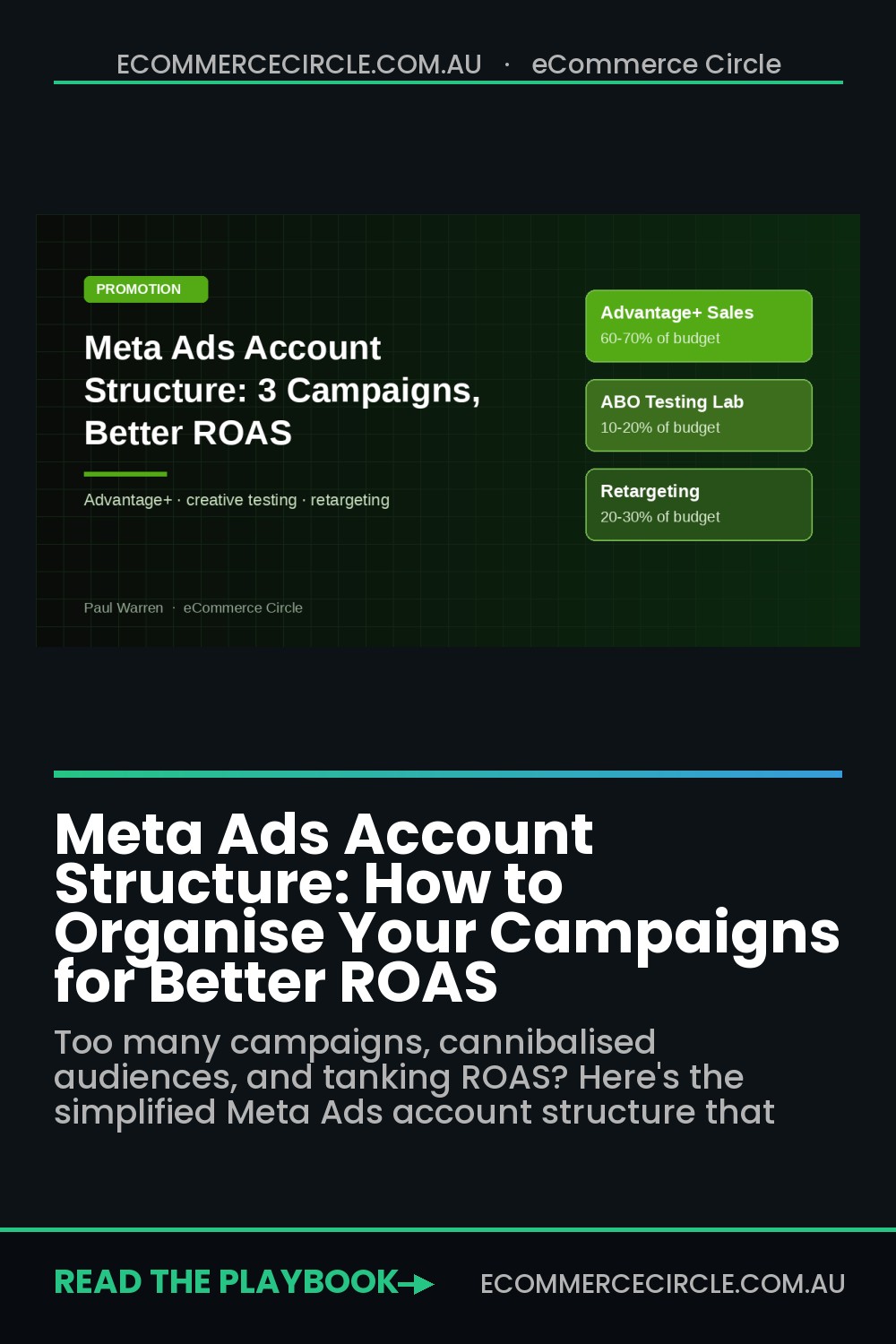
Here’s the exact structure we use with brands doing $30k/month through $1M/month on Meta. Three campaigns, clear jobs, clean separation. You do not need more than this until you’re consistently spending over $3,000/day and have the creative volume to justify a dedicated scale campaign.
Campaign 1: Advantage+ Shopping (ASC+): Prospecting Engine. This is your main scaling campaign and should receive 60-70% of your total budget. One campaign, one (or at most two) ad sets, all creative concentrated here, CBO on. Meta’s Q1 2025 earnings report showed advertisers earning $4.52 for every $1 spent on Advantage+ campaigns (22% higher than manually managed campaigns) with 17% lower CPA on average.
For Shopify brands with mature pixels (100+ purchases in the last 28 days), ASC+ is no longer optional. It’s the floor.
Campaign 2: ABO Creative Testing. The Lab. This is where every new concept gets its first chance to prove itself. Ad Set Budget Optimisation (ABO), not CBO, because you want equal spend behind each concept. Not Meta picking a “winner” based on 20 impressions.
One ad set per concept, 3-5 ads per ad set, $20-50/day per ad set, 3-7 day test window. Anything that beats your account-wide ROAS target gets graduated into the ASC+ campaign.
Anything that doesn’t gets killed. This is the engine that feeds the scaling campaign fresh ammunition.
Campaign 3: Retargeting. The Closer. One campaign, one ad set, warm audiences only (website visitors 30-60 days, engagers, view content, add to cart). 20-30% of your total budget. This is where you run your social proof, founder story, bundle offers, and objection-handler creative.
Retargeting campaigns on Meta typically return a 3.61:1 ROAS versus 2.19:1 for new customer acquisition, so you want it running. But you don’t want it eating the prospecting budget.
That’s it. No “cold LAL 1%”, “cold LAL 2%”, “cold interest stack A”, “cold interest stack B”. No separate campaigns for each product collection.
No “cold video view” campaigns. Three campaigns, three jobs. If your account doesn’t look like this by Tuesday, this article has failed you.
The Budget Split That Keeps You Profitable While You Scale
A good structure with a bad budget split still loses money. Here’s the allocation we hold brands to. And the logic behind each number.
- 60-70% to ASC+ prospecting. This is your top-of-funnel volume. If you’re not filling the top of the funnel, your retargeting audiences shrink within weeks and your whole account stalls. Prospecting is the job that never stops.
- 10-20% to ABO creative testing. Treat this as an R&D budget, not a performance budget. You’re buying data and learning, not revenue. If your testing campaign runs at a 1.5x ROAS that’s fine. Its job is to tell you which concept to scale, not to hit a target.
- 20-30% to retargeting. Split this across two ad sets if you need to: 30-day website / add-to-cart, and 60-day engagers. Cap frequency at 2.5-3 per week so you don’t burn the audience.
- 0-10% to retention / lapsed customers. Optional. Only worth running if you have a clean customer list of 10k+ and a reason for them to come back (new drop, seasonal, win-back offer).
A practical minimum for this structure to work is $150-300/day total. Below that, you won’t give ASC+ enough spend to generate the 50 weekly events it needs, and you’ll end up stuck in perpetual learning. If you’re below $150/day, don’t try to run this structure.
Focus on email, retention, and conversion rate work until your margin supports a real media budget. That’s a Profit conversation, not a Promotion one.
How to Test Creative Without Destroying Your Scale Campaign
Here’s the rule that separates the brands scaling from the ones flatlining: you never test new creative inside your scaling campaign. Ever. New creative goes into the ABO testing campaign first.
Only winners graduate into ASC+. This is non-negotiable. If you drop an untested ad into a scaling campaign, you either (a) force it to eat spend from proven winners and drag down blended ROAS, or (b) have to set a tiny budget cap that starves it of signal and guarantees it looks bad.
The testing workflow we run weekly with eCommerce Circle members looks like this:
- Brief 4-8 new concepts per week. A “concept” is a hook angle plus a creative format. Not a colour variation. Think “founder-to-camera unboxing”, “customer testimonial compilation”, “before/after transformation”, “problem/agitate/solve UGC”.
- Launch each concept in its own ad set. 3-5 ad variations (hook swaps, thumbnail swaps) per concept. $30-50/day per ad set. Run for 3-5 days minimum, or until you’ve spent roughly 1x your target CPA per ad set.
- Kill anything below 0.8x your account ROAS target. Don’t get attached. Don’t give it another 48 hours. Cut it.
- Graduate anything above 1.2x your target into the ASC+ campaign by duplicating the ad into the existing ad set. Do not launch it as a new ad set inside ASC+. That restarts learning.
- Keep a kill-and-graduate log. Which hooks worked. Which formats worked. Which CTAs worked. That log is worth more than any ads course.
Creative volume is the real targeting lever in 2026. The top brands we work with ship 10-20 new concepts per month into their testing campaign. That sounds insane until you realise most of them are variations, hooks, and thumbnail tests.
Not full production shoots. If you’re shipping two new ads a month and wondering why your ROAS is crumbling, the structure isn’t the problem. The creative engine is.
The Real-World Results: What This Structure Actually Delivers
Let’s put numbers around this so you know what to hold yourself to. The average ecommerce ROAS across Meta in 2025 sat at roughly 2.87x. Shopify’s own guidance calls 4x the “ideal” starting point for profitable scaling.
Our working benchmark inside eCommerce Circle for a healthy Australian Shopify brand on Meta is a blended account ROAS of 3.5-5x, with the ASC+ campaign itself at 3-4x and retargeting at 6-8x. If you’re under those numbers on a 60-70% margin product, the account structure is almost certainly the first thing to fix.
A well-documented jewelry brand case study from 2024 showed what’s possible when the structure is right: after flipping to an ASC+ led account, their highest-ROAS campaign was Advantage+ at a lower cost per result, they hit a 5.93x ROAS at the account level in month one, revenue grew 167% by month two, and they finished the year with an 11.39x ROAS blended across the account. That’s not a freak result. It’s what a mature pixel, consolidated structure, and steady creative testing look like when they compound.
We’ve seen the same pattern repeat across Australian brands in apparel, supplements, homewares, and beauty. The shift is almost always the same: go from 8-15 fragmented campaigns down to 3, pull 40% of budget out of retargeting and push it into ASC+, build a weekly creative testing rhythm, and stop touching the account mid-day.
Blended ROAS usually improves 30-60% within 4-6 weeks. Not because anything magical happened, but because Meta’s algorithm was finally allowed to do its job.
The Tools We Actually Use to Run This (and What You Can Skip)
You do not need a $500/month stack to run a good Meta account. You need a small number of tools doing their job well.
- Meta Ads Manager (obviously). Turn on the Advantage+ Shopping option when building the prospecting campaign. Make sure the Conversions API (CAPI) is installed, either through Shopify’s native Meta channel or through an app like Elevar if you’re serious about signal quality. Without CAPI, you’re flying blind post iOS 14.5.
- Triple Whale or Northbeam for attribution. Meta’s in-platform ROAS is directionally useful but overstates itself by 20-40% on most accounts. Triple Whale’s pixel and post-purchase survey will give you a much closer read on real, blended ROAS. If you can’t stretch the budget, Shopify’s own Marketing reports plus a simple “how did you hear about us” post-purchase survey (using Fairing or a free Shopify form) gets you 80% of the value for 20% of the cost.
- Motion or Atria for creative analytics. These tools tag every ad by hook, format, offer, and angle so you can see which types of creative are winning. Not just which specific ad. For brands shipping 10+ concepts per month, this is the difference between learning and guessing.
- A shared Notion or Google Sheet creative log. Low-tech. Extremely high-value. Every concept, every result, every winner, every killed ad. It becomes the single most valuable document in your marketing team within 90 days.
A 7-Step Setup Walkthrough You Can Follow This Afternoon
Enough theory. If you want to rebuild your account using this structure today, here’s the exact sequence. Budget a clean two hours, have a coffee, and don’t multitask.
- Export your last 60 days of ad performance at the ad level. Sort by spend and by purchases. Identify your top 5-10 winning ads. These are the creatives you’ll seed into the new ASC+ campaign.
- Create the ASC+ prospecting campaign. Campaign objective: Sales. Toggle on “Advantage+ Shopping Campaign”. Set your daily budget at 60-70% of your current total. One ad set. Load your 5-10 winners as the starting ad rotation. Leave existing audience / placement / bid settings on full Advantage defaults.
- Create the retargeting campaign. Campaign objective: Sales. Manual ad set. Audience: 30-day website visitors + 30-day add to cart + 60-day Instagram engagers, excluding purchasers in last 90 days. Budget: 20-30% of total. Load 3-5 retargeting-specific creatives (reviews, founder story, bundle offer).
- Create the ABO creative testing campaign. Campaign objective: Sales. ABO (ad set budget). One ad set per new concept, $30-50/day each, broad targeting (no interests, no lookalikes, worldwide cold). 3-5 ads per ad set.
- Pause your old structure. Do not delete. Pause. This preserves your learning data for 30 days in case you need to reference it. Kill anything that hasn’t spent in 14 days.
- Set your management cadence. Weekly: review testing campaign and graduate winners. Every 2 weeks: refresh retargeting creative. Monthly: review budget split and adjust if prospecting is saturating. Daily checks are a bug, not a feature. They create the learning-phase chaos you’re trying to escape.
- Block your calendar for creative briefing. Every Monday. One hour. Brief 4-8 concepts to your editor or UGC creators for launch the following week. Without this ritual, the whole structure collapses in 6 weeks because you run out of ammunition.
The Common Mistakes That Will Sabotage You in Week One
Three mistakes derail almost every rebuild. Watch for them.
Mistake 1: Touching the account mid-day. The single biggest lever for Meta performance in 2026 is leaving it alone. Every budget change, every ad pause, every new ad pushes the ad set back into learning. If you log into Ads Manager every morning, you are the problem.
Check results once a day, make changes once a week, and trust the structure to work. We tell members: “Hands off the steering wheel.”
Mistake 2: Scaling budget in 200% jumps. When something is working, the instinct is to double it overnight. Don’t. Meta’s learning phase breaks at roughly 20-30% budget increases or larger.
Scale in 15-20% steps every 2-3 days once the campaign is stable. Yes, it’s slower. It’s also why your ROAS stops crashing every time you push.
Mistake 3: Judging the rebuild on day 3. The first 5-7 days after restructuring look chaotic. Learning phase, unstable CPMs, weird attribution. Hold your nerve.
The benchmark is the 14-day rolling blended ROAS, not yesterday’s number. Brands that panic and flip back to the old structure on day 4 never get the benefit. Brands that hold for 3 full weeks almost always see the improvement.
Name Everything the Same Way: The 10-Minute Fix That Makes Your Account Readable
Half the chaos in most Meta accounts is not strategy. It is naming.
When ads are called “New Test 3 FINAL v2”, nobody can tell what won, why it won, or what to brief next. A consistent naming convention turns your Ads Manager into a searchable creative library.
Here is the convention we set up with members. Use it at every level, separated by a pipe:
- Campaign: Objective | Type | Market. For example “SALES | ADV+ | AU”.
- Ad set: Concept | Audience | Launch date. For example “Founder story | Broad | 2026-10-06”.
- Ad: Hook | Format | Offer | Creator. For example “Hook: Sore feet | UGC 9×16 | 15% off | Jess”.
Note that newer accounts now label the Advantage+ Shopping setup as an Advantage+ sales campaign. The structure in this guide still applies: one consolidated prospecting campaign doing the heavy lifting.
The payoff shows up in your creative tools. Motion and Atria read naming tags, so a clean convention lets you filter by hook or format in seconds and spot that, say, founder-to-camera hooks beat product demos by 30% on cost per purchase. Pair it with the weekly rhythm in our Meta creative testing engine and every brief you write starts from evidence, not gut feel.
Worked Example: Consolidating a $250/Day Aussie Apparel Account
Imagine you run a Sydney apparel brand spending $250 a day on Meta, about $7,500 a month. Your target cost per purchase is $45 and your average order value is $120.
Before: 9 campaigns and 14 ad sets. That is an average of about $18 a day per ad set. At a $45 cost per purchase, each ad set gets around 3 purchases a week.
Meta wants roughly 50 optimisation events per ad set per week to exit learning, so every ad set is stuck in learning, permanently. Blended ROAS sits at 1.9x.
After: three campaigns, five ad sets.
- Advantage+ prospecting at $165 a day (66%): one ad set, seeded with the eight best ads from the last 60 days.
- ABO testing at $35 a day (14%): one concept at a time at $35 a day for four to five days, rotating weekly.
- Retargeting at $50 a day (20%): one ad set, 30-day visitors and add-to-carts, frequency capped near 3 per week.
The prospecting campaign now spends about $1,155 a week. At a $45 cost per purchase that is roughly 26 purchases, still under 50, but with all the signal pooled in one place it stabilises far faster than 14 starved ad sets ever could.
Hold your nerve for 14 days, then judge on the 7-day blended number in your attribution setup, not Meta’s in-platform ROAS. A realistic target for this account is moving from 1.9x to 2.5x to 3x blended within six weeks, which at the same spend is an extra $4,500 to $8,250 a month in revenue.
How This Fits Into Your Wider Growth Engine
Meta ads are the loudest lever in a Shopify growth engine but not the only one. The structure above pulls its weight when it’s surrounded by the rest of the system. Your email flows need to catch the traffic Meta sends, which is why we keep pointing brands back at our breakdown of the email marketing funnel every Shopify brand needs.
Your site needs to convert it, which is why checkout optimisation and site speed show up on our dashboard every single week. Your unit economics need to absorb a 3-4x ROAS profitably, which is a contribution margin conversation, not an ads conversation.
This is why the More Orders Operating System treats Promotion as one of ten P’s, not the whole game. If you fix Meta structure but ignore Performance, Patrons, and Profit, you’ll scale spend and shrink margin.
Nobody wins. The brands that compound are the ones who run a clean account structure and a clean everything else.
Your 30-Minute Action Plan
If you do nothing else after reading this, do these five things before you close the tab:
- Count your active campaigns. If it’s more than 5, you have a consolidation problem.
- Count your active ad sets. If it’s more than 6, divide your daily spend by 6 and check if each one is getting $285+/day. If not, you’re starving the algorithm.
- Check your Conversions API status. If CAPI is not installed and showing “good” signal quality, fix that this week. Nothing else matters if your signal is broken.
- Audit last 30 days of creative. How many genuinely different concepts did you ship? If it’s under 4, you don’t have an ads problem. You have a creative production problem.
- Schedule the rebuild. Put two hours in the calendar this week to rebuild into the 3-campaign structure. Not “soon”. A specific time, on a specific day.
Meta in 2026 rewards simplicity, signal, and creative volume. It punishes fragmentation, tinkering, and clever segmentation.
The brands that understand this are quietly pulling ahead of their competitors. Not because they found a secret audience or a magic hook, but because they cleaned up their account and let the algorithm cook.
Ready to Pressure-Test Your Account?
Inside the eCommerce Circle, Promotion structure is one of the core pillars we work on with every member, alongside email, retention, unit economics, and the weekly dashboard that holds it all together. If you want a second set of eyes on your Meta account and a clear plan to rebuild it without losing learnings, let’s talk. A 30-minute call, no pitch, and you’ll walk away with a structure diagram specific to your brand.