Most Aussie DTC founders treat the welcome email like a receipt. One email. One discount code. Done. Then they wonder why their email channel sits at 8% of revenue while the brand they admire on Instagram is pulling 35%.
What’s in This Article
Here is the part nobody tells you. The 30 days after someone hands over their email is the single highest-converting window your store will ever get with that person. Klaviyo’s 2026 benchmark data, drawn from over 183,000 ecommerce brands, shows welcome flows place an order at 2.32% across all sends, which is roughly 18 times the conversion rate of a broadcast campaign. Top performers push that figure into the 8 to 12% range. The maths is brutal. If you are sending one email instead of a properly sequenced flow, you are leaving 60 to 90% of available revenue on the table before Meta has even finished spending your CAC.
This is the 7-email welcome flow we run with eCommerce Circle members doing $80k to $500k a month on Shopify. It works for skincare, apparel, supplements, homewares, pet brands. It works because it stops treating new subscribers like discount hunters and starts treating them like adults who want to know who you are, why they should care, and what makes your product actually different. By the end of the next 30 minutes, you will have the full structure, the deliverability spine that keeps your sender reputation alive in 2026, and the exact metrics to benchmark every stage against.
Why the welcome flow is the highest-ROI 30 days you will ever run
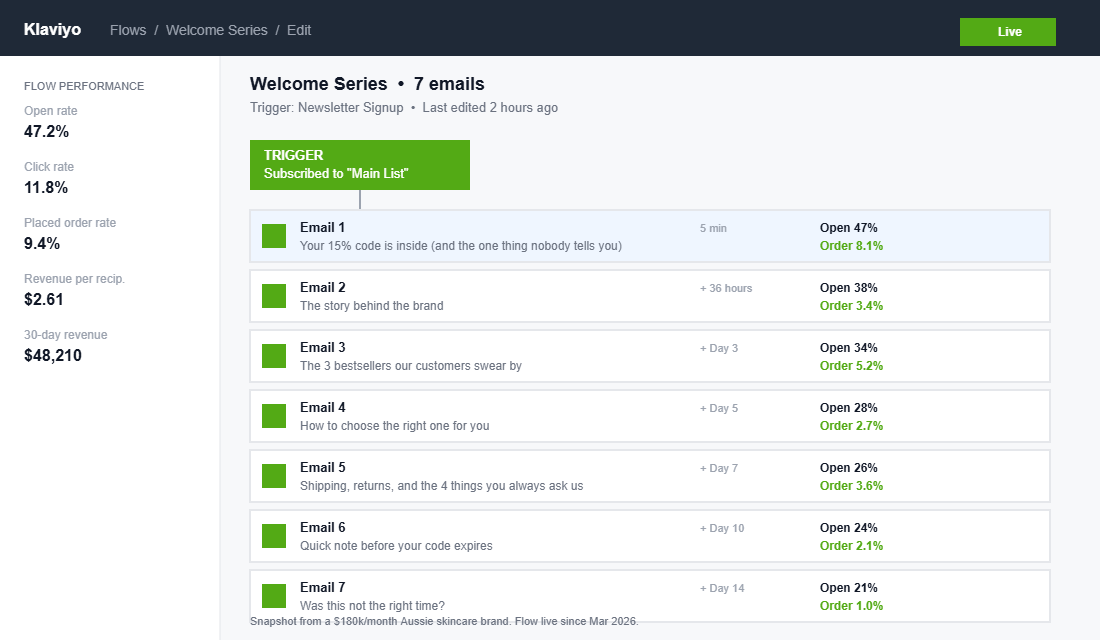
Let’s talk numbers before structure. Klaviyo’s January 2026 benchmark report shows automated flows generate 41% of total email revenue from just 5.3% of sends. Inside that, the welcome flow is the highest-converting automation behind only the abandoned cart sequence. Revenue per recipient on a healthy welcome series sits between $2.35 and $2.65, compared to $0.10 to $0.18 for a typical broadcast campaign.
Why is the window so productive? Three reasons. The subscriber chose to give you their email in the last 5 minutes, so intent is at its peak. They have not yet been desensitised by your weekly campaigns. And the rules of email engagement reward you for striking while the iron is hot. Sending the first email an hour late instead of inside 5 minutes drops open rates by close to 50%. Consumer research consistently shows 74% of new subscribers expect that first email immediately.
The compounding effect is what most founders miss. A 4-email welcome series generates up to 90% more revenue per subscriber in the first 30 days than a single welcome email. Push that to 7 emails over 14 days and you compound the lift again, because you are now reaching subscribers who skipped emails 1 to 3 because the kids were sick, the meeting ran over, or the email landed at 4pm on a Friday. Email frequency without thoughtful sequencing is spam. Sequenced frequency with story, proof, and education is just thorough.
Think of the welcome flow as the customer’s first impression of your brand at scale. You only get one chance to make it. Most brands waste theirs on a 10% off pop-up and a generic “Welcome to the family” email that could be from any of 50,000 other Shopify stores. Yours can do better.
Stage 0: The opt-in (capture the right people, not just any people)
You cannot welcome someone who never subscribed. The flow starts at the pop-up, and the pop-up is where most Aussie stores quietly bleed list quality. The default “10% off your first order” pop-up converts at roughly 3 to 5% on cold traffic. That is the industry baseline, and it is also a magnet for the worst kind of subscriber: a price-only buyer who unsubscribes the moment they redeem the code.
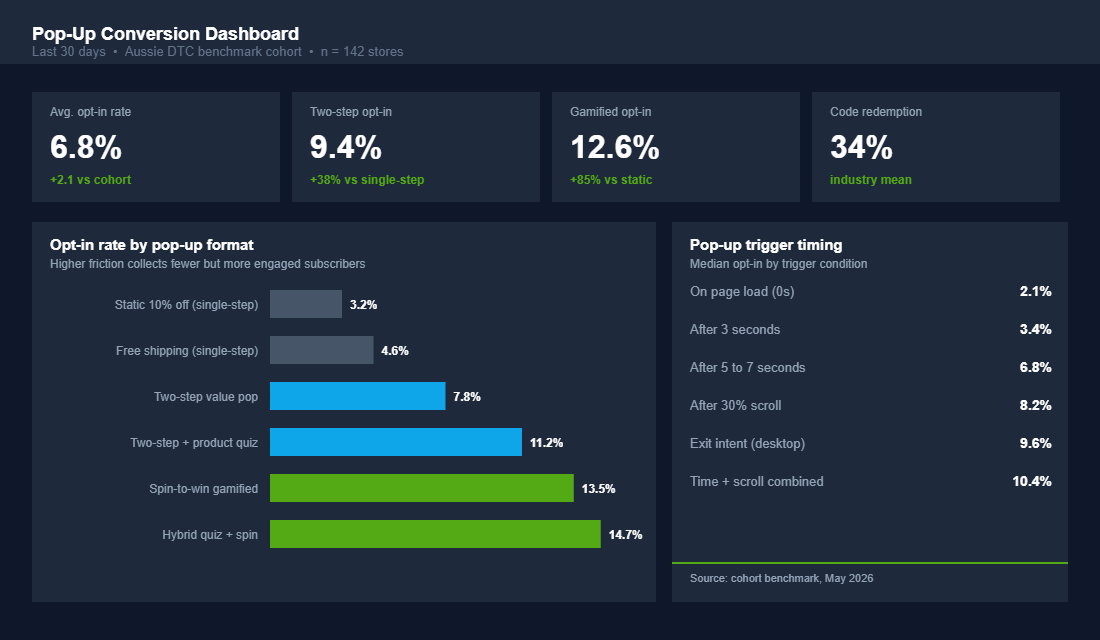
- Two-step pop-up. Lead with the value, not the form. Step 1 asks a yes/no question or shows a benefit (free shipping on first order, early access to a new drop, a $50 gift card competition). Step 2 collects the email. Two-step pop-ups consistently outperform single-step by 30 to 50% in our member tests.
- Gamified pop-up for traffic over 20k a month. Spin-to-win formats hit 8 to 15% opt-in rates compared to 3 to 5% for static discount pop-ups. The catch is that you must control the reward range so you do not give away your margin. Tighten the prize wheel: most slices give 10 to 15% off, one slice gives free shipping, one slice gives a hero product, one slice gives nothing (which is fine, they still get on the list).
- Email-only field. Adding a phone number drops opt-in rates by 30 to 40%. Capture phone in a post-purchase moment or inside email 2, not at first impression.
- Delay timing. Trigger the pop-up at 5 to 7 seconds, on 30% scroll, or on exit intent. Showing it on page load is the fastest way to teach a visitor to close pop-ups without reading.
- Mobile-first design. Roughly 70% of Aussie ecommerce traffic is mobile. If your pop-up looks like a brochure on desktop and chokes the screen on mobile, you are training the algorithm to hate you.
If you are running a quiz on your product education page, even better. A quiz captures 4 times more subscribers than a standard pop-up because the visitor has already invested 2 minutes of attention. We covered the full architecture in The Shopify Quiz Funnel Playbook, and it pairs cleanly with the welcome flow that follows.
Email 1: The 5-minute trigger (deliver the offer, set the tone)
This email goes out within 5 minutes of opt-in. Not 5 hours. Not “the next morning”. Five minutes. Klaviyo’s flow trigger fires instantly when a profile is added to the list, and your job is to make sure the email is approved, the discount code is generated dynamically, and the subject line is doing real work.
- Subject line that earns the open. Skip “Welcome to the family”. Try a curiosity hook (“Your 15% off is inside, plus the thing nobody tells you”) or a name personalisation (“Sarah, your code is ready”). Personalised subject lines lift open rates by 26% on average. Aim for 45 to 70% open rate on this email. Below 40% and your sender reputation, your list quality, or your subject line is broken.
- Open with a single sentence. Not a hero image with no copy above it. Email clients clip preview text after 80 characters. Use the first 80 to reinforce why they opened.
- Deliver the offer immediately. Code visible above the fold. Expiry date stated. Free shipping threshold mentioned in the same panel. The faster the friction-to-purchase drops, the higher the conversion.
- One CTA, repeated 3 times. Top, middle, bottom of the email. The button text changes (“Shop bestsellers”, “Use my code”, “Start shopping”) but the link goes to the same collection page where the code auto-applies.
- Set the next-email expectation. A line at the bottom that says “Tomorrow I’ll tell you the story behind why we built this”. This is the secret to keeping email 2 above 40% open.
Benchmark: this email should hit 50% plus open rate, 8 to 12% click rate, and place an order at 5 to 10% inside 48 hours of receipt. Below those marks, fix the subject line first, then the offer, then the design. In that order.
Email 2: The brand story (24 to 48 hours after signup)
This is where most welcome flows die. The founder writes a beige “About Us” paragraph that lists their values (“integrity, quality, sustainability”) and wonders why nobody buys. Email 2 is not the time to recite your values. It is the time to tell the one story that explains why your brand exists in a way no competitor can copy.
Bondi Sands moved their entire CRM to Klaviyo on Shopify Plus partly because their founders’ story (an Aussie couple wanting safer self tan) was getting lost in generic broadcast emails. The brands that pull 35% of revenue from email almost always tell a sharp, specific founder story inside the first 72 hours of subscription. Generic does not stick. Specific does.
- Lead with the moment that started the brand. “I was standing in a Bondi pharmacy and realised every self tan on the shelf smelled like wet biscuits”. One sentence that paints a picture and dates the brand. Skip the corporate timeline.
- Name the enemy. The wrong product, the broken category, the lazy competitor. You are not attacking by name, you are explaining what you refuse to do. “We refuse to use the cheap fragrance that gives 60% of customers a headache”. Stating what you are against makes what you are for obvious.
- One product hero, with a reason. Pick the bestseller that best represents the brand mission. Two paragraphs on why it exists, what changes when a customer uses it, and a single review block beneath it.
- Soft CTA. The discount code still lives in the footer. The CTA at the top is “Read the full story” linking to your About page or a long-form founder letter on your blog. You are training the click before you ask for the buy.
Expect open rate to drop from email 1 by 10 to 15 percentage points (so 35 to 50% is healthy). Click rate should hold or even lift on the story email because curiosity is doing the work, not urgency. The placed-order rate from this email is typically 2 to 4%, and a meaningful percentage of those buyers cite the story when interviewed.
Email 3: The proof stack (day 3 to 4, social proof + bestsellers)
By day 3 the subscriber has heard the offer and the story. They are weighing up whether your product is for them, and the only question left is “do other people I trust use this?”. Email 3 answers that question with proof, not promises.
- Open with a hero review. Five-star, 80 to 120 words, customer first name and city if you have it (“Mel from Geelong”). Avoid the polished marketing testimonial. The slightly raw, specific review converts harder (“I was sceptical because I’ve tried 4 brands and they all stained the sheets, but…”).
- Three bestsellers, in a grid. Each with star count, review count, and a one-sentence “why it sells” line. Numbers and short reasoning beat hero copy. “Loved by 24,000 customers” is more persuasive than “Our hero serum”.
- UGC strip. Three customer photos in a row, captioned with the customer name. Real photos, not stock shots. If you are short on UGC, that is your next month’s project. Hismile, which Shopify reported scaled global online sales 500% on Shopify Plus, leans hard on UGC in their welcome and post-purchase touchpoints because raw customer photos out-convert glossy brand shots roughly 2:1.
- Press logos or expert endorsements. If you have them. “As seen in Vogue Australia” carries weight in a beauty brand. “Featured in Stockfeed” or “Sponsored by Cycling Australia” carries weight in performance categories. Skip the logo bar if it is thin. A weak logo bar is worse than no logo bar.
This email should drive your highest click rate in the flow because curiosity now has a reason to act. Benchmark: 30 to 45% open rate, 10 to 15% click rate, 4 to 7% placed-order rate. If clicks are strong but orders are weak, the friction is on the product page, not in the email. That is when you start running diagnostic conversion tests against the bestseller PDP.
Emails 4 and 5: Education and objection handling (day 5 to 9)
This is the stretch where most welcome flows go silent. Founders feel they are pushing too hard. The data says the opposite. Engagement on emails 4 to 5 holds steady when the content stops being a sales pitch and starts answering the actual questions a buyer is asking inside their own head.
Open a Google Doc, list the 10 questions your customer service team answers every week, and rank them by how often each one delays or kills a sale. The top 2 are the spine of emails 4 and 5.
- Email 4: The “how to choose” guide. If you sell skincare, this is “Which serum is right for your skin type”. If you sell apparel, this is “How to find your size without the returns drama”. If you sell supplements, this is “How long until you feel it work”. Specific. Useful. Subhead, three options, one recommendation, link to a quiz or a comparison page. This is the educational layer that builds trust without asking for the sale.
- Email 5: The objection email. Front-foot the two reasons people walk away. Shipping concerns (“Free shipping over $80 anywhere in Australia, dispatched same-day from Melbourne”), returns (“60-day no-questions returns, no return-shipping fees”), ingredient or sourcing concerns (“Made in Geelong, vegan certified, no synthetic fragrance”). Each objection gets a short answer and a link to the policy page. Then the email closes with the discount code one more time and a soft “the code is still valid for X more days” line.
The objection email is the highest-converting underrated email in the flow. We see it routinely outperform the bestseller email by 20 to 40% in placed-order rate, because the subscribers who are still on the fence at day 7 are the ones with a real question. Answer the question, and the order follows. For brands paying $35 to $80 CAC on Meta, a 2 to 3% lift in welcome-flow conversion can shave 7 to 14 days off the CAC payback period, which we broke down in The Shopify CAC Payback Period Playbook.
Emails 6 and 7: The respectful close (day 10 to 14)
Most welcome flows end at email 4 or 5. The brands pulling 35% of revenue from email do not. They extend to 7 emails because the data shows roughly 30 to 40% of welcome-flow revenue arrives in the back half of the sequence, particularly when a non-buyer is offered a final, time-bound reason to act.
- Email 6: The “last reminder” email. Subject line stays soft: “Quick note before your code expires”. Body restates the offer with a specific expiry date (real expiry, not a fake countdown). Recap the top 3 bestsellers from email 3. One paragraph at the bottom: “Even if you do not use the code, here is what to look out for from us going forward (one campaign a week, never spam)”. You are showing respect for the inbox, which builds long-term engagement.
- Email 7: The “stay or go” email. The subscriber has had 14 days. They have not bought. Now you ask them a direct, friendly question. “Was this not the right time? Tap one of these to help us send better stuff.” Three buttons (or three tag-based links): “I’m still browsing”, “Send me less often”, “Show me the bestsellers”. Each click moves them into a new segment so your future campaigns are personalised, and your sender reputation does not get dragged down by unengaged subscribers. Brands that run a tag-based “stay or go” close routinely lift list engagement by 15 to 25% inside 90 days.
One technical note. If you sell into both Australia and the US or UK, segment the welcome flow by country so shipping language, GST inclusion, and currency are always accurate. A flow that says “free shipping over $80” to a New Zealand buyer who pays in NZD is the kind of small detail that erodes trust on email 1.
The deliverability layer (where your welcome flow lives or dies in 2026)
You can write the best 7-email sequence in your category. If your sender reputation is broken, half of it lands in spam and you never see the revenue. Since February 2024, Gmail, Yahoo, and Microsoft have enforced new bulk-sender requirements that have only tightened through 2026. If you have not audited your setup since, do it this week.
- SPF, DKIM, and DMARC must all be configured. SPF lists the servers allowed to send for your domain. DKIM cryptographically signs every email. DMARC sets the policy when SPF or DKIM fails. You need all three. Klaviyo, Mailchimp, and Omnisend each publish step-by-step DNS guides for Aussie founders running on common registrars (Crazy Domains, GoDaddy, VentraIP). Block 30 minutes to walk through it with whoever manages your domain.
- DMARC policy progression. Start at p=none for 4 to 6 weeks while you monitor reports. Move to p=quarantine, then p=reject. Bulk senders sitting at p=none indefinitely are increasingly flagged.
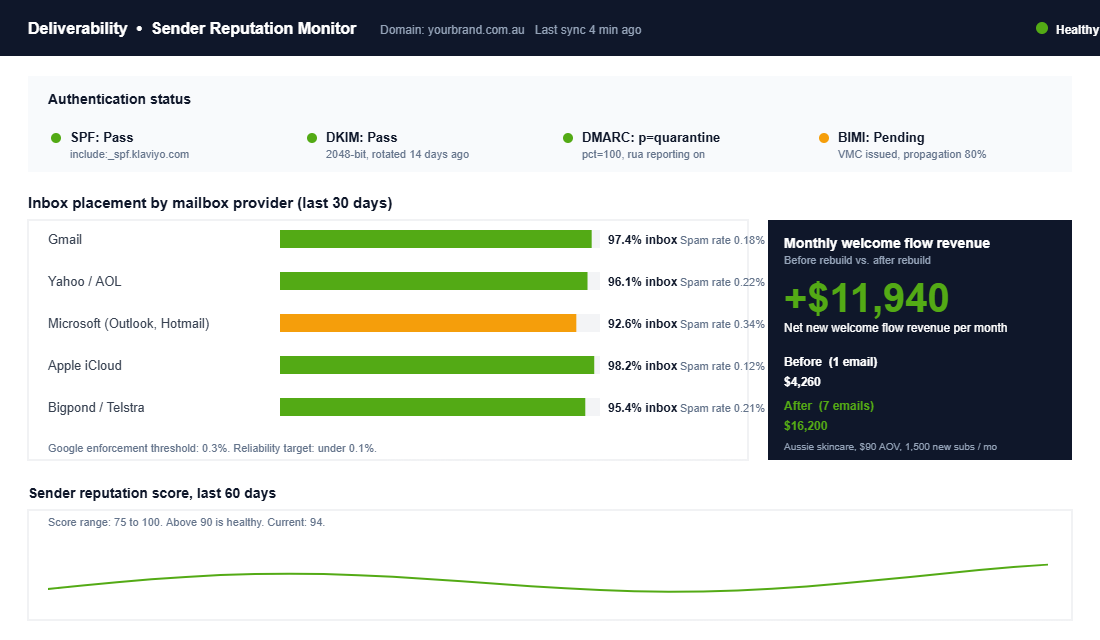
- Spam complaint rate under 0.3%. This is Gmail’s enforcement threshold. Google’s reliability target is under 0.1%. If your complaint rate spikes above 0.3%, expect inbox placement to collapse within days. The fix is segmenting unengaged subscribers out of your campaign sends and using a tag-based close (see email 7 above) inside the welcome flow itself.
- One-click unsubscribe in headers. RFC 8058 is now a hard requirement. Klaviyo, Omnisend, and most modern ESPs add this automatically. If you are running on a custom transactional setup, audit it.
- From-domain alignment. The visible “from” address must match the domain authenticated by SPF or DKIM. Sending welcome emails from gmail.com or your personal address breaks alignment and kills deliverability for the entire flow.
One operational habit that separates the 35%-of-revenue brands from the 8% brands: a monthly deliverability review. Open Klaviyo’s deliverability dashboard, check the inbox placement rate per major mailbox provider, and act on any drop below 95% within 7 days. The earlier you catch a spam-folder pattern, the cheaper it is to repair.
How the system compounds (the revenue maths nobody runs)
Let’s put real Australian numbers on this. Say you run 50,000 sessions a month, capture 3% as new subscribers (so 1,500 new emails), and your AOV is $90. A one-email welcome flow at a 3% placed-order rate generates roughly $4,050 a month. A properly sequenced 7-email flow at 12% generates closer to $16,200 a month from the exact same opt-ins. The CAC is unchanged. The only variable is what happens after the pop-up.
Now apply the second-order effect. A subscriber who buys inside the welcome flow has roughly a 35 to 45% chance of placing a second order in the next 90 days. Push your welcome conversion from 3% to 12% and you triple the first-purchase volume, which triples the population of customers feeding your retention flows, which lifts repeat purchase rate, which lifts LTV. The compounding curve is steep. We have watched eCommerce Circle members add $40k to $90k of monthly revenue inside 60 days from a welcome flow rebuild, with zero increase in ad spend.
This is also what protects you when the ad market gets ugly. When Meta CPMs spike in November and December, the brands sitting at 30%+ of revenue from email and SMS keep growing while the brands sitting at 8% start panicking. The welcome flow is one of the cheapest moats you can build, and the only cost is the 6 to 10 hours of careful work it takes to set it up properly. Pair it with the post-purchase SMS sequence we covered in Post-Purchase SMS for Shopify and you have a two-channel retention engine that does the heavy lifting in your second 30 days too.
The 7-email welcome flow blueprint (copy this)
Save this and walk it through with your email lead this week. Set hard benchmarks per email. Audit any email that falls below the floor for 3 consecutive weeks.
- Email 1. Trigger: 5 minutes after signup. Goal: deliver code, set tone. Open rate floor: 45%. Placed-order rate floor: 5%.
- Email 2. Trigger: 24 to 48 hours. Goal: brand story. Open rate floor: 35%. Click rate floor: 8%.
- Email 3. Trigger: day 3 to 4. Goal: social proof and bestsellers. Open rate floor: 30%. Placed-order rate floor: 4%.
- Email 4. Trigger: day 5 to 6. Goal: education (“how to choose”). Open rate floor: 25%. Click rate floor: 6%.
- Email 5. Trigger: day 7 to 9. Goal: objection handling (shipping, returns, sourcing). Open rate floor: 25%. Placed-order rate floor: 3%.
- Email 6. Trigger: day 10 to 11. Goal: last reminder before code expires. Open rate floor: 22%. Placed-order rate floor: 2%.
- Email 7. Trigger: day 13 to 14. Goal: tag-based “stay or go” segmentation. Open rate floor: 20%. Engagement (any tag click) floor: 8%.
Run it for 60 days. Look at the placed-order revenue from the flow against the same window the year prior. The gap will tell you whether your welcome sequence is doing the job a welcome sequence is supposed to do.
Inside eCommerce Circle, the welcome flow is one of the first pillars we rebuild with every new member, because it is the highest-ROI 6-hour project in the entire More Orders Operating System. If you want a second opinion on yours, let’s talk.