Walk through almost any Aussie Shopify store right now and you will hit the same wall the customer hits: a wall of products, a five-tab mega menu, and a polite request to please figure out which option is right for you. The store assumes the visitor knows what they need. Most of them do not. They know their skin gets tight in winter, or their dog drags them on walks, or their existing supplement makes them feel sluggish. They cannot translate that into a SKU.
What’s in This Article
That gap between what the customer can describe and what your store demands they pick is where conversion rate goes to die. The average Shopify store converts at 2 to 3%. Brands that put a quiz funnel between the visitor and the catalogue are doing 7 to 25% on quiz traffic, with email opt-in rates hitting 42% when the quiz is built properly. IL Makiage built a $400M brand on the back of a foundation-match quiz. Bondi Sands runs a Skin Quiz that gates 20% off three or more products. Octane AI clients like Jones Road Beauty have generated 800,000 leads through quizzes. Hunter and Gather lifted Klaviyo flow revenue 258% by feeding quiz answers into segmentation.
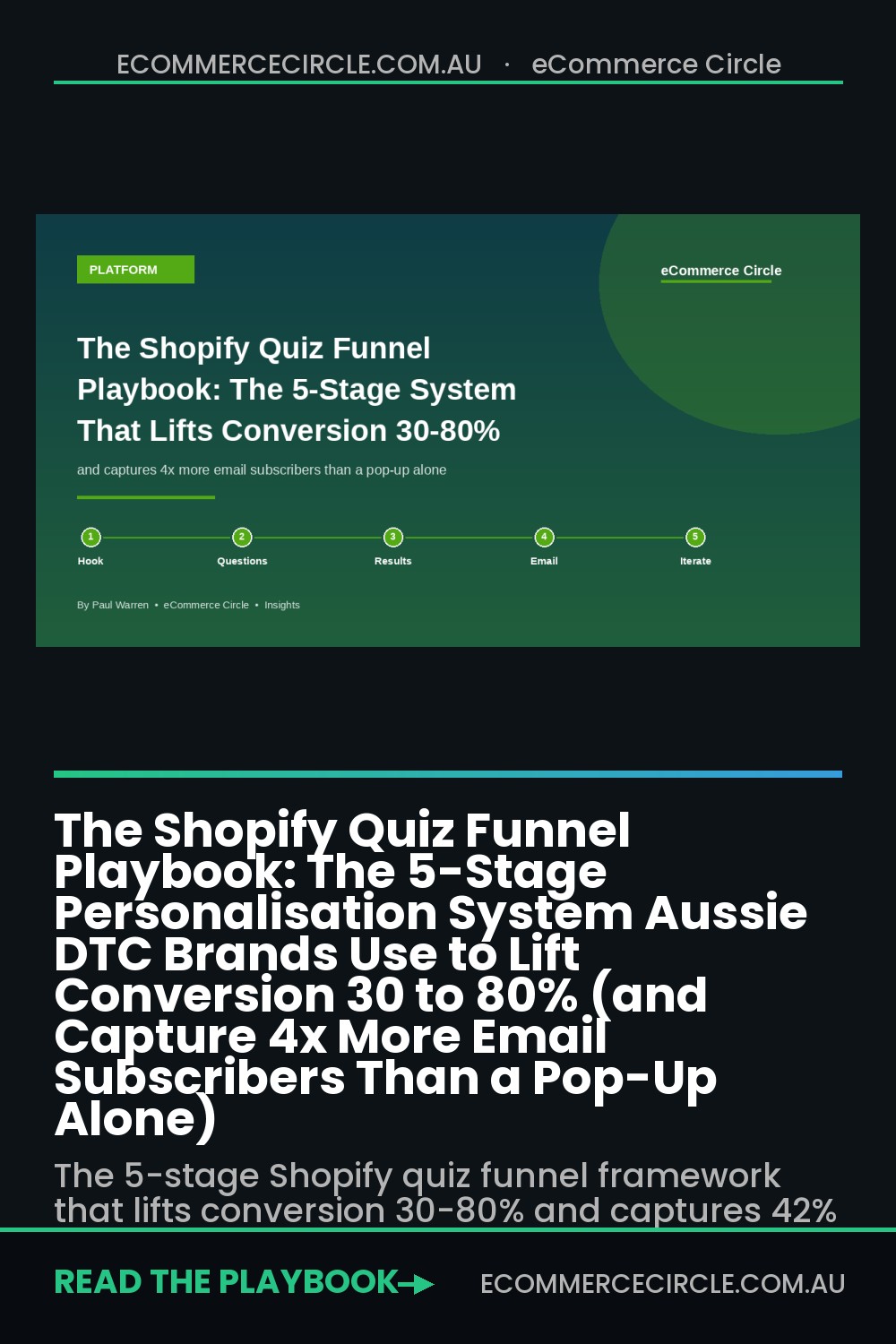
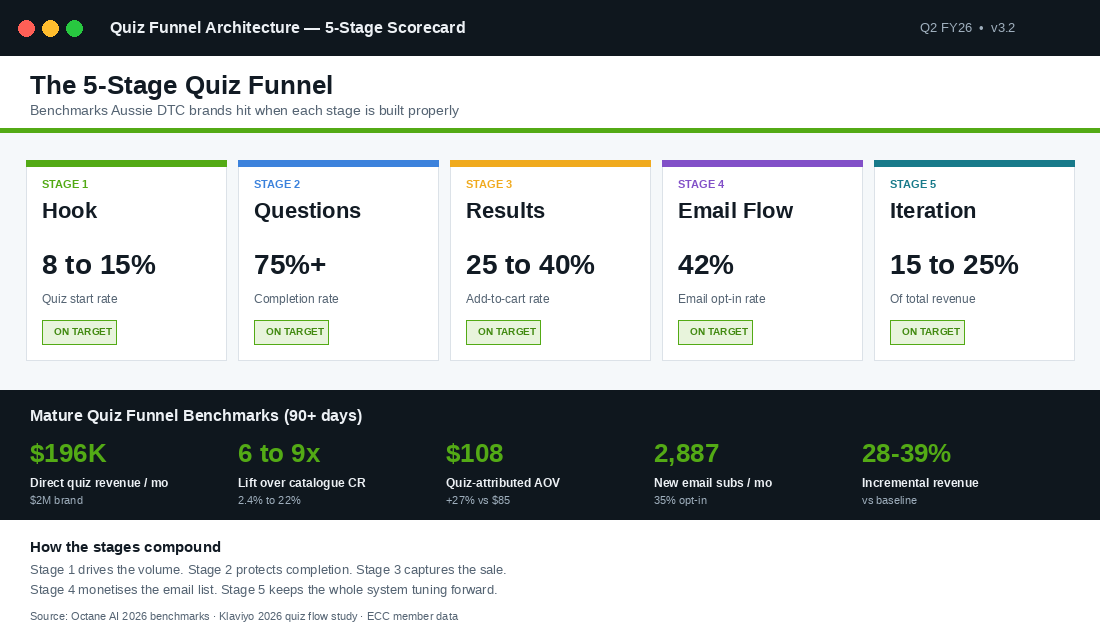
Most Aussie brands look at quizzes as a “nice to have”. This post argues the opposite. A well-built quiz funnel is one of the highest-impact projects you can ship this quarter. Below is the 5-stage framework we use with members inside eCommerce Circle, with real benchmarks, real tools, and an Aussie execution lens.
Why Most Aussie Shopify Stores Under-Index on Quizzes (The Self-Service Trap)
The default Shopify mental model is “give the customer the catalogue, let them browse, hope they pick the right thing”. That works when you sell a single hero product. It collapses the moment you have 8+ SKUs, 3+ skin types, multiple sizing systems, or anything resembling a “which one is right for me” decision.
The data on this is brutal. Baymard puts the average ecommerce conversion rate at 2.7%. Stores running well-built product recommendation quizzes see 37.6% conversion on visitors who reach the results page. AI-driven personalisation lifts conversion 15 to 18% in health and beauty alone. Personalised recommendations make shoppers 4.5x more likely to purchase. 80% of consumers prefer brands that offer personalised experiences and 74% will hand over data in exchange for it.
The “self-service trap” is the founder belief that customers will educate themselves on your category. They will not. They will bounce. The quiz funnel takes that decision off their plate and turns the moment of confusion into a moment of guided commitment. Three things happen at once when a quiz fires:
- The visitor invests time. 60 to 90 seconds of answering builds the sunk-cost commitment that drives 7 to 25% post-quiz conversion versus 2 to 3% catalogue conversion.
- You capture zero-party data. Skin type, goal, current routine, pain point. This is the data Meta and Google cannot give you, and it lives in Klaviyo forever.
- You earn the right to recommend. Instead of pushing the bestseller, you can confidently say “based on what you told us, these three SKUs are the right starting point”. That confidence converts.
The Aussie stores already doing this well include Bondi Sands (Skin Quiz feeding their everyday skincare range), Adore Beauty (skincare quiz at the top of the funnel), MCoBeauty’s shade-match flows, and dozens of pet, supplement, and apparel brands quietly compounding the same advantage. The brands not doing it are the ones running 4% AOV growth while their competitors run 25%.
Stage 1: The Hook (How to Actually Get the Quiz Played)
A great quiz nobody takes is worth nothing. The first stage of the framework is engineering enough quiz starts that you have data to work with. Most Aussie founders bury the quiz on a single homepage banner and wonder why participation sits at 1.5% of sessions. The benchmark you should be targeting is 8 to 15% of site sessions starting the quiz.
Five entry points to design for, in order of impact:
- Hero banner on the homepage. Quiz CTA as the primary call to action above the fold. Replace “Shop now” with “Find my routine in 60 seconds”. Expect 4 to 7% of homepage sessions to click in.
- Exit-intent overlay. Trigger the quiz when the cursor moves toward the tab bar. Standard exit popups convert at 3 to 5%. Quiz-based exit popups convert at 8 to 19%, per Alia and Omnisend benchmarks. Reclaim the bounce.
- Top-of-collection banner. On collection pages with 12+ products, a strip banner that says “Not sure where to start? Take the 60-second quiz” intercepts the overwhelmed browser before they leave.
- Ad campaign landing page. If you run Meta or TikTok, send cold traffic to a quiz landing page instead of a category page. Klaviyo case data shows quiz landing pages outperform category pages by 30 to 80% on email capture and 2 to 4x on first-order conversion.
- Email and SMS reactivation. “It has been a year since your last order, our range has changed, take 60 seconds and we will rebuild your routine.” Lapsed customers convert on quizzes at twice the rate of cold traffic because they already trust the brand.
One Aussie skincare brand we work with moved the quiz from a homepage tile to the hero CTA plus an exit-intent overlay and lifted quiz starts from 1.8% to 11.4% of sessions in 30 days. No paid spend change. Email list grew by 3,400 subscribers in that same month.
Stage 2: The Questions (5 to 8, Mom Test Discipline)
This is where most quizzes implode. Founders try to capture every preference, ask 14 questions, and lose 60% of starters before the results page. The benchmark you should hold yourself to is a quiz completion rate of 75% or higher. Below 60% means the quiz is too long or too vague.
The discipline is this: only ask questions whose answers will change the recommendation. If you cannot honestly explain how the answer routes to a different product, cut the question. Borrowed from the Mom Test methodology we covered in our Founder-Led Customer Interview Playbook, the same rule applies on-site: do not ask hypothetical, do not ask for opinions, ask about real current behaviour and outcomes.
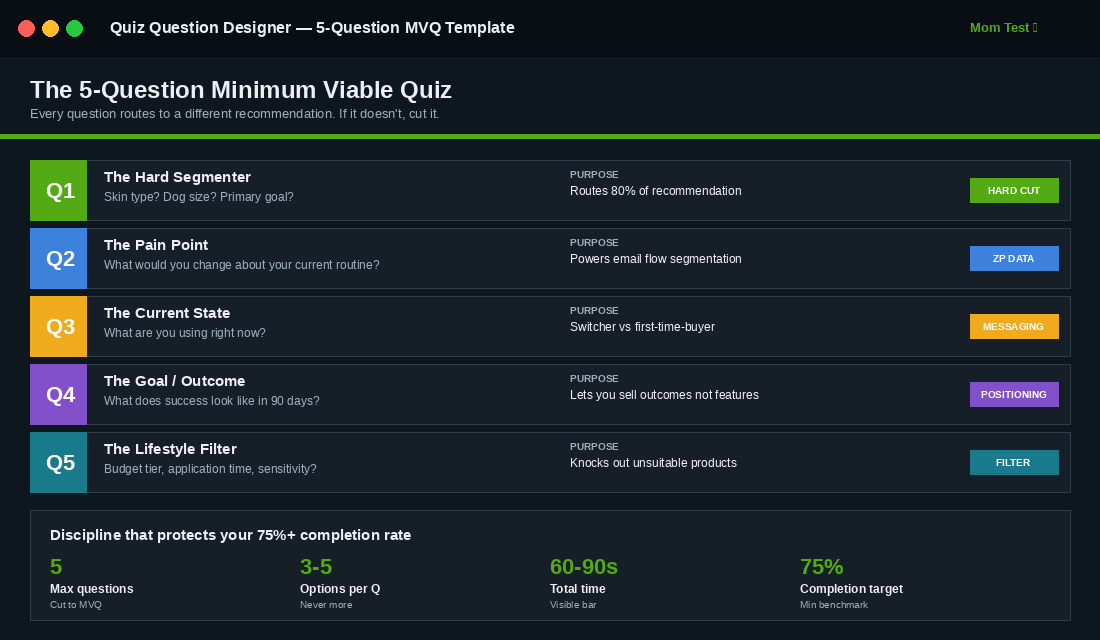
The 5-question minimum-viable quiz structure:
- Q1: The hard segmenter. The one question whose answer routes 80% of the recommendation. For skincare, that is skin type. For pet food, that is dog size. For supplements, that is primary goal. Get this one right and the rest of the quiz is fine-tuning.
- Q2: The pain point. “What is the one thing about your current routine you would change?” or “Which of these frustrations sounds most like you?” This is zero-party gold for email flows later.
- Q3: The current state. “What are you using right now?” Reveals whether they are a switcher, upgrader, or first-time buyer. Changes both the recommendation and the messaging.
- Q4: The goal or outcome. “What does success look like in 90 days?” Gives the customer the future-self vision and lets you tie the recommendation to outcome language, not feature language.
- Q5: The lifestyle filter. Budget tier, application time, sensitivity, or any constraint that knocks out unsuitable products. Keep options to 3 to 4 max.
Tactical rules. Every question is multiple choice or visual choice, never free text. Each question has 3 to 5 options, never more. Use a visible progress bar at the top, numbered (“Question 2 of 5”) so the customer can see the finish line. Add a single optional bonus question that gates a discount: “Want 15% off your first order? Drop your email and we will save your results.” That last move is where the 42% email opt-in rate comes from.
Stage 3: The Results Page (Where Quiz Funnels Earn Their Pay)
The results page is the conversion event. Treat it like a personalised landing page, not a search results dump. The two patterns that lose are throwing 12 SKUs at the user (decision paralysis returns, conversion drops back to catalogue baseline) and recommending a single SKU with no alternative (creates a binary yes/no that loses fence-sitters).
The winning pattern is the “1 hero, 2 supporting, optional bundle” layout. One headline recommendation, framed as the answer (“Your hero match: the Hydrating Serum, because you told us your skin is dry and reactive”). Two supporting products that complete the routine. One bundle option that combines all three at a 10 to 15% discount, which lifts AOV without bleeding margin (and we covered the maths on this in our Discount Discipline Framework).
The other elements that move results-page conversion from 25% to 40%:
- Personalised headline. Use their inputs in the copy. “For combination skin with breakouts, here is your routine, Sarah.” Personalisation lifts conversion 10 to 18% on its own.
- Reason-why panel. A small block under each recommendation that says “We picked this because you told us X.” Removes the suspicion that the quiz was a sales gimmick.
- Social proof from the same segment. “Reviews from other customers with combination skin.” Generic reviews are 3x less effective than segment-matched reviews per Northwestern research.
- Add-to-cart on the results page itself. Do not make them click through to a PDP. The friction kills conversion. Bondi Sands, IL Makiage, and Function of Beauty all let you add the full recommended routine in a single click.
- Save and email the results. If they are not buying today, capture the email and send them their results. Klaviyo data shows quiz-results emails open at 45 to 60% and convert at 4 to 8%, compared to 18 to 22% open and 1 to 2% conversion on standard welcome emails.
One pet brand we work with shifted their results page from “here are 6 recommended foods” to “here is your dog’s primary food plus an optional joint chew and a transition pack”. Add-to-cart rate on the results page jumped from 14% to 31%. AOV on quiz-completed orders rose 38%.
Stage 4: The Email Flow (Where Zero-Party Data Becomes Revenue)
The single biggest mistake we see Aussie brands make with quiz funnels is treating the email opt-in as the finish line. Capturing the email is the start. The flow that fires after the quiz is where the 258% Klaviyo revenue lift Hunter and Gather posted actually comes from.
Plumb the quiz answers into Klaviyo as custom profile properties (Octane AI, Quiz Kit, and Shopify’s free Shop Quiz all integrate natively). Now you can segment by skin type, goal, current product, and lifestyle filter. That opens up a 4-email post-quiz flow that compounds against your standard welcome series:
- Email 1 (sent immediately). “Your results from the quiz.” Recap their inputs, show the recommendation, hard CTA to complete the purchase. Open rate 55 to 70%, click rate 18 to 28%, conversion 6 to 12%.
- Email 2 (Day 1). Education tied to their goal. “5 things that work against combination skin (and the one thing we changed in your routine to fix them).” Builds the case for the recommendation without pushing the sale again.
- Email 3 (Day 3). Social proof from the same segment. “What other customers with [their segment] said after 30 days.” Use real reviews tagged to the same segment.
- Email 4 (Day 5, conditional). If still unpurchased, offer a small bonus. Free travel size, free shipping, or a curated mini-bundle. The discipline is to offer value, not depth of discount.
The bigger win is everything that comes after. Once the customer is in your list with skin type and goal tagged, every campaign you send can be segmented. The “Black Friday hero serum” email goes to dry-skin segments. The retinol restock goes to advanced users. The starter set goes to first-time-buyers. Klaviyo’s own benchmark data shows segmented campaigns outperform broadcast campaigns by 760% on revenue per recipient. Your quiz is what makes that segmentation possible.
If you have not yet built out your campaign and segmentation engine, our Customer Segmentation Playbook walks through the RFM model that pairs with quiz data to layer recency, frequency, and monetary value on top of preference data.
Stage 5: The Iteration Loop (Quiz Analytics and Quarterly Testing)
A quiz is not a ship-and-forget asset. The data it generates is the most valuable insight stream in your store, and the quiz itself should be measured and tuned every quarter. Most brands ship one quiz, never look at it again, and never realise it has been silently dropping 40% of starters at Q3 for a year.
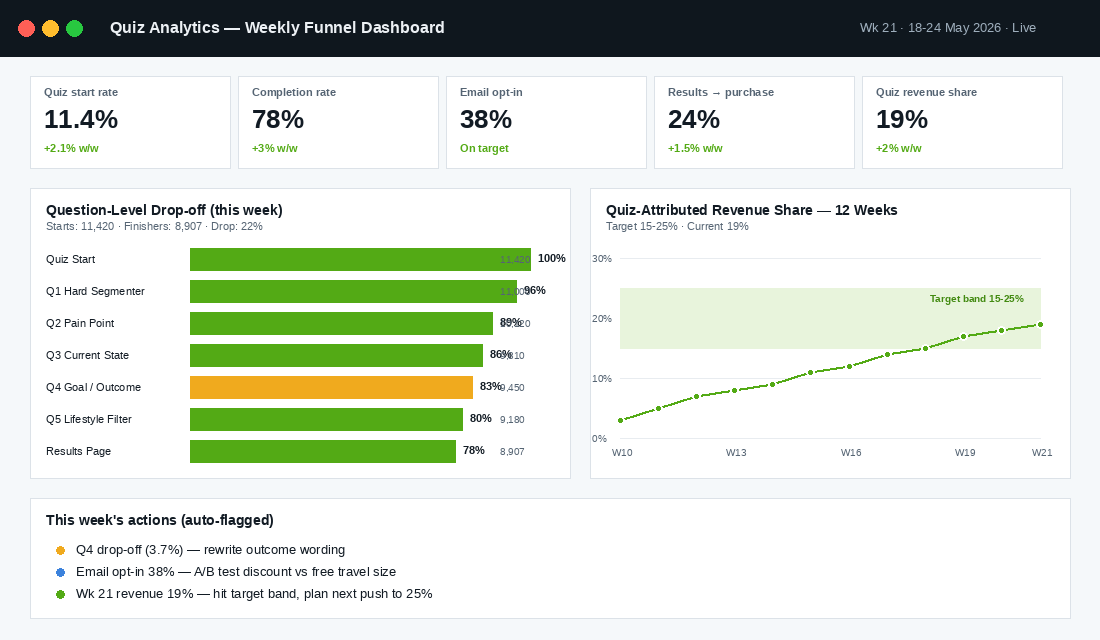
The five metrics to track weekly on the quiz dashboard:
- Quiz start rate. Sessions that begin the quiz divided by total sessions. Target 8 to 15%. Below 5% means your hooks are not working. Above 20% on a hero-CTA placement is unusual but achievable.
- Question-level drop-off. Per-question completion. The question with the biggest drop tells you exactly where the friction is. Long question, confusing wording, or too many options are the usual culprits.
- Email opt-in rate. Quiz finishers who hand over an email. Target 30 to 45%. Below 25% means the opt-in offer is weak or the timing is wrong (offer too early disrupts flow, too late misses the urgency).
- Results-to-purchase rate. The percentage of quiz finishers who make a purchase within 7 days. Target 15 to 30%. This is your money metric.
- Quiz-attributed revenue share. Total revenue from quiz-tagged sessions or quiz-flow emails as a percentage of total revenue. Mature quiz funnels do 15 to 25% of total revenue. If yours is sitting at 3%, you have headroom.
Quarterly A/B tests we recommend running: hero CTA copy (problem-led vs outcome-led vs identity-led), Q1 wording, the number of recommendations on the results page (1 vs 3 vs 6), and the discount or bonus offered at the email gate. Octane AI, Quiz Kit, and Shop Quiz all surface this analytics layer. If you are running a free quiz tool, layer Hotjar or Microsoft Clarity on top to watch live recordings of quiz drop-offs.
The Tool Stack: Picking the Right Quiz Platform for Your Stage
Tool choice should follow your revenue tier and use case. The mistake we see most often is a $200K brand paying for an enterprise quiz platform, or a $5M brand running the free Shopify tool and capping their personalisation ceiling at “category quiz”.
- Under $50K/month: Shopify Shop Quiz (free). Built into Shopify, free, decent template library. Ships in an afternoon. Limitations: less flexible logic, basic analytics, light Klaviyo integration. Good place to prove the concept.
- $50K to $250K/month: Quiz Kit (from $25 AUD/month). Strong template library, native Klaviyo integration, custom logic. Powers thousands of Shopify quizzes including a healthy slice of the Aussie skincare and supplement category. Setup is 1 to 2 days.
- $250K+/month: Octane AI (from $50 AUD/month, custom for enterprise). Used by 5,000+ Shopify stores including Jones Road Beauty and ILIA. Advanced AI recommendations, branching logic, full A/B testing layer, deep Klaviyo and Attentive integration. Setup is 1 to 2 weeks with a proper question design phase.
- Custom / headless: Tally or Typeform plus a recommendation API. If you have engineering resource and a deeply custom product matrix, build the quiz front-end on Tally (free) or Typeform and wire the recommendation logic to your own back-end. Reserve for $5M+ brands with bespoke product systems.
Pair whichever you pick with Klaviyo on the email side, and your analytics stack (GA4 or Triple Whale or Polar) tagged to the quiz UTM so you can attribute revenue properly. Without revenue attribution back to the quiz, you will under-invest in iteration.
The Compound Effect: When Quiz Funnels Become 15 to 25% of Revenue
The reason quiz funnels are one of the highest-impact projects you can ship is that the lifts stack. They do not just lift one metric in isolation.
Run the numbers on a $2M Aussie brand currently doing $166K/month. Sessions per month: 110,000. Baseline conversion: 2.4%. AOV: $85. Email list size: 22,000. A well-built quiz funnel typically achieves the following over 90 days:
- 10% of sessions start the quiz (11,000 starts), 75% complete (8,250 finishers). Of those, 35% opt into email (2,887 new subscribers/month), 22% buy within 7 days (1,815 quiz-attributed orders).
- Quiz orders convert at 6 to 9x baseline. 1,815 orders at an uplifted AOV of $108 (bundle pull) = $196,020 in direct quiz-attributed revenue per month.
- Segmented email revenue lifts 30 to 60%. The 22,000 existing list, now tagged with quiz data via backfill campaigns, drives an extra $18,000 to $35,000/month in campaign revenue.
- Net effect: $214,000 to $231,000 in monthly revenue attributable to the quiz layer. On a baseline of $166K, that is 28 to 39% incremental.
Those numbers are not theoretical. They are the median of the case studies Octane AI publishes (7 to 25% quiz conversion, 42% opt-in) applied to a typical $2M Aussie DTC profile. The brands posting bigger numbers (Hunter and Gather’s 258% Klaviyo revenue lift, Polysleep’s 6x conversion) are running mature quiz funnels with 12+ months of iteration behind them.
The 30-Day Rollout Plan (What to Ship This Month)
If you are starting from scratch, the order of operations matters. Trying to launch a perfect quiz takes 90 days. Launching a “good enough” quiz and iterating takes 30 and starts compounding immediately.
- Week 1: Decide and design. Pick the platform. Write the 5 questions on paper, with answer-to-product routing logic. Get a teammate or member of your audience to do a pen-and-paper walk-through. Map the answers to 6 to 10 product clusters.
- Week 2: Build and connect. Build the quiz in your chosen tool. Wire the Klaviyo integration. Build the post-quiz email flow (4 emails). Test the full path end-to-end with three test profiles.
- Week 3: Launch and acquire. Hero CTA on homepage, exit-intent on key collection pages, one paid campaign sending Meta or TikTok cold to the quiz landing page. Backfill the existing list with a “take the quiz, save your routine” reactivation email.
- Week 4: Measure and tune. Review the 5 weekly metrics. Identify the biggest drop-off question and rewrite it. Identify the lowest-converting recommendation cluster and adjust the product mix. Plan your first quarterly A/B test.
Beyond Week 4, treat the quiz like a campaign asset. Quarterly question audit. Monthly results-page test. Continuous segmentation refinement in Klaviyo. The compounding starts at Day 30 and accelerates over the next 6 months as the data pool grows and the email flows mature.
The Failure Modes to Avoid
Three failure modes account for 80% of underperforming quiz funnels.
- The 14-question epic. Founder tries to capture every preference. Completion rate craters to 40%. Cut to 5 to 7 questions, capture the rest in follow-up emails.
- The catalogue-dump results page. Quiz routes everyone to “shop all”. Add-to-cart rates collapse. Force a 1-hero, 2-supporting structure with named reason-why panels.
- The orphaned email list. Quiz captures emails, dumps them into the generic welcome flow. No segmentation, no quiz-results email, no compounding. Build the post-quiz flow before launch, not after.
The brands winning with quiz funnels are not the ones with the cleverest questions. They are the ones who treat the quiz as a system: hook, questions, results, email flow, analytics. Each stage measured, each stage owned, each stage tuned every quarter.
The Quiz Funnel Maths: What a 3% Take Rate Is Actually Worth
Most founders never run the numbers on their quiz, so they cannot tell whether it is working. Here is the model we use inside the Circle, with benchmark ranges from the Aussie DTC brands we coach.
Take 50,000 monthly sessions. A well-placed quiz hook (hero button plus a mid-page card) gets a 3 to 6% start rate. Call it 4%, so 2,000 starts. Completion for a 5 to 7 question quiz should sit at 70 to 85%, giving you roughly 1,500 completions. Email capture on the results gate runs 35 to 50% when the value exchange is clear, so 600 to 750 new subscribers a month from the quiz alone.
Now the money. Quiz completers convert at 2 to 3 times the site average because the results page removes the choice problem. On a 2% baseline store, expect 4 to 6% from completers, so 60 to 90 orders a month at a $95 AOV. That is $5,700 to $8,500 in directly attributed revenue before the email flow does any work. Add a quiz-results flow converting a further 5 to 8% of the non-buyers over 30 days and you are at $9,000 to $13,000 a month from a page most stores never build.
Put those four numbers (start rate, completion rate, capture rate, completer conversion) on your weekly scorecard. If any one of them is below the bottom of the range, that stage is the bottleneck and it gets the next test.
Turning Quiz Answers Into Klaviyo Segments That Pay
The quiz captures zero-party data. The mistake is leaving it as a text blob on the profile. Every answer should land as a discrete Klaviyo profile property (skin_type, goal, budget_band, experience_level) so you can segment on it for the life of the customer, not just in the results email.
Three segments earn their keep immediately. First, quiz completed, no purchase in 14 days: this is your warmest non-buyer audience and should get its own 3-email nudge with the recommended product, an objection-handling email, and a modest incentive. Second, quiz result plus purchased something different: they ignored the recommendation, which usually means a price or availability issue worth a quick survey. Third, result category by lifecycle stage, so your monthly campaigns speak to “sensitive skin, repeat buyer” rather than “everyone”.
Brands that segment campaigns on quiz data typically see 20 to 40% higher revenue per recipient than a broadcast to the full list. If you have not built your segment layer yet, start with the 7 Klaviyo segments and then layer quiz properties on top. And sync the same properties to Meta as custom audiences: a “quiz completed, no purchase” audience at $20 to $30 CPM will usually outperform a broad retarget by 2x on ROAS because the creative can name their result.
Quiz Funnel vs Pop-Up: When You Need Both
Founders often ask whether the quiz replaces the email pop-up. It does not. They capture different visitors at different moments and they should coexist.
A well-built pop-up converts 4 to 8% of all sessions, mostly first-time visitors in the first 30 seconds. A quiz converts 35 to 50% of a smaller, higher-intent group who have already committed 60 to 90 seconds. Run both and the quiz subscribers will show 2 to 3 times the 90-day revenue per subscriber of the pop-up cohort, while the pop-up still delivers the volume. The trap is letting the two fight: suppress the pop-up on the quiz landing page and on the results page, and suppress it for anyone who already holds a quiz result property.
One more rule that protects the numbers: if your pop-up capture architecture is not finished, build that first. It is a one-week job, it feeds the quiz email flow with a bigger list, and it gives you a baseline conversion rate to measure the quiz against. Then ship the quiz, run it for 30 days, and compare cohort revenue per subscriber in Klaviyo before deciding where to invest the next round of testing.
Inside eCommerce Circle, quiz funnel architecture is one of the core Platform pillars we work on with every member running over $40K/month. If you want a second opinion on yours, let’s talk.