Most Aussie founders think their Meta ads are broken because of the targeting. So they spend their Sunday afternoon cloning ad sets, splitting interests, narrowing the age range, switching to Advantage+ and back again. None of it moves the needle, because none of it was ever the problem.
What’s in This Article
Meta’s machine learning already knows who to show your ads to better than you do. After the Andromeda update rolled out across 2025, creative diversity became the single biggest lever on account performance. The fastest-scaling brands are not the ones with the cleverest audience setup. They are the ones with the best creative testing engine.
That matters more here than almost anywhere. Australian Meta CPMs sit around $9.80 in 2026, up from $8.60 a year earlier, and average CPC has climbed to $1.47. The number of Aussie businesses running active Meta campaigns jumped 22% between Q1 2025 and Q1 2026. We run roughly 20 to 40% higher acquisition costs than US brands on the same playbook. If your creative is mediocre, you are paying a premium to put it in front of people. The framework below is the exact 5-stage system we use with hundreds of Aussie Shopify founders to find winners faster and pull CAC down 20 to 40%.
Why Creative Is Now 80% of the Result
Here is the shift most operators have not caught up to. Pre-2021, you won on Facebook by out-targeting your competitors. Find the cheap interest, the lookalike nobody else had cracked, the placement that converted. Then iOS 14 gutted the signal, Meta leaned hard into automation, and Andromeda finished the job by rewarding accounts that feed the algorithm a wide, varied pool of creative.
In practical terms: the algorithm is the setter, your creative is the spiker. Media buying sets up the play. Creative scores the point. When you treat ad testing as a creative problem instead of a targeting problem, three things happen. You stop wasting budget on structural fiddling. You build a repeatable process for manufacturing winners. And you give Meta the raw material it actually needs to find your buyers cheaply.
The brands doing this well are not guessing. They run a deliberate pipeline: brief, test, measure, kill, scale. Let’s build yours.
Stage 1: Write the Creative Brief Before You Touch Canva
Bad testing starts with someone saying “let’s try some new ads” and a designer guessing. Good testing starts with a brief that isolates one variable so the result actually teaches you something. If you change the hook, the format, the offer and the talent all at once, a winning ad tells you nothing about why it won. You cannot replicate what you cannot name.
Build every test around three layers, and only one of them changes per round:
- The angle. The core reason someone should care. Problem-solution, social proof, founder story, ingredient or feature deep-dive, price-anchored value, identity (“for people who…”). This is the most important variable and the one most founders skip straight past.
- The format. UGC talking-head, static image, founder-to-camera, product demo, before-and-after, listicle, text-on-screen montage. Different formats suit different angles.
- The hook. The first 3 seconds or the first line of static copy. This is what wins or loses the impression. A strong angle with a weak hook never gets seen.
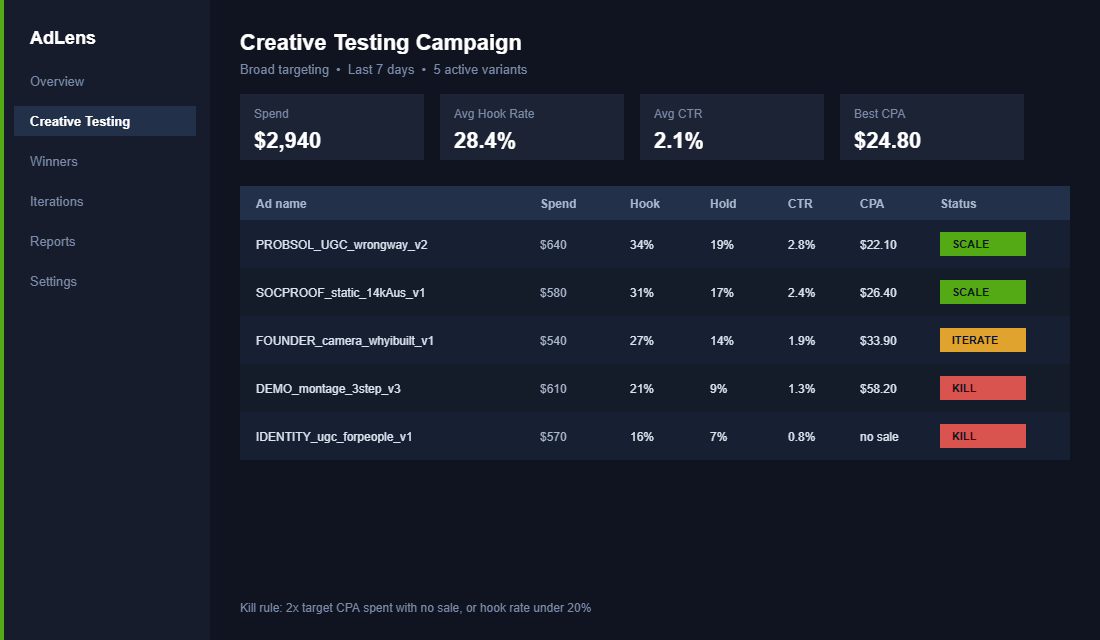
For each test round, pick one angle and produce 3 to 5 hook variations against it. Document them in a simple sheet: ad name, angle, format, hook, and the hypothesis you are testing. Your naming convention matters more than it looks. Something like ANGLE_FORMAT_HOOK_v1 means that three weeks later you can group every “social proof UGC” ad and see the pattern. Sloppy names destroy your ability to learn across tests.
HiSmile and Frank Body, two Aussie brands that scaled internationally on Meta, did not get lucky with one viral ad. They built relentless creative machines that produced dozens of angle variations a month and let the data pick the winners. That is the mindset shift: you are not making an ad, you are running an experiment.
Stage 2: Build a Testing Structure That Reads Clean
You need a campaign whose only job is to find winners, kept separate from the campaigns whose job is to spend on proven winners. Mixing the two pollutes both. The simplest reliable structure for a brand spending under roughly $1,000 a day:
- One dedicated testing campaign. Broad targeting, minimal restrictions. Let Meta find who responds. Your job is to test the creative, not the audience.
- 3 to 5 new creatives per test round, dropped together. Give each enough room to exit the learning phase. Brands that maintain 15-plus active variants across the account see materially lower effective CPMs because fatigue never sets in.
- The 60-30-10 budget rule. Put 60% of ad spend behind proven winners, 30% behind iterations of those winners, and 10% into genuinely new concepts. This protects your CAC while keeping a steady flow of fresh blood into the pipeline. One supplement brand used exactly this split to climb from $18K in losses back to a 2.5x ROAS inside five days, purely by fixing how they allocated spend across new versus proven creative.
Budget per test matters. As a rough rule, give each new creative enough spend to reach at least one to two times your target CPA before you judge it. If your target CPA is $30, that is $30 to $60 of spend per ad minimum before you have a real read. Killing an ad at $12 of spend is not testing. It is flipping a coin and blaming the coin.
Where your traffic lands matters just as much as the ad. A brilliant ad pointed at a weak product page wastes the click. Make sure the offer and message on your product page conversion architecture matches the promise in the ad, or you will kill winning creative for a landing-page problem.

Stage 3: The Metrics That Actually Predict a Winner
ROAS at the ad level is a lagging, noisy signal in the first 24 to 48 hours. You need leading indicators that tell you whether an ad is working before it has spent enough to prove itself on purchases alone. Read the funnel top to bottom, because each metric isolates a different failure point.
- Hook rate (3-second video plays divided by impressions). Is the first 3 seconds stopping the scroll? Treat 25% as table-stakes and 30% or higher as best-in-class. Below 20% and the hook is the problem, full stop.
- Hold rate (ThruPlays or 15-second views divided by impressions). Did the people you stopped actually stay? A good hook with a collapsing hold rate means your hook wrote a cheque the body of the ad could not cash.
- Click-through rate (CTR, link clicks). For ecommerce, 1.5 to 2.5% is a healthy band, with fashion often pushing past 2.6%. Strong hold but weak CTR usually means the call to action or the offer is soft.
- Cost per acquisition (CPA). The decision metric. Median ecommerce CPA sits near $30, but yours is whatever your margins can sustain. This is the number you scale or kill on, once an ad has enough spend behind it.
The power is in reading them as a chain. High hook rate, low hold rate means fix the body. High hold, low CTR means fix the offer or CTA. Strong CTR, weak CPA means the click is being wasted after the ad, so look at price, landing page or shipping. Each combination points to a specific fix, which is how you stop guessing and start engineering.
One caution unique to operating here: with attribution still patchy post-iOS, do not trust Meta’s reported purchases in isolation. Cross-check against your real numbers using a post-purchase survey attribution system so you are scaling ads that actually drive sales, not ads that simply claim credit for them.
Stage 4: Kill Losers Fast, Without Flinching
The discipline that separates profitable accounts from bleeding ones is the willingness to kill creative on a rule, not a feeling. Founders fall in love with the ad they had a hand in making and keep it alive on hope. Hope is expensive at $9.80 CPMs.
Set kill criteria before the test goes live, then enforce them:
- No purchase at 2x target CPA in spend. If your target is $30 and an ad has spent $60 with zero sales, it is almost certainly a loser. Cut it.
- Hook rate under 20% after 1,000-plus impressions. The creative is not earning attention. No amount of budget fixes a hook the market is ignoring.
- CTR under 1% with healthy hold rate. People watched and chose not to click. The offer or CTA is the issue, not the creative craft.
Give every ad a fair shot, which means enough spend and enough impressions to reach significance, then be ruthless. The goal is to find the 1 or 2 ads in every batch of 5 that beat your benchmark, double down on those, and recycle the learnings from the losers into your next brief. A “failed” test that tells you the problem-solution angle beats the founder-story angle is not a failure. It is the most valuable thing you will learn that week.

Stage 5: Scale Winners and Iterate Relentlessly
A winner is not a finish line. It is a template. When an ad clears your CPA bar with volume behind it, you do two things at once: scale the spend behind it, and start manufacturing variations of it. This is where the 30% iteration slice in your budget rule earns its keep.
Iterate along one dimension at a time off the winner:
- New hooks on the same body. The winning concept with 3 fresh opening lines. Often the cheapest win available.
- New formats of the same angle. If a UGC testimonial won, try the same message as a static, a founder-to-camera, or a text-montage.
- New talent or settings. Same script, different creator. Different faces fatigue at different rates and reach different sub-audiences.
Creative fatigue is real and it is fast. Most winning ads start decaying within 7 to 14 days as frequency climbs, and Sculpd-style scaling stories all share one trait: a constant drip of 5 to 8 new creatives every fortnight so there is always a fresh winner ready before the current one tires. You are not trying to find one perfect ad. You are building a conveyor belt that never stops producing them.
Meta is not your only channel, and your best-performing creative angles often translate straight across. The hooks that win on Meta frequently make strong asset-group copy inside your Google Performance Max setup, so the testing work compounds beyond a single platform.
Five Creative Angles Most Aussie Brands Underuse
If you feel stuck for what to test next, the problem is almost never the format. It is the angle. Most accounts cycle the same two or three angles forever and wonder why fatigue hits so fast. Here are five that consistently outperform and that local brands tend to leave on the table:
- The “wrong way” hook. Open by calling out the mistake your prospect is already making. “Most people store their coffee completely wrong.” It pattern-interrupts because it implicates the viewer before it sells anything.
- Founder-to-camera, unpolished. A phone-shot founder explaining why they built the thing routinely beats glossy studio work. It reads as honest, and honesty is rare in a feed full of ads. Cheap to produce, fast to iterate.
- Specific local proof. “Over 14,000 Australians have switched.” Specific numbers and an Australian reference frame convert better here than generic global claims, because the buyer recognises themselves in it.
- The comparison. Your product beside the alternative the customer is currently tolerating. Works especially well for higher-consideration buys where the buyer is quietly weighing options anyway.
- The objection-killer. Build the whole ad around the single reason people do not buy. Too expensive, worried about shipping, not sure it will fit. Naming the objection out loud disarms it.
Test one angle per round against your current control. You are not looking for the angle that feels clever in the meeting. You are looking for the one your market votes for with their attention and their wallet.
The Tool Stack: Seeing Why Ads Win
You can run this entire framework inside Meta Ads Manager for free, and you should start there. Build custom columns for hook rate, hold rate, CTR and CPA, lean on your naming convention to group creative, and review on a fixed weekly cadence. Discipline beats software.
Once you are spending enough that an hour of analysis pays for itself, a creative analytics tool like Motion turns the manual grind into a system. Setting it up is straightforward:
- Connect your Meta ad account. Motion syncs your full ad history automatically, no manual export.
- Let it apply AI tags. It auto-categorises every ad across eight creative elements: hook style, format, messaging angle, talent and more.
- Build a comparative report. Group creative by any tag or by your own naming convention to see how an angle performs across every campaign it ran in, not just one.
- Read the video retention curves. See the exact second viewers drop off, so you know whether to fix the hook, the middle, or the CTA.
The point of any tool is to answer one question faster: why did this ad work, and what should I make next? If your tool is not shortening the distance between a winning ad and the next brief, it is overhead.
How the Five Stages Compound
Run any one of these stages in isolation and you get a marginal lift. Run all five as a loop and the effect compounds. Tight briefs make your tests legible. Clean structure makes the results trustworthy. Leading metrics let you judge fast. Ruthless killing protects your budget. Relentless iteration means you always have a fresh winner before the last one fatigues.
The brand that ships 5 well-briefed creatives a week, reads them properly, kills the duds at $60 and scales the winners is, within a quarter, operating on a completely different cost base than the one cloning ad sets on a Sunday. Same product, same budget, same market. The only difference is the engine. In a market where CAC runs 20 to 40% above the US and CPMs keep climbing, that engine is the difference between scaling profitably and quietly going backwards.
Your Weekly Creative Testing Scorecard
Print this, stick it above your desk, and run it every week without fail:
- Brief. Have I written one angle with 3 to 5 hook variations and a clear hypothesis for this round?
- Launch. Are the new creatives in the dedicated testing campaign on broad targeting, named to my convention?
- Budget. Is spend split roughly 60% winners, 30% iterations, 10% new concepts?
- Measure. Have I logged hook rate, hold rate, CTR and CPA for every ad with enough spend to judge?
- Kill. Have I cut everything past 2x target CPA with no sale, or under 20% hook rate?
- Scale. Have I moved every winner into the proven campaign and briefed at least 3 iterations of it?
- Cross-check. Do Meta’s reported sales line up with my post-purchase survey and real revenue?
Seven boxes. Tick all seven every week and you have a creative testing engine, not a guessing habit.
Inside eCommerce Circle, Meta creative testing is one of the core pillars we work on with every member, because it is the fastest lever most Aussie brands have to pull CAC down without touching price or product. If you want a second opinion on yours, let’s talk.
Related reading: our Meta ads creative testing framework.