Here is the line that should bother you. Roughly one in five online orders comes back. In apparel it is closer to one in three. Every one of those returns walks out the door with a chunk of your margin stapled to it, and most Aussie founders treat the whole thing as a cost centre to be tolerated rather than a moment to be won.
What’s in This Article
That is the wrong frame. A return is not the end of a sale. It is the single highest-intent moment a customer will ever give you. They already bought from you, they already trust your brand enough to have handed over money, and now they are telling you exactly what went wrong. Handle it like a refund queue and you hand the cash straight back. Handle it like a retention engine and you keep the revenue, keep the customer, and learn something your competitors never will.
This is the playbook we run inside eCommerce Circle when a member’s returns are quietly bleeding their profit. It covers the real cost of a return, what Australian Consumer Law actually requires (it is less than most founders think), the exchange-first system that keeps the money in your business, and the tools to make it run on autopilot. Let’s get into it.
The True Cost of a Return (It Is Worse Than You Think)
Most founders only count the refund. The real number is much larger. When you process a return you pay return shipping (commonly 8 to 12 dollars per item), inspection and restocking (another 5 to 8 dollars), and then you eat the depreciation on a product that may never sell at full price again. Add it up and the cost of processing a single return runs anywhere from 20% to 65% of the item’s original value.
On a 60 dollar product with a 40% gross margin, you made 24 dollars on the sale. A return that costs you 30% of the item value to process does not just wipe that 24 dollars. It pushes you into a real loss once you count the shipping out, the shipping back, and the staff time. You did the marketing, paid the ad cost to acquire that customer, paid to ship the order, and now you are paying again to take it back. That is three transactions deep before anyone has made a cent.
This is why the goal is never simply “fewer returns”. A brand with zero returns usually has a returns policy so hostile it is killing sales at checkout. The goal is to keep the revenue inside your business when a return is going to happen anyway. That single shift, from refund-by-default to exchange-by-default, is where the money is.
What Australian Consumer Law Actually Requires
Before we optimise anything, get the legal floor right, because a lot of Aussie founders are operating on myths. Under Australian Consumer Law, you must provide a remedy (repair, replacement or refund) when a product is faulty, not as described, or does not do what you said it would. Those are the consumer guarantees, and you cannot contract out of them. A blanket “no refunds” sign is actually non-compliant, because it misleads customers into thinking their legal rights do not apply.
Here is the part that matters for your margin. The ACCC is clear that you are not required to give a refund for change of mind. If a customer got exactly what they ordered but decided they did not like it, picked the wrong size, or found it cheaper elsewhere, the law does not force you to take it back at all.
That gives you enormous room to design a policy that is generous enough to sell but smart enough to protect you. The catch: if you publish a change-of-mind policy, you must honour it as written. So the rules are simple.
- Faulty or not as described. Customer’s choice of remedy for major faults. Non-negotiable, build it in.
- Change of mind. Entirely your call. This is the lever you get to pull.
- Whatever you publish, you honour. Vague or contradictory policies create disputes and chargebacks, so write it plainly.
None of this is legal advice, and if you sell into other markets you will have other rules to layer on. But for an Australian store selling to Australian customers, this is the foundation everything else sits on.
Why Exchange-First Beats Refund-First Every Time
Now the core of the playbook. When a customer wants to return something, your portal can present two paths first: refund, or exchange. The order you present them in changes everything.
Loop Returns analysed 13.8 million returns across more than 4,000 Shopify merchants. Brands that build exchange-first flows, where the exchange and store-credit options appear before the refund button, convert 30% to 40% of return requests into exchanges or further purchases. The same report found Australian merchants currently convert returns to exchanges at just 13.2%, while the best operators sit far higher. That gap is pure recoverable revenue sitting on the table.
The maths is brutal once you see it. A refund is a guaranteed loss: the revenue leaves, plus you carry the processing cost. An exchange keeps the original revenue in your business and often triggers a second purchase. Loop’s own data puts the two-year revenue swing between an exchange and a refund at roughly 360 dollars in your favour per converted return. Multiply that across a few hundred returns a month and you understand why this is not a small lever.
There is a retention dividend on top. Customers who go through a smooth exchange repurchase faster and stay loyal, because you solved their problem instead of just giving their money back and letting them drift off to a competitor. A return handled well is one of the strongest trust signals you can send.
Your Returns Policy Is a Conversion Tool, Not Fine Print
Most founders bury their returns policy in the footer and never think about it again. That is a mistake, because your customers are reading it before they buy, not after. Around 67% to 84% of shoppers check the returns policy before they commit to a purchase, and 53% will abandon a purchase entirely when the return terms look unfavourable or slow.
Flip that around and the policy becomes a sales asset. A generous, clearly stated returns policy has been shown to lift conversion by 30% to 40% and average order value by 15% to 20%, because it removes the single biggest fear a first-time buyer has: “what if this is wrong and I am stuck with it?”. Take the risk off the table and they buy with more confidence and bigger baskets.
Build a policy that does both jobs. Here is the structure that works:
- A clear window, stated as a benefit. Around 63% of shoppers expect at least 30 days. “30 day easy returns” on the product page beats “Returns accepted within 30 days subject to conditions” hidden in the footer.
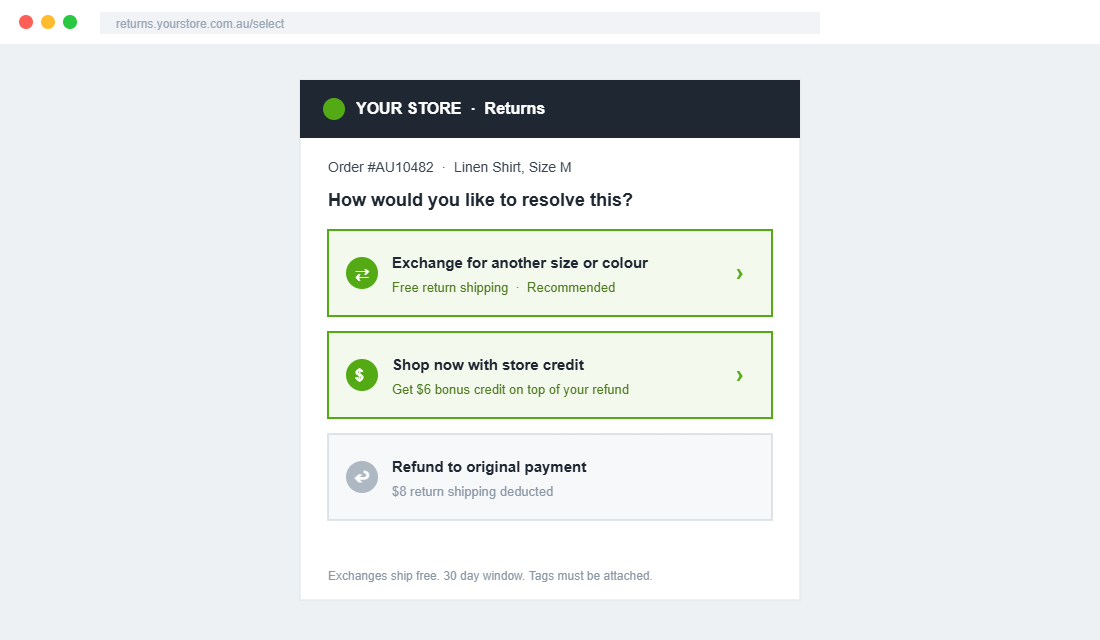
- Free returns on exchanges, paid returns on refunds. Nudge behaviour with the shipping cost. Make exchanging effortless and free. Make refunding the slightly more friction-heavy path.
- Plain English conditions. Tags on, unworn, original packaging. Spell out what disqualifies a return so you are not arguing after the fact.
- The exclusions, up front. Final-sale items, hygiene products, custom orders. Say it loudly so there are no chargeback surprises.
Put the headline version on every product page near the add-to-cart button. Put the full version on a dedicated, well-written policy page. This pairs directly with a strong money-back guarantee, which does the same confidence-building job from the other direction.
The Returns Portal: Tools and Setup
You cannot run exchange-first returns through a shared inbox and a spreadsheet. You need a self-service returns portal that handles the logic automatically and presents the right options in the right order. Two names dominate for Aussie Shopify stores.
- Loop Returns. The category leader for exchange-first returns, with the deepest exchange logic and best retention data. Strong fit once your return volume is high enough to justify it.
- AfterShip Returns. More accessible for smaller and mid-size stores, with a clean branded portal, automation rules, and exchange support out of the box. A sensible starting point if you are setting this up for the first time.
Whichever you choose, the setup that actually moves the numbers follows the same five steps:
- Install and connect to Shopify. Add the app from the Shopify App Store and authorise it to read orders and products. Both Loop and AfterShip sync your catalogue automatically.
- Set your policy rules. Define your return window, eligible and excluded products, and the condition requirements. Encode the policy you wrote in the previous section so the portal enforces it without your team touching it.
- Order the options exchange-first. This is the step that matters. In the portal flow, place “Exchange for a different size or product” and “Store credit” above “Refund to original payment”. Most platforms let you do this in the flow editor.
- Brand the portal. Add your logo, brand colours and domain so it feels like your store, not a generic third-party page. A trusted-looking portal sees far higher exchange take-up.
- Wire up the notifications. Connect Klaviyo so return status updates fire automatically and the customer is kept informed end to end. Set the customer-facing copy to reinforce the exchange option at every step.
Start AfterShip or Loop in test mode, run five or six dummy returns through every path, and only then point your live returns link at it. Half an hour of testing saves a week of angry emails.
Store Credit and Bonus Credit: The Quiet AOV Lever
Here is a tactic the best operators use that almost nobody talks about. When a customer chooses store credit instead of a refund, offer them a little more than the item was worth. A 60 dollar return becomes 66 or 70 dollars in store credit. Loop’s data shows that around half the merchants offering instant exchange pair it with a bonus credit, averaging about 11 dollars.
It feels counterintuitive to give away margin on a return, but run the numbers. You were about to lose 100% of that revenue to a refund. Instead you keep all of it as credit, and the customer almost always spends more than the credit is worth, because store credit behaves like found money. The bonus costs you a few dollars and converts a guaranteed loss into a guaranteed second order at a higher basket.
This is where returns stop being a defensive cost and start feeding your growth flywheel. Store credit keeps customers in your ecosystem and gives them a reason to come back, which is exactly the same engine behind a good store credit strategy and a well-run repeat purchase system. Returns, done right, become a top-of-funnel for your second sale.
Stop Returns at the Source: Reduce the Ones You Should Never Get
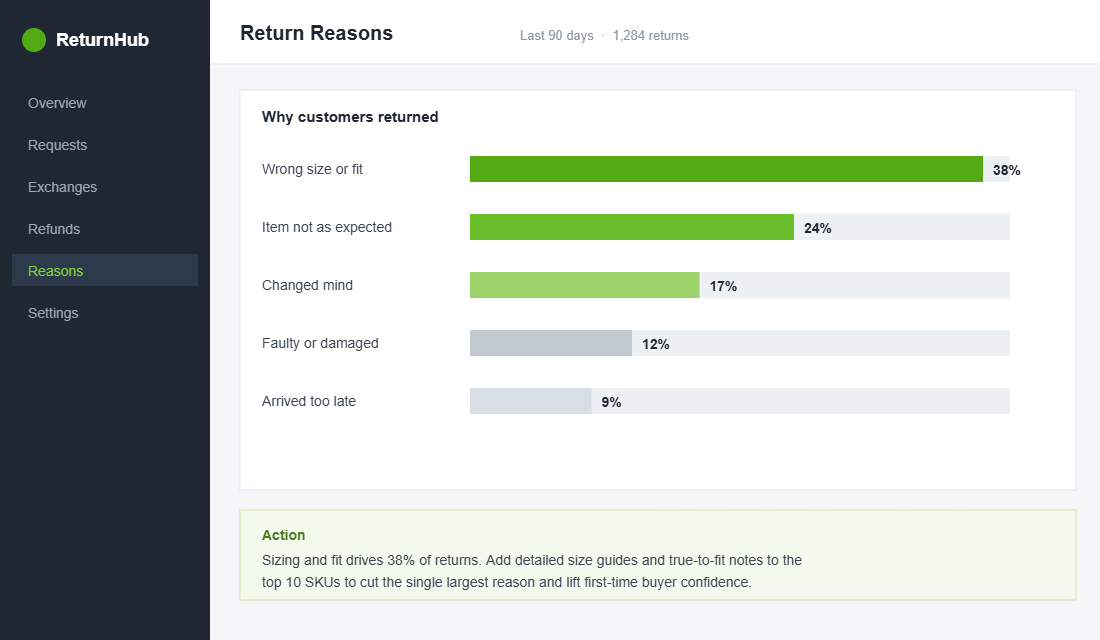
Converting returns to exchanges is the recovery play. The prevention play is fixing the reasons people return in the first place, because the cheapest return is the one that never happens. The data tells you where to look: sizing and fit, and “item not as expected”, are the two biggest drivers across most categories.
- Nail the sizing information. Detailed size guides, model measurements, and “fits true to size / size up” notes pulled from real customer feedback. If apparel returns are 20% to 40% of orders, sizing is where most of that lives.
- Make the product page brutally honest. Show scale, texture, and real-world use. The gap between expectation and reality is what comes back in the box.
- Use reviews and customer photos. User-generated images set accurate expectations far better than studio shots alone, and they cut the “not what I pictured” returns.
- Capture the return reason every time. Make reason codes mandatory in the portal. After a month you will have a ranked list of exactly which products and which problems are costing you, and you can fix the worst offenders.
The Iconic built much of its reputation on free 30-day returns, using a frictionless returns experience as a core part of the buying proposition rather than a grudging afterthought. Australian travel brand July leaned even harder into it, building a long trial period into the offer itself, so the generous returns promise actively closes the sale. Both treat returns as marketing, not admin.
The Three Numbers to Put on Your Dashboard
You cannot improve what you do not measure, and “return rate” on its own is the laziest metric in the business. It tells you how many came back but nothing about whether you kept the money. Track these three instead, and review them every month.
- Return rate. Returns as a percentage of orders, by product and by collection. Useful only when you break it down, because a 30% rate on one problem SKU can hide inside a healthy 12% store average.
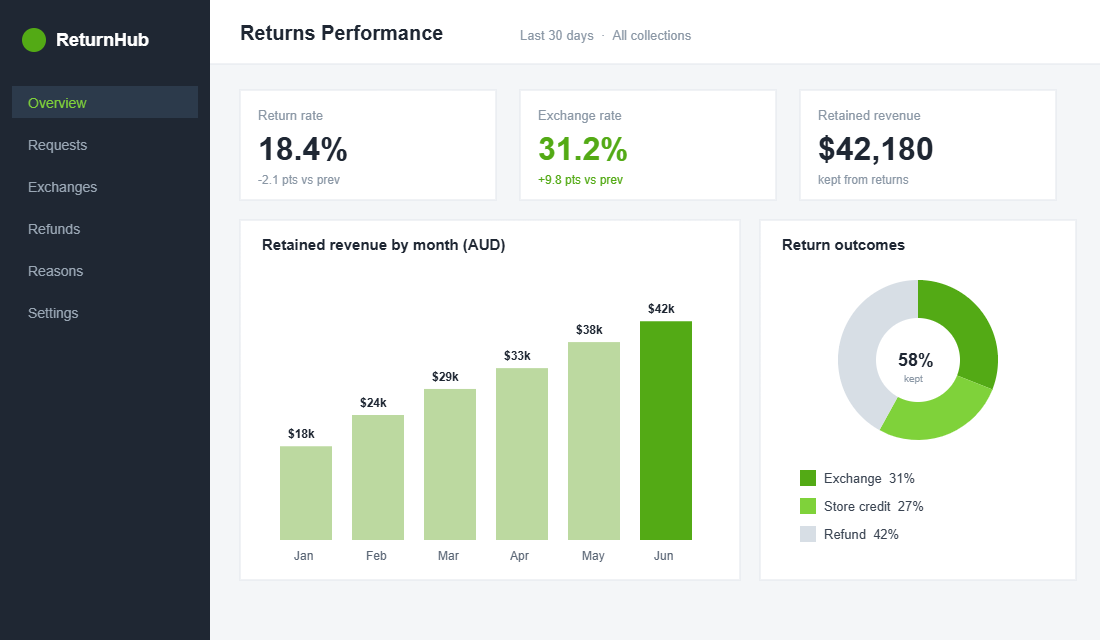
- Exchange rate (the one that matters). The share of returns you convert into an exchange or store credit instead of a refund. Australian merchants average 13.2%. If you are below that, this is the single most profitable number you can move, and getting it toward 30% is realistic with an exchange-first portal.
- Retained revenue. The dollars you kept from returns through exchanges and credit, versus what you refunded out. This is the number that proves the whole system is working and the one to take to your next planning session.
Set a target for exchange rate the same way you would for conversion rate or AOV. When you treat returns as a metric you are accountable for, the behaviour changes fast. Most founders have never once looked at their exchange rate, which is exactly why the opportunity is so large.
The Compound Effect: How the Pieces Work as a System
Look at what happens when these pieces run together instead of in isolation. A generous, clearly stated policy lifts your conversion rate and your average order value at checkout, before a single return happens. When a return does come, the exchange-first portal keeps 30% to 40% of that revenue inside your business instead of refunding it away. Bonus store credit pushes the recovered revenue even higher and triggers a second order. And your return-reason data feeds back into your product pages and sizing, steadily shrinking the returns you should never have received.
Each layer makes the next one stronger. Better policy means more sales. Better portal means more recovered revenue per return. Better data means fewer returns over time. That is the difference between a brand that fears its returns inbox and one that treats it as one of the most profitable touchpoints it owns. The first leaks margin every single day. The second compounds loyalty and revenue out of the exact same situation.
Most Aussie stores are still living in the first world, refunding by default and never measuring the cost. Moving to the second does not require a bigger team or a bigger budget. It requires a deliberate system, which is the whole point of treating returns as a discipline rather than a chore.
Your Returns and Exchanges Checklist
Run your store against this. If you cannot tick every box, you have found your next week of work.
- Compliance. Your policy honours consumer guarantees for faulty goods and never claims “no refunds” outright.
- Policy as a sales tool. The headline returns promise sits on every product page, not just the footer.
- Clear window. At least 30 days, stated as a benefit in plain English.
- Exchange-first portal. Exchange and store credit appear above the refund option in your returns flow.
- Free exchanges. Exchanging is effortless and free; refunding carries slightly more friction.
- Bonus store credit. Customers choosing credit get a small uplift over the refund value.
- Branded portal. The returns experience looks and feels like your store.
- Reason codes. Every return captures a mandatory reason, and you review the data monthly.
- Prevention loop. Top return reasons feed back into sizing guides, product copy and imagery.
Inside eCommerce Circle, turning returns from a margin leak into a retention engine is one of the core pillars we work on with every member. If you want a second opinion on yours, let’s talk.