Scroll through a hundred Aussie Shopify stores and you will find the same tired line sitting in the footer: “Satisfaction guaranteed.” No window, no terms, no promise of what actually happens if the product disappoints. It is wallpaper. Shoppers scroll straight past it, and it moves the conversion needle exactly nowhere.
What’s in This Article
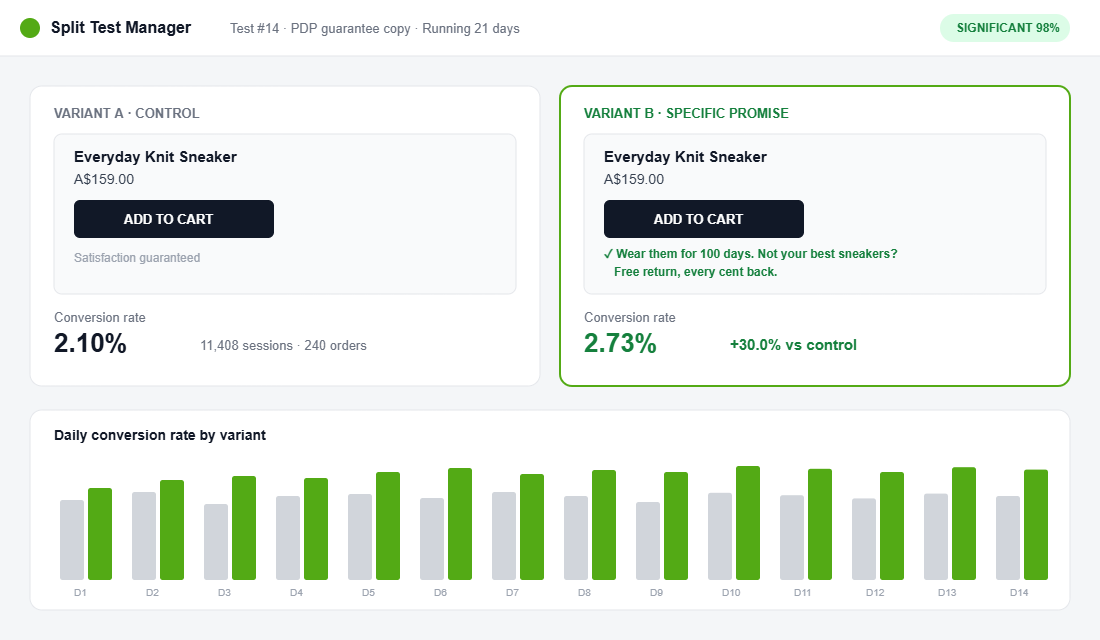
That is a genuine waste, because a properly built guarantee is one of the cheapest conversion levers you have. In one Shopify A/B test run by CRO agency Blend Commerce, adding a specific money-back guarantee directly below the add to cart button lifted conversion rate by roughly 30%. Not a redesign. Not a new ad campaign. One block of copy in the right place.
Most founders avoid bold guarantees for one reason: fear of refund abuse. That fear is not silly (the National Retail Federation estimates return fraud and policy abuse cost retailers more than 100 billion US dollars a year), but it is manageable. The brands winning with guarantees are not naive. They run a system: a specific promise, placed at the moments of doubt, backed by fair-use rules that quietly filter out the serial returners. This playbook builds that system in five parts.
The Maths of Risk Reversal: Why Guarantees Pay for Themselves
Every purchase decision on your store is a silent risk calculation. The shopper is asking: what happens if this mattress feels wrong, if the jacket does not fit, if the blender dies in month three? Baymard Institute research found nearly 18% of online shoppers abandon carts because they do not trust the site with their payment details. Risk, not price, is the quiet killer of your conversion rate.
A guarantee transfers that risk from the customer to you. And the economics are far better than most founders assume, because the fear and the reality of refunds rarely match.
Conversion Fanatics documented a client who extended their guarantee from 90 days to a full year. Conversion rate doubled. Refunds rose by only about 3%. Another client offering a lifetime guarantee found that less than 1% of customers ever claimed it after the first year. The longer window actually softens refund behaviour: there is no deadline pressure, the product becomes part of daily life, and the request never gets made. Psychologists call it the endowment effect. You can just call it free money.
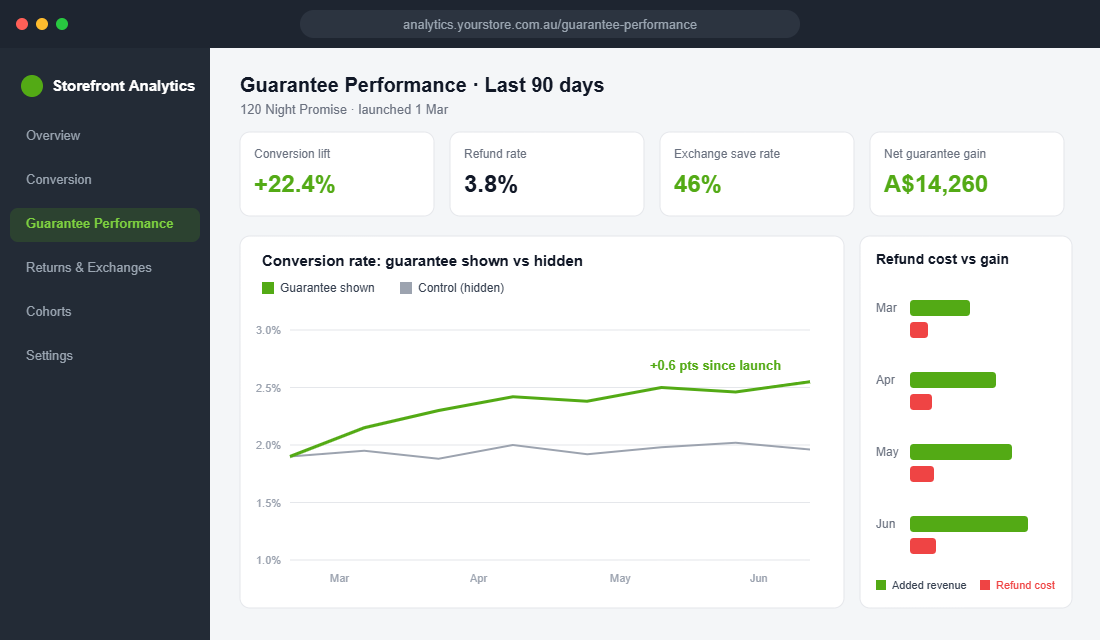
Run the numbers on a store doing 100,000 dollars a month at a 2% conversion rate. A guarantee that lifts conversion by even 15% adds 15,000 dollars in monthly revenue. If refunds creep up from 3% to 4% of orders, that costs you roughly 1,150 dollars on the new revenue base. You are trading a thousand to make fifteen thousand. That is the trade most Aussie founders are too nervous to take.
Part 1: Pick the Guarantee Your Product Can Actually Stand Behind
The biggest mistake is copying another brand’s guarantee without checking whether your unit economics can carry it. There are four guarantee structures, and each suits a different product profile.
- The extended trial. “Use it for X days, return it if it is not right.” Built for considered purchases where the product proves itself through use. Koala runs a 120 day trial on mattresses with a full refund and free pickup in metro Sydney, Melbourne, Brisbane, Adelaide, Canberra and Perth. The trial removed the single biggest objection to buying a mattress online and helped Koala take serious share from retail incumbents.
- The money-back window. The classic 30, 60 or 100 day promise. Works for most consumables, apparel and accessories. The window length should reflect your usage cycle: skincare needs 60 days to show results, a phone case proves itself in a week.
- The lifetime warranty. A durability promise on manufacturing faults, not a change-of-mind offer. Aussie luggage brand July pairs a limited lifetime warranty covering wheels, zips, handles and shell cracks with a separate 100 day returns window. The warranty sells the quality story; the returns window closes the sale.
- The outcome guarantee. “If your skin is not clearer in 60 days, your money back.” The boldest and highest-converting form, but only viable when your product delivers reliably and the outcome is hard to fake. Best for supplements, skincare and education products with strong repeat data.
Before you pick one, pull two numbers from Shopify: your current return rate by product, and your contribution margin per order. The NRF puts average online return rates at 19 to 20% of orders, with apparel running anywhere from 20 to 40% and electronics 8 to 15%. If your apparel store already returns at 30%, an aggressive trial period needs sizing fixes first (a proper size guide will do more for you than a longer window). If you are a hard-goods brand returning at 5%, you have enormous headroom to make a louder promise.
Part 2: Write It Like a Promise, Not a Policy
Guarantee copy beats guarantee badges. A generic shield icon that says “satisfaction guaranteed” tests worse than one plain sentence with a number in it. The specificity is the persuasion.
Here is the four-line formula that converts:
- The number. “120 nights.” “100 days.” “Lifetime.” A concrete unit of time the shopper can picture.
- The trigger. What earns the refund. “If you do not sleep better.” “If it does not fit your carry-on.” The more specific the trigger, the more believable the promise.
- The mechanism. What the customer actually does. “Email us, we organise the courier, money back within 5 business days.” Removing effort from the claim process is itself a conversion lever.
- The no-weasel clause. One line that kills the fine-print fear: “No restocking dramas, no interrogation.”
Compare “We offer a satisfaction guarantee on all purchases” with “Sleep on it for 120 nights. If it is not the best sleep you have had, we collect it free and refund every cent.” Same legal commitment. Entirely different selling power.
One more rule: name your guarantee. “The 120 Night Better Sleep Promise” is an asset you can reference in ads, emails and PDP copy. An unnamed policy is just terms and conditions.
Part 3: Placement Architecture (Put the Promise at the Point of Doubt)
A guarantee buried on a policy page converts nobody. The promise has to appear at the exact moments a shopper hesitates. There are five of them.
- Under the add to cart button. This is the placement Blend Commerce tested to a roughly 30% conversion lift. One line, brand green tick, directly below the CTA where the finger hovers.
- In the cart drawer. The second-guess moment. A single reassurance line above the checkout button: “Every order covered by our 100 day promise.”
- At checkout, near the payment fields. This is where Baymard’s 18% trust abandonment happens. Pair your guarantee line with recognised payment logos. Shopify’s own research on trust badges found payment-method marks plus a concrete guarantee line consistently outperform generic security seals.
- In the post-purchase flow. Restating the guarantee in the order confirmation email cuts buyer’s remorse, which shows up later as chargebacks and “item not as described” disputes.
- In your ads and email subject lines. The guarantee is a hook, not just a safety net. “120 nights to decide” earns the click that “Shop now” never will.
Audit your store tonight: count how many of the five placements your current guarantee occupies. Most stores score one. The lift comes from going to five with the same promise, worded identically everywhere, so the shopper meets it three or four times before paying.
Part 4: The ACL Layer (What Australian Law Already Promises for You)
Here is the part most Aussie founders get backwards. Australian Consumer Law already gives every customer a set of consumer guarantees you cannot contract out of: products must be of acceptable quality, fit for purpose and match their description. If they are not, the customer is entitled to a repair, replacement or refund regardless of what your returns policy says. A “no refunds” sign is not just bad marketing, it is unlawful.
That means your voluntary guarantee is never competing with “no guarantee.” It is competing with the legal baseline every competitor already has to honour. So design it as a layer on top, and say so explicitly: “This promise is in addition to your rights under Australian Consumer Law.” That single line does three jobs. It keeps the ACCC happy (warranty documents that fail to reference ACL rights have triggered enforcement action against major retailers), it makes your brand sound bigger and more professional, and it reframes your guarantee as generosity rather than legal obligation.
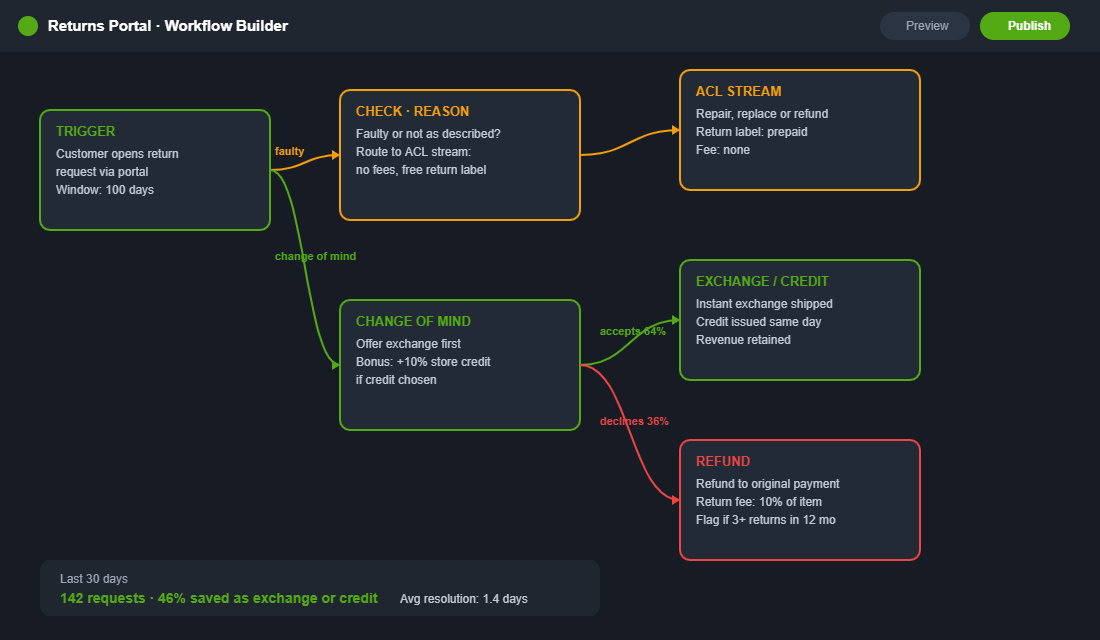
The clean mental model: ACL covers faulty. Your guarantee covers change of mind. Keep the two streams separate in your returns portal and your support macros, because the rules differ. You can charge a return fee or offer store credit on change of mind. You cannot on a genuine ACL fault claim. We covered the full legal architecture in our Shopify consumer law playbook if you want the deeper treatment.
Part 5: Abuse-Proofing (Generous at the Front, Firm at the Back)
Now the fear. Yes, guarantee abuse is real. Around 63% of online shoppers admit to bracketing (ordering multiple sizes or variants intending to return some), and among Gen Z that figure hits 51% as deliberate strategy. Loop’s research on Australian retailers found 39% name policy abuse as a top returns concern. The answer is not a weaker guarantee. It is a louder guarantee with quieter guardrails.
- Write a fair-use clause. One paragraph in your terms: items returned in original condition, proof of purchase required, the brand reserves the right to refuse repeat abusive claims. July does this well: their lifetime warranty covers named components and manufacturing faults, explicitly not wear and tear or misuse.
- Use asymmetric refund mechanics. July charges a 10% return fee on change-of-mind refunds but makes exchanges free. That one design choice pushes most returners into exchanges, which keep the revenue. Our store credit playbook covers how to make the credit option genuinely attractive.
- Flag serial returners. Tag any customer with 3 or more returns in 12 months in Shopify. They get their ACL rights, always, but they do not get the voluntary extras. Industry data suggests 10 to 15% of returns involve some form of fraud or policy gaming; a simple tag-and-review rule catches most of it.
- Photograph high-value dispatches. For orders over a few hundred dollars, a 10 second photo at pack-out kills “item not received as described” claims and feeds straight into your chargeback defence evidence pack.
The Tool: Run It Through Loop Returns
You can manage a guarantee through a shared inbox, but once you pass 10 to 15 returns a week the manual handling eats your margin and your support hours. Loop Returns is the tool we see most often inside well-run Aussie Shopify stores, and it maps neatly onto this playbook.
- Step 1: Install. Add Loop from the Shopify App Store and connect your store. Sync takes minutes and pulls your order history automatically.
- Step 2: Set your windows. Configure the change-of-mind window to match your public guarantee (30, 100 or 120 days) and a separate workflow for faulty-item claims so ACL cases never hit a return fee.
- Step 3: Turn on exchange-first. Enable instant exchanges and bonus credit (for example, an extra 10% if the customer takes store credit instead of a refund). Loop’s whole model is converting refunds into retained revenue.
- Step 4: Set the guardrails. Add your return fee for refunds, free exchanges, and flag rules for customers with repeated returns. This is Part 5 automated.
- Step 5: Wire the portal everywhere. Link the returns portal from your order confirmation email, footer and FAQ so claims never start as angry support tickets.
If Loop’s pricing does not suit your volume yet, ReturnGO and Refundid are credible alternatives popular with smaller Australian stores. The principle matters more than the logo: self-serve portal, exchange-first incentives, separate ACL stream.
Measure It Like a Channel: The Guarantee P&L
A guarantee is an investment with a return, so report it like one. Build a simple monthly view with four lines.
- Conversion delta. A/B test the guarantee placement (on versus off, or specific versus generic copy) for at least two weeks and record the lift.
- Refund cost. Total change-of-mind refunds plus return shipping you covered, minus restocked value you resold.
- Exchange save rate. The percentage of return requests that ended as exchanges or store credit. Loop and similar tools report this natively; above 40% is a healthy benchmark.
- Net guarantee margin. New revenue from the conversion lift minus refund cost. This is the number that ends the internal debate about whether the guarantee “costs too much.”
Review it monthly. If refund cost spikes, the answer is usually a product or sizing fix on one SKU, not a weaker promise across the store. The data will point at the culprit within one reporting cycle.
Three Guarantee Mistakes That Quietly Bleed Margin
- Matching the window to your fear, not your usage cycle. A 14 day window on skincare guarantees disappointment: results take six weeks, so the only people who claim are the angry ones. Counterintuitively, the short window raises your refund rate among claimants while killing the conversion benefit. Set the window to the point where your product has had a fair chance to prove itself, then add buffer.
- Hiding the terms. If the PDP says “100 day guarantee” and the fine print quietly excludes sale items, opened packaging and half your catalogue, you have built a chargeback machine. Customers who feel tricked do not email support, they call their bank. Put the two or three real conditions in plain sight next to the promise.
- Treating the refund conversation as a loss. A refund request is one of the highest-intent conversations you will ever have: the customer cared enough to buy and cared enough to speak up. Brands that respond fast, offer an exchange first and make the money painless see a meaningful share of refunders buy again within months. The ones that stall see reviews like “took three weeks to get my money back,” which costs more than every refund combined.
How the Five Parts Compound
Run the parts in isolation and each one helps a little. Run them together and they feed each other. The right guarantee structure (Part 1) gives you a promise your margins can carry. Specific copy (Part 2) turns that promise into the most persuasive sentence on your store. Placement (Part 3) puts the sentence at every moment of doubt, which is where the 20 to 30% conversion lifts hide. The ACL framing (Part 4) makes the promise sound bigger while keeping you compliant. And the guardrails (Part 5) keep refund costs flat while everything above drives revenue up.
The compounding shows up in places you do not expect. Bolder guarantees produce more confident buyers, who return less. Restating the promise post-purchase cuts disputes and chargebacks. Exchange-first mechanics turn your returns desk from a cost centre into a second conversion point. Koala did not become a category leader despite the 120 night trial. It became one because of it.
The 10-Point Guarantee Audit
Work through this against your store this week. Each yes is a point; under 7 means the playbook above is your next conversion project.
- Our guarantee has a specific number in it (days, nights or lifetime).
- It names a trigger and a mechanism, not just “satisfaction.”
- It has a name we use in marketing.
- It appears under the add to cart button.
- It appears in the cart and at checkout near payment fields.
- It is restated in the order confirmation email.
- It references Australian Consumer Law rights explicitly.
- Change-of-mind and faulty-item flows are handled separately.
- Exchanges are easier or cheaper than refunds.
- We track conversion delta and refund cost monthly.
Inside eCommerce Circle, risk reversal and returns economics are part of the Protection pillar we work through with every member. If you want a second opinion on your guarantee before you make it louder, let’s talk.