There are around 8 million Australians over 18 on TikTok, and a good chunk of them are your customers. So you boost a nice-looking product video, watch the views climb into the tens of thousands, feel briefly great, and then check Shopify. No sales. The money went out, the views came in, and nothing landed in the bank.
What’s in This Article
That gap is not a TikTok problem. It is a strategy problem. Most Aussie founders run TikTok like it is Meta with younger users, obsessing over audiences and targeting while ignoring the only thing the platform actually rewards: creative that stops the scroll and earns the click. On TikTok, the ad is the targeting.
The brands winning here are not spending more. They are testing more, killing losers faster, and sending the click to a page built to convert. This playbook lays out the five-part system to do the same, with the real benchmarks you should be measuring against and the exact way to set your first profitable campaign live.
Why TikTok Rewards Creative, Not Clever Targeting
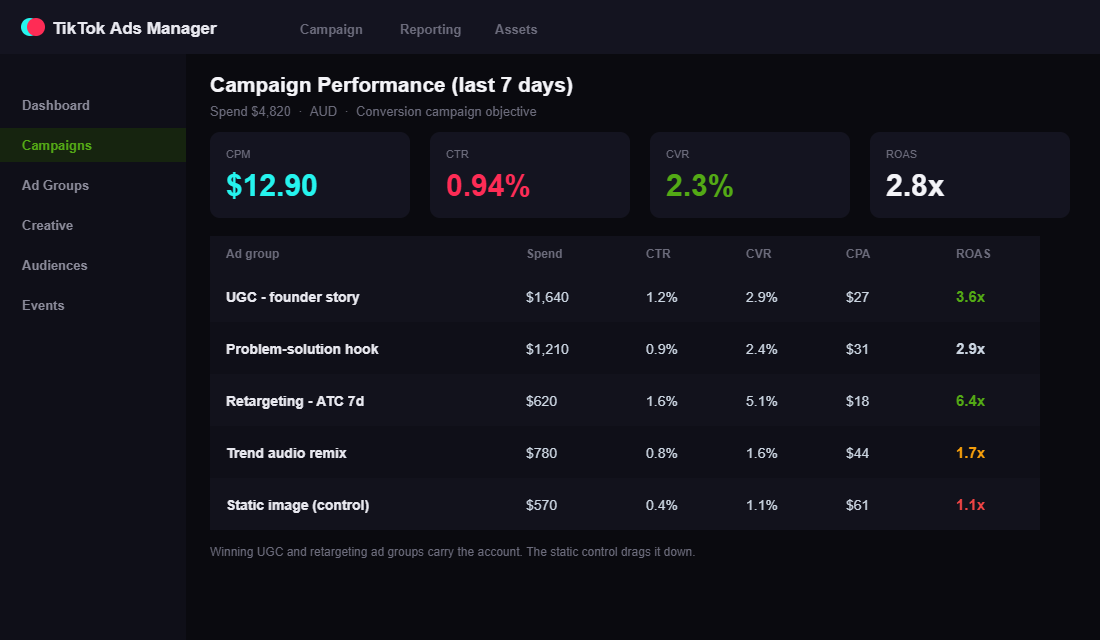
Start with the numbers most founders never look at, because they tell you where the money leaks. In 2025 the average TikTok CPM sat around $13.26, up 16% year on year, so reach is not cheap anymore. Average click-through rate hovers near 0.84%, ecommerce conversion rate lands around 2.0%, and the average return on ad spend has slipped to about 2.21x, with cost per acquisition near $32.74.
Read that chain carefully. You pay a premium to be seen, only a small slice click, and only a slice of those buy. That means every stage has to earn its place, and the single biggest lever is the creative, because it decides your thumbstop and your click-through before targeting ever matters.
This is not a fringe channel either. A 2024 Oxford Economics report found TikTok drove $1 billion in direct revenue for Australian businesses and contributed $1.1 billion to GDP in a single year, and 78% of the businesses surveyed said it had a positive impact on their reach. With TikTok Shop now live in Australia, the distance between a video and a checkout has never been shorter. The opportunity is real. The waste is just as real if you run it blind.
This is why a scrappy phone video from a real customer routinely beats a studio-shot ad that cost ten times more to make. TikTok’s algorithm hands cheap reach to content that holds attention, and punishes content that looks like an ad. Your job is not to outsmart the targeting. It is to feed the machine creative worth showing.
Part 1: Win or Lose in the First Two Seconds
The average person decides whether to keep watching in about two seconds. If your ad opens with a logo, a slow pan, or a smiling model in a studio, you have already lost most of the audience before your product appears. The metric that captures this is thumbstop rate, the percentage of people who stop scrolling and actually watch.
Strong TikTok hooks almost always do one of these things in the first frame:
- Name the problem out loud. “I almost returned this until I figured out one thing” pulls the exact person who has that problem.
- Start mid-action. Show the product being used, unboxed, or tested before you say a single word. Motion holds attention.
- Make a bold, specific claim. “This replaced three products in my routine” beats “our premium formula” every time.
- Look native, not polished. Shot on a phone, natural light, a real face. If it looks like an ad, it gets skipped like an ad.
You do not need a production team for this. You need a real person, a phone, and a hook worth watching. The creative that feels least like advertising is usually the creative that sells the most.
Part 2: Test Hooks, Not Audiences
Here is the shift that changes everything. On Meta you might test ten audiences with one video. On TikTok you test one broad audience with ten hooks. The platform is very good at finding the right people once you give it creative that performs, so your testing budget should go into variations of the ad, not slices of the audience.
Build a simple testing system. Take one product and one offer, then produce four to six versions that change only the first two seconds. Same body, same call to action, different hooks. Run them against a broad audience, give each enough budget to gather real data, and let the metrics decide.
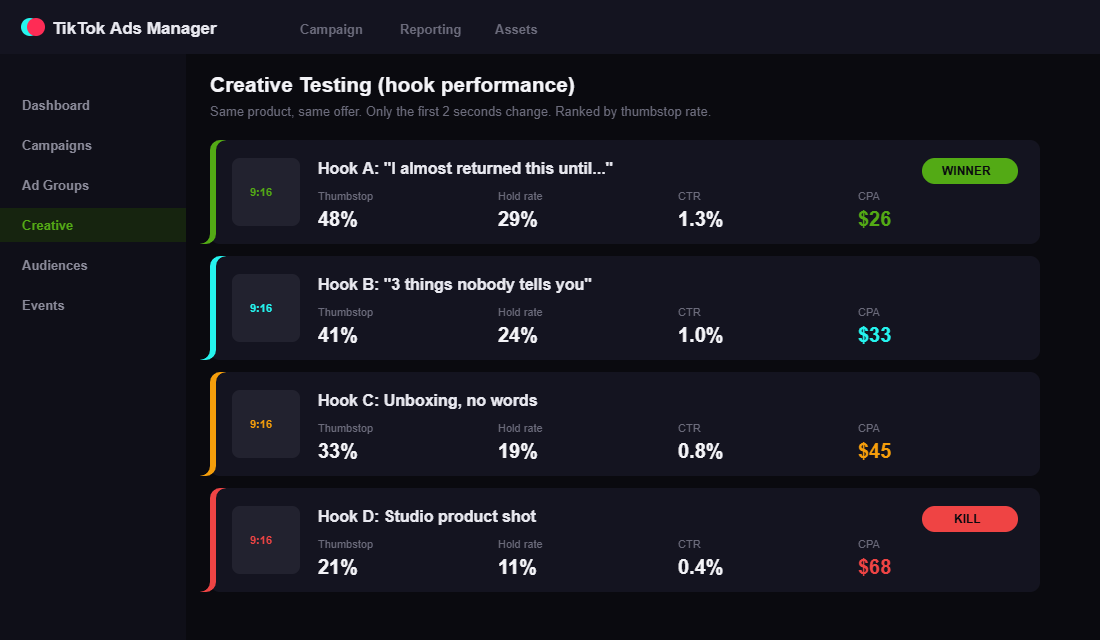
Judge each creative on three numbers before you judge cost per acquisition:
- Thumbstop rate. Are people stopping to watch? Below roughly 30% and your hook is weak, no matter how good the rest is.
- Hold rate. How many are still watching at the halfway mark? This tells you whether the middle of your ad earns the click.
- Click-through rate. Anything consistently above 1% on cold traffic is a creative worth scaling.
Kill the losers without sentiment and pour budget into the one or two winners. Then, and this is the part most founders skip, make three new variations of the winner. Great TikTok accounts are creative factories, not set-and-forget campaigns. If you want to build the video engine behind this, our Product Video Playbook covers the formats that convert.
Part 3: Set It Up Right With the Pixel and Spark Ads
None of the above matters if TikTok cannot see what happens after the click. Before you spend a dollar, get the measurement and the ad format right. This is the tool setup, and it takes an afternoon.
The tool: TikTok Ads Manager, set up in four steps
- Step 1. Install the TikTok Pixel and Events API. In Ads Manager, open Assets then Events, create a web event set, and connect it to your Shopify store through the official TikTok sales channel app. Turn on the Events API as well as the pixel so tracking survives browser and cookie limits.
- Step 2. Map your key events. Make sure View Content, Add to Cart, Initiate Checkout, and Complete Payment are all firing. Test each one with TikTok’s Pixel Helper before you launch so you are not flying blind.
- Step 3. Use Spark Ads, not plain in-feed ads. Spark Ads run through a real TikTok account post, so they carry the likes, comments, and native feel that lift performance. Get creators to authorise their videos with a spark code and run those.
- Step 4. Start with one broad conversion campaign. Optimise for Complete Payment, set a realistic daily budget, keep the audience wide, and load your tested hooks as separate ad groups. Let the algorithm do what it is built to do.
That setup gives TikTok clean conversion signals and gives you honest numbers. Skip it and you will chase ghosts, scaling ads that look good on views and lose money on the backend.
Part 4: Fix the Page the Click Lands On
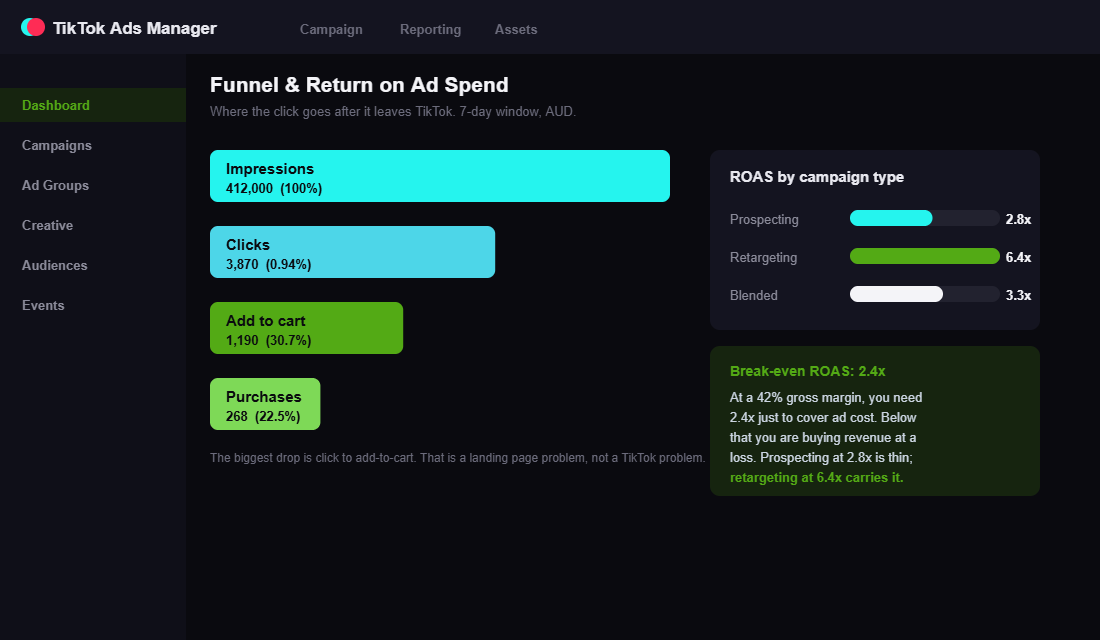
You can win the scroll and still lose the sale if the page is slow, generic, or disconnected from the ad. The biggest drop in most TikTok funnels is not the click. It is the click to add-to-cart, and that is a landing page problem wearing a TikTok costume.
The rule is message match. If your ad promised “the fix for frizzy hair in humidity”, the page they land on should lead with exactly that, not your generic homepage. Send TikTok traffic to a focused product page or a purpose-built landing page, make it load fast on mobile, and put the proof and the offer above the fold.
This is where paid and owned strategy meet. Not everyone buys on the first visit, so capture the ones who do not. A well-timed popup turns expensive TikTok traffic into an owned email list you can sell to for free later, which our Email Popup Playbook breaks down. And to find the exact spot where visitors bail, the Heatmap Playbook shows you how to watch it happen.
Part 5: Measure the Numbers That Predict Profit
Views and follower counts feel good and pay nothing. If you want TikTok ads to make money, you measure against the numbers that actually predict profit, and you know your break-even before you launch.
First, work out your break-even ROAS. At a 42% gross margin you need roughly a 2.4x return just to cover the ad spend. Anything below that and you are buying revenue at a loss, no matter how strong the video looks. Then watch these:
- ROAS by campaign type. Prospecting on TikTok is thin, often 2.0x to 3.5x. Retargeting warm viewers can hit 5x to 10x. Judge them separately, never as one blended blur.
- Cost per acquisition against your target. If your CPA sits well above the $32 industry average and above your own margin ceiling, the creative or the page is the fix, not more budget.
- Thumbstop and hold rate. These are your early warning system. They move before ROAS does, so they tell you which creative to scale a day earlier than the sales data will.
Set a weekly rhythm. Cut anything below break-even, scale the winners, and always have three fresh creatives in testing. That loop is the whole discipline.
One more habit separates the profitable accounts: they check the numbers daily for the first two weeks of any new campaign, then settle into a weekly cadence once the winners are clear. TikTok moves faster than search or even Meta, so a creative that was carrying the account on Monday can fatigue by Friday. Watching the leading indicators, thumbstop and hold rate, lets you act before the sales data confirms the drop, which on a fast-moving platform is often the difference between trimming a campaign and rescuing one.
What Winning Aussie Brands Actually Do
The Australian brands crushing it on TikTok are not lucky, and they are rarely the ones with the biggest budgets. They are the ones treating creative as a volume game and the relationship with creators as an asset.
Look at White Fox Boutique, the Sydney fashion label founders Georgia and Daniel Contos started from a garage in 2013. It now posts more than 36 TikToks a week and produced over 25,000 pieces of content in 2023 alone, roughly five times its 2018 output. That relentless volume, most of it creator and customer content, is what keeps White Fox in front of Gen Z and feeds its paid campaigns with proven organic winners.
Or take Hismile, the Gold Coast teeth-whitening brand that started self-funded with a little over $20,000. It grew by seeding product to micro-influencers, giving away a handful of kits to build a wall of authentic content, then scaling into bigger names once the model was proven. The lesson is the same on both: build a machine that produces native content at volume, find what resonates, then put money behind the winners.
How the Five Parts Compound
Run one part in isolation and TikTok stays a money pit. Run all five together and it becomes a channel you can scale with confidence. A scroll-stopping hook earns cheap reach. A testing system finds the winners fast. Clean tracking and Spark Ads give the algorithm what it needs. A matched, fast landing page converts the click. And the right metrics tell you exactly what to scale and what to kill.
None of it requires a bigger budget than you have now. It requires a system, run weekly, that turns creative into data and data into decisions. That is the difference between founders who quietly give up on TikTok and the ones who make it their best acquisition channel.
Your TikTok Ads Launch Checklist
Before you set a single campaign live, run this checklist. Every box you cannot tick is a leak you would otherwise pay for in wasted spend.
- Tracking. TikTok Pixel and Events API installed, and View Content, Add to Cart and Complete Payment all tested and firing.
- Creative. At least four hooks for one product, each changing only the first two seconds, shot to look native.
- Format. Running as Spark Ads through real account posts, not plain in-feed uploads.
- Structure. One broad conversion campaign optimised for purchase, hooks split into separate ad groups.
- Landing page. Message matched to the ad, fast on mobile, proof and offer above the fold, an email capture in place.
- Maths. Break-even ROAS calculated from your real margin, with prospecting and retargeting judged separately.
Six boxes. Tick them all and your first campaign launches with tracking that tells the truth, creative built to earn the click, and a page ready to convert it. That preparation is what separates a test from a gamble.
Three Ways Founders Quietly Waste TikTok Budget
Most TikTok ad money is not lost on a single bad decision. It leaks slowly through three habits that feel productive but quietly drain the account. Catch these early and you save weeks of spend.
- Judging ads on views instead of sales. A video with 200,000 views and no add-to-carts is not a hit, it is an expensive vanity metric. Always tie a creative back to CPA and ROAS before you call it a winner, because reach without revenue is just noise you paid for.
- Killing campaigns too early, or far too late. Cutting an ad group after a few hours gives the algorithm no chance to find buyers, while letting a loser run for a fortnight bleeds cash. Give each test enough budget to reach a real sample, then decide with conviction and move on.
- Making one great video and running it forever. TikTok creative fatigues fast, often within a week or two at scale, as the same people see it again and again. Your CPA creeps up, your ROAS drifts down, and you blame the platform when the fix is simply fresh creative in the queue.
The founders who avoid all three treat TikTok like a discipline, not a lottery. They separate signal from vanity, respect the learning window, and never let the creative pipeline run dry. Do that and the platform stops feeling random and starts behaving like a channel you can actually forecast.
TikTok is not too young for your brand, too expensive, or too unpredictable. It is a creative-led channel that rewards the founders who test relentlessly and send the click somewhere worth landing. Build the system, watch the right numbers, and it will pay you back.
Inside eCommerce Circle, paid acquisition and creative strategy is one of the core pillars we work on with every member. If you want a second opinion on yours, let’s talk.
Related reading: the TikTok Shop Australia playbook.