Here is an uncomfortable number. Between 96 and 98% of the people who land on your Shopify store today will leave without buying anything, and the data says most of them are never coming back. First-time visitors convert at roughly 1 to 2%. Returning visitors convert at 4.5 to 6%, often two to three times higher. The whole game is getting a first-time visitor to come back, and you cannot bring anyone back if you have no way to reach them.
What’s in This Article
Most Aussie founders try to solve this with more traffic. They turn the Meta budget up, chase another influencer, test a new TikTok hook. Then they send all that hard-won, expensive traffic to a store that has no mechanism to capture the 97% who are not ready to buy on the spot. The traffic leaks straight out the back door.
The brands that compound do the opposite. They treat the email popup as the single most important 0.5% of screen real estate they own, because email still returns somewhere between $36 and $42 for every dollar spent. This is the playbook for building a popup that turns anonymous, paid traffic into an owned list you can sell to for years. Five parts, real benchmarks, and an exact Klaviyo setup at the end.
Why Your Popup Is the Highest-Return 0.5% of Your Store
Think about what an email address actually is. It is permission to talk to a customer again, for free, as many times as you like, without paying Meta or Google a toll each time. Every subscriber you capture today is an asset that pays out across your welcome flow, your campaigns, your launches and your Black Friday. Paid traffic is rent. An email list is equity.
The economics are stark. If you are paying $1.50 a click and 97% of those clicks leave forever, your real cost per customer is brutal. But if your popup captures even 6% of those visitors onto a list, and your welcome email flow converts 5 to 10% of them into first-time buyers, you have just halved the effective cost of every customer. The popup is the bridge between traffic you rent and revenue you own.
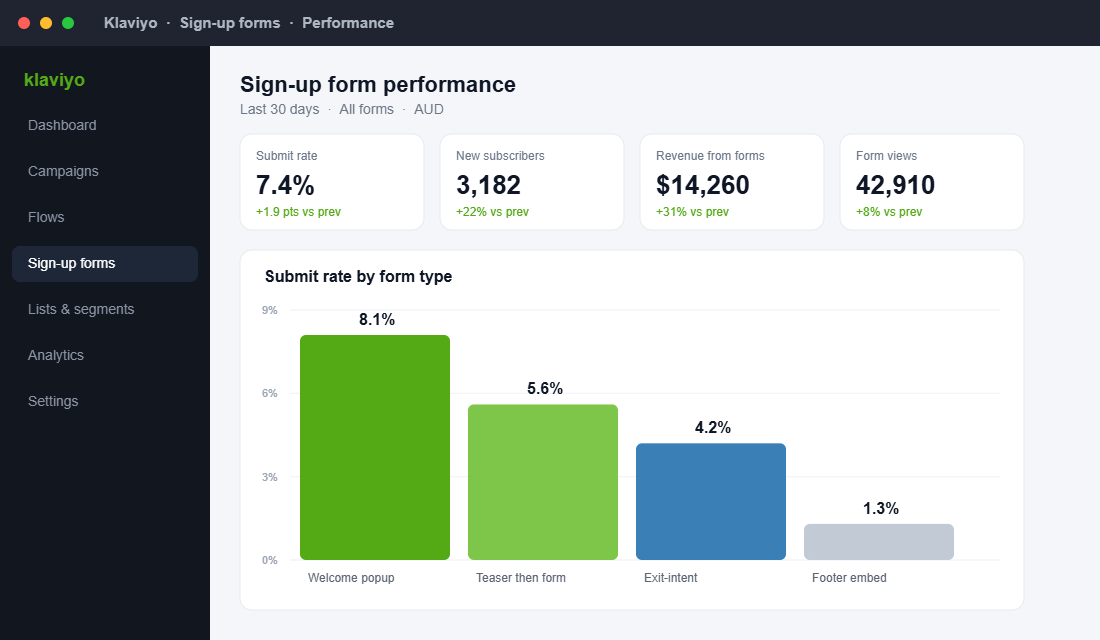
Here is what good looks like once the system is running. Ecommerce email popups average a 5 to 8% submit rate, well above the cross-industry average of 2 to 3.5% that Omnisend found across more than a billion popup displays. The brands hitting the top of that range are not lucky. They have deliberately engineered the five parts below.
Part 1: The Offer (Give Them a Reason Worth an Email Address)
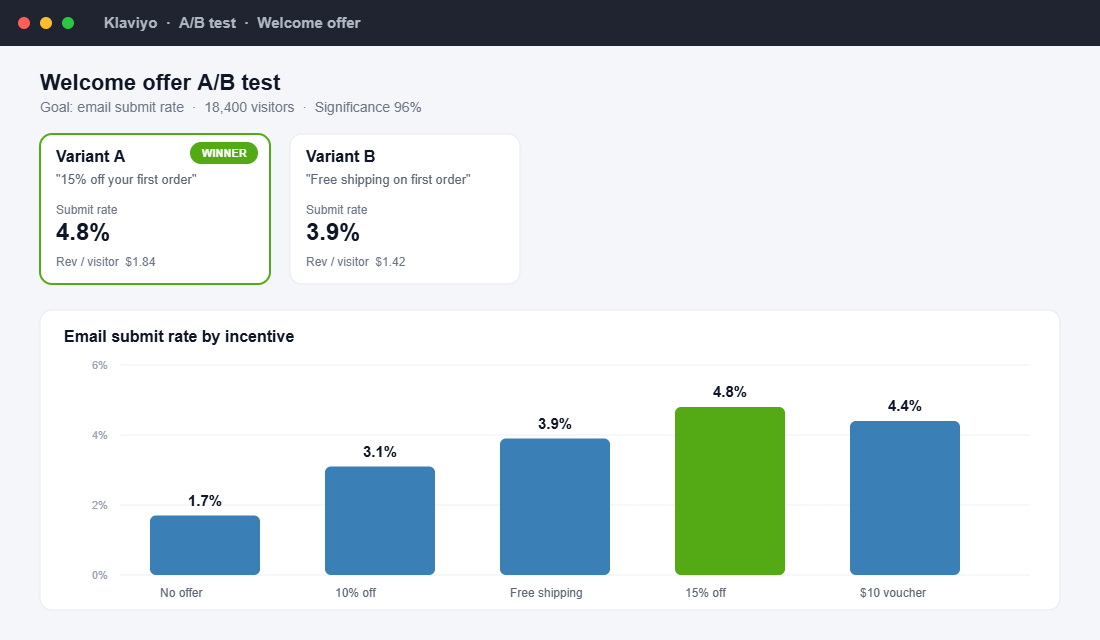
An email address is not free to give. Your visitor knows it means inbox clutter, so “subscribe to our newsletter” is dead on arrival. You need to trade something of clear, immediate value. The data is blunt here: popups with a discount offer convert at around 2.4%, versus 1.7% for popups with no offer at all. The incentive is doing real work.
Specificity matters even more than the discount itself. A clear “15% off your first order” outperforms a vague “special offer just for you” by 40 to 60%. The shopper can do the maths instantly and the brain rewards certainty. So name the exact benefit.
Pick the offer that fits your margin and your customer:
- Percentage off the first order. The default for a reason. 10 to 15% is the sweet spot for most Aussie DTC brands. Anything over 20% trains discount-hunters and erodes contribution margin.
- Free shipping on the first order. Powerful in Australia where postage anxiety is real and shipping costs are high. Often converts nearly as well as a percentage discount without devaluing the product.
- A fixed-dollar voucher. “$10 off your first order” can beat a percentage on higher-priced products because it feels generous against a $120 cart.
- Value, not money. A free sizing guide, a recipe pack, early access to a launch, or entry to a giveaway. Best for premium brands that refuse to discount.
One rule that protects your profit: gate the offer behind the email and make it single-use and time-bound. “Here is your code, it expires in 48 hours” creates urgency and stops the discount leaking to people who would have paid full price anyway.
Part 2: The Trigger (Timing Beats Aggression)
The fastest way to kill conversion and annoy a shopper is to fire your popup the instant the page loads. Nobody hands over an email to a brand they have known for half a second. The research is clear that a delay of 6 to 10 seconds converts best, because the visitor has had time to register that your store is worth engaging with.
Match the trigger to the device, because they behave differently:
- Time delay (6 to 10 seconds). The reliable baseline that works on every device.
- Scroll depth (40 to 60% of the page). Fires when a visitor has shown genuine interest by reading down a product or collection page. Often your highest-intent trigger.
- Exit-intent (desktop). Triggers when the cursor races toward the close button or back arrow. Exit-intent popups convert at around 3.8%, and it is a last-chance capture that costs you nothing because the visitor was leaving anyway. Note that true exit-intent only works on desktop. On mobile, use scroll percentage or time on page instead.
Frequency is the other half of timing. Show the popup once, respect a “no”, and do not re-show it for at least a week to anyone who closed it. Use a teaser, a small tab in the corner that says “Get 15% off”, so the offer stays available without ambushing the same person twice. The split below shows why this discipline pays: the same offer can swing two full percentage points depending on how and when it is presented.
Part 3: The Form (Two Steps, Built for Thumbs)
Most popups ask for too much. Every extra field you add drops your submit rate. For the first capture, ask for one thing: the email address. You can collect a name, a birthday or a category preference later, inside the flow, once the relationship exists.
The highest-converting structure is the two-step popup. Step one is pure value and a single button: “Get 15% off your first order”. The shopper clicks, which is a tiny, friction-free commitment. Step two reveals the email field. This “yes ladder” lifts conversion because the visitor has already said yes once before they see the form.
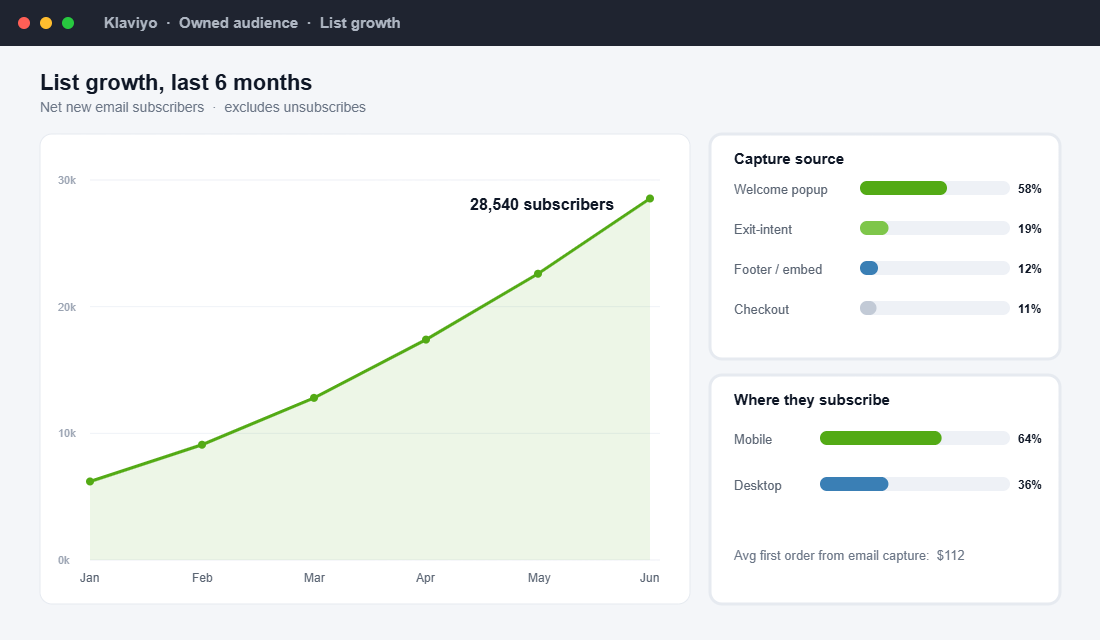
Build for mobile first, because 64% of your captures will happen on a phone, and mobile-optimised forms convert at 2.2% versus 1.4% for forms that were only designed for desktop. That means a tappable button at least 44 pixels tall, text large enough to read without zooming, and a close button that is easy to hit on purpose but hard to hit by accident. Disable the “tap outside to close” behaviour on mobile so a clumsy thumb does not dismiss your best capture moment.
Want to capture more than an email without hurting conversion? Use the second step to ask one zero-party question, like “What are you shopping for?”. That single answer lets you segment from message one. We cover how to use that data properly in the zero-party data playbook.
Part 4: The Targeting (Stop Showing the Same Popup to Everyone)
A popup that shows the same offer to everyone is leaving conversions on the table. The visitor who has already subscribed should never see it again. The visitor with three items in their cart needs a different message to the one who just arrived from an ad.
Set up targeting rules so the right person sees the right thing:
- New visitors get the welcome offer. This is your core capture.
- Existing subscribers are suppressed entirely. Nothing erodes trust faster than asking a loyal customer to “subscribe” for the tenth time.
- Cart abandoners get a different popup. If someone has items in the cart and moves to leave, an exit-intent offer tied to that cart is far more relevant. Pair this with your abandoned cart recovery system.
- Traffic source can shape the message. A visitor from a specific campaign can land on a popup that matches the ad they just clicked.
Targeting is also how you keep your list clean. Capturing the right people, segmented from the first click, means every email you send later is more relevant, your open rates stay high, and your sender reputation stays healthy. A big list of badly captured, mismatched subscribers is worth less than a smaller list of the right ones.
Part 5: The Handoff (A Captured Email Is Worthless Until the Welcome Flow Fires)
This is where most stores fall over. They install a popup, capture emails, and then let those subscribers sit cold until the next campaign. The single highest-return moment in the entire relationship is the 60 minutes after someone subscribes, when intent is at its peak and they are actively expecting to hear from you.
Three things have to happen the moment a subscriber is captured:
- Deliver the offer instantly. The discount code must arrive within seconds, in an automated welcome email, not buried in a popup confirmation they will forget. If the code does not land, the capture is wasted.
- Fire the welcome flow. A welcome sequence should convert 5 to 10% of new subscribers into first-time buyers, and it routinely becomes the highest-revenue automation in the account. The popup feeds it. Build the sequence properly using the welcome email flow playbook.
- Protect deliverability with double opt-in. Turning on double opt-in means new subscribers confirm before joining the list. You lose a few low-quality signups, but you protect your sender reputation and keep your real subscribers landing in the inbox, not in spam.
Get the handoff right and the popup stops being a list-building gimmick and becomes the front of a revenue machine. The capture, the code, the welcome flow and the segmentation work as one system.
Setting It Up in Klaviyo (Step by Step)
Klaviyo is the default for serious Aussie Shopify brands because the popup and the email flow live in the same tool, so the handoff is automatic. Here is the exact build:
- Create the sign-up form. In Klaviyo, go to Sign-up forms, create a new popup, and connect it to a dedicated “Newsletter” or “Welcome” list.
- Set the offer and the two-step. Design step one as the value proposition with a single button (“Get 15% off”). Add a second step that reveals the email field. Generate a single-use Shopify discount code to deliver.
- Configure the trigger. Set the form to show after a 6 to 10 second delay or at 50% scroll. Add a separate exit-intent rule for desktop.
- Add a teaser. Enable a teaser tab so visitors who close the popup can still claim the offer later without being re-interrupted.
- Set targeting and frequency. Show to new visitors only, suppress existing profiles, and cap how often the form re-shows.
- Optimise for mobile. Use Klaviyo’s mobile-specific design and disable close-on-tap-outside for phones.
- Turn on double opt-in for the list, then connect a welcome flow triggered by list subscription so the code and first email fire instantly.
- Watch the submit rate. Klaviyo reports it per form. Aim past 5%, then A/B test one variable at a time: offer, headline, then trigger.
The Compound Effect: What This Looks Like Over a Year
Run the numbers on a store doing 40,000 sessions a month. At a 6% popup submit rate, that is 2,400 new subscribers a month, or roughly 28,000 a year before you count campaigns and referrals. If your welcome flow converts 7% of them at an average first order of $112, that is real, attributable revenue from traffic that would otherwise have leaked away.
That is just the first purchase. Every one of those subscribers now sits inside an owned channel you can market to for free, across launches, restocks, seasonal campaigns and Black Friday. The popup you build once keeps compounding while your competitors keep renting traffic and watching 97% of it disappear.
Australian brands prove this works at scale. Frank Body, the Melbourne skincare brand, leans on a welcome offer and discount-led email to convert first-time visitors, and email has been a core channel in its growth from a $5,000 side hustle. Who Gives A Crap built a list culture where even the transactional emails get opened, because the brand earned permission at the front door first. Both start the same way: capture the email, then earn the relationship.
The Five Mistakes That Quietly Kill Your Submit Rate
Before you rebuild, kill the leaks. These are the errors we see most often when we audit a member’s store, and each one is costing real subscribers every single day.
- Firing on instant load. The most common and most expensive mistake. You are asking for a commitment before the visitor has seen a single product. Add the 6 to 10 second delay and watch the submit rate climb.
- Asking for too much. Name, email, phone and birthday in one form is a conversion killer. Every extra field drops your rate. Capture the email, earn the rest later.
- Showing it to subscribers. If your existing customers keep seeing a “subscribe for 15% off” popup, you look careless and you train them to expect a discount they already have. Suppress known profiles.
- No second chance. A visitor who closes the popup is gone unless you give them a teaser tab to reopen it. Without a teaser you are throwing away every shopper who clicked close out of reflex.
- A dead-end capture. The email goes onto a list and nothing happens. No code, no welcome email, no flow. The hottest moment in the relationship is wasted, and by the time you send your next campaign the intent is stone cold.
Fix these five and most stores see their submit rate move before they have even touched the offer. The popup is a system of small frictions, and removing them compounds fast.
Your Email Popup Checklist
Run your current popup against this before you touch anything else. If you cannot tick every box, you have found your next win:
- Offer: a specific, named incentive (“15% off your first order”), single-use and time-bound.
- Trigger: 6 to 10 second delay or 50% scroll, plus desktop exit-intent. Never on instant load.
- Form: two-step, email only, built mobile-first with tappable buttons.
- Teaser: a corner tab so closers can still claim the offer.
- Targeting: new visitors only, existing subscribers suppressed.
- Handoff: code delivered instantly via an automated welcome email.
- Deliverability: double opt-in on, welcome flow connected.
- Measurement: submit rate tracked per form, target above 5%, A/B test one variable at a time.
Stop Renting Your Audience
Traffic you do not capture is traffic you have to buy again tomorrow. The email popup is the cheapest, highest-return asset on your entire store, and most Aussie founders are running a lazy version of it that captures a fraction of what it should. Fix the five parts and you change the unit economics of every campaign you run after it.
Inside eCommerce Circle, list growth and the capture-to-welcome system is one of the core pillars we work on with every member, because it quietly underwrites everything else. If you want a second opinion on yours, let’s talk.