Every customer you have ever sold to is sitting on a wardrobe, a garage or a cupboard full of your product. Some of it barely used. Some of it returned to you and now gathering dust in a B-grade pile out the back. Most Aussie founders look at that and see nothing. The smart ones have worked out it is trapped revenue, and they have built a channel to release it.
What’s in This Article
That channel is recommerce: reselling pre-loved, returned and refurbished stock through your own store instead of letting it leak out to eBay, Depop and Facebook Marketplace where you make nothing and control nothing. In Australia this is not a fringe idea anymore. The local recommerce market hit roughly US$4.68 billion in 2025 and is forecast to reach US$6.75 billion by 2029. Globally, secondhand apparel is on track to be a US$393 billion market by 2030, about 10% of all apparel spend, growing twice as fast as full-price retail.
Here is the part most founders miss. Patagonia’s Worn Wear resale program turned over around US$13 million in FY25 and runs at a profit. Resale is not charity or a sustainability box-tick. Done right, it is a new profit line, a customer acquisition channel and a retention engine at the same time. This is the playbook we use with eCommerce Circle members to build one.
Recommerce Is a Growth Channel, Not a Threat to Your Full-Price Sales
The first objection every founder raises is the same: won’t cheap secondhand versions of my product cannibalise my full-price range? The data says no. The secondhand buyer is usually a different shopper, often younger, more price-sensitive and brand-new to you. Patagonia, REI and Eileen Fisher have all reported that a large share of their resale buyers are people who had never bought the brand at full price before.
Think of it as the bottom rung of your brand ladder. Someone buys a pre-loved item at a lower price, has a great experience with the product and your service, then trades up to full-price next time. You captured a customer your ads could never afford to acquire, and the resale item paid for itself.
The flywheel has three parts. Customers bring items back for credit, which pulls them into your store to spend again. Those items become inventory you resell to new buyers at a healthy margin. Those new buyers become full-price customers over time. Gen Z and Millennials are expected to drive around 70% of secondhand market growth through 2030, so the pool of shoppers who actively want this is only getting bigger.
The Four Recommerce Models: Pick the One That Fits Your Brand
Recommerce is not one thing. There are four distinct models, and the right one depends on your category, your margins and how hands-on you want to be.
- Trade-in for store credit. Customers send back an old item and get credit toward a new purchase. Levi’s runs this: hand in old jeans in-store, get around AUD 30 credit toward a new pair. It is the simplest model and the strongest retention driver because the payout only spends back with you.
- Brand-owned resale marketplace. You run a dedicated pre-loved section or storefront where customers list and buy your used items, with you taking a cut and controlling the experience. This is the Worn Wear model.
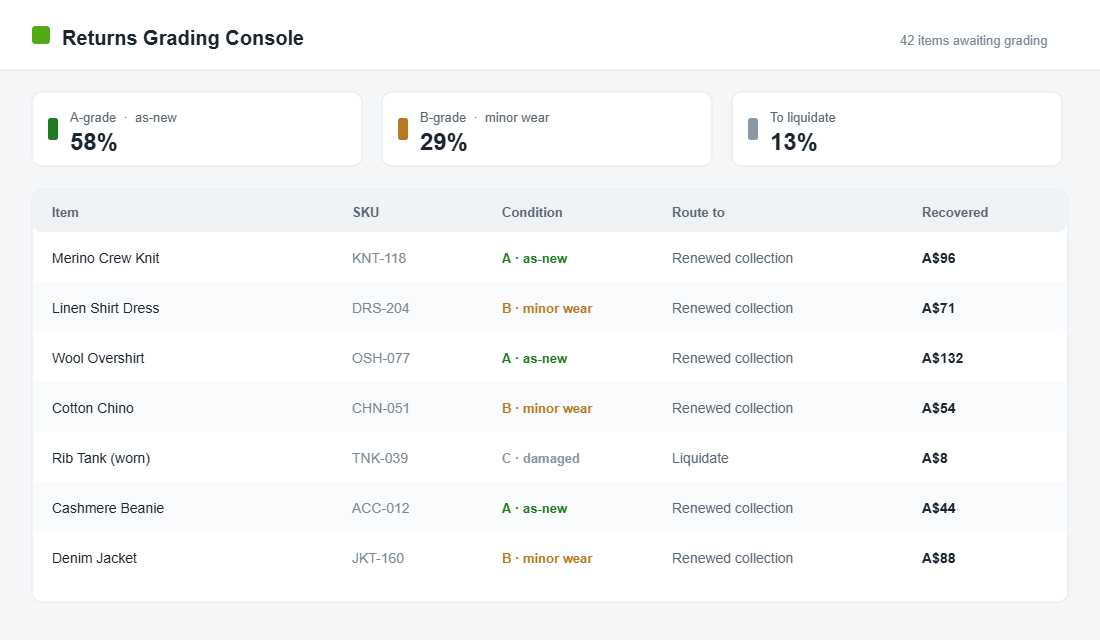
- Refurbished and returns resale. You take your own returns, samples and open-box stock, grade them and sell them as B-grade or “renewed” at a discount. This turns a cost centre into revenue and needs no customer participation to start.
- Embedded resale. A resale option is built into the original purchase. Australian platform AirRobe pioneered this locally with a “digital wardrobe”: at checkout the customer can add their item to a wardrobe they can resell later in one click. The Iconic used this to bring more than 200,000 Australian shoppers into resale.
If you are just starting, the refurbished-returns model is the easiest entry point because you already own the stock. Trade-in is the best second move because it feeds inventory and retention at once.
Turn Your Returns Pile Into Resale Inventory
Returns are the hidden goldmine here. The average Australian ecommerce return rate sits between 20% and 30%, and for apparel it can run as high as 40%. Fit and sizing alone drives up to 70% of clothing returns, and most of those items come back in perfect, resellable condition.
The problem is that a return is expensive. Processing a single return can eat 20% to 65% of the item’s original price once you count return shipping, inspection, restocking and the discount you eventually take to clear it. For a lot of founders, returned stock ends up liquidated at cents on the dollar or written off entirely.
A returns-resale channel changes the maths. Instead of dumping that inventory to a liquidator, you grade it (A for as-new, B for minor wear) and list it in a dedicated “renewed” or “imperfect” collection at 60% to 80% of full price. You recover far more of the value, you attract a price-sensitive new buyer, and you keep the story on your own site. If reducing returns in the first place is still on your list, pair this with your returns management system so fewer items come back and the ones that do have somewhere profitable to go.
Store Credit vs Cash: The Payout Choice That Decides Your Economics
The single biggest lever in a recommerce program is how you pay sellers. You have two options, and they behave very differently.
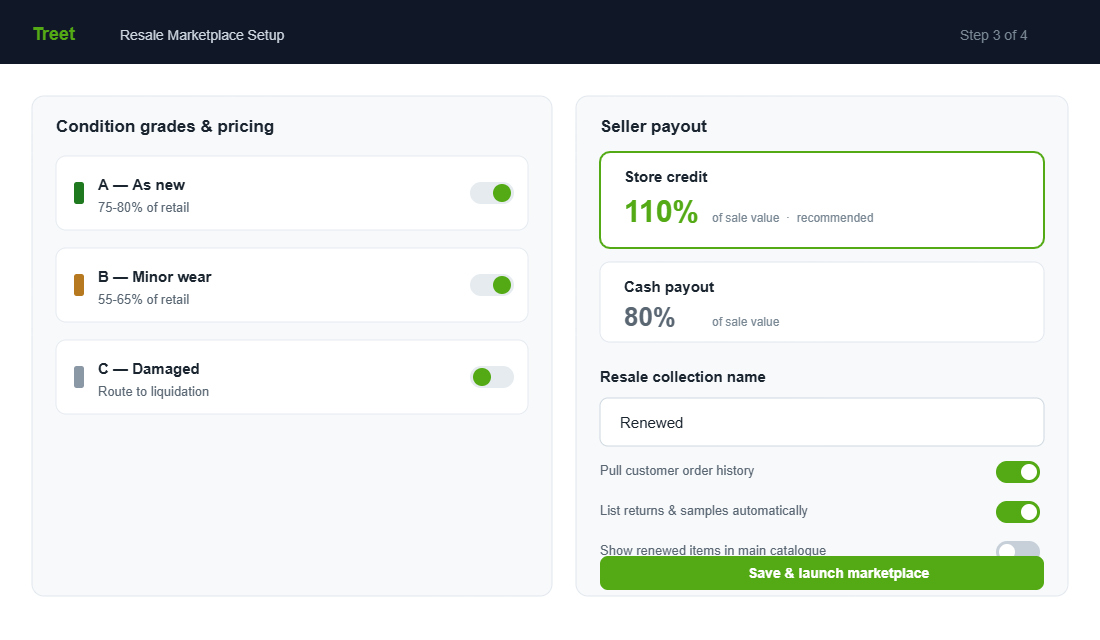
Cash payouts are simple but they walk out the door. Store credit, by contrast, is a closed loop: the payout can only be spent back with you, and customers almost always spend more than the credit is worth. This is why the sharpest programs bribe people toward credit. Treet, one of the leading resale platforms, pays sellers up to 110% of the sale value if they take store credit versus around 80% if they take cash. That extra 30 percentage points costs you very little because it comes back as a future order at full margin.
Store credit also compounds your lifetime value. A customer who trades in, gets credit and buys again has just started a second purchase cycle you did not pay to acquire. If you want to run the numbers on that properly, model it inside your customer lifetime value framework, and build the payout on top of your existing store credit system so refunds, trade-ins and loyalty all run through one balance.
The Recommerce Tool Stack for Shopify
You do not need to build any of this from scratch. A handful of platforms plug into Shopify and handle listing, condition grading, payments and payouts for you.
- Treet. Best for getting started fast. It connects to Shopify by API and lets you list returns, samples and unsold inventory to your own branded resale marketplace in a few clicks. It pulls a customer’s order history so they can list past purchases easily, and it manages store-credit or cash payouts for you.
- Recurate. Puts new and used items in the same cart so shoppers never leave your store to buy pre-loved. Sellers receive cash or store credit through a Shopify app integration.
- Archive. An enterprise-grade branded resale provider (it raised US$30 million) that uses your brand data to simplify listing, with cash or credit payout options.
- Trove. The infrastructure behind Patagonia, Levi’s and Canada Goose resale. This is the heavy-duty option once resale is a serious revenue line.
- AirRobe. The Australian embedded-resale platform used by The Iconic and Country Road Group. Best if you want the “digital wardrobe” option built into the original checkout.
A simple starting path on Shopify: install Treet or Recurate, connect your catalogue, create one “Renewed” collection, set your grading rules and payout ratios (push store credit hard), then add a link to the resale storefront in your main navigation and post-purchase emails. You can be live inside a week.
What the Best Resale Programs Actually Do
Patagonia is the benchmark. Worn Wear launched more than a decade ago, sold more Patagonia product in its first year than the brand’s own eBay presence, and grew revenue around 40% in a recent year to roughly US$13 million. It repaired nearly 175,000 products in FY25 alone. It runs at a profit and it feeds the brand story rather than diluting it.
Levi’s SecondHand made trade-in effortless: bring old jeans into a store, get credit on the spot, put it toward a new pair. The credit keeps the customer inside the Levi’s ecosystem and the old jeans become resale stock. Two problems solved with one move.
Closer to home, The Iconic’s embedded resale partnership with AirRobe brought more than 200,000 Australian shoppers into circular fashion, and groups like Country Road have followed. These are not scrappy experiments. They are deliberate channels with budgets, targets and a place in the P&L. The lesson for a smaller Aussie DTC brand is that you can copy the mechanics at your own scale, starting with a single renewed collection and a trade-in offer.
Price and Position Renewed Stock So It Lifts Full-Price
The fear of cannibalisation is real if you price and position lazily. The fix is to make the trade-off obvious. Renewed stock should be visibly cheaper and visibly “used”, so the shopper who can afford new still chooses new, and the shopper who cannot now has a way in.
Three rules keep the two ranges from competing. First, price on condition, not guesswork: A-grade at around 75% to 80% of full price, B-grade at 55% to 65%, with honest photos and a plain-English condition note on every listing. Second, keep renewed stock in its own collection with its own URL, never mixed into your core product pages, so your full-price hero products stay clean. Third, cap availability. Scarcity is built in because you only have what comes back, and that keeps renewed feeling like a find rather than a permanent discount bin.
Position it as the smart, sustainable entry to the brand, not a clearance rack. The language matters: “renewed”, “pre-loved” and “second life” pull a very different shopper than “cheap” or “clearance”. That framing is also what lets you charge 60% to 80% of full price for a used item without anyone blinking.
Your 30-Day Recommerce Launch Framework
Here is the sequence we take members through to get a first channel live and earning inside a month.
- Week 1: Audit your trapped value. Count your returns, samples, open-box and end-of-line stock. Put a number on what you currently liquidate or write off each month. That number is your starting revenue opportunity.
- Week 2: Pick your model and tool. Start with refurbished-returns resale if you want the fastest cash, or trade-in if retention is the priority. Install Treet or Recurate and connect your catalogue.
- Week 3: Build the offer. Set grading rules (A and B tiers), price the renewed range at 60% to 80% of full price, and set payouts to strongly favour store credit. Create the “Renewed” collection and write clear condition descriptions.
- Week 4: Launch and drive traffic. Add the resale storefront to your navigation, announce it to your email and SMS list, and add a trade-in prompt to your post-purchase and delivery emails. Track resale revenue, new-customer share and credit redemption as separate metrics.
The Compound Effect: One Channel, Four Wins
The reason recommerce is worth the effort is that a single channel pays you four ways at once. You recover value from returns and dead stock you were writing off. You acquire new, younger customers your paid ads could not afford. You deepen retention because store credit pulls trade-in customers back to buy again. And you build a genuine sustainability story that the majority of Australian shoppers now actively reward.
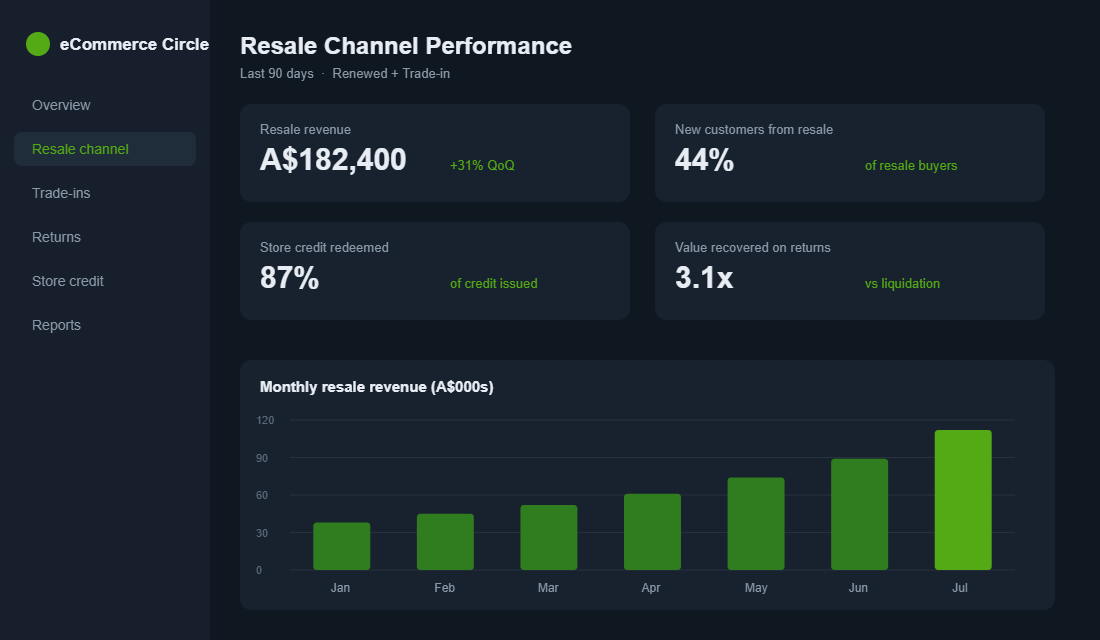
Measure it like a real channel from day one. Track four numbers separately: resale revenue, the share of resale buyers who are new to your brand, store-credit redemption rate, and the recovery rate on returned stock versus what you used to get from liquidation. If your new-customer share is above 40% and most credit is being redeemed, the channel is doing what it should, and you can put more inventory and marketing behind it with confidence.
Most Aussie founders will keep letting that value leak out to peer-to-peer marketplaces where they earn nothing. The brands that win the next five years will be the ones who treated their own resale channel as seriously as their full-price range, and started while it was still an edge rather than a norm.
Inside eCommerce Circle, building a recommerce channel is one of the moves we map out with members who are ready to add a revenue line without spending more on ads. If you want a second opinion on whether it fits your brand, let’s talk.