Returns are the silent killer of ecommerce margins. Most Shopify store owners obsess over acquisition costs, conversion rates, and average order values — but completely ignore the 20-30% of orders that come right back through the door. And every return does not just wipe out the sale. It costs you shipping, restocking, customer service time, and often the product itself.
What’s in This Article
Here is what most brands get wrong: they treat returns as a cost of doing business instead of a system to be optimised. The top-performing Shopify stores we work with have built returns processes that actually strengthen customer relationships while keeping their margins intact. Some have even turned their returns policy into a competitive advantage.
The average Australian ecommerce return rate sits around 20-25%, but the best brands keep theirs under 10%. That gap represents tens of thousands of dollars in recovered profit every year. Here is how to get there.
The True Cost of Returns (It Is Worse Than You Think)
Most store owners calculate return costs as just the refund amount plus return shipping. But the real cost is far deeper. You need to factor in the original outbound shipping cost you absorbed, the return shipping label or postage, warehouse receiving and inspection time, customer service time processing the return, restocking costs (if the item can be resold), and the write-off if the product cannot be resold at full price.
When you add it all up, the true cost of a return is typically 40-65% of the original order value. On a $100 order with a 30% margin, a return does not just erase your $30 profit — it costs you an additional $10-20 out of pocket. Multiply that by hundreds of returns per month, and you start to see why this matters so much.
For a Shopify store doing $100K per month with a 25% return rate, improving your return rate by just 5 percentage points could save $8,000-$12,000 per month in direct and indirect costs. That is $100K+ per year straight to your bottom line.
Prevention: Stop Returns Before They Happen
The cheapest return to process is the one that never happens. Here are the highest-impact prevention strategies for Shopify stores.
Fix your product photography and descriptions. The number one reason for returns in apparel and accessories is “item not as described.” Invest in lifestyle photography that shows scale, detailed close-ups of materials and finishes, and video where possible. Your product descriptions should include exact measurements (not just S/M/L), material composition, care instructions, and honest notes about fit.
Implement a sizing guide that actually works. If you sell apparel or footwear, a generic size chart is not enough. Tools like Kiwi Sizing or True Fit let customers input their measurements and get personalised size recommendations. Stores that implement smart sizing tools typically see a 15-25% reduction in size-related returns.
Use customer reviews strategically. Reviews that mention fit, quality, and real-world use help set accurate expectations. Encourage post-purchase reviews with specific prompts: “How does it fit compared to similar brands?” and “Would you recommend sizing up or down?” Display these prominently on product pages.
Pre-purchase communication. Send a confirmation email immediately after purchase that sets clear delivery expectations. Include care instructions and setup tips for products that need them. A customer who knows exactly what to expect is far less likely to return.
Building a Returns Process That Protects Your Margins
When returns do happen — and they will — your process should minimise costs while maintaining the customer relationship. Here is the framework that works for Australian Shopify stores.
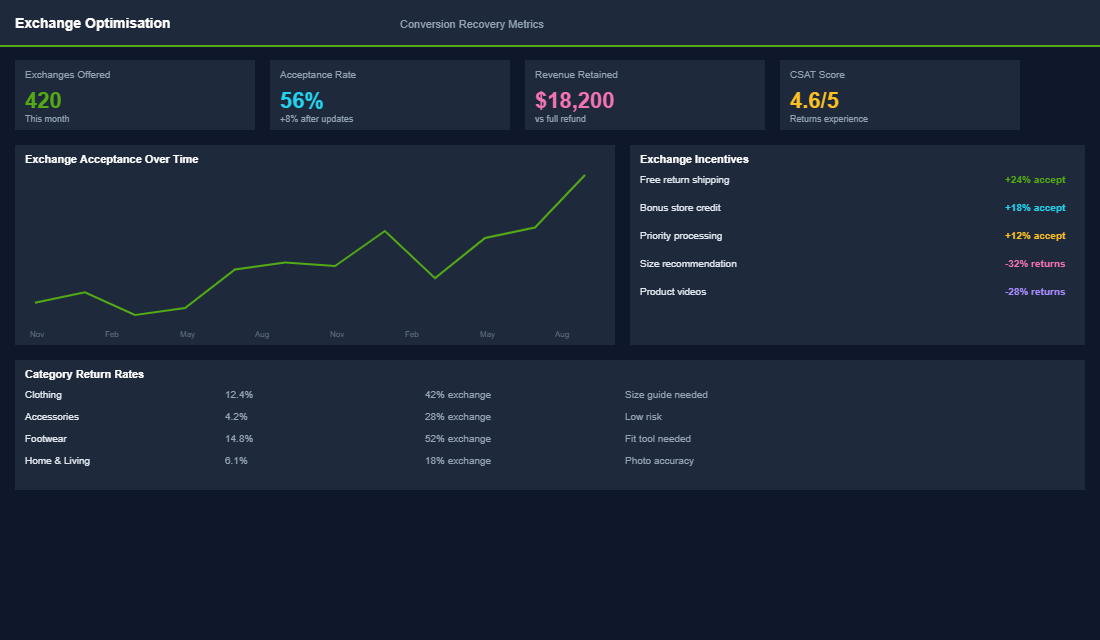
Offer store credit as the default option. Position store credit (with a small bonus, like 110% of the purchase price) as the primary return option, with a cash refund as the secondary choice. Most customers will take the store credit, which keeps the revenue in your business. Brands using this approach retain 40-60% of return revenue as store credit.
Set clear return windows. A 30-day return window is standard for Australian ecommerce. Interestingly, longer return windows (60-90 days) can actually reduce returns because they remove the urgency to decide, and customers often just keep the item. Test what works for your specific products and audience.
Implement a self-service returns portal. Apps like Loop Returns, ReturnGO, or AfterShip Returns let customers initiate returns without emailing your support team. This reduces your customer service costs by 40-50% per return while giving customers a better experience. The data these tools capture also helps you identify return patterns and fix root causes.
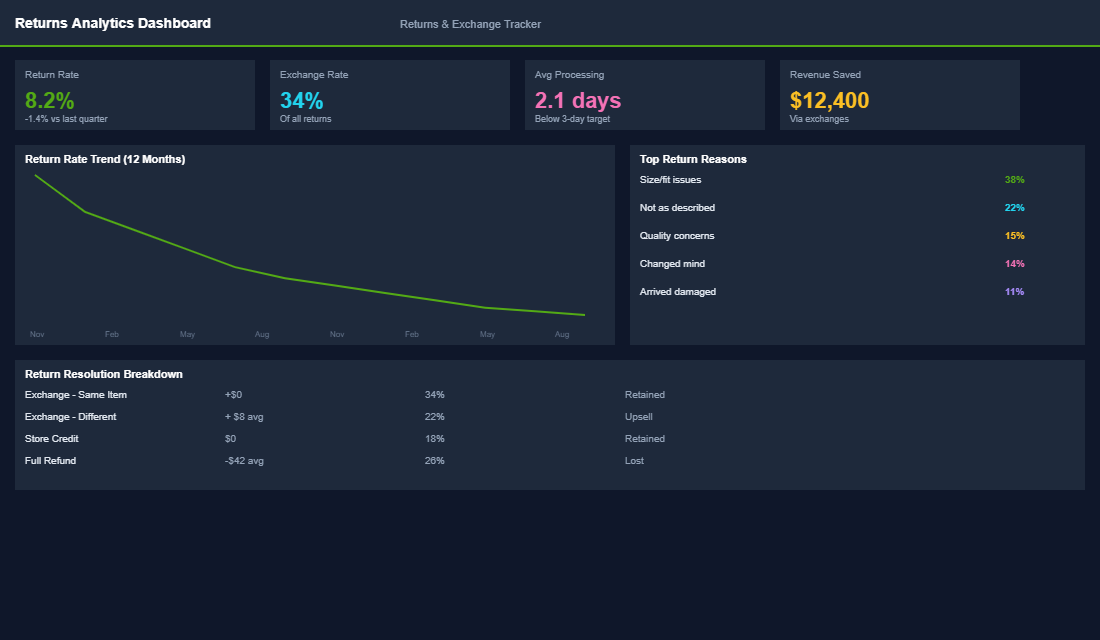
Use return reason data to fix problems. Every return should capture a specific reason. “Did not like it” is not useful. “Colour looked different from photos” is actionable. Track your return reasons monthly and address the top three causes systematically. Most stores find that 60-70% of returns come from just 2-3 root causes.
Turning Returns Into a Loyalty Builder
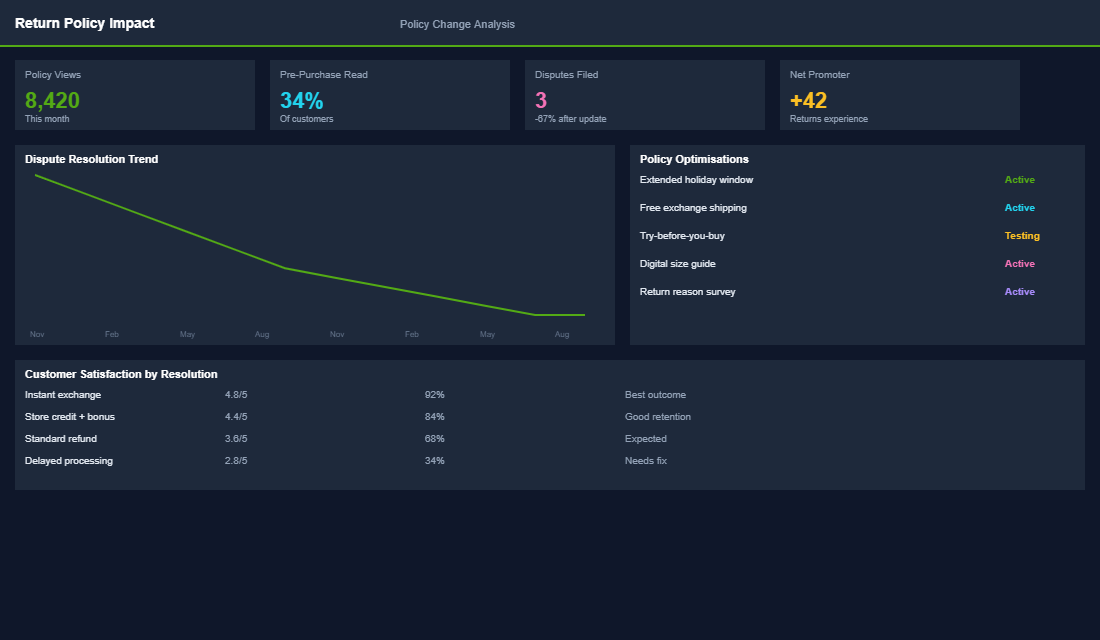
The brands that handle returns well actually create more loyal customers in the process. Research shows that customers who have a positive return experience are 2-3x more likely to purchase again than those who have a negative one. Returns are a moment of truth for your brand.
Speed matters more than anything. Process refunds within 24-48 hours of receiving the return. Delays kill trust faster than almost anything else in ecommerce. Automated returns portals help here — they can trigger the refund as soon as the return tracking shows delivery to your warehouse.
Personalise the follow-up. After processing a return, send a personalised email asking what went wrong and offering curated alternatives. “We noticed the Medium was too snug — here are a few options in Large that our customers love.” This kind of proactive service turns a disappointed customer into a repeat buyer.
Track your net return rate. This is returns minus exchanges and store credit re-purchases. Your gross return rate might be 20%, but if half of those convert to exchanges or store credit purchases, your net return rate is only 10%. That is the number that actually matters for your bottom line.
The Returns Metrics You Should Be Tracking Weekly
- Gross return rate. Total returns divided by total orders. Benchmark: under 15% for most categories, under 25% for apparel.
- Net return rate. Returns minus exchanges and store credit redemptions. This is your true loss metric.
- Return reason breakdown. Categorise every return and track the top reasons monthly.
- Cost per return. Total processing costs divided by number of returns. Target: under $15 AUD per return.
- Store credit retention rate. Percentage of returns that convert to store credit vs cash refund. Target: above 40%.
- Return-to-repurchase rate. Percentage of customers who buy again within 90 days of a return. Target: above 25%.
The Returns Tech Stack That Pays for Itself
Manual returns processing costs you twice. Once in the 10 to 15 minutes of admin per return, and again in the refund you issue when an exchange would have saved the sale. The right app fixes both.
Shopify’s native self-serve returns now handles the basics for free: customers request a return from their account, you approve it, and a label goes out. If you are processing fewer than 50 returns a month, start there before paying for anything.
Past that volume, a dedicated returns platform earns its keep. Loop Returns and ReturnGO both push customers towards exchanges and store credit before offering a refund — and that ordering matters. Brands running exchange-first flows typically retain 30 to 40% of revenue that would otherwise walk out the door as refunds. AfterShip Returns is a solid mid-range option if you also want branded tracking pages in the same ecosystem.
The maths is simple. Say you process 200 returns a month at an $80 average order value. That is $16,000 in monthly refund exposure. Convert even 25% of those into exchanges or store credit and you have kept $4,000 a month — $48,000 a year — for an app that costs a few hundred dollars a month. Bonus: store credit carries a breakage rate too, because a portion of it is never fully spent.
One warning: do not let software replace judgement. Flag serial returners manually before they hit refund-abuse territory. We cover that whole defence system in our Return Abuse Defence Playbook.
Know your category baseline before you panic. Across Australian ecommerce, average return rates sit around 10 to 15% overall, but apparel and footwear regularly run 20 to 30%, while consumables and homewares often sit under 8%. If you sell fashion and your return rate is 22%, you are normal — your job is to grind it down a few points a quarter. If you sell candles and you are at 15%, something is broken: check your photography, your descriptions, and your courier’s damage rate before anything else.
Your Returns Policy Is a Sales Tool (Especially Under Australian Consumer Law)
Most Aussie founders treat the returns policy page as legal fine print. Your customers do not. Around 60% of online shoppers check the returns policy before they buy, and a confusing or stingy policy quietly kills conversions you never see.
Two things need to be crystal clear on that page. First, the Australian Consumer Law baseline: customers are always entitled to a remedy for faulty, misdescribed, or not-fit-for-purpose products — you cannot contract out of that, and saying “no refunds” on faulty goods is itself a breach. Second, your change-of-mind policy, which is entirely yours to design. This is where you differentiate: a 30-day change-of-mind window with free exchanges reads as confidence in your product, and confidence converts.
Then put the policy where the anxiety lives: a one-line summary on every product page near the add-to-cart button (“30-day easy returns, AU-wide”), not buried in the footer. Fit-related anxiety is the biggest returns driver in apparel — pairing that one-liner with a proper sizing tool is the killer combo, and our Size Guide Playbook shows how to cut wrong-size returns at the source. And because “where is my order” anxiety often turns into pre-emptive returns, a branded tracking page helps too — see the Order Tracking Page Playbook.
Your Returns Strategy Is a Profit Strategy
Returns management is not a logistics problem — it is a profit problem. Every percentage point you shave off your return rate drops straight to your bottom line, and every return you convert to an exchange or store credit keeps revenue in your business. The stores that treat returns as a strategic function instead of an annoying cost centre consistently outperform their competitors on margin and customer lifetime value.
A 60-Day Returns-Reduction Sprint (The Numbers Behind a 30% Cut)
The 30% figure in the title is not marketing. It is what happens when you stack a few unglamorous fixes on top of each other. Here is how the maths plays out so you can see why this is worth two months of focused effort.
Imagine you run an apparel store doing AUD 150,000 a month with a 35% return rate, which is normal for fashion. That is roughly AUD 52,500 of product coming back every month, and once you count return shipping, restocking labour, and the items you can no longer sell at full price, each return costs you around AUD 15 to 25 in true margin. At 1,200 returns a month, that is real money walking out the door.
Now run the sprint. Weeks one and two: fix your three worst-offending product pages with better photography, fabric detail, and a proper size guide. That alone typically trims sizing returns by 20 to 30% on those SKUs. Weeks three and four: add real fit feedback to product pages (“runs small, size up”) pulled straight from your return reasons. Weeks five and six: tighten your dispatch accuracy and delivery expectations so “not as described” and “arrived late” stop generating returns. Weeks seven and eight: flag and manage serial returners.
Drop that 35% return rate to 24% and you have cut returns by nearly a third. On our example store that is around 380 fewer returns a month, or AUD 6,000 to 9,000 of recovered margin every single month, with zero extra ad spend. That is the whole argument for treating returns as a profit lever rather than a cost of doing business.
One nuance on that final step. A small slice of customers drive a disproportionate share of returns, and the fastest way to find them is to layer RFM segmentation over your customer base so high-frequency, high-return buyers surface automatically. Most stay profitable and just need gentle nudges. A few do not, and knowing which is which protects your margin without punishing your best customers.
Inside the eCommerce Circle, returns optimisation falls under our Protection pillar — one of the 10 P’s we work through with every member. If your returns are eating into your margins and you are not sure where to start, our coaching can help you build a returns system that actually protects your profit. Let’s Talk — you might be surprised how much margin is hiding in your returns process.