You spent two years getting your product right. The sampling rounds, the failed suppliers, the photography, the packaging, the thousand small decisions that made it yours. Then one Tuesday a customer tags you in a TikTok, and there it is: your product, your colourway, close enough to your logo to squint at, selling for a third of your price.
What’s in This Article
This is not a rare event anymore. The OECD puts global trade in counterfeit goods at 467 billion US dollars a year, around 2.3% of all global imports. And that number only counts outright fakes. It does not count the legal-ish dupes, the lookalike listings, or the chain retailer that releases a suspiciously familiar version of your hero product for 15 dollars.
Most Aussie founders respond in one of two ways. They either rage-post about it and do nothing, or they panic and email a lawyer with no evidence, no trade mark, and no plan. Both waste the one thing you actually control: the system you build before and after the copycat shows up. This playbook is that system, in five parts.
Why Copycats Target Successful Shopify Brands
Copying is a demand-arbitrage business. You pay for the ads, the content, the reviews and the audience. The copycat pays for none of it and skims the demand you created. The better your brand performs, the more attractive that arbitrage becomes. Getting copied is not a sign you failed. It is a sign you built something worth stealing.
The scale is bigger than most founders think. Clothing, footwear and leather goods alone make up 62% of seized counterfeits worldwide, and about 65% of seizures now involve small parcels and mail, which means fakes are flowing through the same international small-parcel channels your customers already use. The fake does not need to beat your product. It just needs to show up in the same feed at a quarter of the price.
Then there is dupe culture, which is a different beast to counterfeiting. A Morning Consult study found 27% of adults have intentionally bought a dupe of a premium product, and research out of Northeastern University puts it at 71% of Gen Z. The #dupe hashtag has racked up close to six billion views on TikTok. Dupes are often legal. That does not make them harmless. They compress your pricing power, dilute what makes you distinctive, and train your next customer to see your product as a template rather than a brand.
Part 1: Audit What You Actually Own
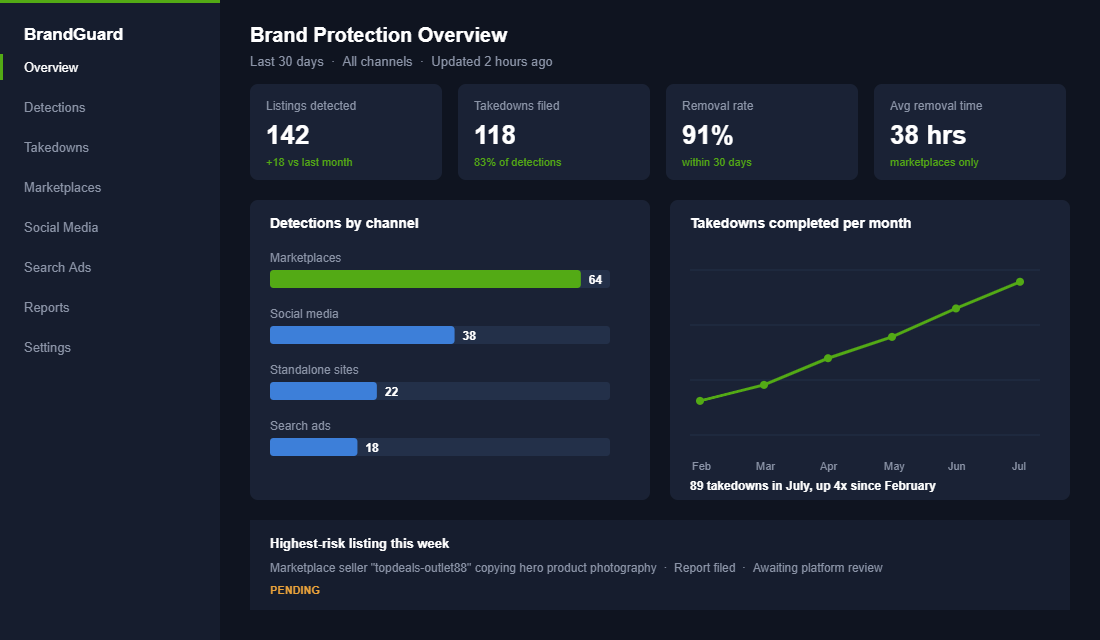
Before you can defend anything, you need a clear-eyed list of what is legally yours. Most founders have never written this down, and it shows the moment they try to file a takedown. Platforms do not act on vibes. They act on registered rights and specific claims.
Sit down for an hour this week and audit four buckets:
- Trade marks. Your brand name, logo, and any product line names. These are your strongest weapons, but only once registered. An unregistered name gives you very limited protection in Australia.
- Copyright. Your product photography, ad creative, website copy and packaging artwork. Copyright is automatic in Australia, which means every stolen product photo is an infringement you can act on today, even with no trade mark.
- Design rights. If your product has a distinctive visual shape or pattern, a registered design protects how it looks. This is the most underused IP right in Australian ecommerce, and it is the one that actually covers the product itself.
- Trade dress and get-up. The overall look a customer recognises from across the room: colour combinations, packaging style, bottle silhouette. Harder to enforce, but it matters under Australian Consumer Law, which we get to in Part 4.
Write each item into a simple spreadsheet with three columns: the asset, whether it is registered or unregistered, and the evidence you hold. That document becomes the backbone of every takedown you ever file. Founders who keep a tidy evidence library file takedowns in 20 minutes. Founders who do not spend a weekend scrambling through old Dropbox folders while the fake listing keeps selling.
Part 2: Register Your Trade Marks Before You Are Famous
The single most expensive brand protection mistake in Australian ecommerce is waiting. Founders tell themselves they will register the trade mark once the brand is “big enough to matter”. By the time it matters, a squatter has filed your name in a class you forgot, or a copycat is disputing your claim, and what should have cost a few hundred dollars now costs five figures in legal fees.
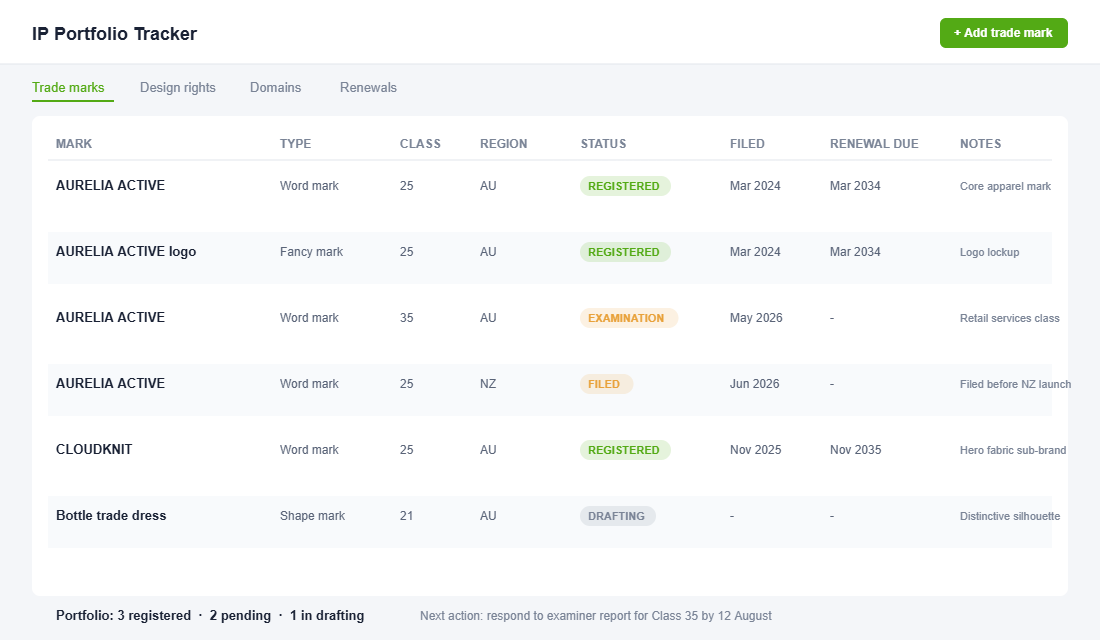
Here is what registration actually costs through IP Australia. A standard application starts at 250 dollars per class when you use the picklist of pre-approved goods and services, or 400 dollars per class if you write your own descriptions. If you have never filed before, use the TM Headstart service: 200 dollars per class for an examiner to pre-check your application and flag problems, then 130 dollars per class to convert it into a formal application. Call it 330 dollars per class to have a professional catch your mistakes before they become refusals.
A registered mark lasts ten years and renews for around 400 dollars per class. For a typical DTC brand protecting a name and logo in two classes, you are looking at roughly 1,000 to 1,500 dollars to be properly armed for a decade. That is less than most brands spend on Meta ads in a slow week.
Three practical rules when you file:
- Cover the class you trade in and the class you sell through. A skincare brand needs Class 3 for the product, and often Class 35 for retail services. An apparel brand lives in Class 25. Check the picklist before assuming.
- File the word mark first. A word mark protects the name in any font or styling. Logo marks are worth having, but logos change every few years. Names do not.
- File in New Zealand when you start shipping there. Australian registration stops at the border. NZ is usually the first export market for Aussie DTC brands and its filing costs are similar.
Part 3: Monitor the Channels Where Fakes Actually Show Up
You cannot take down what you have not found. Most founders discover copycats by accident, usually via a confused customer asking why their “order” arrived broken when it was never bought from you in the first place. By then the fake has often been live for months.
Set up a monitoring routine across the four channels where infringement concentrates:
- Marketplaces. Search your brand name, common misspellings, and your hero product name on Amazon AU, eBay, Etsy, AliExpress and Temu monthly. Copycats love marketplaces because trust is borrowed from the platform.
- Social and ads. Search your brand name in the Meta Ad Library and on TikTok. Scam pages running your ad creative to sell fakes are now one of the most common attacks on DTC brands.
- Google. Set up Google Alerts for your brand name plus terms like “dupe”, “fake” and “review”. Also search your top product photo with Google reverse image search quarterly. Stolen photography is the earliest warning signal you will get.
- Domains. Check for lookalike domains (your brand with hyphens, extra letters, or .shop endings). Fake storefronts on lookalike domains are where chargebacks and brand damage compound fastest.
Do this manually while you are under about 200 orders a day. It costs you 30 minutes a month. Past that point, or the moment you find your third fake, move to software. Red Points is the tool we see most among scaling brands: it uses image recognition and keyword detection across more than 5,000 platforms, processes billions of data points a month, and files takedowns automatically, with most confirmed infringements removed within hours. Setup is straightforward: connect your trade mark numbers and product images, define the marketplaces and regions you care about, approve its first batch of detections manually so the model learns your tolerance, then let it enforce on autopilot and review the dashboard weekly.
Part 4: Run the Takedown Ladder, Not the Panic Button
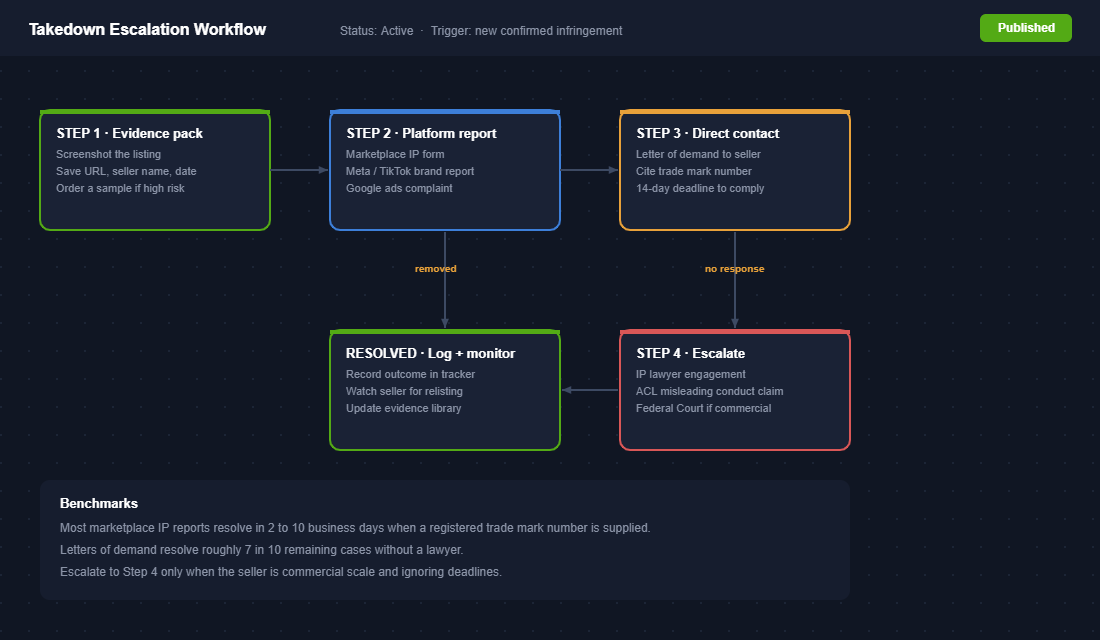
When you find an infringement, the instinct is to fire off an angry DM or jump straight to a lawyer. Both are usually wrong. Takedowns work best as a ladder: start with the cheapest, fastest rung and only climb when the rung below fails.
Rung one: build the evidence pack. Before you touch anything, screenshot the listing with the date visible, save the URL and seller name, and note your registered rights that it breaches. If the seller is doing real volume, order a sample. Ten minutes of evidence now saves weeks later, because listings vanish and reappear under new seller names.
Rung two: platform IP reports. Every major platform has a formal rights-holder channel: Amazon Brand Registry (which requires a registered or pending trade mark and unlocks automated protections), eBay VeRO, Etsy’s IP portal, Alibaba’s IPP platform, Meta’s Brand Rights Protection, and Google’s counterfeit complaint form for Shopping ads. Reports citing a registered trade mark number typically resolve in 2 to 10 business days. Reports without one frequently go nowhere, which is why Part 2 comes before Part 4.
Rung three: the letter of demand. For Australian copycats and dupes that sail close to the wind, a firm letter citing your trade mark registration and section 18 of the Australian Consumer Law (misleading and deceptive conduct) resolves the majority of cases without a courtroom. This is exactly the pressure point in the Frank Green situation: when a retail giant sells a 15 dollar lookalike of a 59.95 dollar cult bottle, the question is not whether copying is rude, it is whether the get-up is likely to mislead consumers into thinking the products are connected. Distinctive, registered, consistently used branding is what makes that argument winnable.
Rung four: escalate with intent. If a commercial-scale infringer ignores the letter, that is when you brief an IP lawyer. You arrive with a registered mark, a tidy evidence pack and a paper trail of ignored deadlines, which makes you the easiest client they will see that week and dramatically cheaper to act for.
One more thing on fake storefronts: they do not just steal sales, they generate chargebacks and destroy trust in your ads. If you are seeing unexplained disputes, read our Shopify Chargeback Defence Playbook alongside this one. The two systems share an evidence library.
Part 5: Build a Brand That Dupes Cannot Touch
Here is the uncomfortable truth: you will never take down every dupe, and the legal system will not save a brand whose only moat is a product shape. The final part of the playbook is making the copy structurally inferior to the original, so that even when customers see the dupe, they still buy you.
Zimmermann, one of Australia’s most counterfeited fashion exports, runs this play publicly: a dedicated brand protection program, clear guidance that garments bought outside authorised channels carry counterfeit risk, and a reporting channel where customers themselves flag fakes. Their customers act as a distributed monitoring network because the brand gave them a reason to care.
For a DTC brand at Shopify scale, the same thinking looks like:
- Warranty and service the dupe cannot match. A lifetime warranty registered at purchase makes the 15 dollar version feel expensive. Copycats cannot afford your customer service.
- Reviews and community as proof of the real thing. Hundreds of verified reviews with customer photos are impossible to clone convincingly. Our Shopify Reviews Playbook covers how to build that engine.
- Product experience details that cost discipline, not money. Serial numbers, QR verification cards in the box, engraved logos, packaging that photographs beautifully. Each one is a checkpoint a counterfeiter has to fake and usually will not.
- Quality as the moat under everything. Dupes win when the original’s quality story is vague. If your QC is tight and your defect rate is visibly low, the gap between you and the copy stays wide. The Shopify Quality Control Playbook is the sister system to this one.
How the Five Parts Compound
Run in isolation, each part is underwhelming. A trade mark you never enforce is a certificate in a drawer. Monitoring without registered rights finds problems you cannot fix. Takedowns without a distinctive brand are a game of whack-a-mole you fund forever.
Run together, they form a flywheel. Registration makes your platform reports land in days instead of never. Monitoring catches fakes while they are small, before they accumulate reviews and ranking. Fast takedowns teach the copycat economy that your brand is expensive to attack, and infringers are rational: they move on to the brand next door that never filed anything. Meanwhile the brand moat in Part 5 means every dupe that does slip through actually markets the original. That is the end state: copycats become a cost of success you manage in 30 minutes a month, not a crisis that eats a quarter.
The Monthly Brand Protection Audit (Steal This Checklist)
Put a 30-minute block in your calendar on the first Monday of each month and run this:
- Search (10 minutes). Brand name and hero product on Amazon AU, eBay, AliExpress and Temu. Brand name in the Meta Ad Library and TikTok search. One reverse image search on your best-selling product photo.
- Check the tracker (5 minutes). Any trade mark renewals or examiner deadlines in the next 90 days? Any classes or countries you now trade in but have not filed in?
- File (10 minutes). Every confirmed infringement gets an evidence pack entry and a platform report the same day. Nothing sits in a “deal with later” list, because later is when the fake earns its 50th review.
- Review outcomes (5 minutes). Update the status of last month’s reports. Two ignored reports on the same seller triggers the letter of demand. Three fakes found in a month triggers the software conversation.
That is the whole discipline. Not glamorous, ruthlessly effective, and roughly the same monthly effort as reconciling your ad spend.
Protect the Demand You Paid For
Every dollar a copycat takes was a dollar of demand you created with your own ad spend, your own content and your own reputation. Brand protection is not a legal chore. It is defending the compounding asset your whole business is built on, and the founders who treat it that way spend hundreds now instead of tens of thousands later.
Inside eCommerce Circle, Protection is one of the ten P’s we work on with every member, and brand defence sits right beside chargebacks and compliance in that pillar. If you want a second opinion on how exposed your brand is right now, let’s talk.