Here is a leak most Aussie founders never look at until it is already draining them. You spend money to win the sale, you pack it, you ship it, and weeks later your payment provider quietly claws the money back and adds a fee on top. The order is gone, the stock is gone, and now you are down the transaction value plus the penalty. That is a chargeback, and it is one of the most expensive line items hiding in your Shopify store.
What’s in This Article
The numbers are moving in the wrong direction. Card fraud on Australian-issued cards jumped 20% to A$913 million in 2024, and almost all of that growth came from card-not-present transactions, which is exactly what an online store is. Overseas card-not-present fraud alone climbed 25% to A$454 million, running at a rate of A$12.08 for every A$1,000 spent. If you sell online, this is your problem, not the bank’s.
Most operators react to chargebacks one at a time, if at all. They read the dispute email, sigh, and either ignore it or upload a screenshot and lose. The founders who actually protect their margin treat chargebacks as a system with four layers: prevent, cover, prove, and fight. Get those four working together and you can push your dispute rate back under the line where processors start paying attention. This is that playbook.
The Three Chargebacks Bleeding Your Store (And Why They Are Not Equal)
Before you can defend against chargebacks, you have to know which kind you are getting, because the defence is completely different for each. Lumping them together is why so many founders waste hours fighting disputes they were never going to win, while ignoring the ones they could have stopped for free.
There are three that matter for a Shopify store. Learn to tell them apart from the reason code on the dispute, because that single label decides your entire response.
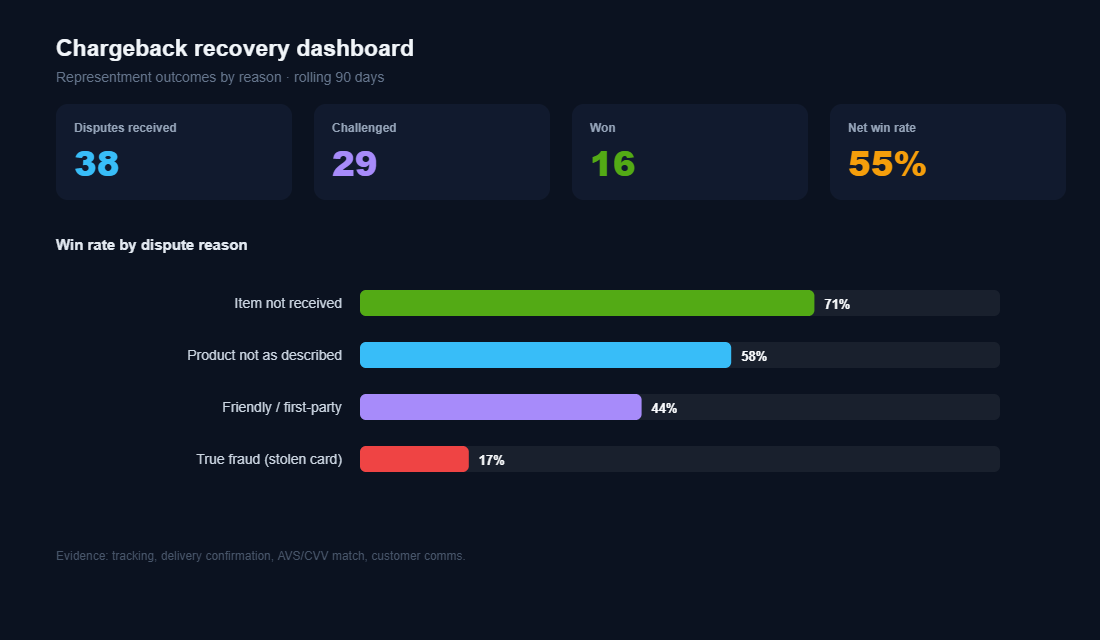
- True fraud (stolen card). A criminal used someone else’s card on your store. The real cardholder disputes it. Merchants win only about 17% of these when they fight, so the money is in prevention, not representment.
- Item not received. The customer says the parcel never arrived. This is the single most common dispute reason, and it is the most winnable one because tracking and delivery proof settle it. Merchants win north of 70% when the evidence is clean.
- Friendly fraud (first-party misuse). A real customer who did receive the order disputes it anyway, sometimes forgetting a subscription, sometimes gaming a refund. First-party fraud has exploded to 36% of all reported fraud in 2024, up from 15% a year earlier, and it is forecast to rise another 40% by 2026.
The lesson from that split is simple. You cannot win your way out of true fraud, so you stop it at the door. Item-not-received disputes you win with proof. Friendly fraud you reduce with clearer billing descriptors and better records. One bucket, one tactic.
The Real Cost Of A Chargeback Is Never Just The Order Value
Ask a founder what a chargeback costs and they will name the order total. That is the smallest part of the bill. The real damage is stacked underneath it, and once you model the full number, spending an hour on prevention suddenly looks like the best-paid hour of your week.
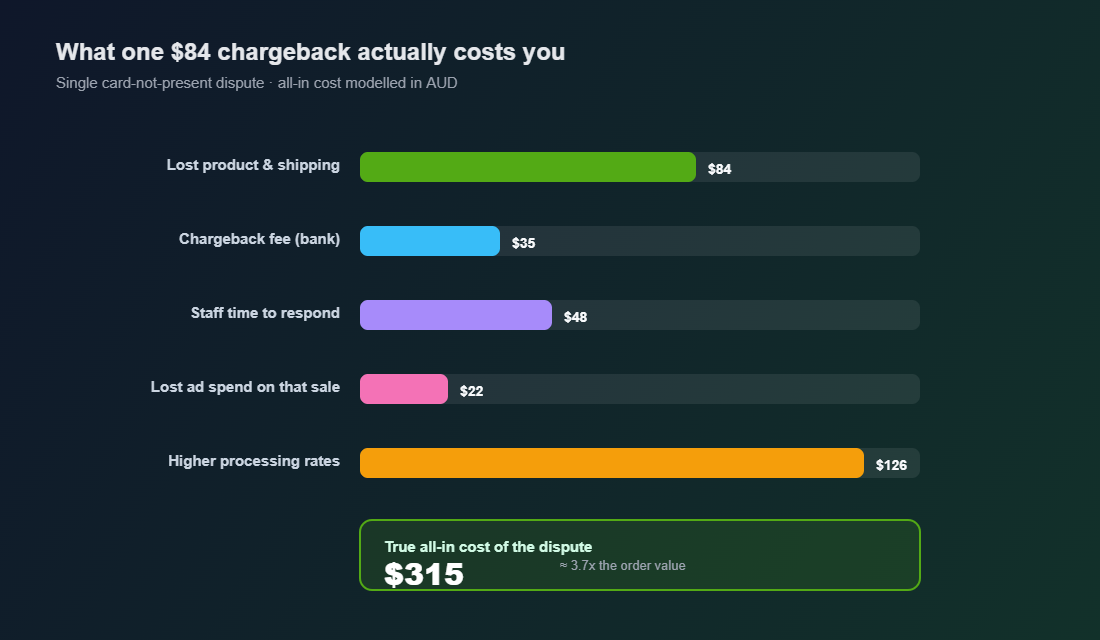
Work it through on a single dispute. The average ecommerce chargeback sits around A$84 in order value, but the all-in cost per dispute lands closer to A$315 once you add everything up. That is why studies put the true cost of fraud at roughly A$4.61 for every dollar actually lost. You are not losing one sale. You are losing three or four.
Here is what makes up that number, and why it compounds:
- The product and the shipping. Stock is gone and the courier is already paid. Neither comes back.
- The chargeback fee. Your provider charges A$20 to A$50 per dispute whether you win or lose.
- The staff time. Someone has to gather evidence and respond, and that hour is not spent selling.
- The processing penalty. Too many disputes and your rates rise or your account is flagged, which is the expensive part.
That last point is the one that ends stores. Visa tightened the screws in 2025 with its new Acquirer Monitoring Program, replacing the old 0.9% thresholds with an early-warning trigger as low as 0.4% of your transactions. Cross the line and your acquirer starts charging per-dispute fines and can put your account under review. A dispute rate you shrug at today can quietly become an existential risk.
Layer One: Stop Bad Orders At The Checkout
Prevention is the highest-return layer because it costs you almost nothing and it kills the disputes you can never win. Shopify already ships most of the tools for this. The problem is that they sit switched on but ignored, like a smoke alarm nobody tests.
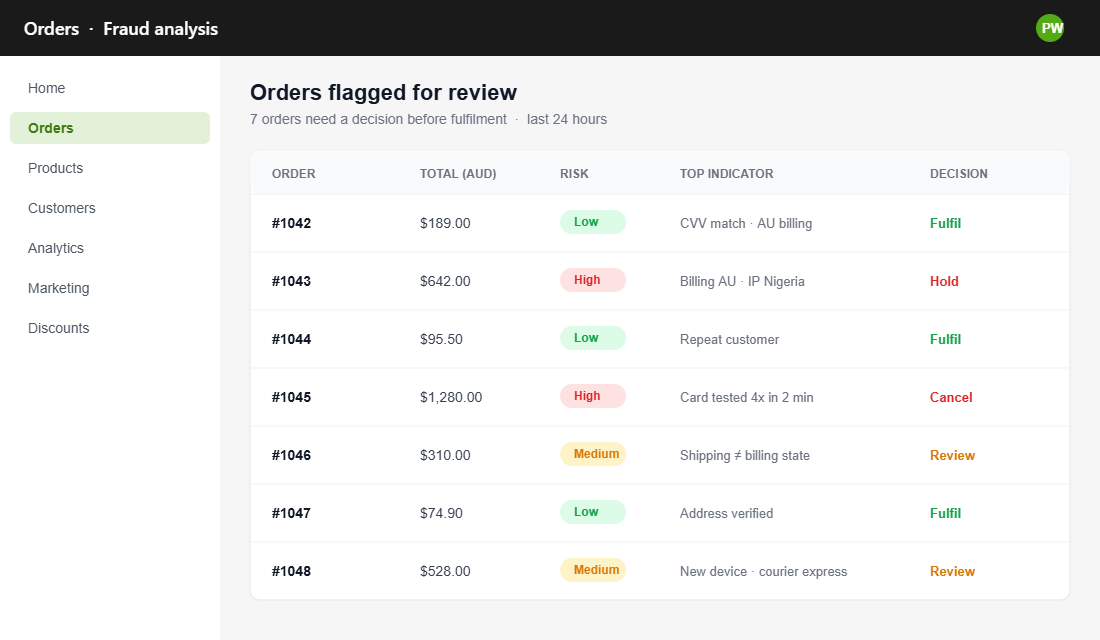
Start with the fraud analysis Shopify already runs on every order. It scores each transaction and flags the risky ones with plain-English indicators: billing and shipping in different countries, the card tested multiple times in minutes, a mismatched CVV, or a delivery address that does not match the card. Your job is to actually read those flags before you fulfil, not after.
Then add rules so you are not reviewing by hand forever. Shopify’s free Fraud Filter (now folded into Fraud Control) lets you write conditions that flag or block orders automatically. A practical starter set for an Aussie store:
- Turn on AVS and CVV enforcement. In Shopify Payments settings, decline transactions where the security code or postcode fails. This blocks a large share of stolen-card attempts at the gate.
- Add a 3-D Secure step for high-risk orders. 3DS2 shifts liability for fraudulent chargebacks to the card issuer, so a confirmed fraud dispute on a 3DS order is not yours to eat.
- Write a Fraud Filter rule to flag any order where billing country is not Australia but shipping is, or where the order value is above your normal average and the customer is brand new.
- Hold, do not auto-cancel. Route flagged orders to manual review so you catch fraud without insulting good customers who simply used a work address.
This layer pairs directly with your checkout itself. A checkout that captures clean, verified data gives you both fewer fraudulent orders and stronger evidence later, which is one more reason to get it right (we break the full flow down in our Shopify checkout optimisation playbook).
Layer Two: The Shopify Protect Reality For Australian Stores
This is where a lot of Aussie founders get a nasty surprise, so read this section twice. Shopify Protect is real, it is free, and it will reimburse you the order value plus the chargeback fee on eligible fraudulent and unrecognised disputes. It sounds like the whole problem solved. It is not, and the reason matters.
Shopify Protect currently covers US-based merchants using Shopify Payments on Shop Pay orders only. If you are running an Australian store, you cannot lean on it as your safety net today. Assuming you are covered when you are not is how a founder discovers the gap at the worst possible moment, on a A$1,200 dispute.
Even where it applies, Protect only covers fraud and unrecognised charges. It does not cover the most common dispute of all, item not received. So no matter where you trade, you still need your own cover for the categories Protect leaves out. For Australian stores, that means a third-party guarantee service:
- Signifyd. Screens every order in real time and offers a financial guarantee on approved orders, including item-not-received claims. If a guaranteed order charges back, Signifyd reimburses you. Strong fit for higher-volume stores that want it fully automated.
- NoFraud. Combines machine scoring with human review to return a clear pass or fail on each order, which tends to reject fewer good customers. Often the more flexible option for stores that want tighter control over rules.
- Chargeflow and similar. Sit on the response side, automating evidence and representment on a success-fee model when disputes do land.
Do not bolt on three overlapping apps at once. Each one adds cost and can slow your store, so pick the single layer that matches your risk and your volume, then measure it. If you have not audited what is already running on your store, that is worth doing first (our app stack audit playbook walks through it).
Layer Three: Kill “Item Not Received” Disputes With Proof
Item-not-received is the most common dispute and, happily, the most winnable. The entire game is evidence. If you can show the parcel was delivered to the address the cardholder gave you, the dispute collapses. If you cannot, you lose by default, even when you did everything right.
The founders who win these do not scramble for proof after a dispute lands. They build the proof into fulfilment so it is already sitting there the day they need it. Make these standard on every order:
- Tracking on every parcel, no exceptions. A tracking number that shows a delivery scan at the correct suburb is your single strongest piece of evidence.
- Signature or photo on delivery for higher-value orders. Most Aussie couriers offer authority-to-leave photos or signature on delivery. Turn it on above a value threshold you set.
- Timestamped customer communication. Order confirmation, shipping notification, and delivery confirmation emails all build a record that the customer was kept informed.
- A clear, recognisable billing descriptor. If your bank statement shows a random company name, customers dispute charges they genuinely made. Match the descriptor to your store name to cut first-party disputes.
The delivery moment does double duty here. The same tracking and confirmation that wins disputes also drives repeat orders, which is why it is worth treating as a real touchpoint rather than an afterthought (more on that in our post-purchase playbook).
Layer Four: Fight Back And Actually Win Representment
When a dispute does land, you get one shot to respond with evidence. This is called representment, and most founders either skip it or send a weak reply and lose. The data says fighting is worth it if you are selective: across all dispute types, merchants win an average of 54% of the cases they challenge.
The key word is selective. Win rates swing wildly by reason code. You will win around 70% of item-not-received disputes with tracking, roughly 44% of friendly-fraud cases, and only about 17% of true stolen-card fraud. Fight the winnable ones hard and do not burn hours on the ones the numbers say you will lose.
A representment response that wins has a spine to it. Do not just upload a screenshot and hope. Include, in order:
- Proof of delivery with tracking number, carrier, and the delivery scan or signature.
- Proof the order was authorised: AVS match, CVV match, and a 3DS confirmation if you have one.
- The customer relationship: prior orders, account history, IP and device consistency with past purchases.
- A short written summary that walks the issuer through the evidence in plain language, not just a pile of attachments.
Watch the net number, not the gross win. After fees and the occasional second chargeback, real recovery lands closer to 12% to 18% of disputed value across a mixed book. That is still money worth reclaiming, but it is one more reason prevention beats representment every time.
Cut Friendly Fraud Before It Ever Becomes A Dispute
Friendly fraud deserves its own attention because it is the fastest-growing category and the one founders feel most powerless against. A real customer, real card, real delivery, and they still dispute. It already makes up roughly 21% of all chargebacks, and for subscription and digital-adjacent stores it runs far higher. The good news is that most of it is preventable with a few small changes, because a lot of “friendly fraud” is honestly just confusion.
Attack it on two fronts: make the charge unmistakable, and make refunding easier than disputing. If asking you for a refund is faster than calling the bank, most customers will choose you.
- Fix your billing descriptor. Make sure the name on the customer’s statement is your store name, not a payment-company code. Unrecognised charges are one of the biggest drivers of first-party disputes.
- Send a pre-charge reminder for subscriptions. A short “your next order ships in 3 days” email kills the classic “I forgot I was subscribed” dispute before it starts.
- Make your refund path obvious. A visible returns and refund policy and a one-click support link mean a frustrated customer comes to you, where a refund costs you the order value, instead of the bank, where a dispute costs you far more.
- Keep the receipts. Save delivery proof and any support conversation. If a customer does dispute after receiving the order, that record is what flips a friendly-fraud case into a win.
Turn It Into A System: Your Chargeback Defence SOP
None of this works as a one-off. It works when it becomes a standing routine that runs whether or not you are thinking about it. Here is the SOP to hand your team or run yourself. Copy it straight into your operations doc.
- Daily: Review every order Shopify flagged as medium or high risk before fulfilment. Hold, verify, or cancel. Never fulfil a high-risk order on autopilot.
- Every order: Ship with tracking. Add signature or photo on delivery above your value threshold. Send confirmation, shipping, and delivery emails automatically.
- Weekly: Check your dispute rate against your processor’s threshold. If it is drifting toward 0.5%, find the source before your acquirer does.
- Per dispute: Read the reason code first. If it is winnable, respond within 48 hours with the full evidence stack. If the numbers say you will lose, log it and move on.
- Monthly: Tally disputes by reason. If item-not-received is climbing, your fulfilment proof has a gap. If friendly fraud is climbing, fix your billing descriptor and subscription reminders.
- Quarterly: Reassess whether a guarantee service like Signifyd or NoFraud now pays for itself at your volume.
Set a target and hold it. A healthy card-not-present store keeps its chargeback rate comfortably under 1%, and ideally under the 0.5% early-warning line, with an item-not-received win rate above 70%. Put those two numbers on a dashboard and check them monthly. What gets measured gets defended.
The Compound Effect Of Defending All Four Layers
Any one of these layers helps a little. Run all four together and they multiply, because each one removes a different slice of your total exposure and makes the next layer cheaper to run.
Watch how it stacks. Layer one stops most stolen-card orders before they ship, so you never fight the 17%-win disputes at all. Layer two covers the fraud that still slips through. Layer three turns every item-not-received dispute into a 70%-plus win. Layer four reclaims the winnable remainder. What is left is a chargeback rate low enough to keep you well clear of Visa’s monitoring thresholds, which protects your processing rates, which protects the margin on every single order you sell, not just the disputed ones.
That is the real prize. This is not about clawing back the odd A$84 order. It is about keeping your merchant account healthy and your effective processing cost low, which quietly lifts the profit on your entire revenue line. Founders who ignore chargebacks pay for it twice: once on the lost orders, and again on the higher rates that follow.
Inside eCommerce Circle, protecting your margin from leaks like this is one of the core pillars we work on with every member. If you want a second opinion on your store’s chargeback exposure and where it is costing you, let’s talk.