The email lands at 9:47 on a Tuesday night. “New 1-star review on your store.” Your stomach drops, you open it, and there it is: three angry paragraphs about a late delivery, sitting at the top of your best-selling product page where every future customer will read it.
What’s in This Article
Most founders do one of three things next, and all three are wrong. They ignore it and hope it sinks down the page. They fire back a defensive reply written while they are still angry. Or they go hunting for a way to delete it. Each of those choices costs you money, and the third one can put you on the wrong side of the ACCC.
Here is the number that should change how you think about this: 82% of shoppers specifically go looking for negative reviews before they buy. Not the glowing five-star ones. The angry ones. Your worst review is one of the most-read pieces of content on your store, and the brands that treat it that way turn 1-star moments into repeat customers. This playbook shows you the 5-step system to do exactly that.
Why Shoppers Read Your Worst Reviews First
Reviews are not decoration. Around 95% of shoppers read them before buying, and 93% say reviews directly influence what they purchase. But the behaviour that matters for this playbook is more specific: shoppers deliberately filter to the low ratings to stress-test your product before handing over their card details.
They are asking three questions when they do it. What actually goes wrong with this product? Does it go wrong often? And when it goes wrong, what does the brand do about it? Your negative reviews answer the first two. Your replies answer the third, and 89% of consumers read those replies.
This is also why a perfect 5.0 rating quietly hurts you. Research from the Spiegel Research Center at Northwestern University found purchase likelihood peaks when a product sits between 4.0 and 4.7 stars, because a spotless score reads as fake. The same research found that displaying reviews can lift conversion by up to 270% on higher-priced products. A few honest negative reviews with professional responses are not a liability. They are proof the rest of your reviews are real.
The flip side: volume of unanswered negatives is genuinely dangerous. Multiple studies put the damage at up to a 70% drop in sales once a product accumulates four or more unaddressed negative reviews. The difference between those two outcomes is not luck. It is a system.
Step 1: Triage Every Review Within 24 Hours
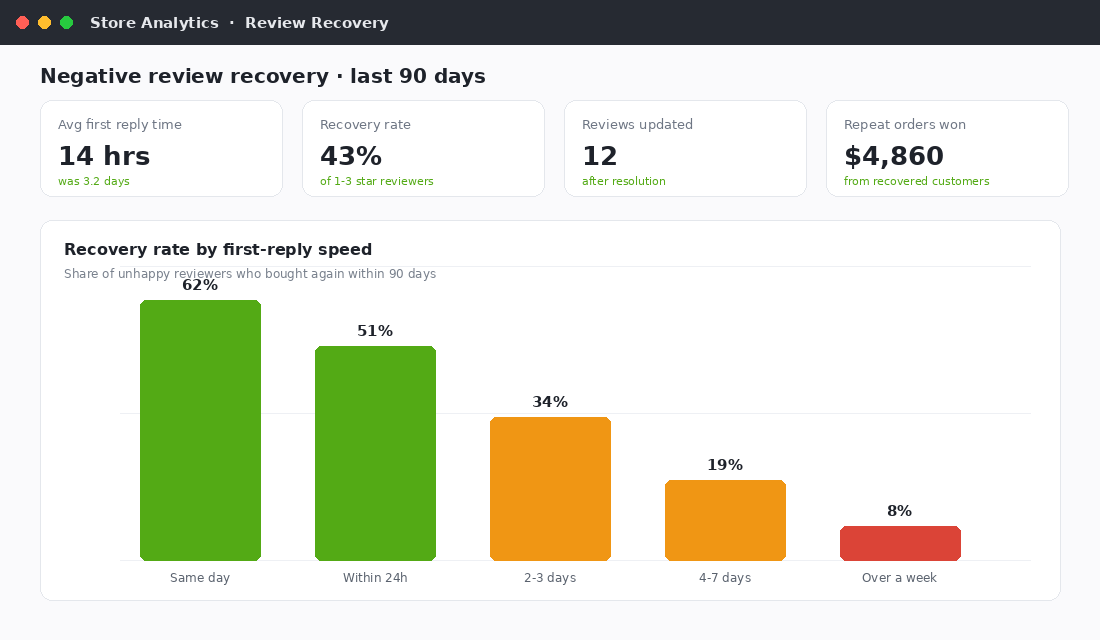
Speed is the first lever. Research shows 53% of consumers expect a business to respond to a negative review within a week, and the closer you get to same-day, the better your recovery odds. Yet only around 5% of businesses respond to reviews at all. That gap is your opportunity, because doing the basics puts you ahead of 19 out of 20 competitors.
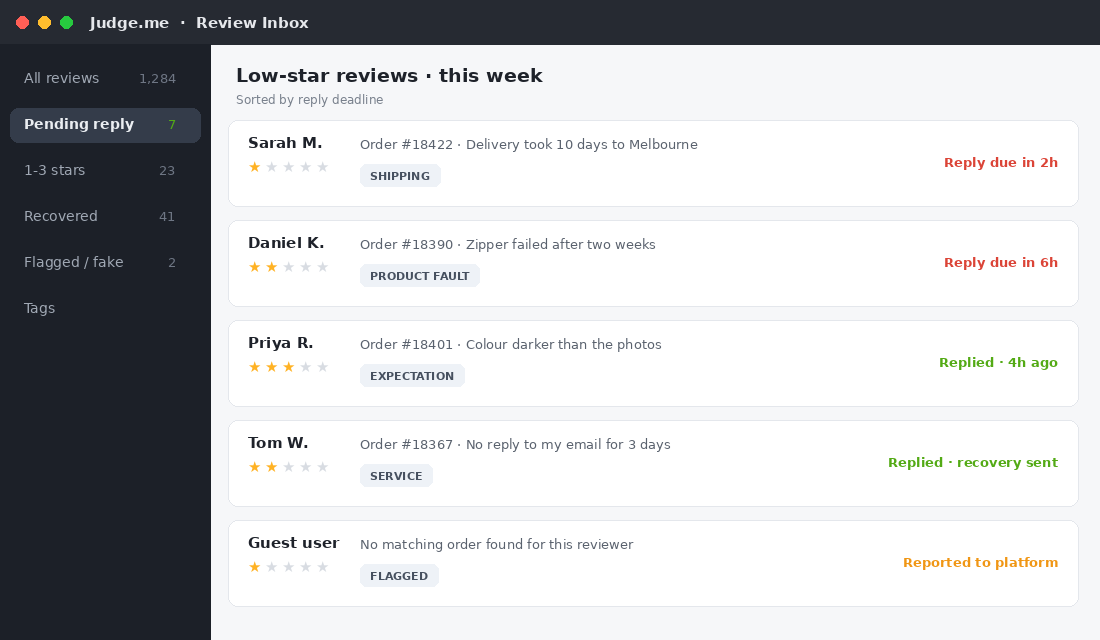
The mistake is treating every negative review the same. Before you type a word, classify it. Every 1 to 3 star review lands in one of five buckets, and each bucket gets a different play:
- Product fault. The item arrived broken, failed early, or does not work as described. This is a warranty conversation and a quality signal. Fix the customer first, then log the fault.
- Shipping and delivery. Late, lost, or damaged in transit. In Australia this is your most common bucket, especially outside metro areas. The customer blames you, not the carrier, so own it.
- Expectation gap. The product worked, but it was smaller, darker, or different to what the customer imagined. This is a product page problem wearing a review costume.
- Service failure. Slow replies, unhelpful support, refund friction. These reviews mention your team, not your product.
- Fake or abusive. Never bought from you, competitor mischief, or content that breaches platform guidelines. This bucket has its own protocol in Step 5.
Tag the bucket in your review app or a simple spreadsheet the moment the review arrives. Thirty seconds of classification now powers everything in Steps 2 through 4, and it turns your review feed into a diagnostic tool instead of a source of dread.
Step 2: Use the Public Reply Formula (You Are Writing for the Next Customer)
Here is the mindset shift that makes negative reviews easy to answer: your public reply is not really for the angry customer. It is for the hundreds of future shoppers who will read the exchange. The reviewer gets your genuine help through the private channel in Step 3. The reply is your shopfront.
That audience is worth writing for. Consumers are 80% more likely to choose a business that responds to all of its reviews than one that ignores them. Every reply follows the same four-part formula:
- Acknowledge, by name, fast. “Hi Sarah, thanks for flagging this.” No corporate wallpaper like “we take your feedback seriously”.
- Own the specific failure. “A ten-day wait for a Melbourne delivery is not the standard we hold ourselves to.” Naming the actual problem shows every reader you are not running a template.
- State the fix, concretely. “We have sent you a replacement on express post and refunded your shipping.” Vague apologies read as evasion. Specific fixes read as competence.
- Move the thread offline. “I have emailed you directly from our support inbox so we can sort the rest.” Never litigate details or share order information in public.
Four sentences, done. What you never do: argue, blame the customer, blame the carrier, offer excuses about being a small business, or copy-paste identical replies down the page. Shoppers reading ten identical responses learn one thing, that nobody is actually home.
One more rule for the heated ones. If a review makes your blood boil, draft the reply, then sit on it for two hours. The review has been public for a day. Two more hours will not hurt you, but a defensive reply screenshot-shared on social media will.
Step 3: Run the Private Recovery (This Is Where the Money Is)
The public reply protects future revenue. The private follow-up recovers current revenue. Salesforce research found 78% of customers will do business with a company again after a mistake, provided the resolution is handled well. Service researchers call it the recovery paradox: a customer whose problem was fixed brilliantly often ends up more loyal than one who never had a problem at all.
Within the same 24 hours as your public reply, email the customer directly. Keep the decision-making simple with a three-tier resolution ladder, agreed in advance so your support person does not need to escalate every case:
- Tier 1, under 20 dollars to fix: replace, refund, or credit immediately, no questions. Approval not required. The lifetime value of a recovered customer beats the cost of a replacement candle every time.
- Tier 2, product faults and wrong items: replacement plus express shipping, plus a small credit for the hassle. Photograph requests are fine, return-the-item demands on low-value goods are not.
- Tier 3, repeat issues or high-value orders: founder or manager makes a personal call. Ten minutes on the phone from the owner converts furious customers into advocates at a rate no email can match.
Then comes the part most founders get wrong. Once the customer is genuinely happy, you may let them know they are welcome to update their review if they feel it no longer reflects their experience. That is all. You cannot pay them to change it, condition the refund on editing it, or nag them. Under Australian Consumer Law, offering incentives for positive reviews or arranging to have genuine negative reviews altered is misleading conduct. Most happily recovered customers update the review on their own, and a 1-star review upgraded to 4 stars with a gracious edit note is the most persuasive content on your product page.
Step 4: Feed Every Review Back Into the Business
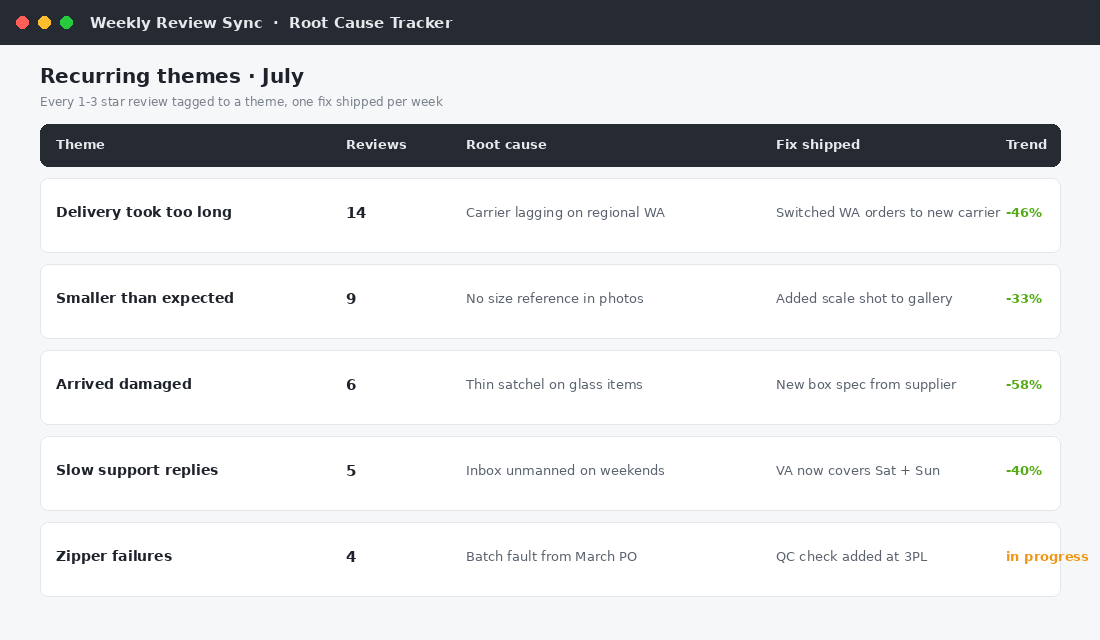
Answering reviews one at a time is defence. The system play is aggregation. Those triage tags from Step 1 become a weekly scoreboard: how many reviews in each bucket, which products, which carriers, which promises on which pages.
Run a 15-minute review sync each week, even if the team is just you and a VA. Three questions: what was our biggest recurring complaint, what is the root cause, and what one change removes it. Then make the change. A recurring “smaller than expected” complaint is a product photography fix. A cluster of late-delivery reviews from regional WA is a carrier or dispatch-cutoff fix. A run of “arrived broken” reviews is a packaging spec fix, and our quality control playbook covers exactly how to chase that upstream with your supplier.
Do this for a quarter and negative review volume falls at the source. Members who run this loop typically find three or four recurring themes cause the large majority of their low-star reviews. Kill those themes and you have not just improved a metric, you have removed the reason dozens of future customers would have been unhappy. This is the same discipline we teach in the voice of customer playbook: reviews are free consulting from the only people whose opinion counts.
Step 5: Handle Fake and Abusive Reviews the Legal Way
Sooner or later you will cop a review from someone who never bought from you, a competitor having a go, or a reviewer who crosses into abuse. There is a right way to handle these, and an expensive wrong way.
The wrong way first, because the case law is brutal. The ACCC has pursued businesses hard over review manipulation. Meriton was fined 3 million dollars after it manipulated its review process to suppress negative feedback. Electrodry copped a 215,000 dollar penalty over fake reviews posted by its network. Bloomex was ordered to pay 1 million dollars in penalties in 2024, partly over misleading star ratings. And since the penalty reforms, maximum fines for misleading conduct now run to 50 million dollars for companies. Burying genuine criticism is not a grey area in Australia. It is enforcement bait.
The right way is procedural, not emotional:
- Check your orders first. No matching order, name, or email? You are likely looking at a fake, and platforms will act on that evidence.
- Report through the platform, with proof. Google, ProductReview.com.au and your on-site review app all have flagging processes for reviews that breach guidelines: no genuine purchase, competitor conduct, abusive language, or content about a different business entirely.
- Reply publicly, calmly, once. “We have no record of an order under this name and have asked the platform to verify this review. If we have missed something, contact us at support@ and we will make it right.” Future shoppers can read between the lines.
- Never touch genuine negatives. Verified purchase, real experience, harsh words? That review stays, gets the Step 2 formula, and goes into the Step 4 scoreboard like every other one.
One caution for the growth-hackers: incentivised reviews are only legal in Australia if the incentive applies equally to positive and negative reviews and the incentive is disclosed. “Leave us a 5-star review for 10% off” breaches Australian Consumer Law. “Leave an honest review for 10% off your next order”, disclosed on the review, is fine. Build the compliant version into your post-purchase flow and you get volume without the legal exposure.
The Tool Setup: A Negative Review Intercept in Judge.me
You do not need enterprise software for any of this. Judge.me, the most widely installed review app on Shopify with a genuinely useful free tier, handles the whole workflow. Okendo, founded in Sydney and popular with larger Aussie DTC brands, does the same with deeper segmentation. Here is the 15-minute Judge.me setup:
- 1. Turn on review notifications. Settings, then Notifications: enable “new review” emails to your support inbox so nothing sits unseen overnight.
- 2. Set a curation window for low ratings. In Review Publishing, switch ratings of 3 stars and under to manual publishing. This is not suppression: you publish them, but the 48-hour window means your reply appears alongside the review rather than days later. Genuine reviews still go live.
- 3. Save your reply skeletons. Load four templates matching the buckets from Step 1 (fault, shipping, expectation, service) into your helpdesk or a shared doc, each following the four-part formula. Personalise every send.
- 4. Wire reviews into support. Connect Judge.me to your helpdesk (Gorgias and Zendesk both integrate) so a 1-star review automatically opens a ticket with the order attached. The review becomes a support case with a deadline instead of a notification you saw in the car park.
- 5. Tag as you reply. Use Judge.me’s review tags for the five buckets so your weekly sync in Step 4 is a filter click, not an archaeology dig.
The Compound Effect: Why This Beats Chasing More 5-Star Reviews
Run the five steps together and they reinforce each other in a way no single tactic can. Fast triage means recoveries start while the customer still cares. Public replies convert the 82% of shoppers who read negatives into buyers who trust you more, not less. Private recovery turns complainants into the 78% who come back. The weekly loop shrinks next quarter’s complaint volume at the source. And the compliance protocol means you build all of this on foundations the ACCC cannot kick over.
Look at how the review-led brands actually did it. Koala did not build its position in the Australian mattress market on a spotless rating. It built it on volume, tens of thousands of reviews, with visible, human responses on the bad ones. Shoppers did the maths: thousands of people bought this, a few had problems, the brand showed up every time. That is what trust looks like at scale, and it is available to a store doing 40k a month just as much as a category leader.
Meanwhile your competitors are in the 95% of businesses that never reply. Every unanswered 1-star review on their product pages is doing silent damage to their conversion rate, and every answered one on yours is doing silent work for it. If you are still building review volume in the first place, start with the reviews playbook and layer this system on top.
Your 1-Star SOP: The Checklist to Hand Your Team Today
Copy this into your ops doc and make it the standing procedure for every review of 3 stars or under:
- Within 2 hours: review acknowledged internally, order history pulled, bucket tagged (fault, shipping, expectation, service, fake).
- Within 24 hours: public reply posted using the four-part formula: acknowledge by name, own the specific failure, state the fix, move offline.
- Within 24 hours: private email sent with the resolution from the three-tier ladder. Tier 1 fixes need no approval.
- Within 72 hours: resolution confirmed with the customer. If they are happy, one light mention that they are welcome to update their review. No incentives, no pressure.
- Weekly: 15-minute review sync. Top recurring theme identified, root cause named, one fix shipped.
- Fake or abusive: order check, platform report with evidence, one calm public reply, no deletion requests on genuine reviews, ever.
Print it, assign an owner, and the next 9:47pm review email becomes a process, not a panic.
Inside eCommerce Circle, protecting your brand’s reputation while turning unhappy customers into loyal ones is core Protection pillar work we do with every member. If you want a second opinion on how your store handles its worst reviews, let’s talk.