Most founders treat their Net Promoter Score the same way they treat a weigh-in. They check it once, feel a flash of pride or panic, screenshot it for a board deck, then go back to whatever they were doing. The number changes nothing. It just sits there.
What’s in This Article
That is the wrong way to run NPS, and it quietly wastes one of the cheapest growth assets you have. Your score is not a grade. It is a sorting machine. It tells you which customers are about to refer their mates and leave five-star reviews, which ones are politely unimpressed, and which ones are about to cost you a refund and a bad word at a dinner party. Then it hands you the exact language to act on all three.
Here is what that gap is worth. The average ecommerce store sits around +28, the top 10% clear +55, and customer-obsessed brands like Chewy and Zappos live above 70. Promoters drive more than 80% of referrals and have a 40% higher repeat purchase rate over six months than detractors. This playbook is the five-step system we use with Aussie Shopify founders to stop collecting a vanity number and start turning one question into referrals, reviews and repeat revenue.
Why NPS Earns Its Place When 90% of Surveys Get Ignored
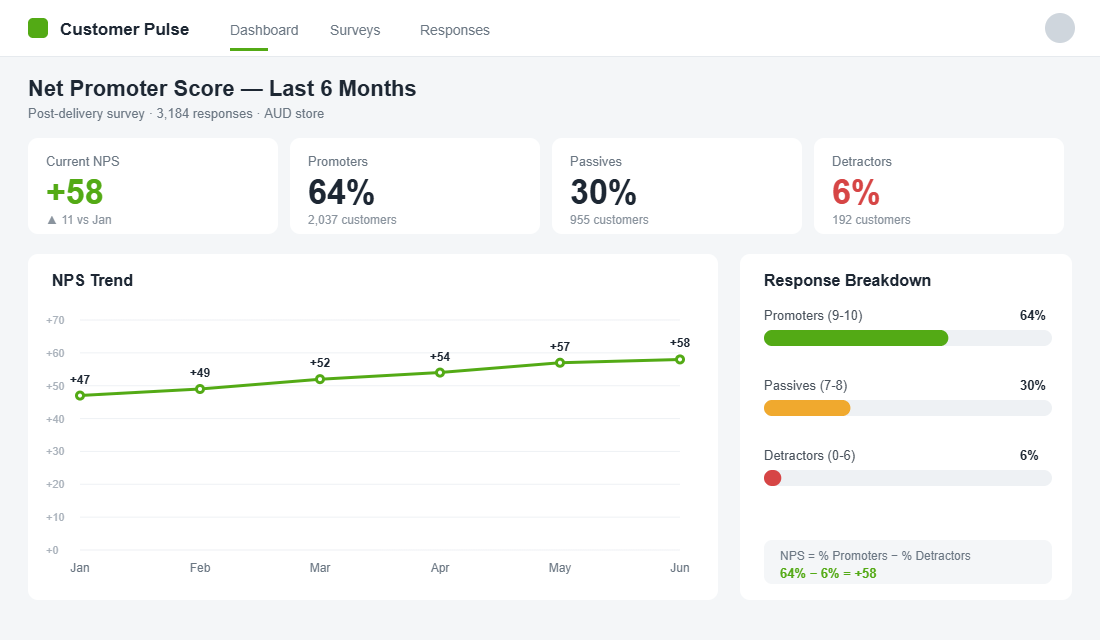
NPS works on one deceptively simple question: “How likely are you to recommend us to a friend or colleague?” scored 0 to 10. The maths sorts every respondent into three buckets, and those buckets behave like completely different customers.
- Promoters (9-10). Your growth engine. They refer, they review, they buy again, and they forgive the occasional stuff-up.
- Passives (7-8). Satisfied but unattached. They like you fine and will switch the moment something shinier shows up.
- Detractors (0-6). The quiet revenue leak. They churn, they request refunds, and one unhappy detractor will tell far more people than a happy promoter.
The score is just promoters minus detractors as a percentage. The reason it is worth measuring is the behaviour gap underneath it. Passives have repurchase and referral rates as much as 50% lower than promoters, and promoters generate roughly seven times as many positive referrals as detractors. When you know who sits where, you stop treating every customer the same, which is exactly the mistake that flatlines a brand at $80k a month.
If you have already built customer segments off purchase behaviour, NPS adds the missing emotional layer. Pair it with the RFM model in our Shopify RFM segmentation playbook and you can see not just who spends, but who actually loves you. Those are not always the same people, and the overlap is where your VIP programme should live.
Step 1: Ask One Question at the Moment It Actually Means Something
The fastest way to ruin your NPS data is to ask at the wrong time. Survey too early and the customer has not used the product, so you are measuring your checkout experience, not your product. Survey too late and the raw emotion has faded into a vague “yeah it was fine”.
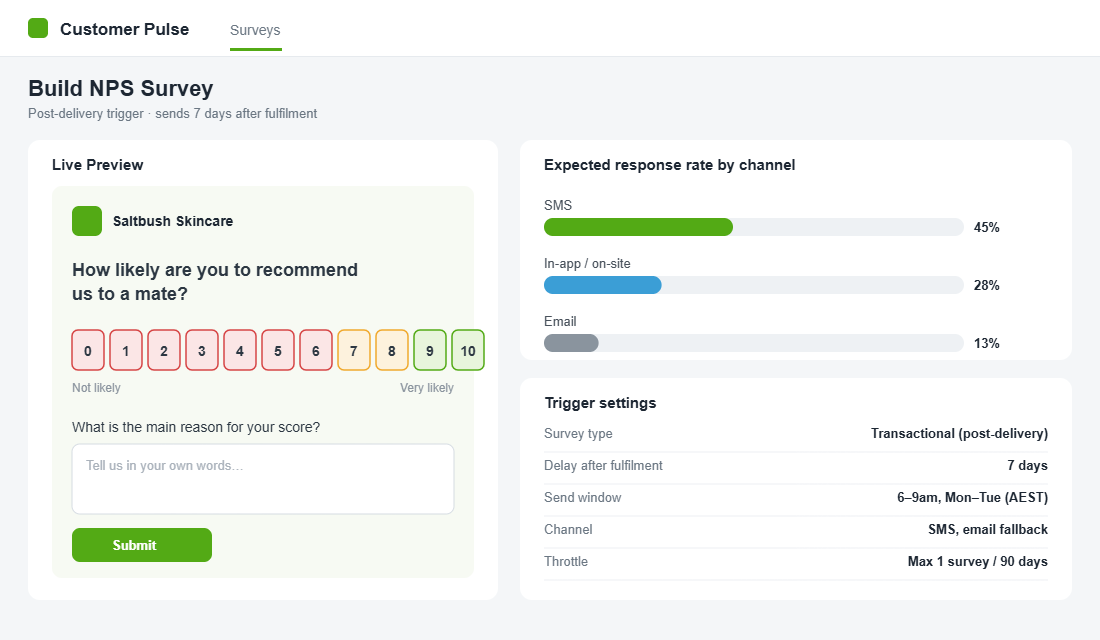
For most Aussie DTC brands, the sweet spot is roughly 7 days after delivery. That gives the customer time to actually use what they bought, while the experience is still fresh enough to pull an honest, specific answer. Skincare, supplements and apparel may need a touch longer so the product can prove itself; a consumable they open on day one can be surveyed sooner.
Keep the survey to two questions and never more. The score question, then a single open-text follow-up: “What is the main reason for your score?” That second question is the part most founders skip, and it is the most valuable line in the entire exercise. The number tells you the temperature. The sentence tells you why, in the customer’s own words, which you will use everywhere from product pages to ad hooks.
One discipline that matters: throttle it. Survey the same customer at most once every 90 days. Nothing trains people to ignore you faster than a survey after every single order.
Step 2: Send It Where People Will Actually Answer
A brilliant survey nobody opens tells you nothing. Channel choice has the single biggest impact on your response rate, and the differences are not small.
- Email: around 12 to 13% on average. Cheap and easy, but it competes with a crowded inbox. A 15% response is a good result here.
- In-app or on-site: 20 to 35%. The survey appears while the customer is already engaged with you, so it is harder to ignore.
- SMS: 40 to 50%. The highest response by a distance, because a text feels personal and lands instantly. Use it sparingly and it converts beautifully.
For an Australian store, a practical setup is SMS as the primary channel with an email fallback for customers who have not opted in to texts. Time the send for the local sweet spot: between 6 and 9am on Mondays and Tuesdays tends to win on open rate. Always send in your customer’s time zone, which matters the moment you start shipping to Perth and Auckland off the same store.
Note the difference between transactional and relational surveys. A transactional NPS tied to a specific order (“how was this purchase”) earns 8 to 12 points higher response than a generic “how do you feel about the brand” relational survey, because the customer knows exactly what you are asking about. Start transactional. You can layer a twice-yearly relational survey on top once the habit is running.
Step 3: Read the Score, But Mine the “Why”
Here is the mindset shift that separates a real NPS programme from a dashboard widget: the score is the headline, the open-text answers are the article. Every founder obsesses over whether the number went from +52 to +55. Almost none of them systematically read the reasons.
Set aside 30 minutes a week to read every open-text response and tag it. You are looking for patterns, not individual complaints. Within a few weeks you will see the same five or six themes repeat: shipping speed, a sizing issue, a hero ingredient people rave about, a confusing returns process. Those tags become a ranked list of exactly what to fix and what to shout about.
The promoter comments are not just nice to read. They are your highest-converting copy, pre-written by the people who already bought. The phrases customers use to describe why they love you will outperform anything your agency writes, because they carry zero marketing polish. Drop them straight into product page bullets, ad hooks and your FAQ.
This is the same engine behind a proper voice-of-customer process. If you want the wider system for capturing customer language across channels, our Shopify post-purchase survey playbook covers the question scripts that pair perfectly with your NPS follow-up.
Step 4: Build a Closed Loop for Every Segment
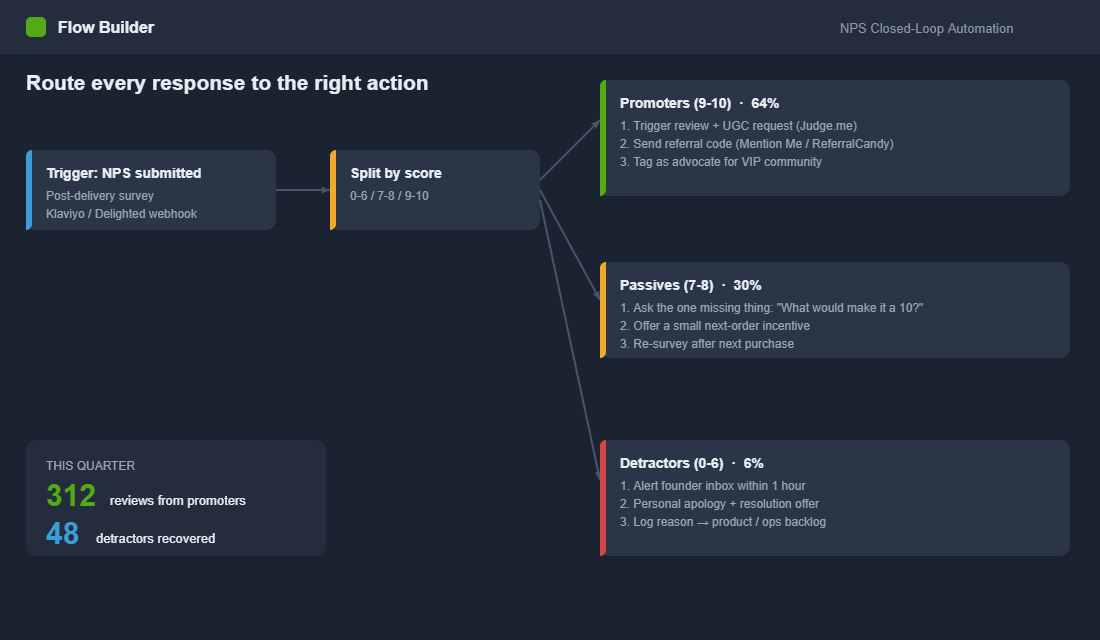
A score with no action attached is a measurement, not a programme. The “loop” in closed-loop feedback means every response triggers a different, automatic next step depending on the bucket the customer landed in. This is where NPS quietly starts paying for itself.
Promoters: harvest the goodwill while it is hot
A customer who just scored you a 10 is at peak enthusiasm. Do not waste it. Fire an automated sequence that asks for a review (Judge.me or Okendo), invites them to refer with a unique code (ReferralCandy or Mention Me), and tags them as an advocate for your VIP or early-access list. Given promoters drive over 80% of referrals, this single automation is the cheapest customer acquisition channel you will ever build.
Passives: ask the one question that moves them up
Passives are the most ignored and most winnable group. Reply with one targeted question: “Thanks for the 8. What is the one thing that would have made it a 10?” The answers are a goldmine of small, fixable gaps. Pair it with a modest incentive on their next order to nudge a second purchase, then re-survey after that order to see if you moved them.
Detractors: get to them within the hour
A detractor response should hit your founder inbox or a Slack channel within an hour, not surface in a monthly report. Speed is everything here. A fast, personal “I saw your feedback and I want to fix this” turns a churned customer into a recovery story surprisingly often, and the reason they gave you goes straight onto your product and ops backlog. Detractors are early churn signals, which is why this connects directly to the warning system in our Shopify churn prediction playbook.
Step 5: Wire NPS Into Your Operating Rhythm
The final step is what makes the difference between a one-off survey and a system that compounds. NPS only earns its keep when it becomes a number you watch on a cadence and tie to money.
- Track the trend, not the snapshot. A single +55 means little. +47 climbing to +58 over six months tells you your changes are working. Review it monthly alongside repeat purchase rate and refund rate.
- Set a target with teeth. If you sit at +28 today, getting to the top-decile +55 is a concrete, motivating goal the whole team can rally behind.
- Segment your score. Slice NPS by product line, by first-time versus repeat buyers, and by acquisition channel. A low score isolated to one SKU or one ad source is a far more useful insight than a blended average.
- Close the loop on the loop. Each month, report what you changed because of last month’s feedback. That is how you prove to the team that the survey is worth running.
Tooling makes this near-automatic. The simplest start for a Shopify store is the free Delighted Post-Delivery Survey app. Setup takes minutes: install it from the Shopify App Store, connect your store, choose the post-delivery delay (set it to 7 days), pick the NPS template, add your logo and brand colour, and responses flow into a live dashboard. If you already run Klaviyo, you can build the same flow natively with an NPS property and segment off the score. For higher response rates, Fairing and Zigpoll layer survey logic on top.
The Four Mistakes That Make Your NPS Lie to You
Before you trust a single number, make sure you are not poisoning your own well. These four mistakes are why so many founders end up with a score that looks fine and tells them nothing.
- Gaming the timing. Only surveying customers you know are happy, or firing the survey right after a glowing support chat, inflates the score and hides the problems you most need to see. Survey everyone on the same rule.
- Leading the witness. “We would love a 10, how did we do?” is not a survey, it is a request. Keep the wording neutral so the answer is real.
- Reading a score off ten responses. A handful of replies will swing wildly month to month. Wait for a meaningful sample before you react, and remember email at a 13% response rate needs a decent send volume to get there.
- Collecting and doing nothing. The most common failure of all. If feedback does not change a product decision, a copy line or a customer’s experience, you have built a museum, not a system.
Avoid those four and your NPS becomes a number you can actually steer by. Fall into them and you get a comforting figure that quietly drifts away from reality.
What This Looks Like for an Aussie Brand
Picture a Melbourne skincare brand doing $150k a month. They turn on a 7-day post-delivery SMS survey, throttled to once a quarter, and within a month they have a few hundred responses and a +44 starting score. The open-text answers cluster fast: promoters keep mentioning one hero serum and how quickly it arrived; detractors keep flagging a confusing returns process.
So they do three things. They push the serum and the fast-dispatch promise to the top of their ads and product pages using the customers’ own phrasing. They rebuild the returns page that detractors complained about. They switch on an automated review-and-referral ask for every promoter. Two quarters later the score is climbing toward +58, the referral channel is producing orders for almost nothing, and the returns complaints have dropped out of the feedback entirely. No new ad budget. Just a question, asked properly, and acted on.
The Compound Effect: How the Five Steps Become a Flywheel
Run any one of these steps and you have a nice-to-have. Run all five and they stack into a flywheel that gets stronger every month.
You ask the right question at the right moment, so the data is honest. You send it on the right channel, so enough people answer to trust the trend. You mine the “why”, so you are constantly feeding sharper copy into your marketing and a clear fix-list into your product. You close the loop per segment, so promoters manufacture referrals and reviews while detractors get rescued before they churn. Then you wire it into your monthly rhythm, so the whole thing keeps turning without you chasing it.
The numbers do the rest. Promoters spend up to 3.5 times more over their lifetime than detractors, and each one becomes a small, unpaid marketing channel. A store that lifts its NPS from +28 toward the top-decile +55 is not just feeling better about itself. It is compounding referrals, reviews and repeat orders that competitors stuck on a vanity score will never see.
There is a quiet structural advantage here too. Most of your competitors are running their stores on guesswork and a gut feel for what customers want. The moment you have a steady stream of scored, tagged feedback flowing into your product and marketing decisions, you are operating with information they simply do not have. That edge does not show up in a single month. It shows up as a brand that keeps getting sharper while everyone around it keeps guessing.
NPS Benchmarks and the Tool Stack to Run It
Founders always ask what a “good” score is. For DTC ecommerce, the average NPS lands between 45 and 50. Above 60 puts you in the top tier of consumer brands. Below 30 means something structural is wrong, usually delivery times or product expectations rather than the product itself.
Treat those numbers as context, not a scoreboard. A score of 48 that has climbed from 41 over two quarters beats a flat 55 every time. The trend is the signal.
- Klaviyo: if you already pay for it, build the survey with a simple 0 to 10 email block and trigger flows off the response. No extra subscription.
- Delighted: purpose-built NPS from about $17 USD a month, with throttling and scheduling handled for you.
- KnoCommerce or Grapevine: best for on-site post-purchase delivery, where response rates hit 30% to 50% versus 10% to 25% by email.
- A Google Sheet: genuinely fine under 300 orders a month. Do not let tooling delay the first send.
Whichever tool you choose, the system in the five steps above does the heavy lifting. The software just moves the answers around.
Your NPS Launch Checklist
Use this to stand the system up in a week, not a quarter.
- Pick your trigger. Transactional survey, sent 7 days after fulfilment.
- Write two questions only. The 0-10 score, plus “What is the main reason for your score?”
- Choose channel and timing. SMS primary, email fallback, sending 6 to 9am Mon to Tue in local time, throttled to once per 90 days.
- Build three automated branches. Promoters to review and referral asks, passives to a “what would make it a 10” reply, detractors to a one-hour founder alert.
- Tag every open-text answer weekly. Turn the themes into a fix-list and a swipe file of customer language.
- Review the trend monthly. Track NPS next to repeat purchase rate and refund rate, segmented by product and channel.
Inside eCommerce Circle, listening to customers properly is one of the core pillars we work on with every member, because it quietly drives Product, Promotion and Patrons all at once. If you want a second opinion on your feedback loop, let’s talk.