Here is an uncomfortable truth about your product pages. Most of the copy on them was written by the one person least qualified to describe the product: you. You know the fabric weight, the manufacturing story, the reason you started the brand at 2am in a spare room. Your customer knows none of that, and cares about almost none of it.
What’s in This Article
So you write “engineered with premium performance fabric for a superior fit” and you wonder why the page converts at 2%. Meanwhile, sitting in your reviews, a customer has already written the sentence that would double it: “I always size up in activewear, but these fit true to size and I did not have to return them.”
That sentence is worth more than any headline you will ever brainstorm, because a real buyer wrote it in the words other buyers use. As many as 95% of shoppers read reviews before they buy, according to Fera’s 2025 review data, and 88% trust those reviews as much as a recommendation from a friend. Voice of customer research is simply the discipline of harvesting that language on purpose and putting it back into your pages. This is the 5-part system we use with members to do exactly that.
Your Best-Converting Copy Is Already Written
Founders treat copywriting like a creative act. It is closer to detective work. Every objection, every moment of hesitation, every reason someone finally clicked buy is already documented in your reviews, your support inbox, and your survey responses. Your job is not to invent language. It is to find the language that is already converting and stop hiding it.
The numbers back this up hard. Fera’s data shows conversion rates lift by 76.7% when a store displays reviews at all, and by at least 143% once a product has more than 100 reviews. When one team ran a voice of customer rewrite documented by CXL, a single headline swap that used the customer’s own words drove over 400% more clicks on the primary call to action and 20% more form submissions on the next step. That is not a design change or a discount. That is the same offer, described in the buyer’s language instead of yours.
There is a second reason this matters more in 2026 than it did five years ago. Since Apple’s App Tracking Transparency changes, agencies routinely work with ad data that is 30 to 40% incomplete. The pixel cannot tell you why someone bought. Your customers can, in plain English, if you bother to collect it. Voice of customer work is the most reliable signal you own, and you already paid for it.
Part 1: Build Your Source Stack
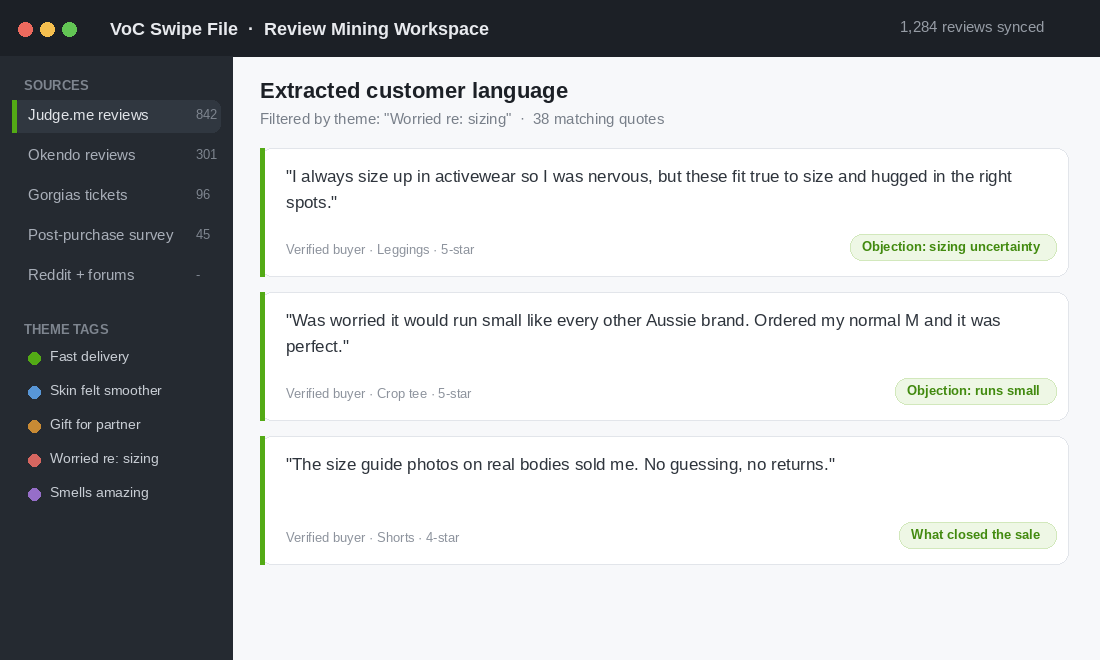
You cannot mine what you have not collected in one place. The first job is to pull every scrap of customer language into a single workspace. We call it the swipe file, and the best ones draw from five sources, ranked roughly by how honest the language is.
- Product reviews. Your richest seam. Judge.me, Okendo, Yotpo and Shopify’s native reviews all export to CSV. This is where buyers describe the outcome they got.
- Support tickets. Gorgias and Zendesk hold the pre-purchase questions and the post-purchase frustrations. Objections live here.
- Post-purchase surveys. One or two open questions on the thank-you page capture why someone bought while it is fresh. Pair this with our post-purchase survey playbook to set it up.
- Competitor reviews. Read the 3-star reviews on a rival’s bestseller. Their unmet needs are your positioning.
- Communities. Reddit threads, Facebook groups and YouTube comments in your category show unfiltered language nobody wrote for a brand.
Here is the exact setup we run with a store that uses Judge.me, and it takes about 20 minutes to stand up. First, in Judge.me open Settings, then Data and Export, and export all reviews to CSV. Second, open a Google Sheet and paste the review body, the star rating, and the product into three columns. Third, add four empty columns titled Pain, Desired Outcome, Objection, and Exact Phrase. Fourth, connect Gorgias and export the last 90 days of tickets tagged pre-sale into the same sheet. Fifth, add a post-purchase survey question asking “What almost stopped you from buying?” and pipe responses in weekly. You now have one living document instead of five scattered tools.
Part 2: The Extraction Pass
With everything in one sheet, you read with a pen, not a highlighter. You are hunting for four things, and every useful quote gets tagged as one of them. This is where most founders quit too early, so give it a proper hour with 200 or so reviews in front of you.
- Pain. The problem they had before your product. “Every legging I owned went see-through in squats.”
- Desired outcome. The result they were chasing. “I wanted one pair I could wear to the gym and the school pick-up.”
- Objection. The reason they hesitated. “I was worried it would run small like every other Aussie brand.”
- Exact phrase. A sentence so good you would put it on the page verbatim. “Ordered my normal M and it was perfect.”
The magic is in the tagging, because it turns anecdotes into patterns. When you sort your sheet by the Objection column and see the same worry 40 times, you are not guessing anymore. You are looking at the single sentence standing between a shopper and their card. Frank Body, the Melbourne scrub brand, built an entire cheeky first-person voice by mirroring the way customers already talked about the product, right down to calling the reader “babe”. Who Gives A Crap does the same with plain, funny, human language that sounds like a customer, not a marketing department. Neither voice was invented in a boardroom. It was overheard.
Keep your survey inputs short so this seam keeps filling. Survicate’s 2025 benchmark of 4,332 surveys found two and three-question surveys hit a median 16% response rate, while surveys of seven or more questions collapse below 7%. Ask less, tag more.
Part 3: Mine the Objections Hiding in Your Bad Reviews
Most founders read their 5-star reviews for a dopamine hit and skip the 2 and 3-star ones because they sting. That is backwards. Your negative reviews are the most valuable copy research you own, because 82% of shoppers deliberately seek out negative reviews to judge whether a brand is credible. If you do not answer those objections on the page, the shopper answers them alone, and usually decides no.
Pull every 1 to 3-star review into its own view and tag the objection behind each one. Then count. When you plot the frequency, a hierarchy appears fast, and it almost never matches what you assumed the problem was. In the store below, more than half of all complaints traced back to sizing or a confusing size guide. That is not a product problem. That is a copy and merchandising problem you can fix this week.
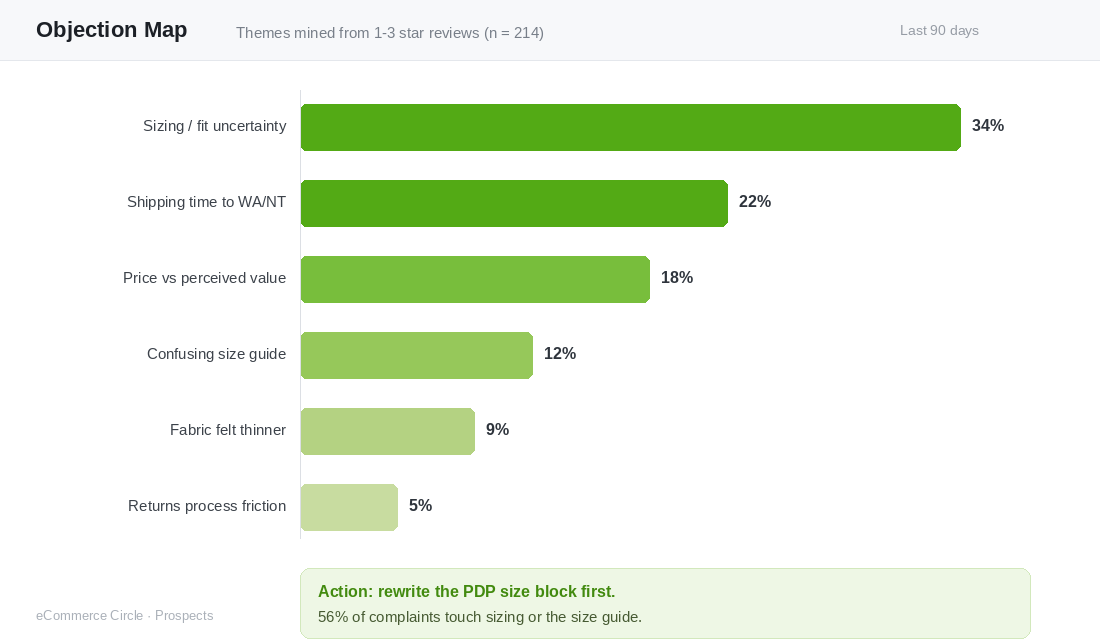
This is where voice of customer work quietly connects to your whole funnel. The objections you surface here are the same fears your ads should pre-empt and your customer research should validate. One objection map can rewrite a product page, three ad hooks, and a returns policy in an afternoon.
Part 4: Rewrite the Money Pages
Now you spend the language. Start with the pages closest to the sale, because that is where a small lift returns the most. Your product page is first, then your highest-traffic collection page, then your paid-traffic landing pages, then email subject lines.
The rewrite rule is simple. Replace every brand-speak claim with a customer sentence that proves it. “Superior fit” becomes “Ordered my normal M and it was perfect.” “All-day support” becomes “wore them from the gym to school pick-up and forgot I had them on.” You are not writing new copy so much as transplanting proven copy from the review section, where nobody reading the product page ever scrolls, up to the buy box, where everybody does. Our product description playbook goes deeper on the structure around it.
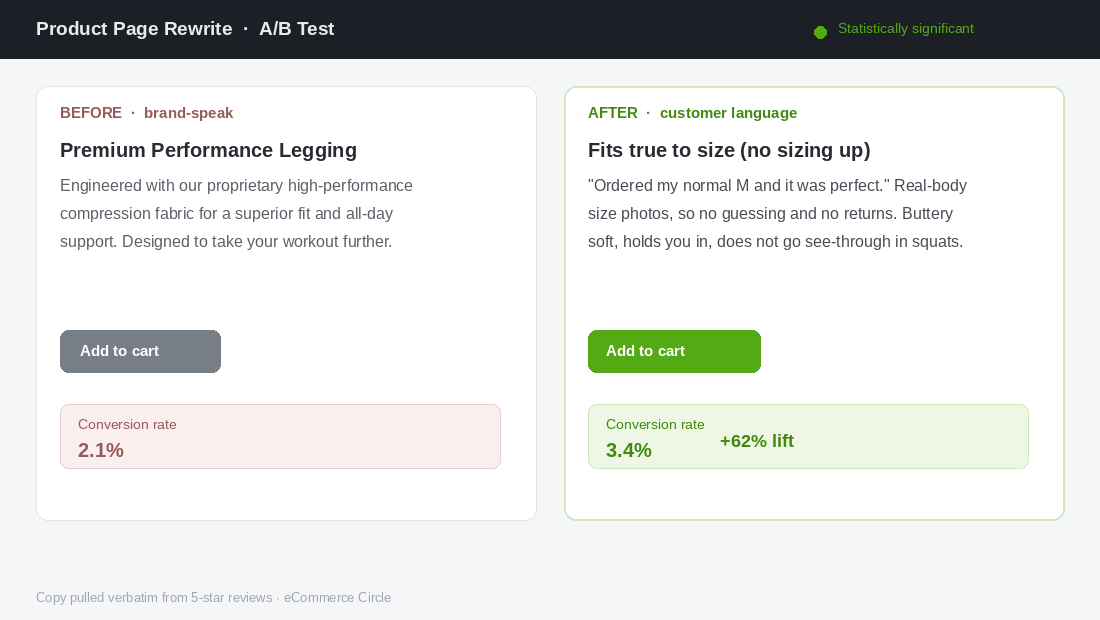
Do not stop at the headline. Address the top objection directly, near the add-to-cart, in the customer’s phrasing. If sizing is your number one objection, put “Runs true to size. Order your normal size.” beside the size selector, not buried in a tab. The best answer to a fear is the exact words of someone who had that fear and bought anyway.
Part 5: Close the Loop and Keep a Living Swipe File
Voice of customer research is not a one-off project you tick off. Your customers, products and objections shift every season, and last year’s winning phrase can go stale. The founders who win treat the swipe file as a living asset and run the loop on a schedule.
Two habits keep it alive. First, ship the rewrite as an A/B test, not a blind swap, so you know the lift is real. On-site and post-purchase surveys pull 40 to 70% response rates according to Triple Whale’s benchmarks, so you will have fresh language coming in constantly to test with. Second, block 30 minutes at the end of each month to re-read the newest reviews and tickets, tag the fresh quotes, and update your objection map. When a new objection climbs the chart, you catch it before it quietly costs you a quarter of sales.
The Voice of Customer Swipe File: Your Takeaway Template
Steal this structure. Build a sheet with these columns and this monthly rhythm, and you will never stare at a blank product page again.
- Column 1 to 3: Source data. Review or ticket text, star rating or channel, product.
- Column 4: Pain. The before state, in their words.
- Column 5: Desired outcome. The result they wanted.
- Column 6: Objection. What made them hesitate.
- Column 7: Exact phrase. A verbatim sentence you can paste onto a page.
- Monthly loop: Collect, tag, map, rewrite, test. 30 minutes, first Monday of the month.
The Compound Effect
Any one of these parts helps. Together they compound into something bigger than better copy. When your product page uses the buyer’s words, it converts more of the traffic you already pay for. When your ads lead with the real objection, your click-through rate climbs and your cost per acquisition falls. When your emails borrow the sentence a happy customer actually wrote, open and reply rates lift because the message sounds like a person.
That is the quiet advantage of voice of customer work. It does not require more traffic, a bigger budget, or a rebrand. It requires you to stop guessing and start listening to the buyers who already told you what to say. Your competitors are inventing clever headlines. You are reading the ones your customers already wrote and tested for you.
The Tool Stack That Makes Voice of Customer Repeatable
The system above works with nothing but a spreadsheet and two hours. It works faster with the right tools, and the difference between a one-off research sprint and a permanent advantage is usually whether the collection step is automated.
- Review collection: Judge.me or Okendo. Both push review requests automatically and both let you export the raw text. Aim for a 5 to 12% review submission rate on delivered orders. If you are under 3%, your request timing is wrong, not your product.
- Post-purchase surveys: Fairing or a simple Shopify checkout survey. One question, asked at the moment of highest goodwill, will out-perform a five-question form emailed a week later. Response rates of 25 to 40% are normal for a single-question checkout survey.
- Support ticket mining: Gorgias or Zendesk tags. Tag every ticket by theme for one month and you will have a ranked objection list without any extra research.
- On-site behaviour: Hotjar or Microsoft Clarity. Clarity is free and good enough. Watch 20 sessions of people who scrolled past the add-to-cart without clicking.
- Exit intent and on-page polls: a single “what nearly stopped you buying today?” poll on the product page will produce more usable copy than a month of competitor research.
- Storage: one Google Sheet or Notion database. The tool matters far less than everyone having access to it.
Two cautions. Do not let AI summarise your reviews for you at the extraction stage. Summaries strip out the exact phrasing, and the exact phrasing is the entire point. Use AI to cluster and tag once you have the verbatim quotes, never to paraphrase them. And do not outsource the reading. The founder who reads 200 reviews personally comes away with product ideas, not just copy. If your review volume is the bottleneck, the Shopify Reviews Engine covers how to build collection to a reliable rate first.
The 90-Day Voice of Customer Operating Rhythm
The reason most brands do voice of customer work once and never again is that it never becomes anyone’s job. Put it on a rhythm and it stops being a project.
- Weekly, 15 minutes: read every new review and support ticket from the past seven days. Add any new phrasing to the swipe file. That is the whole task.
- Monthly, 60 minutes: re-rank your objection list by frequency. Objections move as your traffic mix changes, and the number one blocker in March is rarely the number one blocker in September.
- Quarterly, half a day: rewrite one money page using the current swipe file. Product page, then homepage, then your top-performing ad, then your welcome email. Four quarters covers the four pages that carry your revenue.
- Quarterly, measure: compare the rewritten page against its 90-day baseline. Look at add-to-cart rate and bounce rate, not just conversion, because copy usually moves engagement before it moves revenue.
Set a realistic expectation on results. A product page rewritten with genuine customer language typically lifts add-to-cart rate 8 to 20% and conversion 5 to 15%. That is meaningful, not miraculous. The compounding comes from doing it four times a year across four pages rather than once heroically and never again. Give each rewrite at least 30 days or 300 conversions before you judge it, and change one page at a time so you know what caused the movement. If you want a structured way to sequence those tests instead of rewriting whatever feels worst, the 2026 conversion benchmarks will tell you which page is genuinely furthest behind.
Inside eCommerce Circle, voice of customer research is one of the core pillars we work on with every member, because it lifts every other P at once. If you want a second opinion on where your copy is losing sales, let’s talk.