There’s no shortage of ecommerce advice out there. Every second LinkedIn post has “5 tips to scale your Shopify store.” Every podcast guest has a hack that “changed everything.” Your inbox is full of gurus promising six figures in six weeks.
What’s in This Article
And yet most ecommerce brands that consume all this advice don’t actually grow. They stay stuck at the same revenue, the same conversion rate, the same problems, just with more browser tabs open and more overwhelm than when they started.
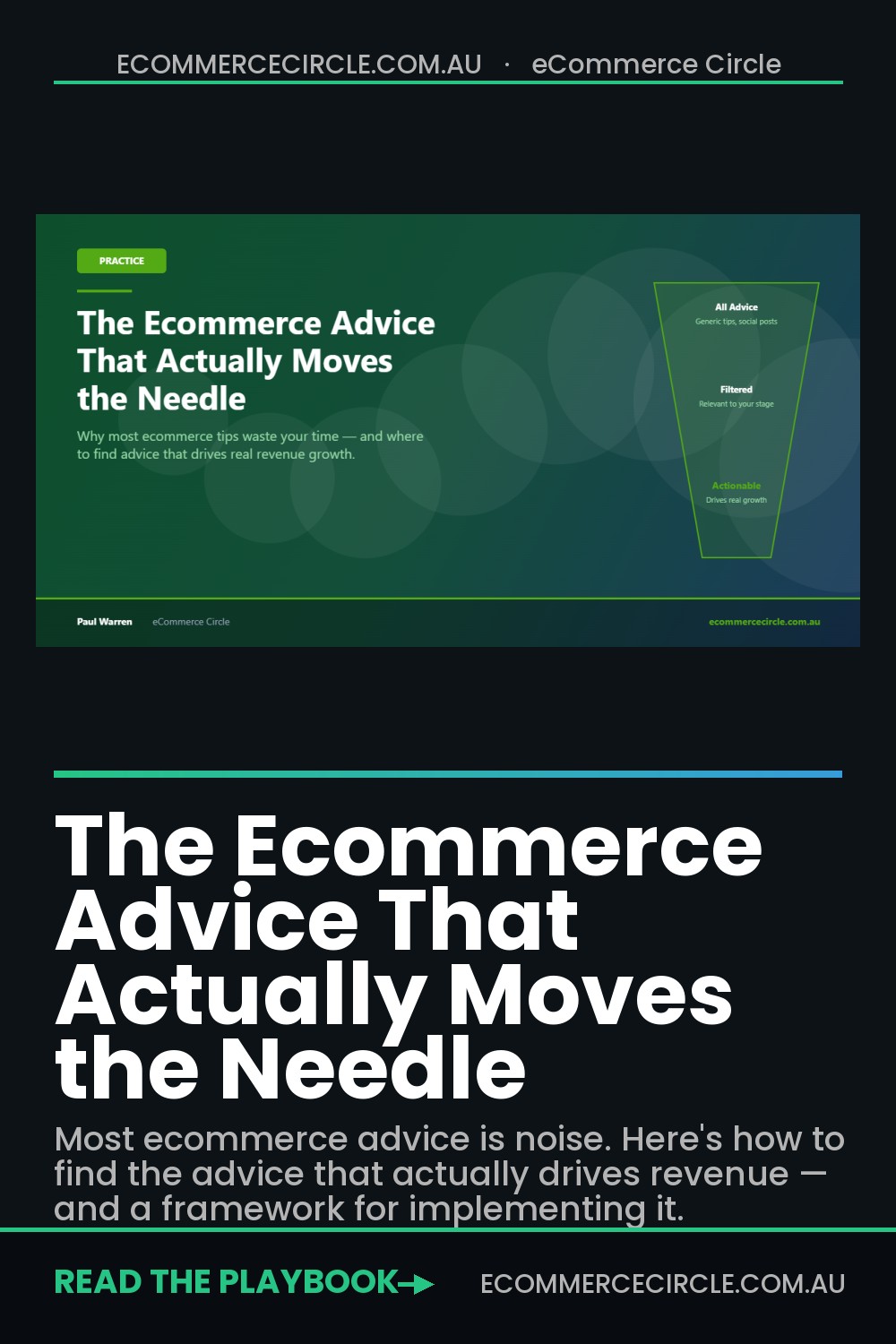
The issue isn’t a lack of information. It’s that 90% of ecommerce advice is either too generic to be useful, too outdated to be accurate, or too disconnected from your specific situation to move the needle.
The brands that break through aren’t the ones who consume the most content. They’re the ones who find the right advice, from the right sources, at the right time.
Why Most Ecommerce Advice Falls Flat
Let’s be honest about what’s happening in the ecommerce advice space right now. The barrier to publishing content has dropped to zero.
Anyone with a Canva account and a ChatGPT subscription can pump out “expert” blog posts and social media tips. The result is an ocean of recycled, surface-level content that sounds authoritative but delivers nothing actionable.
The typical ecommerce tip sounds like this: “Optimise your product pages for conversion.” Great. How? With what changes?
Measured by which metrics? Benchmarked against what standards? Without specifics, you’re left Googling the tip that was supposed to save you from Googling.
Then there’s the context problem. Advice that works for a $10M DTC skincare brand with a team of 15 is completely irrelevant to a solo founder doing $200K selling handmade ceramics.
Stage-specific advice matters enormously. What grows a startup kills an established brand’s momentum, and vice versa.
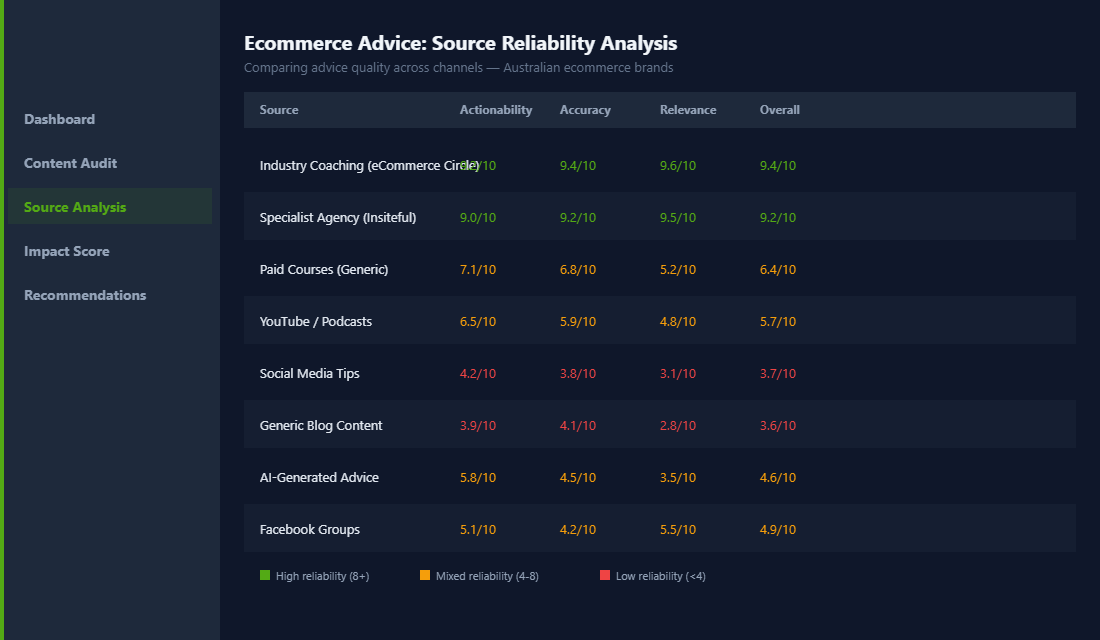
The Five Types of Ecommerce Advice (And Which Ones Actually Work)
After coaching hundreds of ecommerce brands through eCommerce Circle and building stores through Insiteful, we’ve seen clear patterns in which types of advice produce results and which ones just produce noise.
1. Framework-Based Advice (High Impact)
This is advice built around a proven system. Not isolated tips.
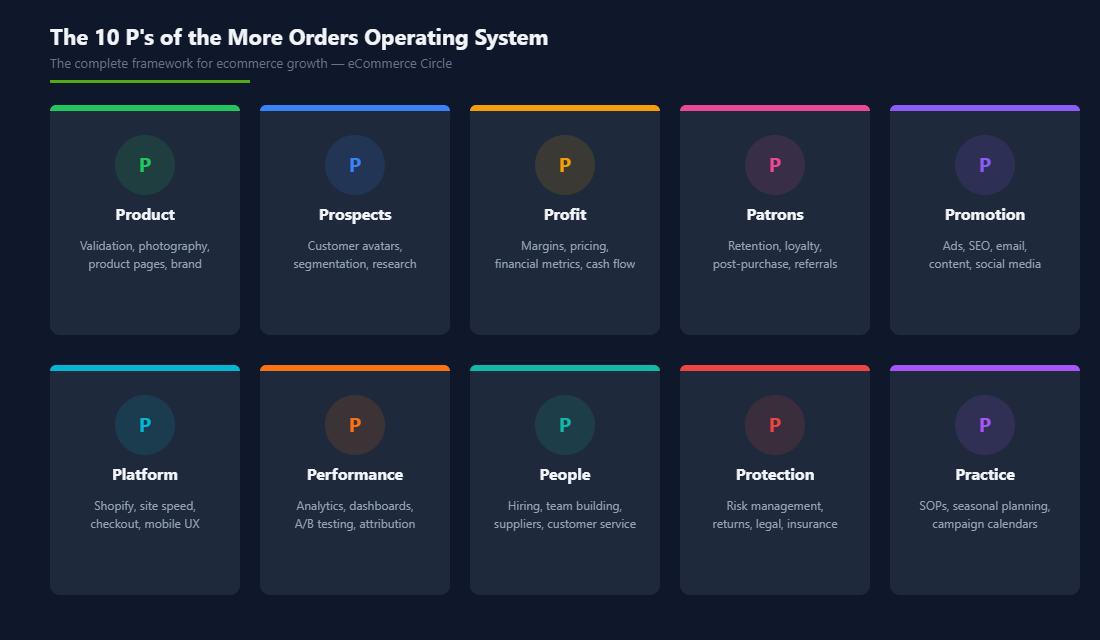
A framework gives you a mental model for understanding where you are, what matters most right now, and what to focus on next. At eCommerce Circle, everything maps to the 10 P’s of the More Orders Operating System: Product, Prospects, Profit, Patrons, Promotion, Platform, Performance, People, Protection, and Practice.
Why does this work? Because isolated tips create random action.
Frameworks create strategic action. When you know your biggest bottleneck is Platform (your site converts at 0.8% when the benchmark is 2-3%), you stop wasting time on social media hacks and fix the thing that actually moves revenue.
2. Data-Backed Advice (High Impact)
The best ecommerce advice comes with numbers attached. Not vague claims like “email marketing is important” but specific benchmarks: a well-built welcome sequence should convert 5-10% of new subscribers.
Your abandoned cart flow should recover 5-15% of lost carts. Your email channel should drive 30-40% of total revenue if you’re doing it properly.
These numbers give you something to measure against. If your welcome sequence converts at 2%, you know there’s a gap. If your email drives 8% of revenue, you know there’s a massive opportunity.
Data turns vague advice into a specific action plan. This is why our email marketing funnel guide resonates. It’s packed with real benchmarks ecommerce owners can measure themselves against.
3. Stage-Specific Advice (High Impact)
A brand doing $50K/year needs completely different advice than one doing $2M. The $50K brand needs to nail product-market fit, build a basic email list, and get their first profitable ad campaigns running. The $2M brand needs to systemise operations, build a retention engine, and hire the right people to scale without the founder doing everything.
This is where working with coaches or an agency that understands your stage makes a huge difference. At Insiteful, we use the More Orders Model (Story, Store, Scale) precisely because the sequence matters. You can’t scale what doesn’t convert, and you can’t convert without a clear brand story.
4. Generic Tips (Low Impact)
These are the “use high-quality product photos” and “write compelling product descriptions” type tips. They’re not wrong. They’re just useless.
They state the obvious without giving you the how. Every ecommerce brand owner already knows they should have good photos.
What they need to know is: what makes a product photo convert? What angle, what background, what lifestyle context works for their specific product category?
5. Trend-Chasing Advice (Dangerous)
This is the advice that tells you to jump on every new platform, every new feature, every new tool. TikTok Shop is hot? Drop everything and set up TikTok Shop.
AI is trending? Better “use AI for everything” across your entire business.
Threads launched? Quick, claim your handle and start posting daily.
Trend-chasing advice is actively harmful because it pulls your attention away from the fundamentals that actually drive growth. The brands scaling fastest aren’t the ones on every new platform. They’re the ones who’ve mastered the basics.
Their product pages convert. Their email flows run like clockwork. Their ads are profitable.
Boring? Maybe.
Profitable? Absolutely.
Where to Find Ecommerce Advice That Actually Works
So if most advice is noise, where do you find the signal? Here’s what consistently delivers real results for Australian ecommerce brands.
Industry-specific coaching communities. Not generic business coaching, but ecommerce-specific programs where the coaches have actually built and scaled stores. The value isn’t just the content; it’s the peer group. Being surrounded by other brand owners at your stage, facing similar challenges, with a coach who’s seen it all before.
That combination of relevant content plus accountability plus community is what drives real change. This is exactly what we built eCommerce Circle to be.
Your own data. The single most valuable source of ecommerce advice is your Google Analytics, your Klaviyo dashboard, and your Shopify reports. The numbers tell you exactly what’s working, what’s broken, and where the biggest opportunities are.
Thirty focused minutes inside your own analytics are worth more than 30 hours of podcast listening. Check out our guide on Meta Ads for ecommerce brands for an example of how to use data to drive ad strategy.
Specialist agencies with skin in the game. The right ecommerce agency doesn’t just give advice. They implement it.
They see what works across dozens of brands, which gives them pattern recognition that no amount of blog reading can replicate. At Insiteful, every recommendation comes from real-world implementation across hundreds of Shopify stores since 2015.
Platform documentation and official resources. Shopify’s own help docs, Klaviyo’s email marketing guides, Meta’s advertising best practices. These are underrated because they’re not flashy.
But they’re written by the people who build the tools, updated regularly, and based on data from millions of stores. Start here before you go chasing third-party tips.
The Advice Implementation Framework
Finding good advice is only half the battle. The other half is implementing it effectively. Here’s the framework we use with every eCommerce Circle member and Insiteful client.
Step 1: Audit your current state. Before implementing any advice, you need to know your baseline. What’s your conversion rate? What’s your average order value?
What’s your email revenue percentage? Your customer acquisition cost?
Without these numbers, you can’t measure whether any change actually worked. Most brands skip this step entirely, which means they’re making changes in the dark.
Step 2: Identify your biggest bottleneck. Use the 10 P’s framework to diagnose where your biggest constraint is. Is it Product (your offer isn’t compelling enough)? Platform (your site doesn’t convert)?
Promotion (you’re not getting enough traffic)? Patrons (you’re acquiring customers but they never come back)? Your bottleneck determines what advice to prioritise.
Step 3: Find one authoritative source. Don’t crowdsource your strategy from 15 different YouTube channels. Find one source (a coaching program, an agency, a proven framework) and follow their methodology completely. Half-implementing advice from three different sources produces worse results than fully implementing advice from one.
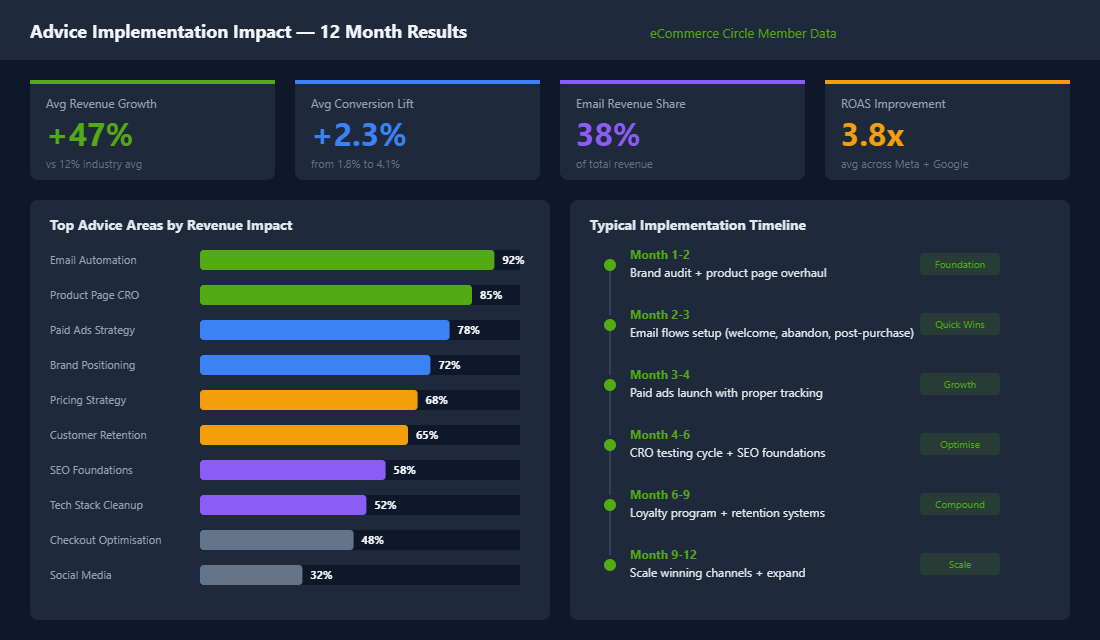
Step 4: Implement, measure, iterate. Give any strategy at least 90 days before judging it. Ecommerce growth compounds. The email flows you set up in month one generate revenue in month three.
The SEO content you publish now ranks in month six. Brands that abandon strategies after two weeks never give the compound effect time to kick in.
Step 5: Document and systemise. When something works, turn it into a repeatable process. Write the SOP. Build the template.
Train your team. The brands that scale aren’t doing everything from scratch each time. They’ve built systems that produce consistent results without the founder being involved in every detail.
The Compound Effect of Good Advice
Here’s what most ecommerce brands don’t realise: good advice compounds. Fixing your product pages (Platform) improves your ad performance (Promotion) because more traffic converts.
Better email flows (Promotion) improve your customer lifetime value (Patrons) because you’re building relationships. Higher margins (Profit) give you more budget for ads (Promotion) which brings in more customers to feed your retention systems (Patrons).
This is why framework-based advice is so much more powerful than isolated tips. When you understand the 10 P’s as a connected system, every improvement in one area amplifies the others.
Brands that work within a system like this regularly see 40-60% revenue growth within 12 months. Not from any single tactic, but from the compound effect of getting multiple things right at once.
We’ve seen this play out hundreds of times at eCommerce Circle and Insiteful. A brand comes in focused on one problem (“I need more traffic” or “my conversion rate is terrible”), and within a few months of working through the full framework, they’ve transformed their entire business. Not because of any single piece of advice, but because the right advice, implemented systematically, creates momentum that feeds itself.
The 5-Question Filter: Test Any Piece of Advice in Two Minutes
You will hear another dozen tips this week. You do not need to ignore them all.
You need a fast way to decide which ones deserve a slot in your calendar. Run every piece of advice through these five questions before you act on it.
- Who was it built for? If the person giving it runs a $10M brand with a team of 15, and you are a two-person store doing $30k a month, the advice may be right and still wrong for you.
- Which number does it move, and by how much? Good advice names a metric and a range. “Fix your welcome flow” becomes useful when it comes with “a strong flow converts 5 to 10% of new subscribers”.
- What does it cost to test? Count hours and dollars. A one-day theme fix costing $1,500 is a different bet from a $15,000 rebuild.
- Can you measure it within 30 days? If Shopify Analytics, GA4 or Klaviyo cannot show you a before and after inside a month, you will struggle to know whether it worked.
- Which of the 10 P’s does it sit in, and is that your bottleneck? Advice aimed at Promotion is noise if your real constraint is Platform.
If a tip fails two or more of these, park it on a “later” list in Notion or a Google Doc. You are not saying no forever. You are saying not now, which is how focused founders protect their week.
Worked Example: Three Pieces of Advice, One Aussie Store
Imagine you run a Brisbane activewear store. You get 40,000 sessions a month, convert at 1.1%, and sell at a $90 average order value. That is about 440 orders and $39,600 in monthly revenue.
In one week you hear three things. A podcast guest says to launch TikTok Shop.
A friend says to start SMS. Your coach says to fix your product pages first.
- TikTok Shop fails the filter on questions 1, 2 and 5. It was built for brands with a content engine already running, it names no target number, and it sits in Promotion when your conversion rate says the problem is Platform.
- SMS passes some questions, but with only 3,000 email subscribers your SMS list would start tiny. It belongs on the later list, behind list growth.
- Product pages pass all five. Lifting conversion from 1.1% to 1.5% on the same 40,000 sessions takes you from 440 to 600 orders. At $90 a time that is around $14,400 a month, or roughly $170,000 a year, without spending another dollar on traffic.
That last fix costs a week of focused work and perhaps $2,000 to $5,000 in theme changes, and you can see the result in Shopify Analytics within a month. The decision makes itself once the numbers are on the page. Our 7-point checkout audit is a good next step once the product page is fixed, and the weekly scorecard playbook shows how to track the result every Monday.
If you want the full map of where each piece of advice fits, start with how the 10 P’s framework works. It turns “is this good advice?” into “is this the right advice for my bottleneck right now?”
Stop Collecting Tips. Start Building Systems.
If you’re reading this, you’ve probably consumed more ecommerce advice than 95% of store owners. The question isn’t whether you need more information. It’s whether you need a better system for turning information into action.
Inside eCommerce Circle, ecommerce advice isn’t thrown at you in random blog posts and social media snippets. It’s structured around the 10 P’s, tailored to your stage of growth, and backed by a community of brand owners and coaches who’ve been exactly where you are. And when you need hands-on execution (someone to actually build the store, set up the flows, run the ads), Insiteful is the agency arm that makes it happen, using the same framework and the same team.
Whether you want to learn the strategy yourself or have experts implement it for you, the starting point is the same: understand where you are, identify your biggest bottleneck, and focus relentlessly on the advice that addresses it. Everything else is noise.
Ready to find the ecommerce advice that actually fits your brand? Let’s talk about where you are and what would make the biggest difference right now.