Most Shopify store owners treat email like a megaphone — blast a discount to the whole list, cross your fingers, and hope for sales. Then they wonder why open rates tank, unsubscribes climb, and revenue from email flatlines at 10-15% of total sales.
What’s in This Article
The stores pulling 30-40% of their revenue from email? They are running a structured campaign calendar. Not random sends when they feel like it — a deliberate rhythm of content, offers, and engagement touchpoints that keep their list warm and buying month after month.
Here is how to build an email campaign calendar that turns your list into a predictable revenue engine — without burning out your subscribers or your team.
Why Random Sends Are Killing Your Email Revenue
The biggest email mistake is inconsistency. You send three campaigns one week, then nothing for a fortnight. Your subscribers forget who you are. Inbox providers notice the erratic pattern and start filtering you to spam. Your deliverability drops, and suddenly even your best offers are invisible.
A campaign calendar solves this by creating a predictable sending rhythm. Most successful Shopify stores send 2-4 campaigns per week — not all promotional. The mix matters as much as the frequency.
The data backs this up. Klaviyo benchmarks show that stores sending 3-4 campaigns per week generate 2.3x more revenue per subscriber than stores sending once a week. But those campaigns need to follow a strategic mix — not just discount after discount.
The 3-2-1 Campaign Mix Formula
For every six emails you send across a fortnight, follow this ratio:
- 3 Value Emails. Educational content, styling guides, behind-the-scenes stories, user-generated content roundups. These build trust and keep engagement high without asking for the sale.
- 2 Promotional Emails. Product launches, limited-time offers, bundle deals, seasonal promotions. These drive direct revenue but only work if your list trusts you from the value emails.
- 1 Engagement Email. Surveys, polls, reply-to questions, social proof spotlights. These boost deliverability by generating replies and clicks that tell inbox providers your emails matter.
This 3-2-1 ratio keeps your list warm without triggering the fatigue that comes from constant selling. One Aussie skincare brand we worked with switched from all-promotional sends to this mix and saw their revenue per email increase by 47% within six weeks.
Monthly Calendar Architecture: The Four Phases
Every month should follow a four-phase structure that maps to how your customers buy:
Week 1 — Warm Up. Start the month with value-first content. Share a blog post, a styling guide, or a customer story. Reintroduce your brand to people who have not engaged recently. This phase primes your list for the promotional push coming later.
Week 2 — Soft Sell. Introduce a product spotlight or new arrival without heavy discounting. Use social proof, benefit-driven copy, and curiosity to drive clicks. Think “here is what our best sellers are loving this month” rather than “20% off everything.”
Week 3 — Promotional Push. This is where your main monthly offer lives. A flash sale, a bundle deal, a loyalty-exclusive discount. Send 2-3 emails around this offer: announcement, reminder, and last chance. This concentrated push typically drives 40-50% of the month’s email revenue.
Week 4 — Wind Down and Re-engage. Close the month with engagement content. Ask for reviews, run a quick poll, share user photos. This rebuilds goodwill after the promotional push and sets the stage for next month’s cycle.
Seasonal Anchors: Planning Around Key Dates
Your campaign calendar should be built around seasonal anchor points — the dates that drive outsized revenue for ecommerce. For Australian Shopify stores, the big ones are:
- EOFY Sales (June). Australians are primed to spend. Position this as a clearance event to move seasonal stock before the new financial year.
- Click Frenzy / Black Friday / Cyber Monday (November). Your biggest revenue month. Start teasing offers 2-3 weeks early. Build a VIP early-access list to maximise day-one sales.
- Christmas / Boxing Day (December). Gift guides, last-shipping-date urgency, and Boxing Day clearance. Plan separate campaigns for gift buyers vs. self-purchasers.
- Back to School / Valentine’s Day / Mother’s Day (Q1-Q2). Depending on your niche, these can be significant. Even if your product is not an obvious gift, create a “treat yourself” angle.
Map these onto your annual calendar first, then build your monthly rhythms around them. The stores that plan their BFCM email sequence in September consistently outperform those scrambling in November.
Segmented Sends: The Right Message to the Right People
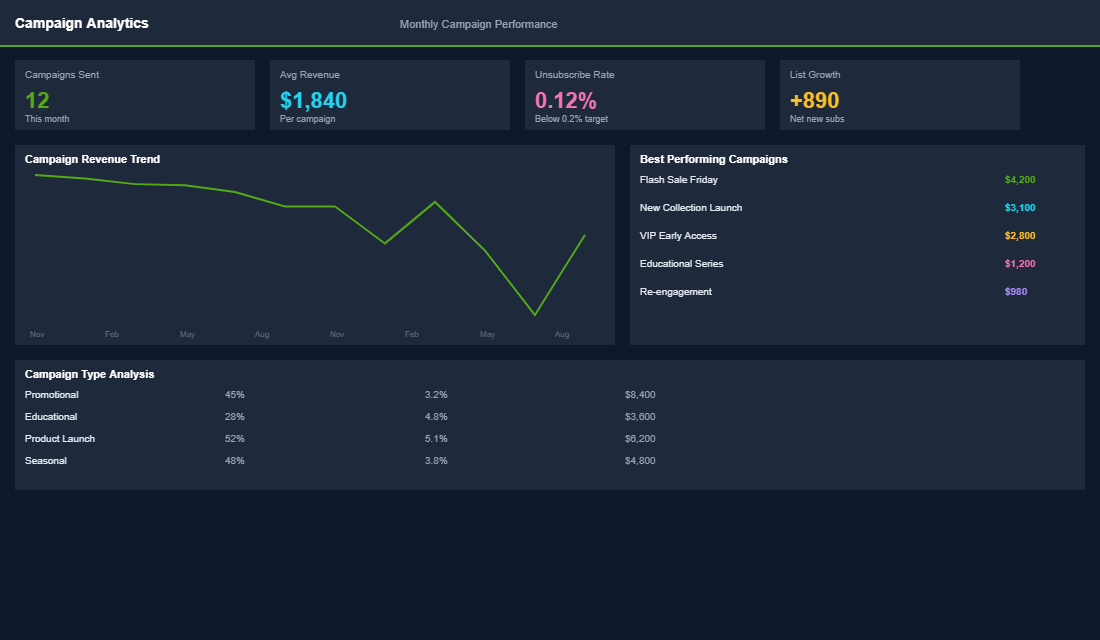
A campaign calendar is not just about what you send — it is about who receives each send. Sending every campaign to your entire list is the fastest way to tank deliverability and train subscribers to ignore you.
At minimum, segment your campaign sends into these groups:
- Engaged Subscribers (opened or clicked in last 60 days). These get every campaign. They are your core revenue drivers and most likely to convert.
- Semi-Engaged (opened in last 90 days but not clicked). Send them value emails and major promotions only. Skip the softer engagement emails.
- At-Risk (no opens in 90-180 days). Only send your biggest offers and re-engagement campaigns. If they do not respond to a dedicated win-back sequence, suppress them.
This approach typically lifts open rates by 8-12 percentage points because you are only sending to people likely to engage. Higher engagement signals tell Gmail and Outlook your emails are wanted, which improves inbox placement across your entire list.
Building Your Calendar in Practice
Here is how to actually build this out. Open a spreadsheet — Google Sheets works fine — and create columns for: date, email type (value/promo/engagement), subject line, segment, and status. Map out four weeks at a time.
Start with your anchor dates and work backwards. If BFCM is your big Q4 event, plot the teaser emails, early access, main event, and extension emails first. Then fill the surrounding weeks with your 3-2-1 mix.
Use Klaviyo’s campaign scheduling feature to queue emails in advance. Most of our members batch-create two weeks of campaigns every fortnight — spending about 3-4 hours to plan, write, and schedule everything. That is far more efficient than scrambling to send something every other day.
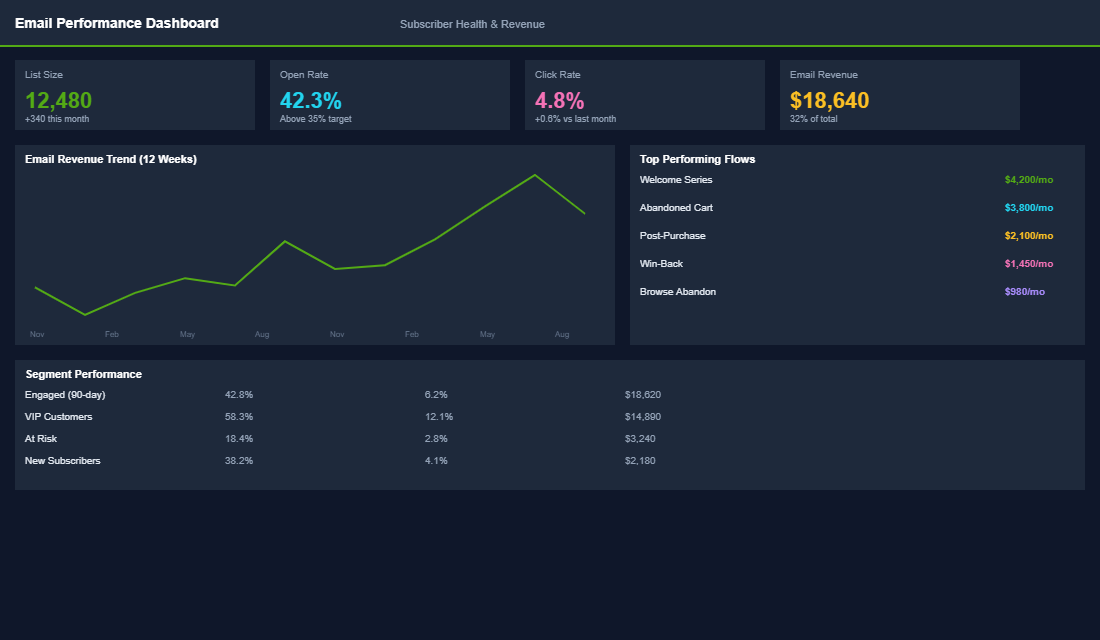
Track three metrics weekly to see if your calendar is working: revenue per email sent, list growth rate, and unsubscribe rate. If revenue per email drops below $0.10, your promotional mix is off. If unsubscribes climb above 0.3% per send, you are over-sending or under-delivering value.
The Compound Effect of Consistent Sending
Here is what most brands miss: the real power of an email calendar is not any single campaign — it is the compounding effect of consistent, strategic communication over months.
Month one, you are building the habit. Month two, your deliverability improves because inbox providers see consistent engagement. Month three, your subscribers start anticipating your emails. By month six, email is reliably driving 30%+ of your total revenue because you have trained your audience to open, click, and buy.
One member in the eCommerce Circle went from $2,800/month in email revenue to $14,200/month in five months — just by implementing a structured campaign calendar alongside their existing Klaviyo flows. No list growth hacks. No new tools. Just consistent, strategic sending.
Stop Winging It, Start Planning It
Your email list is one of the few marketing assets you actually own. Social algorithms change, ad costs rise, but your list is yours. The question is whether you are treating it like the asset it is — or leaving money on the table with random, inconsistent sends.
Subject Lines and Send Times: The 20% That Drives Most of the Result
A perfectly planned calendar still dies in the inbox if nobody opens the email. The subject line and preview text do about 80% of the work of getting the open, so treat them as their own craft, not an afterthought you write 30 seconds before hitting send.
Build a simple habit: write three subject line options for every campaign, then split-test the best two against a 20% slice of your list. Send the winner to the remaining 80% a few hours later. Over a year of campaigns that single discipline routinely lifts open rates by 5 to 10 percentage points, and it costs you nothing but ten minutes. If you want to run these tests properly, our guide to A/B testing for Shopify stores walks through sample sizes and significance so you are not chasing noise.
Benchmarks worth holding yourself to in 2026 (post Apple Mail Privacy Protection, opens are inflated, so weight clicks and revenue heavily):
- Open rate: 35 to 45% for an engaged Aussie retail list. Below 25% means a deliverability or list-quality problem, not a copy problem.
- Click rate: 1.5 to 3% of delivered. This is the number that actually predicts revenue.
- Send time: test Tuesday to Thursday mornings against Sunday evenings. Australian retail audiences often over-index on Sunday night planning sessions.
List Hygiene and Deliverability: The Calendar Fails If the Inbox Never Sees It
Here is the trap most founders fall into: they send more, to everyone, forever. The more you mail disengaged subscribers, the more mailbox providers like Gmail and Outlook quietly route you to spam, dragging down delivery for the people who actually want to hear from you.
Keep your spam complaint rate under 0.1% (Gmail will start throttling you above 0.3%) by sunsetting subscribers who have not opened or clicked in 90 to 120 days. A smaller, engaged list of 8,000 will out-earn a bloated list of 20,000 nearly every time, because every campaign lands in the primary inbox instead of the promotions graveyard.
Two foundations make this work. First, get your authentication right so providers trust you: our email authentication playbook covers SPF, DKIM and DMARC in plain English. Second, before you cut disengaged subscribers loose, try to win them back. A short, well-timed win-back flow reactivates 5 to 10% of sleepers and lets you suppress the rest with a clear conscience.
The Numbers That Tell You the Calendar Is Working
A calendar is only as good as the revenue it produces, so review these four numbers monthly and let them steer the next month’s plan.
- Email and SMS as a percentage of total revenue: aim for 25 to 30%. If you are stuck under 20%, your campaign rhythm is the single fastest lever you have.
- Revenue per recipient (RPR): total campaign revenue divided by emails delivered. A healthy Shopify store sits around AUD 0.15 to 0.40 per send. Watch the trend more than the absolute number.
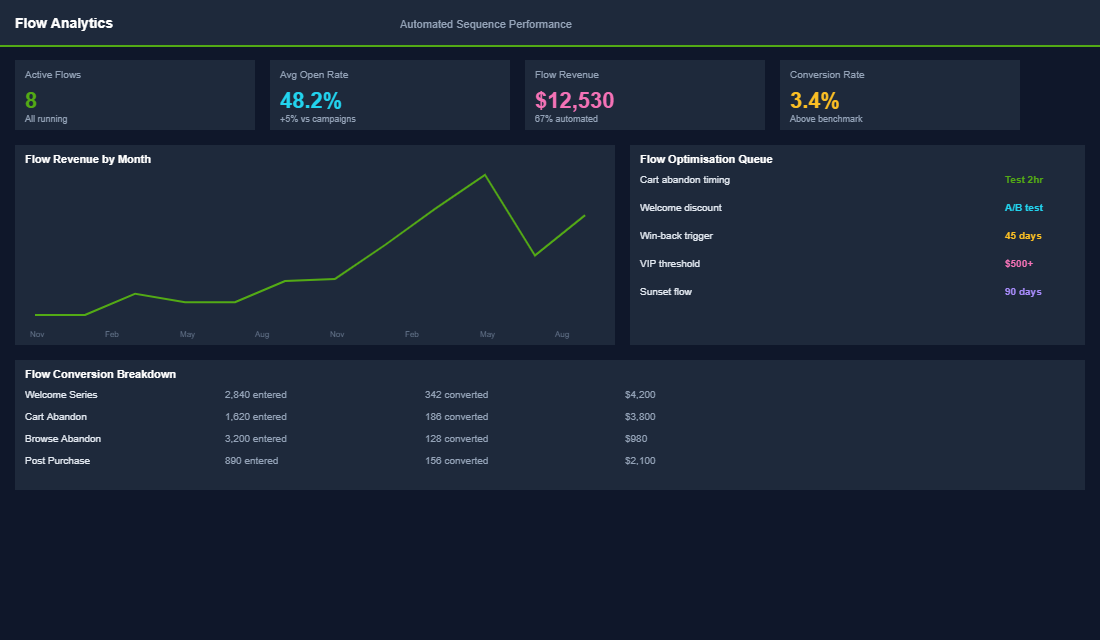
- Campaign vs flow split: your automated flows (welcome, abandoned cart, post-purchase) should carry the heavy lifting while campaigns drive the spikes. If flows are weak, fix them first with the welcome email sequence playbook.
- List growth rate: net new engaged subscribers per month. A flat list with a great calendar still plateaus.
One more layer most stores skip: segment the calendar itself. Sending your VIPs the same offers as one-time buyers leaves money on the table. Layering RFM segmentation over your calendar (so your best customers get early access and your lapsing buyers get a different hook) often adds another 10 to 15% to campaign revenue without sending a single extra email.
Whether you run Klaviyo or Omnisend, every metric above lives in the dashboard already. Klaviyo’s benchmarks tab even shows you how you stack up against other Australian Shopify stores in your category, which is a fast reality check on whether your calendar is pulling its weight.
Inside the eCommerce Circle, email campaign strategy is one of the core areas we map out with every member. We help you build a 90-day campaign calendar tailored to your products, your audience, and your seasonal peaks — so email stops being a guessing game and starts being your most predictable revenue channel.
If your email revenue is stuck below 20% of total sales, a structured campaign calendar is the fastest lever to pull. Build the rhythm, trust the mix, and let compounding do the heavy lifting.
Your campaign calendar does not need to be complicated. It needs to be consistent, segmented, and measured. Map the rhythm once, hold the discipline on subject lines and list hygiene, and watch email climb from an afterthought to your most predictable revenue channel.
Email campaign strategy is one of the core areas we map out with every member inside the eCommerce Circle. If your email revenue is stuck and you want a 90-day calendar built around your products and seasonal peaks, let’s talk.