You’re doing everything yourself. Customer emails. Order processing. Social media. Product uploads. Inventory. And somehow you’re also supposed to work on the business — strategy, growth, new products, partnerships. But there’s never enough time because you’re trapped working in it.
What’s in This Article
If you’re doing $20K-$100K/month and you don’t have a virtual assistant, you are the bottleneck in your business. Every hour you spend answering customer emails is an hour you’re not spending on the activities that actually grow revenue. And the maths is stark: your time as the business owner is worth $80-$150/hour on revenue-generating activities. A skilled VA costs $8-$12/hour. That’s a 10x arbitrage.
Hiring your first VA feels daunting. Where do you find them? How do you know if they’re good? What if they mess up your customer service? This guide walks you through the entire process — from identifying what to delegate to having a fully trained VA running 28 hours of tasks per week.
Step 1: Audit Your Time (Find the 28 Hours You’re Wasting)
Before you hire anyone, you need to know exactly where your time goes. For one week, track every task you do and how long it takes. Be honest — include the 20 minutes you spend processing returns, the 45 minutes answering customer DMs, the hour updating product listings.
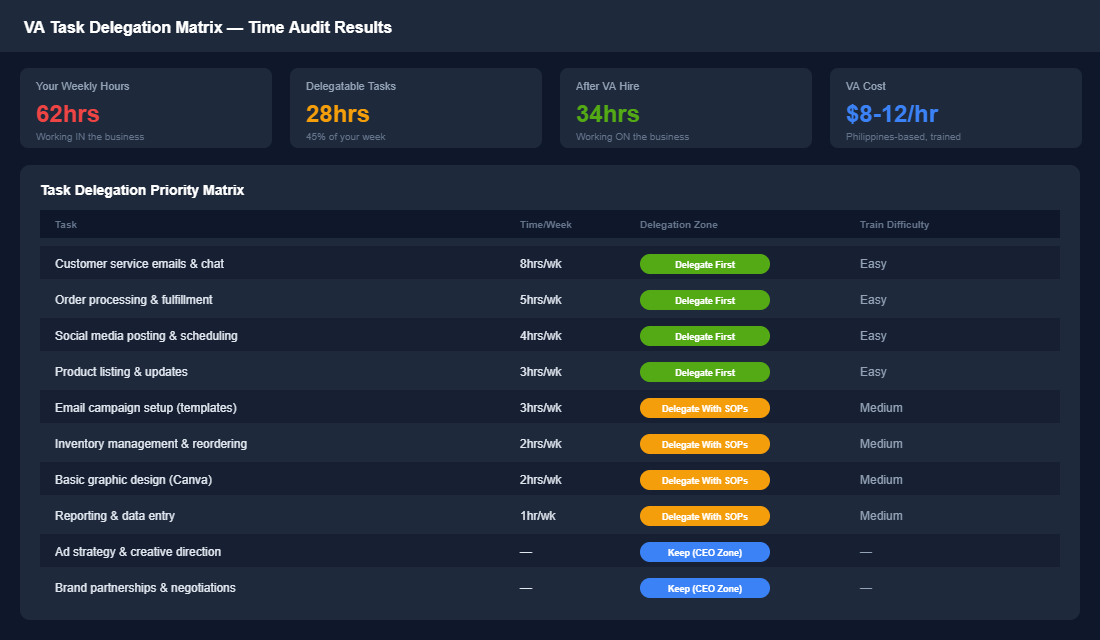
Sort every task into three buckets: “Delegate First” (repetitive tasks that don’t require your expertise — customer service, order processing, social media scheduling), “Delegate With SOPs” (tasks that need training and documentation — email campaign setup, inventory management, basic design), and “CEO Zone” (tasks only you can do — strategy, brand partnerships, high-level creative direction). Most store owners find 25-30 hours per week in the first two buckets.
Step 2: Write SOPs Before You Hire
This is the step most people skip — and it’s why most first VA hires fail. Standard Operating Procedures (SOPs) are step-by-step guides for every task you’ll delegate. Without them, you’ll spend more time explaining and fixing mistakes than you save.
You don’t need fancy documentation. Record a Loom video of yourself doing each task while narrating the steps. Then have the VA write the SOP document based on the video. This does two things: creates documentation AND tests whether the VA can follow instructions accurately.
Start with SOPs for your top 5 most time-consuming delegatable tasks. For most Shopify stores, that’s: responding to customer emails (with templates for common questions), processing orders and handling fulfillment issues, scheduling social media posts, updating product listings, and processing returns and exchanges.
Step 3: Where to Find Quality VAs
The Philippines is the go-to market for ecommerce VAs — strong English skills, cultural alignment with Western business practices, and cost-effective rates ($8-$12 USD/hour for experienced VAs). The best platforms:
OnlineJobs.ph — The largest Filipino job board. You’ll get 50-100+ applicants for a well-written job post. Costs $99/month for employer access. This is where most successful ecommerce brands find their VAs. Upwork — Good for project-based or part-time VAs. Higher rates but easier to vet through platform reviews. Facebook Groups — “Filipino Virtual Assistants” and similar groups have active job seekers. Less structured but can find gems through referrals.
What You Should Actually Pay a VA in 2026 (Real AUD Benchmarks)
Underpaying is the most expensive mistake Aussie store owners make here. You save $200 a month and lose the person at month four, then burn another six weeks hiring and training a replacement. Pay at the top of the band for the role you actually need and the person stays.
Here is what the market looks like right now for Philippines-based ecommerce VAs, in AUD, for full-time (40 hours a week):
- General admin VA (0-1 years ecommerce): $900-$1,300/month. Order processing, data entry, basic product uploads. Needs tight SOPs and daily review.
- Customer service VA (1-3 years): $1,300-$1,900/month. Handles your inbox and DMs solo, uses macros, escalates properly. This is the highest-ROI first hire for most stores.
- Ecommerce operations VA (3+ years, Shopify-native): $1,900-$2,800/month. Owns fulfilment exceptions, inventory reconciliation, supplier follow-ups, reporting.
- Specialist VA (Klaviyo, Meta Ads, design): $2,200-$3,500/month, or $18-$35/hour part-time. Narrow scope, measurable output.
Two costs Aussie owners consistently forget. First, 13th month pay — a legally expected annual bonus in the Philippines equal to one month’s salary, usually paid in December. Budget for it from month one, because springing a “no” on your VA in November is how you lose them in January. Second, Philippine public holidays, which don’t line up with ours. Map them against your peak trading dates now, especially Christmas and Chinese New Year, so you aren’t discovering a coverage gap on the Monday of Black Friday week.
The timezone maths is genuinely in your favour. Manila is two to three hours behind AEST depending on daylight saving, so a 9am-6pm Manila shift covers roughly 11am-8pm Melbourne. Your VA is live for your entire afternoon customer service peak, and they’re clearing the overnight inbox before you open your laptop. If you want the deeper breakdown of scoping the role itself, the Shopify VA playbook maps it out role by role.
Step 4: The Hiring Process That Finds A-Players
Don’t just hire the first applicant who looks good on paper. A structured hiring process dramatically increases your chances of finding a great VA.
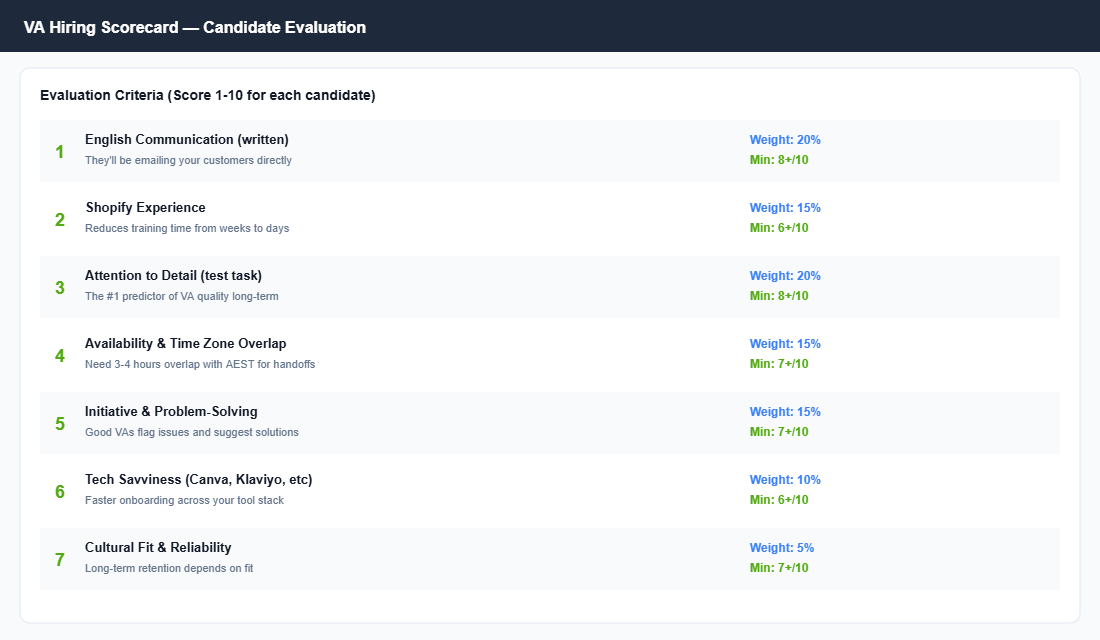
Stage 1: Application screening. Include a specific instruction in your job post (e.g., “Start your application with the word ‘Shopify'”). This instantly filters out mass applicants who didn’t read the listing. From 100 applicants, you’ll typically shortlist 15-20.
Stage 2: Written test. Send your shortlist a brief written exercise relevant to the role. For a customer service VA: “Write a response to this customer complaint email.” For a social media VA: “Write 3 Instagram captions for this product.” This tests their English, tone, and ability to follow brand guidelines. Narrow to 5 candidates.
Stage 3: Paid test task. Give your top 3-5 candidates a paid test task ($20-$30 each). A real task from your business — process 10 practice orders, schedule a week of social posts, respond to 5 sample customer emails. Pay for this — it shows respect and you get a realistic preview of their work. Pick your winner.
Stage 4: Video interview. A 15-minute Zoom call with your final 2-3 candidates. Assess communication skills, personality fit, and ask about their work setup (reliable internet, quiet workspace, backup power). This is also where you gauge initiative — do they ask smart questions about the role?
Seven Red Flags That Predict a Failed VA Hire
Every one of these has cost a store owner I’ve worked with real money. Screen for them before the paid test task, not after.
- They didn’t follow the keyword instruction. If they can’t follow a one-line instruction in a job post, they won’t follow a twelve-step SOP at 2am when an order goes sideways.
- Generic copy-pasted application. No mention of your store, your products, or your category. Roughly 70% of applicants fall here. Bin them.
- Vague answers about the work setup. Ask directly: what’s your internet speed, do you have backup power, is your workspace quiet? Power outages are common in parts of the Philippines. A serious VA has a plan; an unserious one gets defensive.
- Juggling four other clients. Part-time is fine if you scoped part-time. But someone stitching together five part-time gigs will always deprioritise the smallest one, and early on that’s you.
- Won’t do the paid test task. You’re offering $30 for an hour of work. Refusal means they’re stretched, not principled.
- Perfect written English, awkward on video. Not a dealbreaker for back-office roles, but a mismatch this large usually means the written test wasn’t their own work. Always do the video call.
- They never ask you a question. A-players interrogate the role: who do I report to, what does good look like, what’s the growth path. Silence signals someone who’ll sit on a problem for a week rather than raise it.
One more filter that costs nothing: ask every finalist to describe the worst mistake they made in a previous role and what changed afterwards. The people who answer honestly and specifically are the ones who’ll tell you the day they break something in your Shopify admin, instead of quietly hoping you don’t notice for a fortnight.
Step 5: Onboarding That Sets Them Up to Win
The first 30 days make or break a VA relationship. Don’t throw them in the deep end. Follow this timeline:
Week 1: Tool access and SOP review. Walk them through every tool (Shopify, Klaviyo, Canva, your project management tool). Have them shadow your work. Daily 15-minute check-ins. Week 2: Supervised task execution. They do the work, you review everything before it goes live. Correct early and often — this is where habits form. Week 3-4: Semi-independent. They handle 80% of tasks solo. You review a sample of their work daily. Weekly 30-minute check-in instead of daily. Month 2+: Fully independent on trained tasks. Weekly check-in. Start training on the next batch of delegatable tasks.
The Tool Stack Your VA Needs on Day One
Have all of this set up and tested before their first shift. Nothing kills momentum in week one like a VA sitting idle waiting on a login.
- Shopify staff account with scoped permissions. Give access to Orders, Customers and Products. Withhold Finances, Apps, and Settings until month three. This isn’t distrust, it’s the same principle you’d apply to any new staff member.
- A shared helpdesk rather than your personal inbox. Gorgias, Re:amaze or Zendesk all work. The point is a shared view with assignment rules and macros, so you can see what was answered and how.
- Loom for SOP recording, both directions. When the VA hits something they can’t solve, a 90-second Loom beats a 400-word message every time.
- A task board — ClickUp, Asana or Trello. Recurring daily checklists live here, not in chat, where they get buried.
- A password manager — 1Password or Bitwarden. Never send credentials over chat, and never share a login you can’t revoke in one click.
- Klaviyo and Canva at viewer or editor level if the role touches email or creative.
Budget roughly $150-$300/month AUD for the stack on top of the salary. It’s the difference between a VA who works independently and one who pings you eleven times a day. If your SOPs aren’t documented yet, the SOP playbook is the fastest way to get them written without spending a weekend on it.
How to Keep a Good VA (Losing One Costs You Six Weeks)
Replacing a trained VA costs you the hiring cycle again plus the ramp — call it six weeks and $2,000 of your own time. Retention is cheaper than recruitment every single time, and it comes down to four habits.
Review pay at six months, then annually. A 10-15% rise at the six-month mark for someone performing well is the single highest-ROI retention move available. It costs you $150-$250 a month and removes the reason they’d take a recruiter’s call.
Give them a scorecard, not a vibe. Three to five numbers they own: first-response time under 4 hours, CSAT above 90%, zero fulfilment errors per week, inbox cleared daily. People who can see themselves winning stay. People guessing at whether you’re happy leave.
Keep the weekly 30-minute one-on-one, permanently. Not a status update — you have the board for that. Ask what’s frustrating, what’s slow, what they’d change. Your VA sees friction in your operation that you stopped noticing two years ago.
Show them the next rung. Customer service VA to operations VA to team lead over eighteen months. The moment you hire VA number two, your first hire should be helping train them. That’s how a $1,700/month hire quietly becomes the person running your back office, and it’s the same progression covered in the delegation playbook.
The ROI: Why This Is the Best ,000/Month You’ll Spend
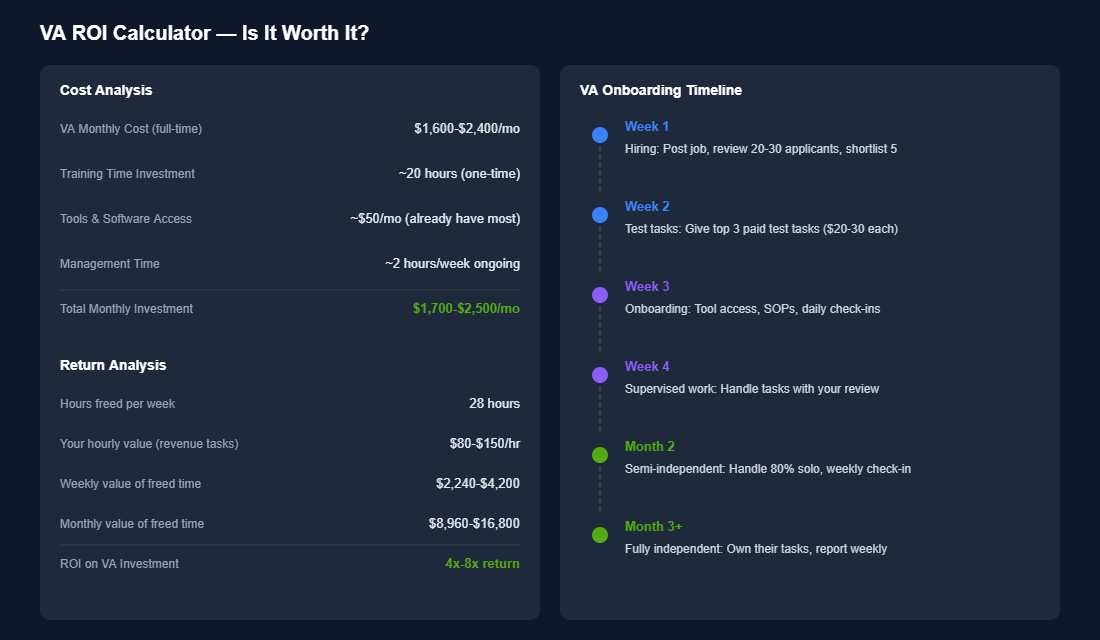
The maths is simple but powerful. Your VA costs $1,700-$2,500/month. They free up 28 hours of your week. If you redirect even half of those hours to revenue-generating activities — working on your ad strategy, building partnerships, improving your product line, creating content — the return is 4-8x your investment.
But beyond the maths, there’s something more important: you stop being the bottleneck. Your business can operate without you being in every customer email, every order, every social post. That’s the difference between having a job and having a business.
Your Next Step
This week, do the time audit. Track every task for 5 days. Identify your top 5 delegatable tasks. Record Loom videos of yourself doing each one. Then post a job on OnlineJobs.ph. From posting to having a trained VA handling tasks is about 4-6 weeks. Your future self will thank you.
Inside the eCommerce Circle, building your team is one of the core pillars we work on with every member — because you can’t scale a business that depends entirely on you. If you want help hiring and training your first VA, let’s talk.