Most ecommerce brands lose their best hires inside 90 days. Not because the person was wrong. Because the onboarding was.
What’s in This Article
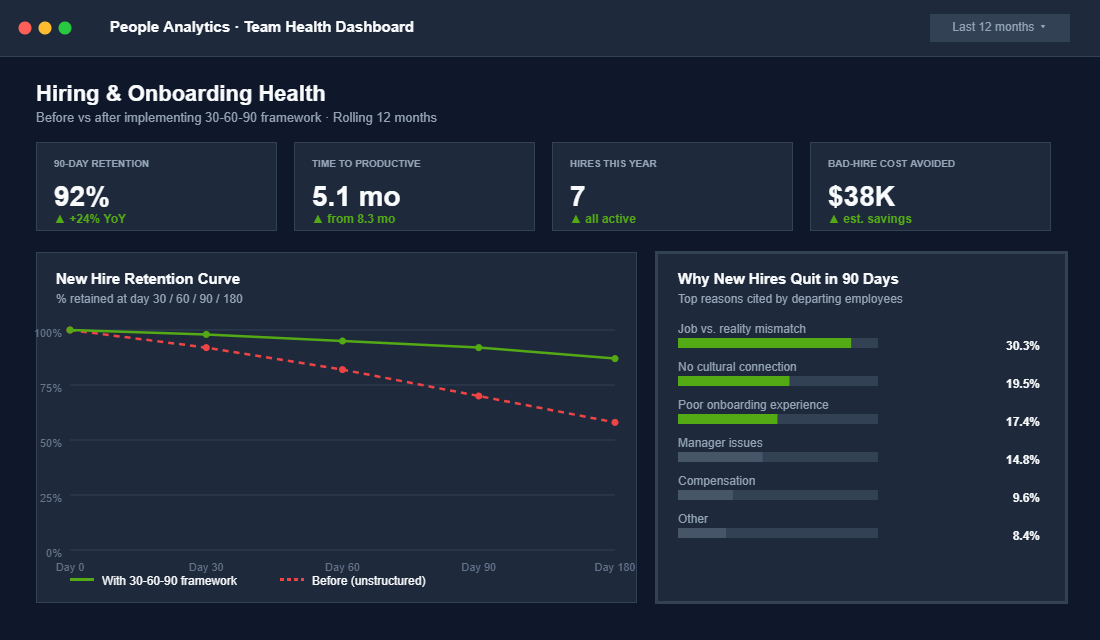
Nearly 30% of new hires quit within the first 90 days, and 22% of those leave in the first 45. The top reasons? A mismatch between what the job was sold as and what the job actually is (30.3%), poor cultural connection (19.5%), and a straight-up bad onboarding experience (17.4%). None of those are about pay. All of them are about what happens in the first three months after someone accepts the role.
Here is what most ecommerce founders do when a new person starts. They hand over a Klaviyo login, a Shopify backend invite, a vague Loom walkthrough, and say “ping me if you get stuck.” Then they get frustrated three weeks later when the work is mediocre, the new hire feels lost, and everyone wonders why the role is not working. The problem is not the person. The problem is that you are running a sink-or-swim operation and calling it training.
Inside the brands we coach that scale past $5M, onboarding is a system. Not a Google Doc. Not a Loom library. A structured 30-60-90 framework that takes a new hire from confused to confident to owning a revenue-generating function inside a quarter. That system is the difference between hiring being your biggest growth lever and hiring being your biggest time sink. Let’s break it down.
Why Most Ecommerce Onboarding Fails (The Real Reason)
The average new employee takes 8 months to reach full productivity. For ecommerce brands running lean teams, that is terrifying. You cannot afford to carry a half-productive hire for two-thirds of a year. So what do most founders do? They skip the onboarding runway entirely. They assume the new person will “figure it out” because they did when they started the business.
Here is the trap. You built your store by learning through pain. You made every mistake yourself. You developed instincts through months of 2am troubleshooting. That knowledge sits in your head, not in any document. When you hire, you expect the new person to absorb that knowledge by osmosis, through being in the Slack channel or sitting on a few calls. That is not how learning works.
The failure pattern is predictable. Week one, the new hire is excited. Week two, they are overwhelmed but hiding it. Week four, they are asking the same question for the third time and feeling dumb. Week six, they are checking job boards. Week ten, they resign. And you are back to square one, except now you are out the $15K-$40K it costs to replace someone (studies put the cost at up to 2x annual salary for mid-level roles).
Brands with a structured onboarding process reduce time-to-productivity from 8 months to around 5 months and improve first-year retention by over 80%. That is not a soft metric. That is three months of extra output per hire, every hire, forever. It compounds. Let’s talk about what structure actually looks like.
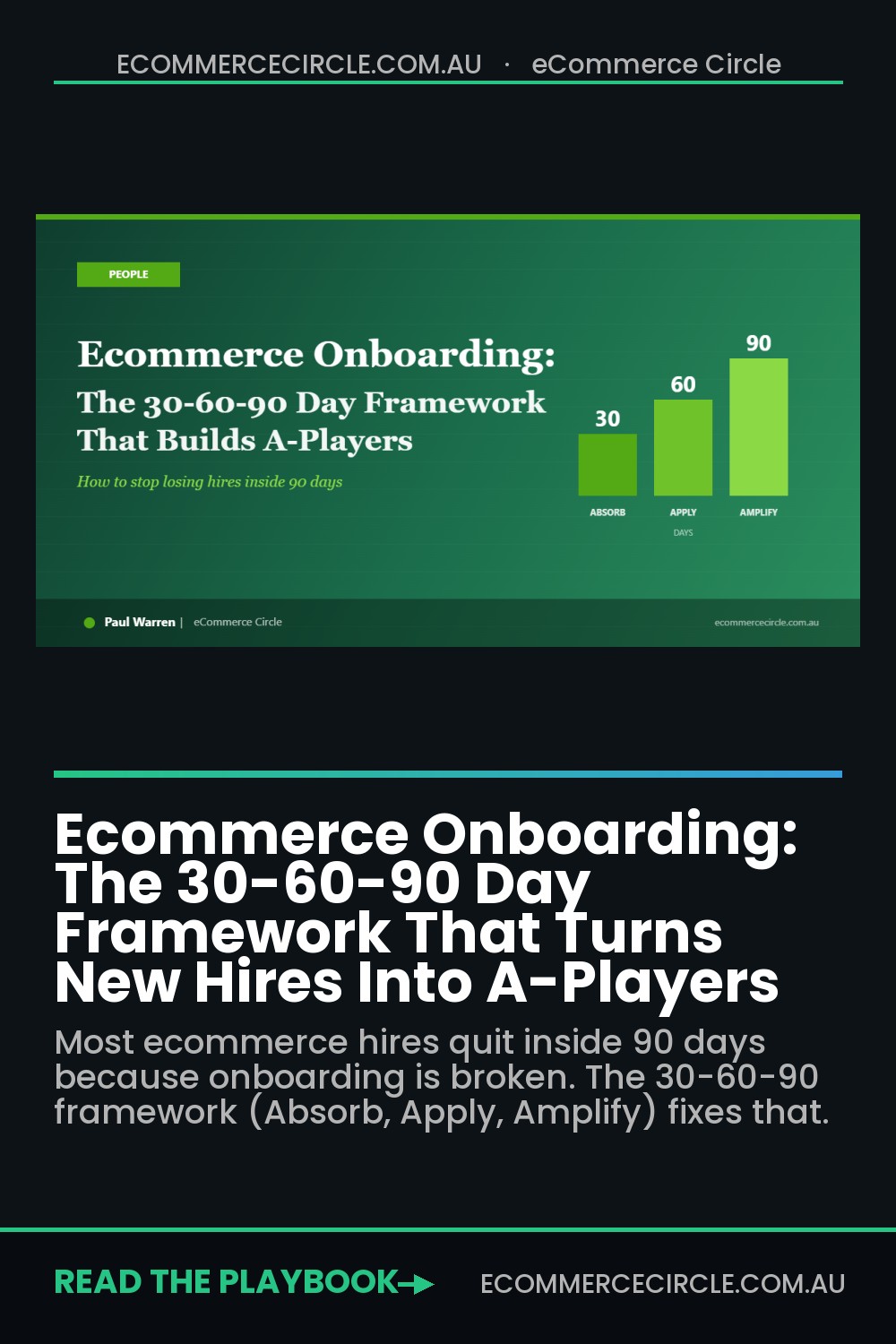
The 30-60-90 Framework (Absorb, Apply, Amplify)
The 30-60-90 framework breaks a new hire’s first quarter into three distinct phases, each with a different goal, different activities, and different success metrics. The mistake most founders make is treating all 90 days as the same “ramp-up” period. They are not. Each phase needs a different kind of support.
Here is the structure:
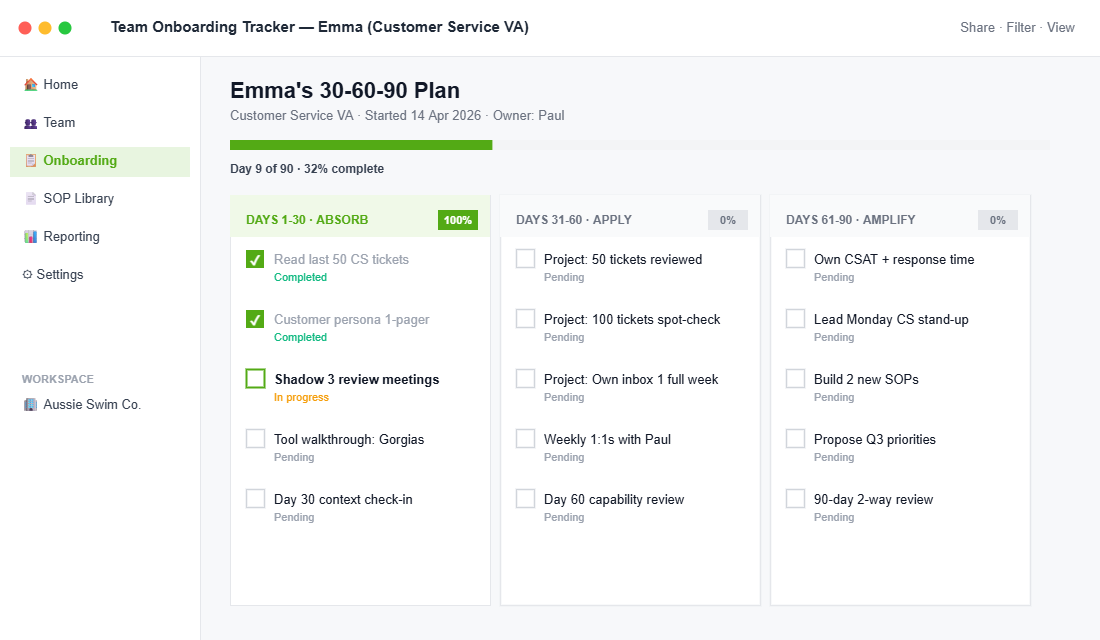
- Days 1-30: Absorb. The new hire learns the business, the tools, the customer, and the language. They produce very little. They consume a lot. The goal is context.
- Days 31-60: Apply. The new hire starts doing the work under close supervision. They make mistakes. You catch them early. The goal is capability.
- Days 61-90: Amplify. The new hire owns a clear slice of the business. You reduce oversight. They ship independently. The goal is ownership.
If you skip phase one and jump straight to “here is your first campaign, go,” you get shallow, mistake-riddled work. If you stay stuck in phase one for 90 days, you build dependent employees who cannot move without your approval. The phases exist to sequence the handoff deliberately, so you build a team member who can think, not just follow orders.
This framework works for every role in an ecommerce business — a customer service VA, a Meta ads buyer, a content coordinator, an operations manager. The tasks change. The phases do not. That consistency is what makes it a system rather than a one-off training plan.
Days 1-30: Absorb (The Foundation Phase)
The first 30 days are the most misunderstood. Founders feel guilty if the new hire is not producing “output” in week one. That guilt leads them to hand over tasks too early, which creates sloppy work, which requires rework, which eats more time than just letting the person absorb properly. Resist that urge.
In the first 30 days, the new hire should be doing four things:
- Learning the customer. They should read your last 50 customer service tickets, listen to 10 recorded sales calls or reviews, and write a one-page summary of “who our customer is and what they actually want.” This exercise forces them to build their own mental model, not just parrot yours.
- Learning the business. Walk them through your P&L at a high level. Show them the 10 P’s of your operation — Product, Prospects, Profit, Patrons, Promotion, Platform, Performance, People, Protection, Practice. Where does their role fit? What metrics move when they do their job well?
- Learning the stack. Shopify admin, Klaviyo, Meta Business Manager, Google Analytics, the help desk, Slack. Not just how to log in. What each tool is for, which decisions it informs, and the last time you actually used it.
- Shadowing real work. They sit on three calls with you, watch you build one email campaign, and observe one weekly review meeting. No note-taking pressure. Just absorbing how decisions actually get made.
Here is the test at day 30. Can the new hire, unprompted, tell you who your best customer is, what problem your product solves for them, what your gross margin is roughly, and which three numbers your business cares about most? If yes, they have absorbed the context and are ready for phase two. If not, extend the phase. Do not skip ahead because you feel behind.
I know founders who hate this phase because it feels unproductive. But a hire who absorbs properly in month one will out-produce a hire who was thrown into tasks on day three by a factor of three or four for the next two years. The runway is not lost time. It is compounded advantage.
Days 31-60: Apply (The Contribution Phase)
Now the new hire starts producing. But this is not the “here is your full role, go” phase. This is supervised reps. Think of it like teaching someone to drive. You do not drop them on a freeway in month two. You take them to an empty carpark, then quiet streets, then busier roads. Same principle.
In phase two, the new hire takes on three structured projects that progressively expand in scope and autonomy. Here is what this looks like for the most common ecommerce roles:
- For an email marketer. Project 1: Audit and rewrite the current welcome flow. Project 2: Build one new campaign from scratch (strategy, copy, design, segmentation, send). Project 3: Run one A/B test end-to-end and present the results.
- For a customer service VA. Project 1: Handle 50 tickets under your review (you approve every reply before it sends). Project 2: Handle 100 tickets with spot-checks. Project 3: Own the inbox for a full week with a daily 15-minute handover call.
- For a Meta ads specialist. Project 1: Audit the current account and identify three issues. Project 2: Launch one new testing campaign with a $500-1,000 AUD budget. Project 3: Present a 30-day ads roadmap to you and defend the strategy.
- For an operations manager. Project 1: Document three existing processes as SOPs. Project 2: Identify one broken process and redesign it. Project 3: Run one weekly team meeting solo.
The critical habit during phase two is the daily 15-minute async check-in. Not a meeting. A written update in Slack or your project tool that answers three questions: what I worked on yesterday, what I am working on today, and what I am stuck on. This creates visibility without micromanagement. You spot problems on day two instead of week three.
This is also when you should be doing scheduled weekly one-on-ones. Not check-ins disguised as “catch ups.” Real, structured conversations where you ask what is blocking them, what they are learning, and what they think the business should prioritise. If they cannot answer that last question by week six, you have a follower, not an operator. Correct course or cut losses fast — the cost of a bad hire balloons the longer you wait.
Days 61-90: Amplify (The Ownership Phase)
By day 61, if the previous phases worked, the new hire should be dangerous in a good way. They should be making decisions you would have made, seeing problems before you see them, and suggesting improvements you had not considered. Your job now is to get out of the way without abandoning them.
In phase three, three things change:
- You transfer real ownership. The new hire owns a clear slice of the business with a revenue or retention metric attached. An email marketer owns email-attributed revenue. A CS VA owns CSAT score and response time. An ads specialist owns MER (marketing efficiency ratio) on their channels. No metric, no ownership — it is just task-doing in disguise.
- You reduce the meeting cadence. Daily check-ins become two or three per week. Weekly one-on-ones stay, but they become strategic conversations about direction rather than tactical reviews. Your calendar opens back up because they need less of you.
- You start asking forward questions. “What would you change if you had unlimited budget?” “What is the biggest risk in your area right now?” “If you had to pick one thing to double down on next quarter, what would it be?” These questions force them to think like an owner, not an executor.
The 90-day review conversation is where it all lands. Do not make it a performance review. Make it a two-way conversation. You share what you have seen go well, where you think they need to grow, and what the next 90 days look like. They share what they need from you, what is frustrating them, and where they want to take the role. Most founders skip this conversation because they are “too busy.” That is exactly why their teams churn.
Here is the measurement at day 90. Can this person run their function for two weeks while you are on holiday, without the business going backwards? If yes, you have built capacity. If no, you have built dependency. The goal of onboarding is never that the new hire needs you. The goal is that the new hire makes you need them less.
The Onboarding Documents Every Ecommerce Brand Needs
A 30-60-90 plan is only as good as the documents that sit behind it. If your onboarding runs on vibes and Loom videos no one can find, you will burn through the same explanations with every new hire for the next five years. That is a waste of your most expensive time.
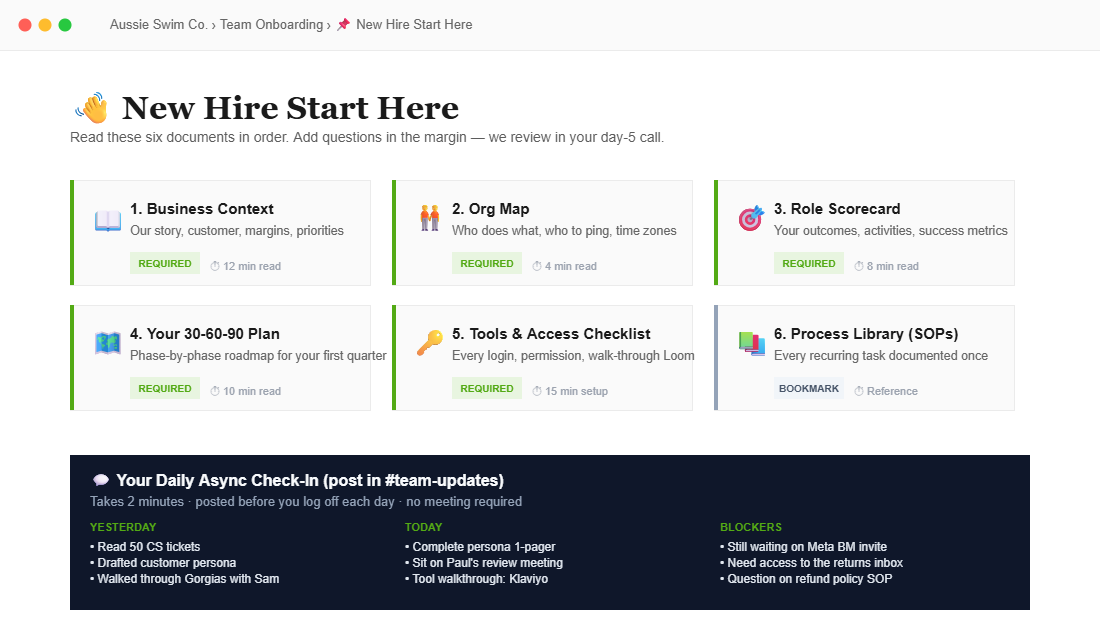
Here are the six documents every ecommerce brand should have before the next hire starts:
- The Business Context Doc. One page on your origin story, your customer, your products, your margins at a high level, your current quarterly priorities, and the three metrics you obsess over. Every hire reads this on day one.
- The Org Map. Not a fancy org chart. A plain list of who does what, who they report to, and what function they own. Add Slack handles and time zones for remote teams.
- The Role Scorecard. For each role, a one-page document listing the outcomes the role exists to deliver, the activities that create those outcomes, and the metrics you will measure success against. If you cannot write this, you cannot hire for this.
- The 30-60-90 Plan Template. The phase-by-phase plan for this specific role. Projects, milestones, meeting cadence, check-in format.
- The Tools and Access Checklist. Every login, every permission level, every tool-specific training doc or video. Nothing wastes a new hire’s first week like waiting five days for a Meta Business Manager invite.
- The Process Library. Your SOPs. Every recurring task in the business documented once, so nobody ever has to ask “how do we do X?” again. If you do not have SOPs yet, start there — we wrote a full breakdown on why ecommerce SOPs stop you being the bottleneck.
Do not build all six at once. Build them as you hire. Your first hire triggers the first three documents. Your second hire forces you to sharpen the Role Scorecard. By hire number four, you have a complete onboarding library that pays dividends forever. The best founders I coach treat these documents as assets, not admin.
The Tool Stack: Notion + Loom + a Shared Task Tool
You do not need fancy HR software. You need a lightweight stack that holds three things: written knowledge, video walkthroughs, and task visibility. The combination most of our Connect members use is Notion plus Loom plus either ClickUp or Asana. Here is how to set it up.
- Step 1: Create a “Team Onboarding” workspace in Notion. Inside it, create a page for each of the six documents above. Add a “New Hire Start Here” page that links to them in the correct reading order. Give every new hire editor access on day one so they can take notes and ask questions in context.
- Step 2: Record a Loom for every repeatable explanation. The first time you explain how to pull a Shopify sales report, record it. Three minutes, done. Drop the link into the relevant Notion page. The next time you are about to explain the same thing, send the Loom instead. Over a year, this saves you 40-60 hours of repeat explanation.
- Step 3: Use a task tool for the 30-60-90 plan itself. Create a project called “[New Hire Name] Onboarding” with a task for every milestone. Days 1-30 tasks, Days 31-60 projects, Days 61-90 ownership handovers. Tag the new hire on every task. They can see the whole arc. You can see where they are blocked.
- Step 4: Add a daily async template. In your task tool or Slack, create a simple template the new hire fills out every day: yesterday, today, blockers. No meeting required. Read it over coffee.
The whole setup takes a weekend to build for your first hire. For every hire after that, it takes 45 minutes to customise. The payoff is obvious. You are building the onboarding machine once, then running it forever.
The VA Onboarding Twist (For Remote and Offshore Hires)
If you are hiring a VA from the Philippines or anywhere overseas, the 30-60-90 framework still works — but you need to be more deliberate about two things. Time zones and written clarity. Both are fixable if you know the traps.
For a Philippines-based VA, you typically pay $8-$15 AUD per hour for excellent quality work in customer service, admin, or product listing. For the same work in Australia you would pay $35-$60 AUD per hour. That gap is why offshore hiring is now standard for scaling ecommerce brands. But the gap disappears fast if you have not set the hire up to succeed. A $10/hour VA who produces nothing useful is more expensive than a $50/hour one who ships.
The two rules for offshore onboarding are simple. First, default to written. Verbal explanations get lost in accent and time zone. Written instructions, Loom videos with captions, and detailed Notion pages win every time. Second, build in a structured handover call at the start or end of their day — not yours. Even 15 minutes when their shift begins makes the difference between a VA who guesses and a VA who executes. For more on this, we have a deep dive on how to hire your first ecommerce VA without wasting $5K finding out.
One more thing on remote hires. Day one should include a video call where you actually meet the person, walk them through the team, introduce them to anyone they will work with, and make them feel like part of the business. Most offshore hires never get this, which is why retention on offshore teams is often worse than it needs to be. Treat them like employees, not vendors. They will stay longer and produce more.
The Compound Effect (Why This Changes Your Business)
Here is the full picture. A single structured onboarding saves you roughly three months of time-to-productivity per hire. It cuts your first-year attrition by up to 80%. It avoids one bad-hire replacement cost of $15K to $40K. On one hire, that is significant. On the ten hires you will make over the next three years as you scale, it is transformational.
But the real compounding effect is not the per-hire savings. It is what happens to your own time. When your team is onboarded properly, they stop pinging you for every small decision. They start shipping on their own. Your calendar opens up. You stop being the bottleneck on every marketing campaign, every supplier issue, every customer complaint. You get to work on the business instead of constantly inside it.
The brands we coach that break through the $5M to $20M range all have one thing in common. The founder works half the hours they worked at $1M. They have more margin. Their team ships without them. That is not because they are more talented. It is because they built the onboarding system that turns new hires into A-players, and they run it every single time.
Start with one hire. Build the 30-60-90 plan before they sign. Set up the onboarding hub in Notion. Record the first five Looms. Run the Day 30, 60 and 90 reviews. Watch what happens to your business over the next six months. Then do it again for the next hire.
The Onboarding Scorecard: What to Measure at Day 30, 60 and 90
A framework you do not measure is a document, not a system. Three checkpoints, four numbers each, and you will know whether the hire is working long before the problem becomes a resignation.
Day 30 (Absorb). Score four things out of five: product knowledge, tool fluency, understanding of who the customer is, and clarity on what success looks like in the role. Anything under 3 on customer understanding is your warning light, because a hire who cannot describe your buyer will guess at every decision for the next two years. Also track a simple one: how many questions did they ask this month? Fewer than ten usually means they are afraid to ask, not that they know everything.
Day 60 (Apply). Now you want output. Pick two or three concrete deliverables they owned end to end and rate quality, not effort. Track rework rate, meaning the percentage of their work that needed a redo. Above 30% at day 60 signals the brief was unclear rather than the person being wrong, so fix the brief first. And ask them to run one process without supervision. If they cannot, your documentation has a hole in it.
Day 90 (Amplify). The test is ownership. Can they run their area for a fortnight while you are unreachable? Do they improve a process rather than just follow it? Have they trained or documented anything for the next person? A hire who has written one SOP by day 90 is compounding. One who has written none is still consuming your time.
The Benchmarks Worth Holding Yourself To
- 90-day retention above 90%. If more than one in ten new hires is gone inside a quarter, the problem is your onboarding or your hiring brief, not the market.
- Time to first meaningful contribution under 21 days. Not “answered emails”. Shipped something that mattered.
- Cost of a failed hire: 30-50% of first-year salary. On a $75,000 AUD role that is $22,500 to $37,500 in recruitment, wasted wages and your own time. A weekend spent building the onboarding hub is cheap insurance against that.
- Manager time per new hire: 8-10 hours in month one, under 2 by month three. If your hours are not falling, they are not actually taking ownership.
Write the scores in the same shared doc every time so you can compare hire three against hire one. Patterns show up fast. If every hire dips at day 60, your Apply phase is under-documented. If every hire scores low on customer understanding at day 30, your induction skips the customer entirely.
The cheapest version of this is to test the person before they ever reach day one. A short paid trial tells you more than three interviews and costs less than a bad first month. And if you want to see what happens when onboarding has never been documented, look at what a business goes through when a key person resigns. Every hour you invest in the onboarding hub is an hour you are not scrambling later.
Let’s Talk
Inside the eCommerce Circle, onboarding is one of the core pillars under the People P of the More Orders Operating System. We help founders design their 30-60-90 frameworks, build their onboarding hubs, and turn their next ten hires into compounding capability rather than compounding overhead.
If you are about to hire, already onboarding someone, or watching good people leave before they hit their stride, we should talk. Book a Connect call and we will map out exactly where your onboarding is breaking and what to fix first.