If you are still building Meta campaigns the way you did in 2023, you are losing money. Stacked interest audiences. Manual lookalikes. Eight ad sets, twelve creatives each, and a daily ritual of pausing the bottom performers. That playbook stopped working the moment Meta rebuilt its delivery system around machine learning, and the brands still running it are paying a tax they cannot see in their dashboard.
What’s in This Article
The shift is now measurable. Advantage+ Shopping Campaigns are averaging a 4.52x ROAS across ecommerce advertisers, compared to 3.70x for manually structured campaigns. That is a 22% lift, sitting there for any brand willing to hand the steering wheel over to Meta’s AI. Yet most Aussie founders we work with inside eCommerce Circle are still running a hybrid setup that gets the worst of both worlds: not enough volume for the algorithm to learn, too much complexity to manage well.
This is the 2026 playbook for running Advantage+ Shopping Campaigns (ASC) on a Shopify store. Not a generic overview. The exact settings, budget math, creative volume, and weekly operating rhythm that we see working right now for Australian brands doing $40k to $500k a month. If you are spending more than $15k a month on Meta and your ROAS feels like it has plateaued, this is the rebuild.
What ASC actually is (and why it replaced your old account structure)
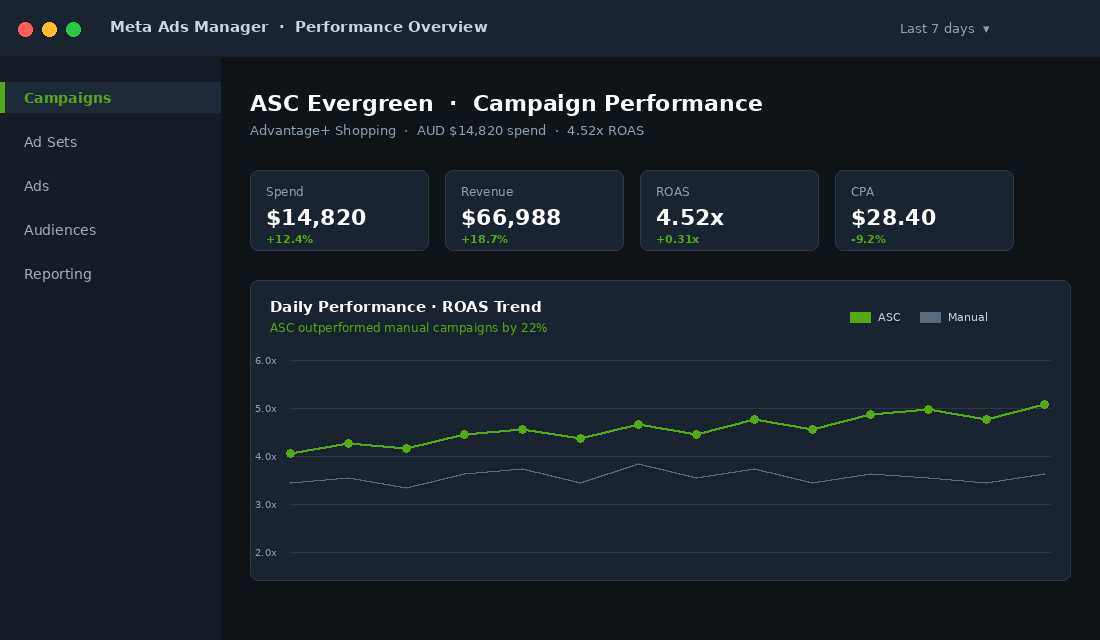
Advantage+ Shopping Campaigns are a single, AI-controlled campaign type built specifically for ecommerce advertisers. Meta’s system handles audience selection, placements, bidding, creative pairing, and budget allocation across ad sets automatically. You provide three things: the catalog, the creatives, and a budget. The algorithm does the rest.
The reason this matters is that Meta’s machine-learning model now has access to signals you could never replicate manually. Real-time purchase intent, on-platform browsing behaviour, cross-app movement between Facebook, Instagram and Threads, and conversion patterns from millions of similar shoppers. When you build a manual campaign with five interest audiences and four lookalikes, you are essentially telling Meta to ignore most of what it knows about your buyer.
ASC also fixes the iOS 14.5 attribution gap that has been bleeding accounts since 2021. Because the system optimises against on-platform signals first and uses your Conversions API data as a secondary signal, you keep delivery quality even when third-party cookies are dead. If your server-side tracking is set up properly, ASC will outperform a manual setup running on the same data within 14 days, every single time.
The trade-off is loss of control. You cannot exclude placements, you cannot set granular audience parameters, you cannot tell Meta which creative to push where. For operators who like to tinker, this is uncomfortable. For founders who care about the line on the P&L, it is liberating.
The account architecture: 1 to 2 campaigns, never more
The single biggest mistake we see in Meta accounts right now is account proliferation. Five ASC campaigns, each with three or four ad sets, all running against the same audience pool. The algorithm cannot learn anything because the budget is spread too thin and the conversion events are fragmented across campaigns.
Here is the structure that wins:
- Campaign 1: ASC Evergreen. Your core catalog, your best creatives, no promotional overlay. This is the workhorse and gets 70 to 80% of the total Meta budget.
- Campaign 2: ASC Promotional (optional). A second ASC running during sale windows, product launches, or category pushes. Different creative angle, different offer overlay. Only switched on when there is a genuine reason. Gets 20 to 30% of budget when active.
- Manual remarketing campaign (optional). If you are running a high-AOV product and need to keep retargeting separated for reporting clarity, run one small manual campaign for warm audiences. Cap it at 10% of total spend.
That is it. Three campaigns maximum. Most Aussie brands under $200k a month should run just one ASC plus a small manual remarketing layer. Anything more is splitting your learnings and burning budget on the exit ramp of the learning phase.
Frank Body, Bondi Sands and Who Gives A Crap all run versions of this architecture. Single dominant ASC, supported by tightly scoped retargeting or category-specific pushes. The reason these brands scale efficiently is not that they have better creatives than you. It is that their account structure lets the algorithm actually do its job.
The Existing Customer Budget Cap (the make-or-break setting)
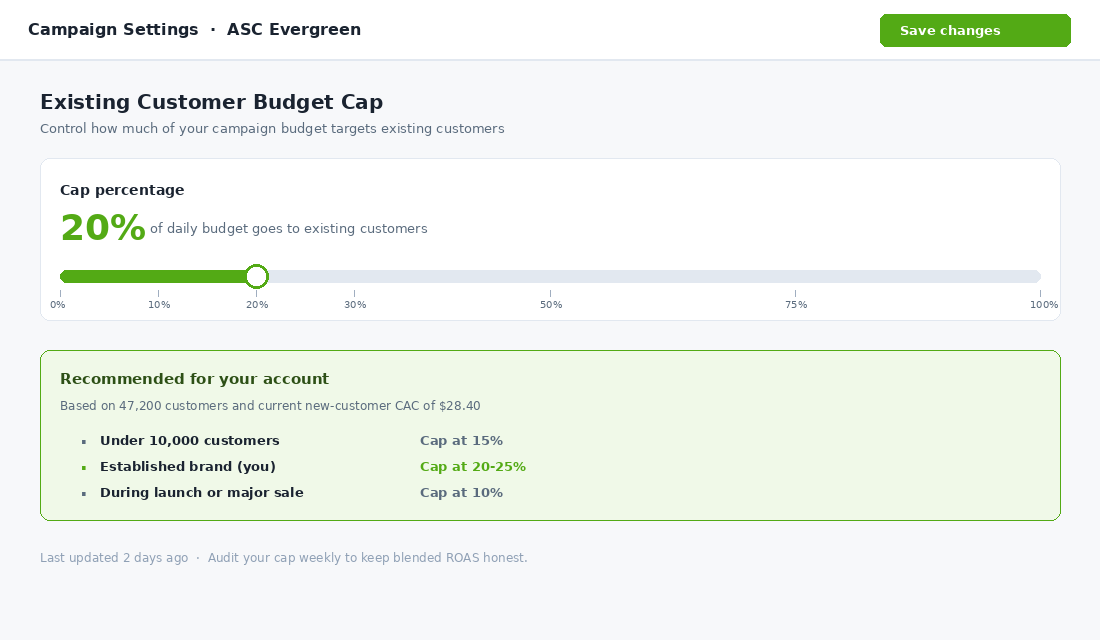
If there is one setting that separates the brands hitting 4.5x ROAS from the brands hitting 2.8x, it is the Existing Customer Budget Cap inside ASC. Get this wrong and ASC will quietly spend 60 to 70% of your budget retargeting people who would have bought anyway, inflating your reported ROAS while your new-customer acquisition flatlines.
Here is what the cap does. Without it, ASC will deliver to whoever Meta thinks is most likely to convert today. That almost always means your existing customer list, because they have already bought from you, engaged with your content, and have a Pixel event history. Easy conversions. High reported ROAS. Zero growth.
The cap forces Meta to spend a defined minimum on net-new prospects. Set it correctly and you separate “ad ROAS” from “actual incremental revenue”, which is the only number that matters when you are deciding whether to scale.
Starting settings we recommend:
- New brands under 10,000 customers: set existing customer budget cap to 15% maximum. You need new buyers more than anything else.
- Established brands with strong retention: 20 to 25%. You can afford to give Meta some easy wins because your CRM is already monetising existing customers via email and SMS.
- Brands during a launch or major sale: drop to 10% for the duration. You want net-new buyers exposed to the launch, not your existing list catching the promo.
Check the cap weekly. Meta released expanded cap controls in the March 2026 update, including the ability to set different caps by product set inside the same ASC. If you are running a hero product alongside long-tail SKUs, you can now cap aggressively on the hero and let the system push existing customers on the long tail.
Creative volume: the 20 to 50 asset rule
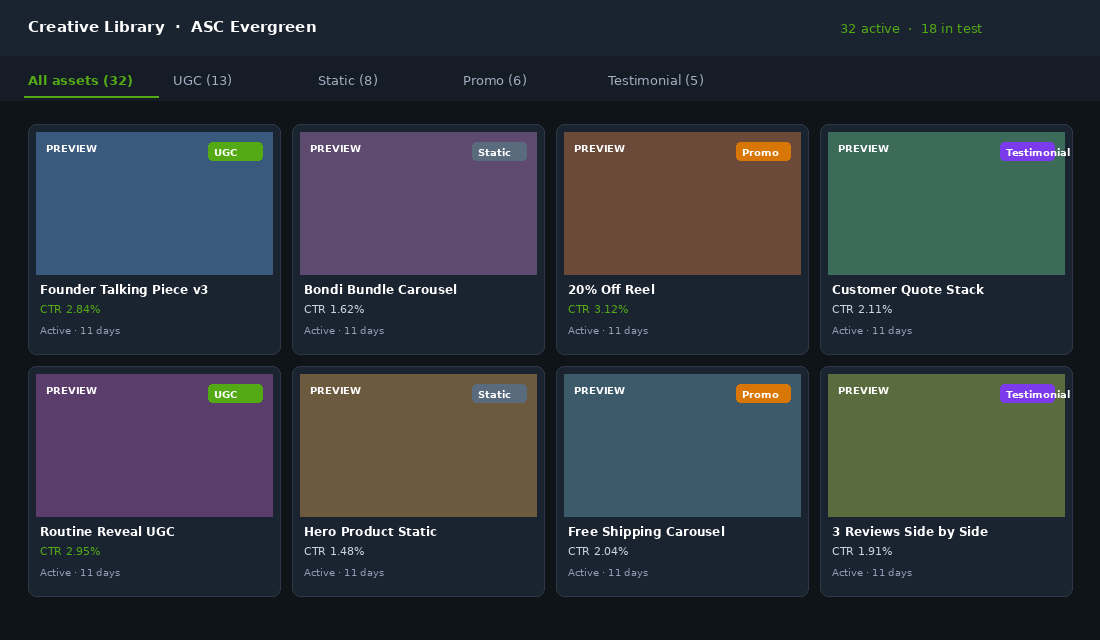
This is where most accounts collapse. ASC needs creative volume to function. Meta’s system can test up to 150 ad combinations inside a single ASC campaign, but it can only do that if you upload enough source assets to combine. The minimum to launch is 10 creatives. The minimum to win is 20 to 50.
Creative is now responsible for over 50% of Meta ad performance in 2026, more than audience, bid strategy or placements combined. The brands winning right now treat creative production as a weekly subscription, not a quarterly project. Five new concepts per week, each in three to five formats (square, vertical, story, reel cut-downs), is the minimum cadence to keep ASC fed.
The mix that performs best inside ASC right now:
- 40% UGC and creator content. Founder talking pieces, customer demonstrations, real-life unboxings. Aje and Sand & Sky are running this hard.
- 25% static product carousels. Multi-product carousels with strong product photography and concise benefit copy. Lower CPM, longer shelf life.
- 20% promotional or offer-driven. Discount overlays, free shipping callouts, bundle deals. These spike CTR but burn out faster.
- 15% testimonial and review-led. Social proof stitched into the creative. Customer quotes overlaid on product imagery. Works particularly well for Aussie skincare and supplement brands.
Refresh aggressively. The half-life of a Meta creative in 2026 is around two weeks for promotional content and four to six weeks for evergreen UGC. If your top creative has been running for three months, it is no longer your top creative. It is a fatigue trap pulling your CTR down.
The budget floor: why 3 a day is the magic number
Meta’s optimisation engine needs 50 conversion events per week per ad set to exit the learning phase. This is hard-coded into the system and has not changed since 2018, despite everything else changing. Until you hit that threshold, delivery is unstable, CPAs swing wildly, and your data is too noisy to act on.
The maths is simple. If your CPA is $20, you need 50 conversions a week, which means roughly $143 a day in spend on that ASC. If your CPA is $35 (more typical for a $100 AOV brand in fashion or beauty), you need around $250 a day to keep ASC out of the learning phase reliably.
This is the number that tells you whether ASC is the right model for your stage. Brands spending under $4,000 a month on Meta should not run ASC at all. The conversion volume is too thin for the algorithm to learn from. Stay with manual campaigns and a single ad set targeting broad audiences with five to eight creatives until your conversion volume justifies the upgrade.
Once you cross the $5,000 a month threshold, switch to ASC and watch the learning phase exit within 14 days. The CPA will be unstable in week one. By week three, the system will have found its rhythm and the ROAS will lift noticeably. We see this pattern with almost every brand we transition off manual.
Reading the data: blended vs incremental ROAS
The reported ROAS inside Ads Manager is not the number you should be making decisions on. Meta’s attribution model uses a 7-day click and 1-day view window, and inside ASC, the system will claim credit for any purchase from a customer who saw a single impression in the last week. That includes returning customers who would have bought anyway.
The two numbers that matter:
- Blended ROAS. Total Shopify revenue divided by total Meta spend. This is the honest number. It tells you what your Meta budget is actually returning at the business level.
- Incremental ROAS. Calculated by running geo-holdout tests or comparing periods with and without Meta spend. This is the gold standard but takes 30 to 60 days to measure properly.
If your Meta-reported ROAS is 5.2x but your blended Shopify revenue divided by total ad spend is 2.8x, you have an attribution problem, not a performance problem. The ads are getting credit for revenue that would have happened organically. The fix is usually a combination of tightening the Existing Customer Budget Cap and pulling more honest signal from a tool like Northbeam or Triple Whale.
For a deeper view on the metric stack that actually predicts profit, our breakdown of the Profit-Per-Visitor framework shows why ROAS alone is misleading and what to replace it with.
The weekly operating rhythm for ASC
ASC requires less tactical attention than manual campaigns, but more strategic attention. You are not pausing ad sets and bumping bids. You are feeding the system creative, watching for fatigue, and making structural decisions on caps and budgets. The right cadence:
- Monday morning: 20-minute review of the previous 7 days. Check blended ROAS, new customer acquisition, and the existing customer share. Adjust the cap if it has drifted outside your target range.
- Tuesday and Wednesday: creative production day. Brief, shoot, edit, upload. Aim for 5 new concepts uploaded by Wednesday evening.
- Thursday: launch new creative inside the existing ASC. Do not create new campaigns. Meta will fold the new assets into the existing learning.
- Friday: 10-minute fatigue check. Pull frequency by ad. If frequency is over 4 and CTR has dropped more than 25% from peak, the creative is cooked.
- Sunday: set the week ahead. Budget commits, promo overlays, calendar of creative drops.
This rhythm replaces the daily campaign-pausing dance most operators are still doing. The brands that scale past $250k a month treat their Meta operator role as 80% creative strategy and 20% campaign management. The opposite ratio is what most still default to.
When to scale up (and when to hold)
ASC scales differently from manual. The old playbook of duplicating winning ad sets or doubling daily budgets in 24-hour increments does not apply. The system rebalances itself when you increase spend, and aggressive jumps trigger a learning reset that can take 7 to 10 days to recover from.
The rule we use: scale the existing ASC budget by no more than 25% in any 7-day period. If your daily budget is $400 and the previous week’s blended ROAS hit target, increase to $500 next week. If it holds, push to $625 the week after. Compound increases beat single big jumps every time.
Hold or pull back when:
- New customer acquisition cost is rising faster than AOV. Your unit economics are deteriorating even if ROAS looks stable.
- Frequency across the campaign is over 5. The system is running out of fresh audience to deliver to. Push more creative or pull back budget until the audience pool recovers.
- Blended ROAS has fallen for two consecutive weeks. Two weeks is signal, not noise. Pause the budget increase and audit the creative library.
The brands that compound efficiently on Meta scale slow and steady, not in lurches. A 25% weekly compound from $400 a day takes you to $1,200 a day in just over a month, without resetting the learning. A single jump from $400 to $1,200 will tank performance for two weeks and put you back where you started.
The compound effect: why this rebuild changes everything
The brands we work with who fully commit to this ASC model see three things happen in the first 90 days. Blended ROAS climbs from 2.8 to 3.5x to a sustained 3.8 to 4.5x. Creative production speed doubles or triples because the team finally has a clear cadence. And the operator stops spending an hour a day inside Ads Manager, freeing up time for the work that actually moves the business forward.
The shift is real, and it is structural. You are not optimising ad sets anymore. You are running a creative production engine that feeds an AI-controlled delivery system. The skills shift from media buying to creative direction. The metric you care about shifts from ROAS to blended profit per customer acquired.
This is also why conversion rate benchmarks matter more than ever. ASC will keep sending traffic at whatever your current conversion rate is. If your PDP converts at 1.8% and your competitor’s converts at 3.1%, you cannot out-bid them on Meta. You have to fix the store to fix the ads.
Your 30-day ASC rebuild checklist
If you want to run this play in the next month, here is the order of operations:
- Week 1: audit your current account structure. Count active campaigns. If you have more than three, consolidate. Verify your Conversions API is firing correctly through Shopify’s native integration or your CAPI app.
- Week 2: brief and produce 20 to 30 new creative assets. Mix UGC, static carousels, promo-led, and testimonial formats. Upload to your library.
- Week 3: launch your single ASC Evergreen campaign with the new creative library. Set existing customer budget cap to 20%. Set daily budget at the level that hits 50+ conversions per week. Do not touch the campaign for 7 days.
- Week 4: review performance. Compare blended Shopify revenue to total Meta spend. Adjust the cap if existing customer share is too high. Schedule your weekly operating rhythm. Plan the next 20 creatives.
Print this. Stick it next to your monitor. The brands that win on Meta in 2026 are not the ones with the cleverest targeting tricks. They are the ones with the simplest account structure, the strongest creative engine, and the discipline to leave the algorithm alone long enough to learn.
Inside eCommerce Circle, building a sustainable Meta engine is one of the core pillars we work on with every member. If you want a second opinion on your ASC setup, let’s talk.
Related reading: setting up your Google Shopping product feed.