A privacy policy template for an Australian online store needs to cover seven things the Privacy Act spells out in Australian Privacy Principle 1.4: what you collect, how you collect and store it, why, how customers can access and correct it, how they complain, whether it goes overseas, and to which countries. From 10 December 2026, a covered business must also add a short section on automated decisions, and that deadline is less than two weeks away.
Most Shopify stores we audit have one of two problems. Either the privacy policy is a generic generator output that names GDPR, California and “our Data Protection Officer” but never mentions the Office of the Australian Information Commissioner (OAIC). Or it was written in 2020, before the store added Klaviyo, Meta’s Conversions API, a review app, an AI chatbot and a 3PL, and it now describes a business that no longer exists.
Neither is a small issue any more. Since the 2024 reforms, an inadequate privacy policy can attract an infringement notice without the OAIC needing to go to court. And your customers care: in the OAIC’s 2023 community attitudes survey, 70% of Australians said privacy is highly important when choosing a product or service. This guide gives you a plain-English template, a clause-by-clause walkthrough, and a 30-minute audit you can run tonight.
This article is general information, not legal advice. Laws change and every business is different, so have a lawyer review your final policy, especially if you collect health information or sell to the EU or US.
Do Small Online Stores Even Need a Privacy Policy?
Here is the honest answer. Under the Privacy Act 1988, a business with annual turnover of $3 million or less is generally exempt from the Australian Privacy Principles. Plenty of Aussie Shopify stores sit under that line.
But the exemption has holes, and ecommerce businesses fall through them more often than founders realise. According to the OAIC, a small business is still covered if it:
- Trades in personal information. If you disclose customer data to anyone else for a benefit, service or advantage (or collect it from others that way), you are likely covered regardless of turnover.
- Provides a health service. Supplements, skincare with therapeutic claims, fitness programs and wellness coaching can all edge into this territory.
- Is related to a covered business. If your store sits inside a group where another entity turns over more than $3 million, check this carefully.
- Has opted in. Some businesses choose to opt in to show customers they take privacy seriously.
Then there are the practical reasons. Shopify links your privacy policy in the checkout footer automatically, Google Merchant Center and Meta expect a working policy URL, payment providers ask for one, and the Spam Act requires you to be clear about how you got someone’s consent to email them. If you are growing towards $3 million, you will cross the threshold mid-year without noticing.
Our view is simple. Write a policy that meets the APP standard now, even if you are technically exempt. It costs you an hour, it builds trust with the 84% of Australians who told the OAIC they want more control over how their information is used, and it means nothing breaks the day your turnover ticks over.
What Changed in 2025 and 2026 (and Why the Date Matters)
The Privacy and Other Legislation Amendment Act 2024 was the first tranche of the biggest privacy overhaul in decades. Three parts of it matter for an online store.
1. Cheaper, faster enforcement
The OAIC now has a tiered penalty system. Serious interferences with privacy can attract penalties up to the greater of $50 million, three times the benefit obtained, or 30% of adjusted turnover. Below that sits a mid-tier penalty of up to $3.3 million, and a lower tier for administrative failures with a civil penalty of up to $330,000 and infringement notices of $19,800 per contravention for most companies. Law firm Ashurst notes that inadequate privacy policies under APP 1.3 and 1.4 are a textbook example of what those infringement notices are for.
2. A statutory tort for serious invasions of privacy
Since June 2025, individuals can sue directly for serious invasions of privacy. The bar is high (the invasion must be serious, and intentional or reckless), but it is another reason to know exactly what data you hold and why.
3. Automated decision-making disclosure from 10 December 2026
This is the one with a deadline. New APP 1.7 to 1.9 require covered businesses to explain in their privacy policy when a computer program makes, or substantially helps make, a decision that could significantly affect a person’s rights or interests using their personal information.
According to the OAIC’s final guidance (released 30 September 2026 and summarised by Allens), “computer program” is broad. It covers rule-based tools, AI and machine learning, chatbots, and even spreadsheets. The guidance flags that differential or personalised pricing may be captured, which matters if you run dynamic discounts, AI-driven offers or automated fraud screening that can cancel orders.
You do not need to publish your algorithms. You need to disclose the kinds of personal information used, the kinds of decisions made solely by programs, and the kinds of decisions where a program does something substantially related to the decision. Categories are fine.
The 7 Things APP 1.4 Says Your Privacy Policy Must Cover
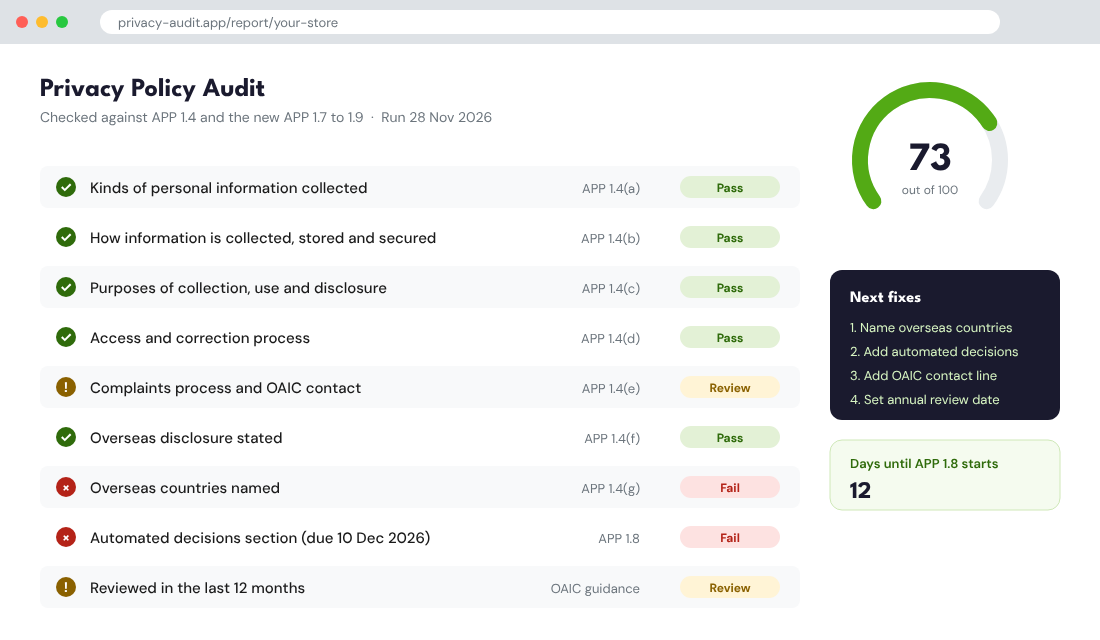
Before the template, here is the legal checklist it is built on. APP 1.4 says a privacy policy must contain information about:
- The kinds of personal information you collect and hold (names, emails, addresses, order history, device data).
- How you collect and hold it, including how you store and secure it.
- The purposes for which you collect, hold, use and disclose it.
- How a customer can access their information and ask for it to be corrected.
- How a customer can complain about a breach of the APPs, and how you will handle that complaint.
- Whether you are likely to disclose information overseas.
- The countries those overseas recipients are likely to be in, if it is practicable to say.
The OAIC adds some practical expectations: write it in plain English, avoid legal jargon, keep it up to date, make it available free of charge, and review it at least once a year. A layered approach (a short summary up top linking to the detail) is explicitly encouraged.
Notice what is not on that list: a requirement to sound like a law firm. The best policies we see read like the rest of the brand.
The Overseas Question Most Stores Get Wrong
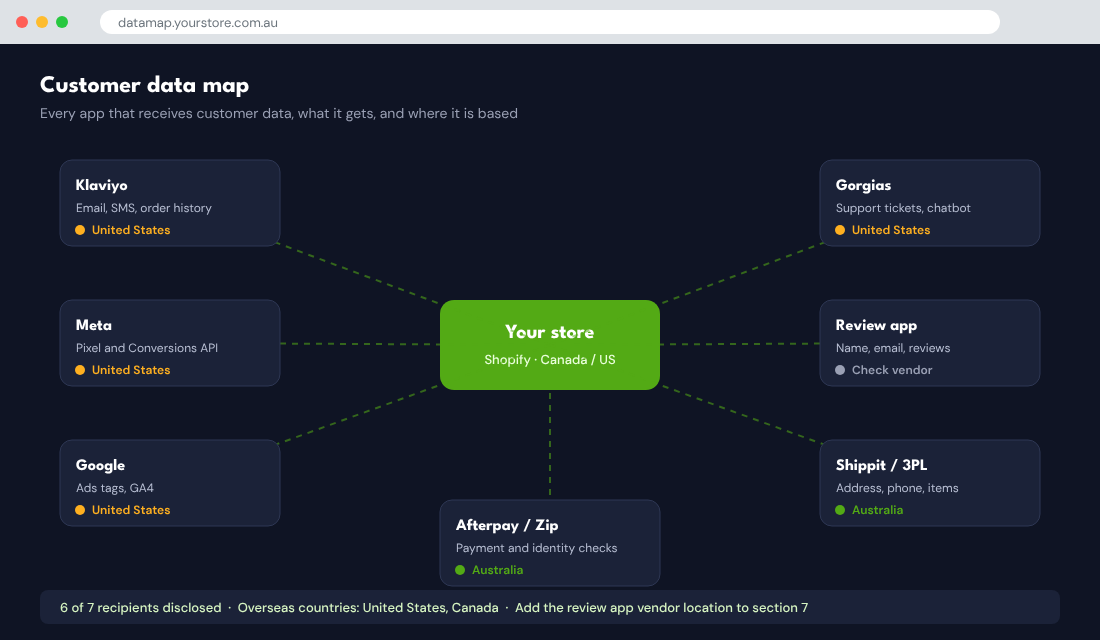
Item seven trips up nearly every Australian store, because almost every Shopify tech stack sends data offshore. Shopify itself is a Canadian company with significant infrastructure in the United States. Klaviyo, Meta, Google, Gorgias, Okendo, Judge.me and most AI tools process data primarily in the US. Your 3PL might be local, but its software might not be.
The OAIC’s 2023 survey found that 90% of Australians are concerned about organisations sending their information overseas. Saying “we may transfer data to third parties” without naming countries is both unhelpful and, where it is practicable to name them, non-compliant.
The fix is a quick data map. List every app that touches customer data, note what it receives and where it is based, and you have both your overseas disclosure and the “who we share with” section of your policy.
Kmart Australia is a good model here. Its privacy policy, last updated in May 2026, has a dedicated “Transfer of information overseas” section that names the United States, the United Kingdom, European countries and specific Asia Pacific countries including China, India and Singapore. You do not need Kmart’s scale to copy that level of clarity. A store with eight apps can do it in a single paragraph.
Free Privacy Policy Template for Australian Online Stores
Copy this template into a document, replace everything in [square brackets], and delete anything that does not apply. It is written for a typical Shopify store selling physical products to Australian consumers. Keep the headings: they map directly to APP 1.4 and the new APP 1.8.
Copy this template
[Store name] Privacy Policy
Last updated: [date]

1. Who we are
[Legal entity name] (ABN [number]), trading as [store name] ("we", "us"). We sell [products] online at [domain]. We handle personal information in line with the Privacy Act 1988 (Cth) and the Australian Privacy Principles.

2. The short version
We collect what we need to process your orders, deliver them, support you and, if you agree, send you marketing. We never sell your personal information. Some of our service providers are overseas; they are listed in section 7.

3. What we collect
- Contact details: name, email, phone, delivery and billing address.
- Order details: products purchased, order value, returns and support history.
- Payment details: processed by [Shopify Payments / Stripe / PayPal / Afterpay]. We do not store full card numbers.
- Account and preference details: login, wishlists, survey answers, quiz results.
- Device and usage data: IP address, browser, pages viewed, collected through cookies and pixels.
- [Any sensitive information, e.g. health information from a skin quiz. Only collect this with consent and say why.]

4. How we collect and store it
We collect information when you place an order, create an account, join our email or SMS list, contact us, leave a review, enter a competition or browse our site. Our store runs on Shopify, and your information is stored by Shopify and the providers listed in section 7. We protect it with [two-factor authentication on all staff accounts, role-based access, encrypted connections] and we only keep it as long as we need it for the purposes below or as the law requires.

5. Why we use it
- To process, deliver and support your orders, returns and warranty claims.
- To send marketing by email or SMS if you have opted in. Every message has an unsubscribe link.
- To show you relevant ads on platforms such as Meta and Google, using cookies and pixels.
- To prevent fraud and protect our store.
- To improve our products, website and service.
- To meet our legal obligations (tax, consumer law, record keeping).

6. Automated decisions
We use software to help make some decisions that use your personal information:
- [Fraud screening: our payment and fraud tools assess orders using order, payment, device and address data. Orders flagged as high risk may be held or cancelled. A team member reviews cancellations before they are final.]
- [Personalised offers: we may show different discounts or product recommendations based on your purchase and browsing history.]
- [Customer service chatbot: our chatbot answers common questions using your order details. It cannot refuse refunds; a person handles those.]
If you want to know more about a decision that affected you, contact us using the details in section 9.

7. Who we share it with, and where they are
We share information only with providers who help us run our business:
- Shopify (ecommerce platform): Canada and United States
- [Klaviyo] (email and SMS): United States
- [Meta and Google] (advertising and analytics): United States
- [Gorgias] (customer support): United States
- [Judge.me / Okendo] (reviews): [country]
- [Shippit / Australia Post / your 3PL] (delivery): Australia
- [Afterpay / Zip] (payments): Australia
We may also disclose information where the law requires it.

8. Access and correction
You can ask for a copy of the personal information we hold about you, or ask us to correct it, at any time by contacting us. We will respond within 30 days and there is no charge.

9. Questions and complaints
Contact our privacy officer at [privacy@yourstore.com.au] or [postal address]. We will acknowledge your complaint within [5] business days and aim to resolve it within 30 days. If you are not satisfied, you can contact the Office of the Australian Information Commissioner at oaic.gov.au or 1300 363 992.

10. Changes to this policy
We review this policy at least once a year and whenever we add a new tool that handles customer data. The date at the top shows the latest version.
That is roughly 650 words, which is exactly where you want to be. Long enough to be specific, short enough that a customer might actually read section 2.
Clause by Clause: Where Stores Usually Go Wrong
Section 3: Be honest about pixels
If you run the Meta pixel, Google tags or TikTok’s pixel, you collect device and browsing data whether you think of it as “personal information” or not. IP addresses combined with order history can identify someone. Say so plainly.
Section 5: Separate service from marketing
Customers accept that you need their address to ship an order. They feel differently about being retargeted for a month. Listing marketing as its own purpose, with the opt-in and unsubscribe spelled out, lines up with your Spam Act obligations as well. Our guide to Spam Act compliance for Shopify stores covers the consent side in detail.
Section 6: Do not skip automated decisions
Shopify’s fraud analysis, Shopify Protect, Signifyd-style screening, AI discount engines and support chatbots are all worth checking against the new test. The OAIC survey found 96% of Australians want conditions in place before AI is used to make decisions that affect them. A clear, calm paragraph saying what you automate and where a human steps in is a trust builder, not a confession.
Section 9: Name the OAIC
Generic policies often point to “your local data protection authority”, which is a GDPR phrase. Australian customers should be told they can go to the OAIC. Kmart’s policy has a dedicated “How to contact OAIC” section; yours can be a single sentence.
Section 10: Put a review date in the calendar
Bellroy, one of Australia’s best-known DTC brands, has a privacy policy with sensible plain-English headings like “Who are ‘we’?” and “International data transfers”. It is a solid structure to borrow. Yet the page says it was last reviewed on 1 July 2020. The lesson for smaller stores: a good policy goes stale quietly. Tie your review to your EOFY checklist so it happens every July.
How to Set Up Your Privacy Policy in Shopify (Step by Step)
Shopify gives you two options: let Shopify’s automated policy manage it, or write your own. The automated version is a reasonable starting point for a brand-new store, but it cannot know about your Klaviyo flows, your 3PL or your chatbot, and it will not contain an automated decisions section tailored to your stack. For an established store, write your own using the template above.
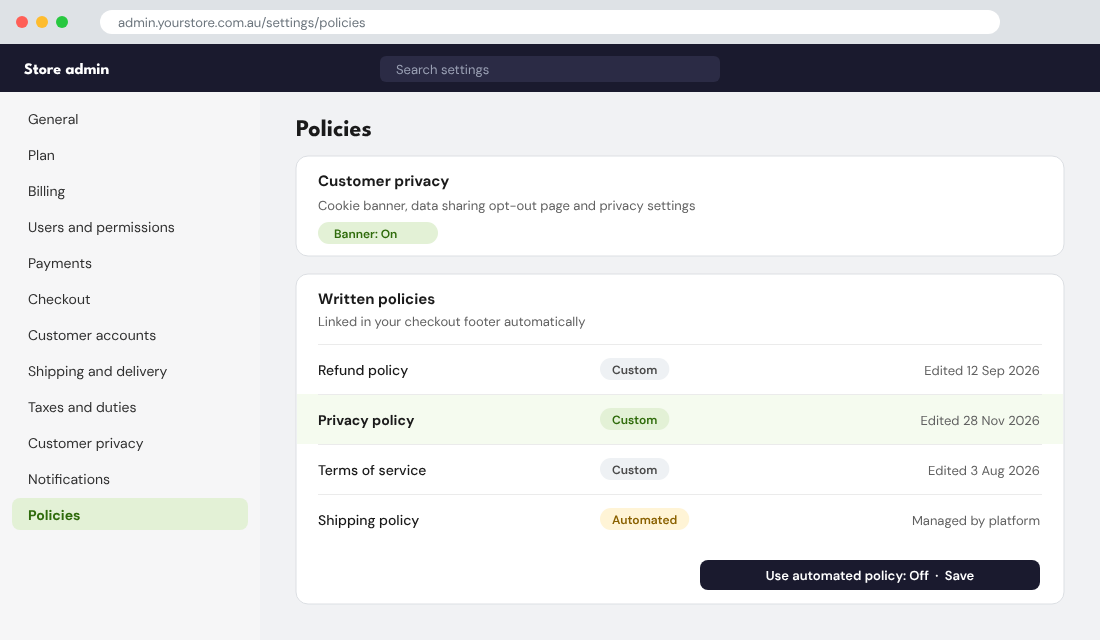
Here is how to add a custom policy, based on Shopify’s help centre:
- Open your policies. In the Shopify admin, go to Settings then Policies.
- Select your privacy policy. In the Written policies section, click Privacy policy.
- Turn off automation. If Use automated policy is switched on, turn it off so your custom text is not overwritten.
- Paste and format. Paste your completed template into the editor. Use headings for each numbered section so it scans well on mobile.
- Save. Click Save to publish. Your policy is now live at yourdomain.com.au/policies/privacy-policy and linked in the checkout footer automatically.
- Add it to your footer menu. Shopify does not add the policy to your storefront menus. Go to Content then Menus, open your footer menu, click Add menu item, search for your privacy policy, add it and click Save menu.
- Check your cookie banner. While you are in Settings, open Customer privacy and confirm your cookie banner and data sharing opt-out settings match what your policy says.
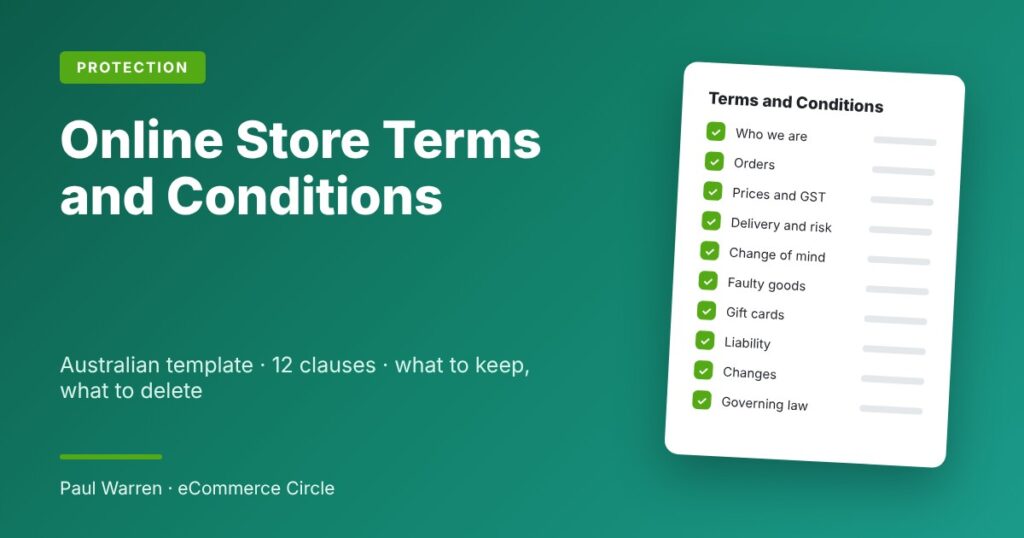
Time required: about 15 minutes once your template is filled in. If you also need a terms and conditions page, our guide to online store terms and conditions follows the same approach.
The 30-Minute Privacy Policy Audit Checklist
Already have a policy? Run it against this checklist. Each “no” is a fix to make before 10 December.
Privacy policy audit checklist
- ☐ The policy names your legal entity and ABN.
- ☐ It lists the kinds of personal information you actually collect today, including pixel and device data.
- ☐ It explains how you store and secure data (2FA, access controls, retention).
- ☐ Marketing is a separate purpose from order fulfilment, with opt-in and unsubscribe explained.
- ☐ Every app that receives customer data is covered, either by name or by clear category.
- ☐ Overseas recipients are disclosed and the countries are named.
- ☐ There is an automated decisions section covering fraud screening, personalised pricing or offers, and chatbots (if you use them).
- ☐ Customers can see how to access and correct their information, free of charge.
- ☐ There is a named complaints contact, a response timeframe and a pointer to the OAIC.
- ☐ No leftover references to GDPR roles, US states or a “Data Protection Officer” unless they genuinely apply.
- ☐ The “last updated” date is within the last 12 months.
- ☐ The policy is linked in your footer, checkout and email signup forms.
If you hit a breach scenario while doing this audit (for example, you discover a former VA still has admin access), stop and fix that first. Notifiable data breaches hit a record 1,205 notifications in 2025, up 8% on 2024, according to the OAIC, with malicious or criminal attacks the leading cause. Our Shopify privacy compliance guide covers access reviews, retention and breach readiness in more depth.
How a Good Privacy Policy Pays You Back
It is tempting to treat this as pure admin. It is not. Privacy sits in the Protection pillar of the 10 P’s, and like the rest of that pillar, it compounds quietly.
- Trust at the point of purchase. Seven in ten Australians weigh privacy when choosing where to buy. A clear policy linked from checkout and signup forms removes a reason to hesitate.
- Cleaner marketing data. Mapping your data flows for section 7 usually uncovers apps you stopped using but never disconnected. Removing them reduces risk and often speeds up your site.
- Smoother platform reviews. Google Merchant Center, Meta, payment providers and BNPL partners all check for a working, accurate policy.
- Lower regulatory risk. A $19,800 infringement notice would wipe out the margin on a lot of orders. An hour of work removes most of that exposure.
- A sellable business. When you come to sell, buyers and their lawyers look at privacy and data handling. A documented, current policy is one less red flag in due diligence.
The stores that handle this well do not do anything clever. They write it once properly, link it everywhere, and review it every July and every time they add a new app.
Quick Answers
Is a privacy policy a legal requirement in Australia?
For businesses covered by the Privacy Act (generally those turning over more than $3 million, plus some smaller businesses such as those that trade in personal information or provide health services), yes. APP 1.3 requires a clearly expressed, up-to-date privacy policy. For everyone else, it is still expected by Shopify checkout, ad platforms and payment providers.
Can I use Shopify’s automated privacy policy?
You can, and it is better than nothing for a new store. Once you add email marketing, review apps, a 3PL or AI tools, a custom policy will describe your business far more accurately.
How often should I update my privacy policy?
The OAIC suggests reviewing it at least annually. In practice, update it whenever you add or remove an app that handles customer data, and before 10 December 2026 if you use automated decision-making.
Make Protection Part of Your Operating Rhythm
Inside eCommerce Circle, Protection is one of the 10 P’s we work through with every member, alongside the growth levers that get more attention. A current privacy policy, clean app access and a breach plan take a few hours to put in place and protect years of work. If you want help building that rhythm into your business, connect with the eCommerce Circle team. And if you want to see which of the 10 P’s is capping your store right now, take the free More Orders Scorecard. It takes two minutes.
Sources
- OAIC, APP Guidelines Chapter 1: APP 1
- OAIC, Small business and the Privacy Act
- OAIC, Australian Community Attitudes to Privacy Survey 2023
- OAIC, Data breach notifications increase to all-time high in 2025
- Allens, Mandatory automated decision-making disclosure requirements are coming
- Ashurst, Australia’s first tranche of privacy reforms: a deep dive
- Shopify Help Center, Adding store policies