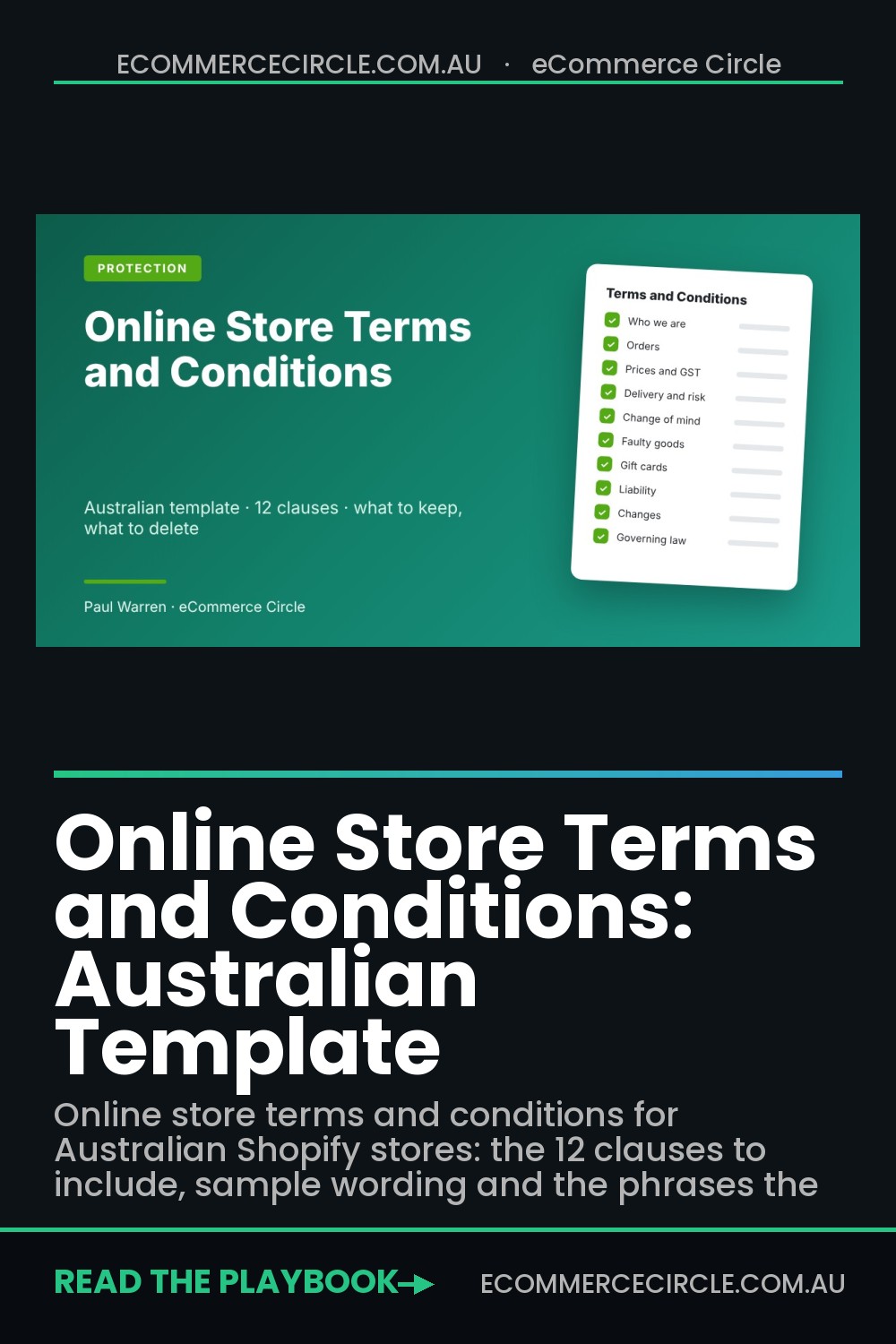
Online store terms and conditions are the contract between you and every customer who orders from you. In Australia they need 12 clauses, they cannot remove a customer’s rights under the Australian Consumer Law, and on Shopify they live in Settings, then Policies. The template below gives you plain-English wording for each clause.
Most store owners get this page one of two ways. They click the button that generates a generic policy and never read it, or they copy the terms from a bigger brand and swap the name. Both feel finished. Neither has been checked against Australian law, and the copied one usually still mentions a US state.
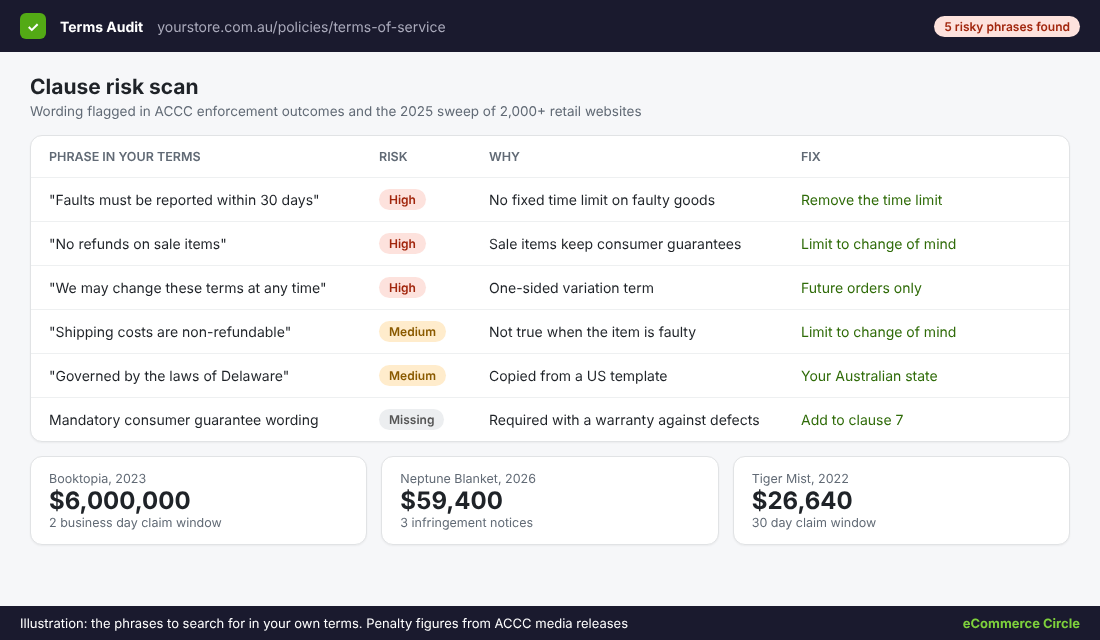
That matters more than it used to. In February 2025 the ACCC reviewed more than 2,000 Australian retail websites and sent warning letters over terms that could mislead shoppers about their rights. Booktopia paid $6 million over two sentences in its Terms of Business. A small online blanket retailer paid $59,400 in September 2026. The stores that get this right treat their terms as a working document that matches how they actually trade, and it takes about an hour to do properly.
A quick note before we start. I’m an ecommerce coach, not a lawyer, and this is general information rather than legal advice. Use the template to get a solid first draft and to spot the risky wording, then have an Australian lawyer review it if you sell anything regulated, run subscriptions or turn over serious volume.
What terms and conditions do for an online store
Your terms and conditions set out the rules of the sale. When a contract forms, what the price includes, when the goods become the customer’s problem, what happens when something goes wrong, and which state’s law applies if you end up in a dispute.
You are not legally required to publish a document called “terms and conditions”. You are required to follow the Australian Consumer Law, display prices properly and honour consumer guarantees whether you have terms or not. So why bother?
- They give you a position when things go wrong. A pricing glitch lists a $400 jacket at $40. A customer claims a parcel never arrived. Someone stacks four discount codes. Without terms, you are negotiating from scratch every time.
- They help you win chargebacks. Card schemes ask what the customer agreed to at purchase. A linked policy the buyer accepted at checkout is evidence. A blank page is not.
- They stop arguments before they start. Clear delivery windows, a stated change of mind position and a named contact method cut support tickets.
- They show the regulator you know the rules. A terms page that states consumer guarantee rights correctly is the cheapest compliance signal you can send.
One thing terms cannot do is override the law. You cannot contract out of consumer guarantees, and a clause that tries to is worse than no clause at all, because the clause itself can be the breach.
Terms and conditions vs your other policy pages
Store owners often blur four documents together. They do different jobs, and Shopify gives each one its own slot.
| Document | What it covers | Who it protects |
|---|---|---|
| Terms and conditions (Shopify calls it Terms of service) | The contract of sale: orders, price, payment, risk, liability, disputes | You and the customer |
| Returns policy | Change of mind rules and how faulty items are handled | Mostly the customer |
| Shipping policy | Carriers, dispatch times, costs, delivery windows | Both |
| Privacy policy | What personal information you collect and what you do with it | The customer |
Keep them separate and have your terms point to the others. If you repeat your returns rules inside your terms, you now have two versions to keep in sync, and the day they drift apart a customer will quote the one that suits them.
If you have not written the other pages yet, start with our Shopify returns policy template for Australia and the shipping policy template. Both are written to sit alongside the terms in this article.
The Australian laws your terms have to respect
You do not need to read legislation. You do need to know the four rules that catch online stores most often.
1. Consumer guarantees cannot be excluded
Every product you sell to a consumer comes with automatic guarantees: acceptable quality, fit for purpose, matches the description. If a product has a major failure, the customer chooses between a refund and a replacement. No clause, sale sticker or “final sale” banner changes that.
There is also no fixed deadline. ACCC Commissioner Liza Carver put it plainly in the Tiger Mist matter: “a consumer’s right to a remedy for a faulty product is not limited to a specific time period”. A 30-day claim window on faulty goods is the single most common mistake in Australian store terms.
2. Unfair contract terms now carry penalties
Your terms are a standard form contract. The customer cannot negotiate them, they take it or leave it. Since 9 November 2023, proposing or relying on an unfair term in a standard form contract is a breach with penalties attached, not just a clause a court can strike out.
The maximum for a company is the greatest of $50 million, three times the benefit gained, or 30% of turnover during the breach period. For an individual it is $2.5 million. No one expects a $1 million store to be fined $50 million, but the direction is clear. A term is at risk if it creates a significant imbalance, is not reasonably necessary to protect your legitimate interests, and would cause the customer detriment. The classic examples are terms that let only you vary the contract, only you cancel, or only you decide whether there has been a breach.
3. Prices must be the total price
If you are registered for GST, the price a consumer sees must be the full price including GST. Mandatory fees that apply to every order belong in the headline price, not at the last step of checkout.
4. Gift cards must run for at least three years
Since 1 November 2019, most gift cards sold in Australia need a minimum three-year expiry, with the expiry date shown, and no post-purchase fees. If your terms mention gift cards, they need to match. We cover the setup in our Shopify gift cards guide.
Real penalties: what the wrong wording has cost
These are all published ACCC outcomes. Look at how small the offending wording was in each case.
| Business | What the terms or statements said | Outcome |
|---|---|---|
| Booktopia (March 2023) | Refunds only if you notified within 2 business days of receiving a faulty item. Digital products non-refundable for any reason | $6 million penalty in the Federal Court |
| Tiger Mist (May 2022) | “All claims need to be made within 30 days of receiving your order”, and items had to be unworn with tags attached | $26,640 across two infringement notices |
| Neptune Blanket (September 2026) | Emails implied exchanges were discretionary or store credit only. Returns page was missing the mandatory warranty wording | $59,400 across three infringement notices |
Booktopia’s terms ran on its site from at least January 2020 to November 2021. The ACCC said it did not know how many customers had been put off asking for a refund because of what they read. That is the point. You do not need to refuse a single refund to be in breach. The statement on the page is enough.
Neptune Blanket is the one to pay attention to if you run a lean Shopify store. It is an online-only retailer, the penalty worked out at $19,800 per notice, and one of the three notices was for leaving out a required paragraph. ACCC Commissioner Dr Philip Williams also noted that fixing things after the regulator calls “may not prevent enforcement action”.
And in mid-2026 the ACCC took Amazon Australia to the Federal Court, alleging that terms letting it change its Prime service and vary its contract were unfair. More than 850,000 annual subscribers were moved to a service with ads. Those are allegations and the case is still running, but it tells you where the regulator is looking: one-sided “we can change anything, anytime” clauses.
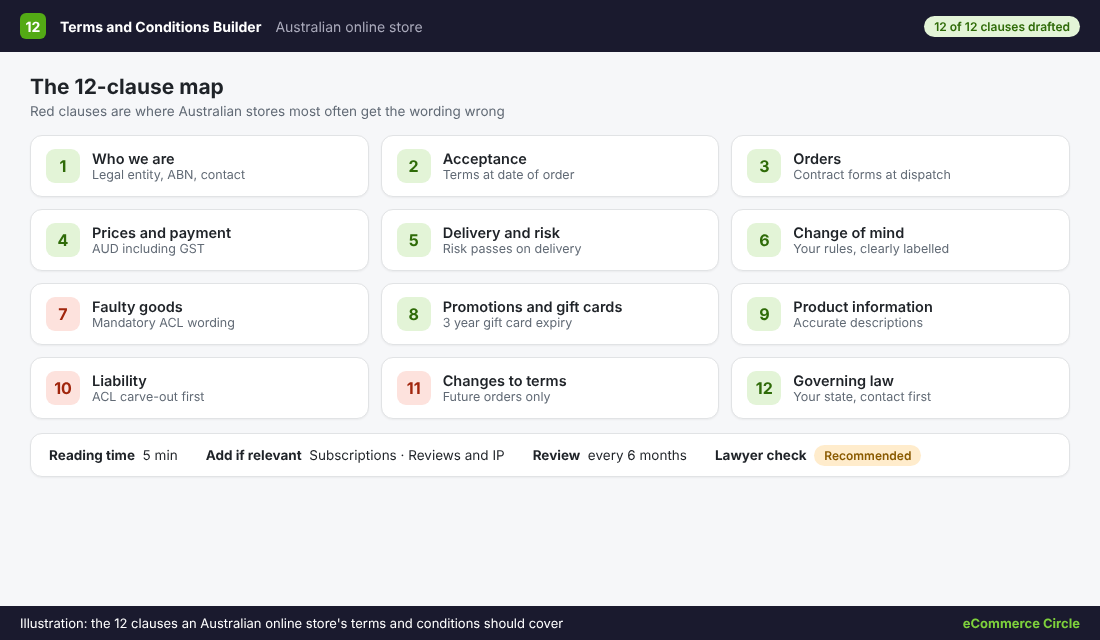
The 12 clauses every Australian online store needs
Here is the template. Each clause has the job it does and sample wording you can adapt. Replace anything in square brackets, delete clauses that do not apply to you, and keep the language this plain. A customer should be able to read the whole page in five minutes.
1. Who we are
States the legal entity behind the store, so the customer knows who the contract is with.
“This website is operated by [Legal Entity Pty Ltd] (ABN [number]), trading as [Store Name]. You can reach us at [email] or [phone], Monday to Friday, 9am to 5pm AEST.”
2. Acceptance of these terms
“By placing an order you agree to these terms. If you do not agree, please do not place an order. These terms apply to your order as they appeared on the date you placed it.”
That last sentence does real work. It tells customers you will not change the deal after they have paid, which is exactly the fairness test regulators apply.
3. Orders and when a contract forms
This is your pricing error protection.
“Your order is an offer to buy. We accept your offer when we send a dispatch confirmation. Before then, we may decline or cancel an order if a product is unavailable, there is an obvious error in the price or description, or we suspect fraud. If we cancel, we will refund you in full to your original payment method.”
Keep the cancellation reasons specific. “We may cancel any order for any reason” is the kind of one-sided term that invites trouble.
4. Prices, GST and payment
“All prices are in Australian dollars and include GST. Delivery charges are shown before you pay. We accept [Visa, Mastercard, PayPal, Afterpay, Shop Pay]. Payment is taken when you place your order.”
If you are not registered for GST, drop the GST words rather than leaving them in.
5. Delivery and risk
“We deliver within Australia [and to the countries listed in our Shipping Policy]. Delivery times are estimates. Ownership of the goods passes to you when we receive full payment. Risk of loss or damage passes to you when the goods are delivered to the address you gave us. Full details are in our Shipping Policy.”
Do not write “we are not responsible for parcels once they leave our warehouse”. Customers are entitled to receive what they paid for, and that sentence reads as an attempt to dodge it.
6. Change of mind returns
This is the one area where you set the rules. Offering change of mind returns is your choice, and so are the conditions.
“If you change your mind, you can return unused items in original condition within [30] days for a [refund / store credit]. You pay return postage for change of mind returns. See our Returns Policy for how to start a return. This clause does not limit your rights under clause 7.”
7. Faulty, wrongly described or damaged goods
The clause that keeps you out of the ACCC’s sweep. Use the mandatory wording that applies to warranties against defects under the Australian Consumer Law, close to word for word:
“Our goods come with guarantees that cannot be excluded under the Australian Consumer Law. You are entitled to a replacement or refund for a major failure and compensation for any other reasonably foreseeable loss or damage. You are also entitled to have the goods repaired or replaced if the goods fail to be of acceptable quality and the failure does not amount to a major failure.”
Then add how to make a claim: “Contact us at [email] with your order number and a description or photo of the issue. We cover the reasonable cost of returning faulty items.”
No time limit. No “original packaging” condition. No restocking fee. The ACCC lists the current mandatory wording on its website, so check it when you paste this in.
8. Promotions, discount codes and gift cards
“Discount codes cannot be combined unless we say so, cannot be applied after an order is placed, and have no cash value. Gift cards are valid for three years from the date of purchase and cannot be redeemed for cash except where the law requires.”
9. Product information
“We take care to describe and photograph our products accurately. Colours may vary slightly between screens. Sizes and weights are approximate where we say so.”
This manages expectations. It does not excuse a wrong description, and you should not word it as if it does.
10. Our liability
The clause people copy from American sites and get badly wrong.
“Nothing in these terms excludes, restricts or modifies any right or remedy you have under the Australian Consumer Law. Subject to that, and to the extent the law allows, we are not liable for indirect or consequential loss arising from your use of this website.”
Lead with the carve-out. A liability clause that opens with “we accept no liability whatsoever” is misleading on its face for consumer sales in Australia.
11. Changes to these terms
“We may update these terms from time to time. The updated terms apply to orders placed after the date they are published. They do not change orders you have already placed.”
Compare that with “we may change these terms at any time without notice”, which is the wording at the centre of the current unfair terms cases.
12. Governing law and contact
“These terms are governed by the laws of [Victoria], Australia. If you have a concern, please contact us first at [email] so we can try to resolve it.”
Add two more clauses only if they apply to you. Subscriptions: billing frequency, how to cancel, the cut-off before the next charge, and how price changes are notified in advance. Intellectual property and reviews: your content is yours, and customers give you permission to display the reviews and photos they submit.
Wording to delete from your terms today
Open your current terms and search for these phrases. Every one of them appeared in either an ACCC enforcement outcome or the 2025 sweep findings.
| If your terms say | Why it is a problem | Replace it with |
|---|---|---|
| “No refunds on sale items” | Sale goods carry the same consumer guarantees | “Change of mind returns do not apply to sale items. Your Australian Consumer Law rights are not affected.” |
| “Faults must be reported within 7 / 14 / 30 days” | No fixed time limit applies to faulty goods | Remove the time limit from the faulty goods clause |
| “Items must be returned in original packaging” (for faults) | Not a condition of a remedy for a faulty product | Keep it for change of mind only |
| “Made to order items cannot be returned” | True for change of mind, false for faults | “Made to order items are excluded from change of mind returns.” |
| “Shipping costs are non-refundable” | Not when the item was faulty | “Shipping is non-refundable for change of mind returns.” |
| “A restocking fee applies to all returns” | Cannot be charged on a faulty return | Limit it to change of mind, or drop it |
| “Warranty claims must go to the manufacturer” | The customer can come to you as the seller | “You can contact us or the manufacturer.” |
| “We may change these terms at any time” | One-sided variation, unfair term risk | “Changes apply to future orders only.” |
Notice the pattern. Almost every fix is the same move: narrow the rule to change of mind, and say out loud that statutory rights are untouched.
How to add terms and conditions in Shopify
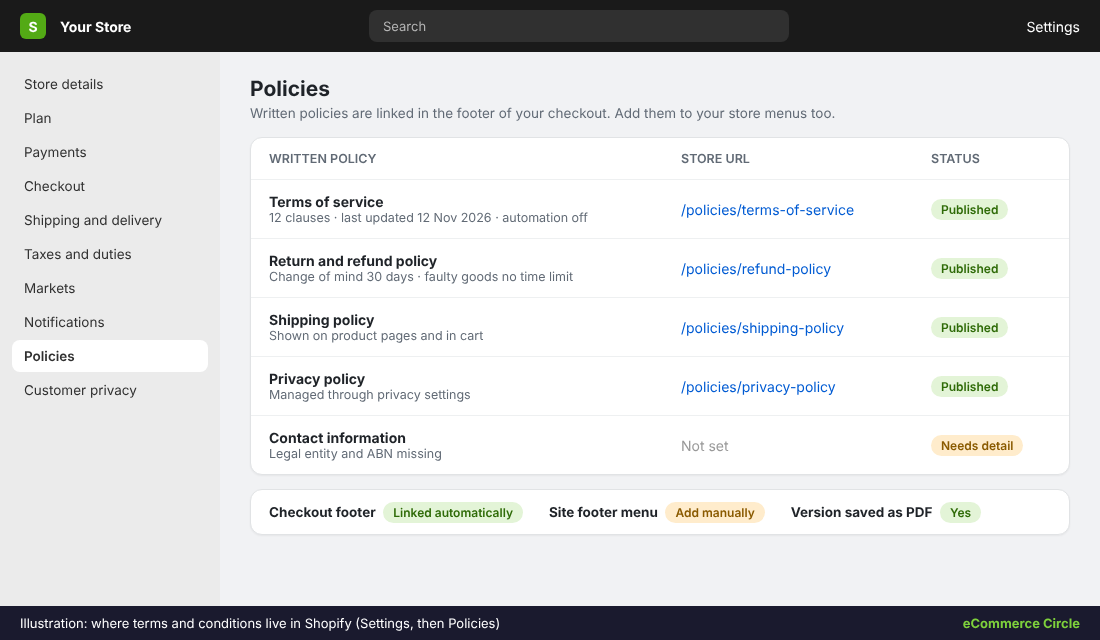
Shopify has a built-in policy area that publishes your terms at a fixed URL and links them from checkout automatically. Setup takes about ten minutes once your wording is ready.
- Open the policy editor. In your Shopify admin, go to Settings, then Policies. Under Written policies, click Terms of service.
- Decide on automation. Shopify can generate an automated policy. If you turn on “Use automated policy” it replaces whatever is in the box, so copy your existing text somewhere safe first. For this job, leave automation off and paste in your own terms built from the 12 clauses above.
- Format and save. Use headings for each clause so the page is scannable on a phone. Click Save. Your terms are now live at yourstore.com.au/policies/terms-of-service.
- Check the checkout footer. Shopify links saved policies in the checkout footer automatically. Place a test order and confirm the link opens.
- Add it to your site footer. Go to Content, then Menus, open your footer menu, click Add menu item, search for the policy and save. Checkout links are not enough on their own. Customers and regulators look in the footer.
- Do the same for returns, shipping and privacy. Each has its own slot on the same Policies screen.
A word on Shopify’s generated template. Shopify says its automated policies are for information only, are not legal advice, and that it “isn’t liable for your use or publication of these materials”. It is a starting structure written for a global audience. It does not include the Australian mandatory wording in clause 7, so do not publish it untouched.
Should you add an “I agree” tick-box?
Terms that a customer actively accepts are easier to rely on than terms sitting quietly in a footer. Research from the Consumer Policy Research Centre found 94% of Australians do not read all the policies that apply to them, and one international estimate put the time needed to read them all at 244 hours a year. Nobody is reading your terms for fun. What matters is that you gave clear notice and they took a clear action.
For most stores, the checkout footer link plus a line near the pay button is reasonable notice. If you sell high-value items, custom products or subscriptions, add a tick-box. On the cart page that is a small theme edit or an app such as a terms and conditions checkbox app from the Shopify App Store. Inside checkout itself it needs a checkout app, and some checkout customisation is limited to Shopify Plus.
When to pay a lawyer and what it costs
A template and an hour of care is enough for a simple store selling physical products to Australian consumers. Get a lawyer involved when any of these apply:
- You run subscriptions or memberships. Auto-renewal, cancellation and price change terms are where the regulator is currently focused.
- You sell regulated goods. Food, supplements, cosmetics, children’s products, alcohol, vapes or anything with a safety standard.
- You sell wholesale as well as retail. Business customers need different terms, and small business contracts get unfair terms protection too if the buyer has fewer than 100 staff or under $10 million turnover.
- You sell overseas. Other countries’ consumer laws can apply to your sales there.
- You have had a dispute or chargeback your terms did not cover.
On cost, online legal services sit at the low end. Lawpath, for example, advertises unlimited legal documents for $45 a month and offers a store terms and conditions template. Fixed-fee firms that draft ecommerce terms from scratch charge more, and it is worth getting two quotes. Either way you are paying for a document that gets tested the first time something goes wrong, which is cheap insurance next to a $19,800 infringement notice.
For the wider legal picture, including business structure, privacy and trade marks, read Legal Essentials for Australian Shopify Stores.
Your 30-minute terms and conditions audit
Run this once now and again every six months, or whenever you change how you trade.
- Legal entity and ABN are correct. Many stores still show a sole trader name after moving to a company.
- No US wording. Search for “state of”, “arbitration”, “class action” and “DMCA”.
- Prices stated as AUD including GST, if you are registered.
- Contract forms at dispatch, with specific reasons you can cancel.
- Faulty goods clause has no time limit, no packaging condition and no fees.
- Mandatory consumer guarantee wording is present, word for word.
- Change of mind rules are labelled as change of mind.
- Sale, custom and clearance exclusions apply to change of mind only.
- Gift card expiry says three years.
- Liability clause opens with the Australian Consumer Law carve-out.
- Variation clause applies to future orders only.
- Terms match what your support team actually does. Booktopia’s penalty covered what staff said on calls, not only what the website said.
- Linked in the footer and the checkout, and the links work on mobile.
- A “last updated” date at the top, and a saved copy of every previous version.
That last item is the one nobody does. If a customer disputes an order from March, you need to prove what your terms said in March. Save a PDF each time you update.
How your terms fit with the rest of your store
Terms and conditions are one layer of Protection, and they only work when the layers agree with each other. Your terms say contracts form at dispatch, so your order confirmation email should say “order received”, not “order confirmed”. Your terms say faulty items are covered, so your support macros cannot ask for original packaging. Your terms say discount codes do not stack, so your Shopify discount settings should block combinations.
When those line up, a few things happen together. Chargeback responses get easier because the evidence is consistent. Support tickets fall because the answers are already published. Your team stops improvising policy in the inbox. And if a regulator, a marketplace or a buyer doing due diligence on your business ever reads your site, they find a store that knows the rules.
It is unglamorous work, and it will never show up in your ad account. It also takes an hour, costs almost nothing, and removes a risk that has cost other Australian retailers anywhere from $26,640 to $6 million.
Inside eCommerce Circle, Protection is one of the 10 P’s we work through with every member, right alongside the growth levers. If you want to see where your store is exposed and what is capping your orders, take the free More Orders Scorecard. It takes two minutes and shows you which of the 10 P’s to fix first. And if you would like to see how we work with Australian store owners, connect with us here.
Sources
- ACCC, sweep of online return policies and terms and conditions, February 2025
- ACCC, Booktopia to pay $6m, March 2023
- ACCC, Tiger Mist pays penalties, May 2022
- ACCC, Neptune Blanket pays penalties, September 2026
- SmartCompany, unfair contract terms penalties
- Piper Alderman, ACCC v Amazon AU, July 2026
- The Conversation, 94% of Australians do not read all privacy policies (CPRC research)
- Shopify Help Centre, Adding store policies