Most Aussie Shopify founders research their market by scrolling their competitors’ Instagram. You look at the creative, you look at the comments, you decide their hook is working, and you brief something similar. Three weeks later the ad is live and it performs about the same as everything else you have run this year.
What’s in This Article
Meanwhile the single richest source of customer language in your category is sitting in public, fully indexed, free to read, and almost nobody in your niche is reading it properly. It is the three-star review. Not the glowing five-star ones your competitor screenshots for their landing page, and not the furious one-star rants about a courier. The three-star review is where a real buyer, who actually paid, tells you exactly what they expected, what they got, and where the gap sat.
This matters more than it used to. PowerReviews found that 96% of shoppers now seek out negative reviews at least sometimes, 69% do it always or regularly, and 52% go straight to the one-star filter before they buy anything. Your prospects are already reading the criticism of your category. If you have not read it too, they know something about your product that you do not.
Review mining is the habit of systematically pulling, coding, and acting on that feedback. It takes an afternoon a quarter. It replaces guessing with evidence across four parts of your business at once: product page copy, ad angles, range planning, and supplier conversations. Here is how to run it.
Why the three-star review is worth more than the five-star one
A five-star review tells you a customer was happy. It rarely tells you why in a way you can use. “Love it, exactly as described” is pleasant and commercially useless.
A one-star review is usually about a broken process, not a product truth. Late delivery, damaged box, an unanswered email. Worth fixing, but it teaches you about logistics, not about what the buyer wanted.
The three-star review is the honest one. The customer liked the product enough to keep it and cared enough to explain the compromise. That compromise is a product gap, a positioning gap, or an expectation gap, and every one of those is a lever you can pull.
The commercial case for taking reviews seriously is already well documented. Northwestern’s Spiegel Research Center analysed more than 100,000 SKUs and 15 million page views and found a 270% lift in conversion for products showing five reviews versus none, rising to 380% on higher-priced items. The same research found purchase likelihood peaks between 4.2 and 4.5 stars, not at 5.0. A perfect score reads as filtered. A few honest criticisms make the praise believable.
So the criticism is not a problem to be buried. It is the part shoppers actually trust, and it is the part that tells you what to build and how to sell it.
Step 1: Build the mining list (where Aussie reviews actually live)
Do not start by opening a competitor’s product page. Their on-site reviews are curated, often filtered, and heavily weighted to recent promotions. Start with the sources they do not control.
- ProductReview.com.au. The most underrated research asset in Australian ecommerce. It has been running since 2003, carries more than 450,000 reviews from over 350,000 registered members, and pulls roughly 4.5 million visitors a month. For homewares, appliances, furniture, insurance, and anything considered, this is where Australians go before they buy.
- Trustpilot AU. Skews toward service and delivery experience rather than product detail, which makes it the best place to find operational objections you can beat.
- Amazon AU listings for adjacent products. Even if you do not sell on Amazon, someone in your category does. Amazon reviews are long, structured, and often mention specific use cases.
- Reddit threads. Search “r/australia [category] recommendations” or the relevant hobby subreddit. Reddit gives you the unfiltered comparison language people use when no brand is listening.
- TikTok and Instagram comments on competitor ads. Sort by most recent. The complaints under a paid post are the objections your own ads will meet.
- Your own support inbox and returns notes. Free, first-party, and almost always ignored as research material.
Pick three direct competitors and two adjacent category leaders. Adjacent brands matter because they reveal what your buyer compares you to when they are not comparing you to you.
One filter to apply from the start: recency. Bazaarvoice’s 2025 shopper research found 53% of consumers consider reviews older than three months no longer relevant. Reviews from 2023 will teach you about a product formulation that may no longer exist. Weight the last two quarters heavily and treat anything older than a year as background.
Step 2: Pull 200 reviews in 90 minutes
Volume beats depth here, but only to a point. Two hundred reviews across five brands is enough to see a theme repeat. Five hundred takes three times as long and tells you the same thing.
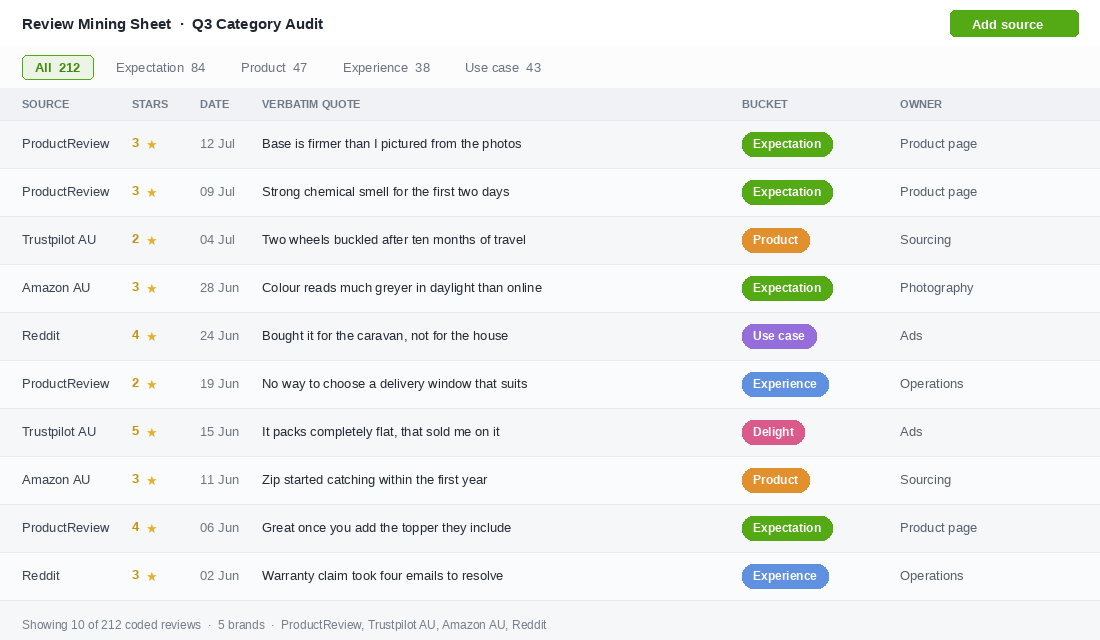
Set up a single Google Sheet with six columns: Source, Brand, Star Rating, Date, Verbatim Quote, Theme. Then work through this order:
- Filter to three and four stars first. Copy 25 per brand. This is your highest-signal pool and most people skip it entirely.
- Then take 10 one and two-star reviews per brand. You are looking for the complaint that repeats, not the outlier who received a damaged parcel.
- Then take 5 five-star reviews per brand. Not for the praise. For the phrasing. Five-star reviews tell you the exact words a delighted customer uses, and those words belong in your ad copy.
- Paste the verbatim, not your summary. The moment you paraphrase, you launder the customer’s language into marketing language and lose the whole point.
If you want to speed this up, paste a batch of 50 raw reviews into an AI assistant and ask it to cluster them into recurring themes with the supporting quotes attached. Do not let it write the summary for you. Ask it to group and quote, then read the quotes yourself. The value is in the language, and a summary destroys the language.
Step 3: Code every review into one of five buckets
Raw quotes are interesting. Coded quotes are actionable. Every review you pulled goes into exactly one of these five buckets, and each bucket routes to a different owner in your business.
- Expectation gap. The product was fine, but not what they pictured. “Firmer than I expected.” “The colour is more grey than the photos.” Routes to your product page: photography, copy, and sizing detail.
- Product gap. A genuine functional shortfall. “The wheels gave out after ten months.” Routes to sourcing and range planning.
- Experience gap. Delivery, packaging, support, returns. Routes to operations.
- Use case discovered. The customer bought it for something you never marketed. Routes to your ad angles, and this is usually the most valuable bucket of the lot.
- Delight trigger. The specific thing that made someone love it. Routes to your hooks and headline copy.
Two live Australian examples show how quickly the pattern appears.
Koala. The Koala Mattress sits around 4.9 stars across roughly 1,375 reviews on ProductReview.com.au, which is an excellent score. Read the mid-range reviews and three themes repeat: a strong chemical smell on unboxing, a base that feels firmer than buyers expected, and delivery scheduling friction. None of those are secrets. All three are expectation gaps, which means a competitor could beat Koala on the product page alone by publishing an honest off-gassing window, a firmness scale with a comparison point, and a delivery window you can actually pick.
July. The luggage brand carries a limited lifetime warranty covering wheels, zips, handles, straps, and specific shell cracks. Read the three-star reviews and the repeating themes are wheel wear on hard-cased carry-ons, scuff-prone shells, and inconsistent experiences when a warranty claim gets lodged. That is one product gap and one experience gap sitting side by side. For anyone selling luggage in Australia, “we replace wheels without a claim form” is a positioning line written entirely by someone else’s review section.
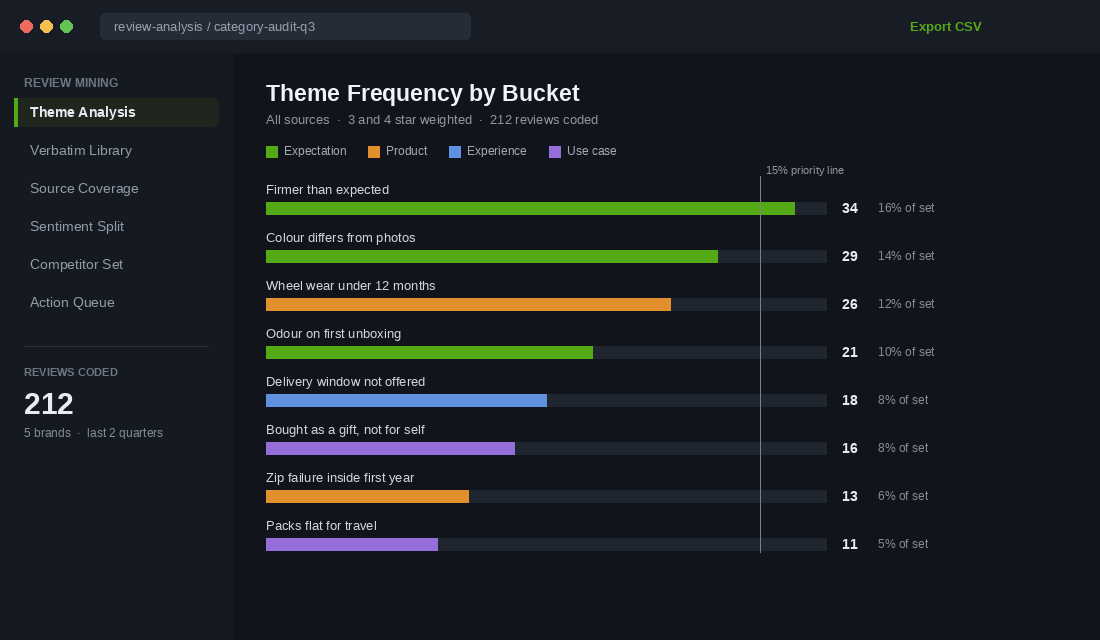
You are not looking for a single killer insight. You are looking for the theme that appears in more than 15% of the reviews you coded. That is the one your buyer will hit too.
Step 4: Rewrite your product page to pre-handle the top three objections
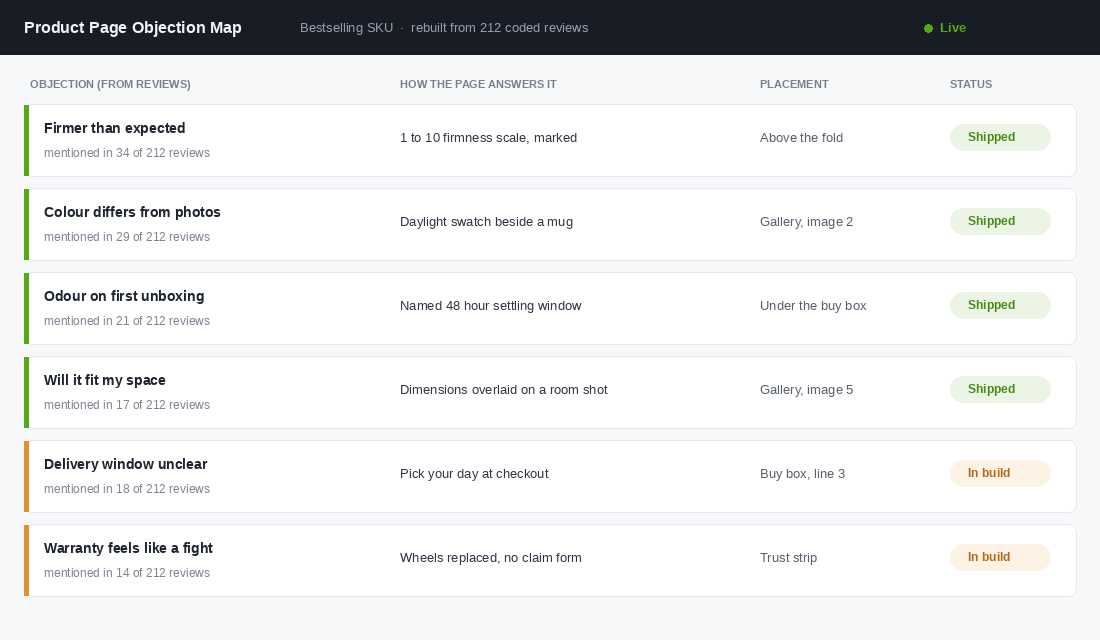
Take the three most frequent expectation gaps in your sheet. Those are the three objections your product page has to answer before the customer thinks of them.
The mistake here is burying the answer in an FAQ accordion at the bottom of the page. If 20% of category reviews mention firmness, firmness belongs above the fold, not in a collapsed panel three scrolls down.
- Turn each objection into a spec, not a paragraph. “Firmer than expected” becomes a 1 to 10 firmness scale with your product marked and two familiar reference points named.
- Answer it with a photo where you can. Colour objections are solved with a swatch shot in natural light next to a common household item, not with the word “charcoal”.
- Name the downside yourself. “There is a light cotton smell for the first 48 hours. That is the fabric finish, and it fades.” A brand that volunteers the compromise reads as honest, and the Spiegel data on the 4.2 to 4.5 sweet spot suggests buyers price honesty in.
- Put a real review beside the claim. Not a carousel of five-star quotes at the footer. One specific four-star review sitting directly under the spec it validates.
If you want the deeper version of this work, our Shopify Customer Research Playbook covers how to pair mined review themes with direct customer interviews so you are validating, not assuming.
Step 5: Turn the same themes into ad angles
Your “use case discovered” bucket is your ad brief. Every time a reviewer says “I actually bought this for X”, you have found a segment your competitor is serving accidentally and nobody is targeting deliberately.
The pattern that works: take the exact phrasing from the review, use it as the hook, then let the creative demonstrate the claim.
- Hook from a delight trigger. If eight reviewers independently mention that it packs flat, “It packs flat” is your first three seconds. You did not write that line, your market did.
- Hook from a competitor’s product gap. If wheel failure is the repeating complaint in your category, an ad that opens on a wheel test does the objection handling for you.
- Hook from a discovered use case. A camping product bought overwhelmingly by parents for school holidays is a completely different campaign to the one aimed at hikers, with a different season and a different creative.
One caution. Comparative claims about a named competitor carry real risk under Australian Consumer Law if you cannot substantiate them. Write the angle around the customer benefit, not around the other brand’s failure. “Wheels replaced free, no claim form” is safe. “Better wheels than [brand]” invites a problem you do not need.
Step 6: Feed the themes back into range and supplier decisions
This is the step most operators skip, and it is where review mining pays back the most over a year.
Your “product gap” bucket is a specification brief you did not have to pay for. Take the top three functional complaints in your category to your supplier with the quote count attached. “Eleven of the thirty reviews I pulled on the competing model mention the zip failing inside a year. What would it cost to move to a YKK zip on ours?” is a very different conversation to “can you make it better”.
- Range extension. If reviewers repeatedly ask for a size, colour, or format nobody in the category sells, that is a validated SKU before you have spent a cent on stock.
- Range deletion. If your own mid-star reviews cluster on one product, that product is quietly costing you repeat purchase across the whole catalogue.
- Bundle logic. Two themes that appear together (“great bag, wish it came with a cover”) is a bundle with demonstrated demand.
- Warranty positioning. Where the category’s experience gap is claim friction, a simpler warranty is a marketing asset, not just a cost line.
Bring the sheet to the supplier call. Quote counts change the tone of a negotiation because they turn your opinion into their market data.
Set up Judge.me so next quarter you mine your own data
Mining competitors is how you start. Mining your own reviews is how you compound, and that only works if you are capturing structured feedback rather than a star rating and a sentence.
Judge.me is the practical pick for most Aussie stores under $500k a month. It is inexpensive, it handles review requests automatically, and its custom forms feature lets you capture the exact attributes your mining exercise told you matter. Here is the setup:
- Install from the Shopify App Store and connect your store. Judge.me imports historical reviews from most other review apps during onboarding, so you do not lose your existing social proof.
- Set the review request delay to match your use cycle. Default is seven days after fulfilment. For anything with a break-in period (mattresses, shoes, skincare) push it to 21 to 30 days so the review reflects real use rather than unboxing excitement.
- Build a custom form with three questions drawn from your theme buckets. If firmness was the top expectation gap, add a 1 to 5 firmness scale. If fit was the issue, add “runs small / true to size / runs large”. These become filterable attributes on your product page and structured data in your export.
- Turn on photo and video reviews and offer a small incentive. Visual reviews resolve colour and scale objections that no amount of copy will fix.
- Export to CSV every quarter and run the same five-bucket coding on your own reviews. This is the loop. Ninety minutes a quarter, forever.
One more thing worth doing while you are in there: respond publicly to the critical reviews. Our Shopify Negative Review Playbook walks through the response structure that turns a two-star review into proof that you actually answer people.
The compound effect: one afternoon, four departments
Look at what a single 90-minute mining session produced in the sequence above. Three rewritten product page sections that pre-handle the objections costing you conversions. Three ad angles written in your customer’s own words rather than your copywriter’s. A specification brief for your next supplier call. A validated SKU idea and a bundle with demonstrated demand.
Four departments, one afternoon, no research budget. That is the return, and it comes from the fact that most operators in your category are still guessing while their customers publish the answers weekly.
There is a second-order effect too. Once you are coding review language regularly, your instinct for what your market actually wants improves. You stop briefing ads from what you think sounds good and start briefing from what you have watched buyers say twelve times in a row. That instinct is the real asset, and it only builds through repetition.
Run it once this quarter on five competitors. Run it next quarter on your own review export. By the third cycle you will be able to predict which product page changes will move conversion before you ship them, and you will be sourcing against real complaints rather than a supplier’s catalogue. If you want a structured way to collect the same intelligence pre-purchase, the Shopify Product Quiz Playbook covers the on-site version of this loop.
Your review mining checklist
- Pick three direct competitors and two adjacent category leaders.
- Pull 25 three and four-star reviews per brand, 10 low-star, 5 five-star.
- Weight the last two quarters. Treat anything over a year old as background.
- Paste verbatim quotes into a six-column sheet. Never paraphrase.
- Code every quote into one of five buckets: expectation, product, experience, use case, delight.
- Flag any theme appearing in more than 15% of reviews as a priority.
- Rewrite the top three expectation gaps into specs, photos, and above-the-fold copy.
- Brief three ads from the use case and delight buckets using the customer’s exact words.
- Take the product gap list, with quote counts, to your next supplier call.
- Install Judge.me with a custom form built from your top themes.
- Diarise the next session for 90 days from today.
Inside eCommerce Circle, customer research like this is one of the core pillars we work on with every member, because it is the cheapest competitive advantage available to a store doing between $40k and $500k a month. If you want a second opinion on what your category’s reviews are telling you, let’s talk.