Most Aussie Shopify founders think they know their customer. They have a slide somewhere with a stock photo, a name like “Busy Brittany, 34”, and a tidy list of demographics: married, two kids, shops on her phone after the school run. That avatar has never sold a single product. Demographics tell you what someone looks like on paper. They tell you nothing about why she reached for her card at 9:47pm on a Tuesday.
What’s in This Article
Here is the number that should keep you up at night. The average ecommerce customer now costs between AUD 100 and AUD 130 to acquire, with the global benchmark sitting at USD 68 to 84 in 2025, and that figure climbs every single year. When you are paying that much just to get someone onto a product page, guessing what they actually want is the most expensive mistake in your whole business.
The brands that win do the opposite of guessing. They treat customer research as a system they run every quarter, not a workshop they did once in 2023 and never opened again. Returning customers already generate around 60% of direct-to-consumer revenue, and the only way to earn that repeat business is to understand the person behind the order better than your competitors do. This is the five-part system we use inside eCommerce Circle to do exactly that.
Part 1: Mine the Goldmine You Already Own
Before you spend a dollar on a fancy research tool, understand this: you are already sitting on more customer insight than most agencies could gather in a month. Your reviews, your support inbox, your Instagram DMs, your order notes. That is raw voice-of-customer data, and conversion copywriters will tell you that research makes up roughly 70% of the actual work. The writing is the easy 30% once you know what to say.
Start with review mining. Export every product review you have ever received and read them with a highlighter, not a calculator. You are not counting stars. You are hunting for the exact words customers use to describe the problem your product solved and the moment they decided to buy.
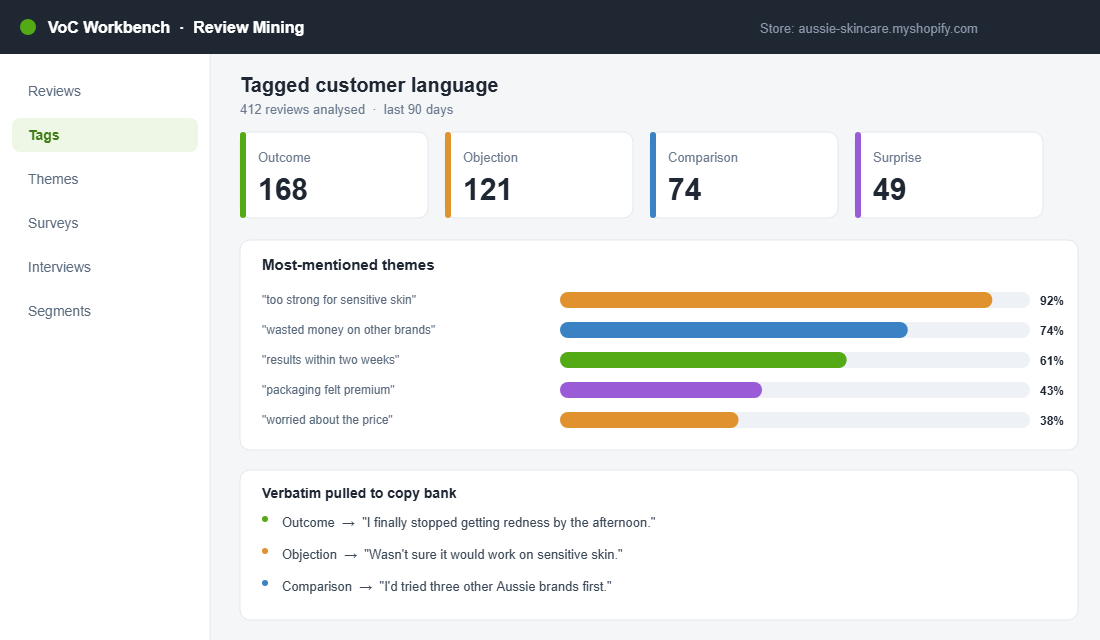
As you read, tag each comment into one of four buckets. This is where the gold sorts itself out.
- Outcome. The result they got. “I finally stopped getting headaches by 3pm.” That line belongs on your product page, word for word.
- Objection. The hesitation they had before buying. “I was worried it would be too strong for sensitive skin.” Every objection you find is a sentence your sales copy needs to answer.
- Comparison. What they tried before you. “I’d wasted money on three other brands first.” This tells you who you are really competing against.
- Surprise. The thing they did not expect. “Honestly didn’t think the packaging would feel this premium.” Surprises become your differentiators.
Frank Body, the Melbourne scrub brand, built an entire empire on this. Their copy talks to the customer like a cheeky mate (“hello babe”) because that is genuinely how their customers talked about the product in reviews and on social. They did not invent a voice in a boardroom. They mined it from the people already buying. That is the difference between copy that sounds like you and copy that sounds like your customer.
Do the same sweep across your support tickets. Every “how do I”, “does it”, and “can I” is a question your product page or FAQ has failed to answer. If five people email asking whether your supplement is vegan, that is not five support tickets. That is a conversion leak you can patch in ten minutes.
Part 2: Ask the One Question That Surfaces Every Objection
Mining what you have is step one. Now you go and ask for what you are missing. The fastest, highest-leverage way to do this is a post-purchase survey, because you are catching the customer at the exact moment their decision is fresh in their mind.
If you ask only one question, make it this one: “What almost stopped you from buying?” Conversion specialists consider it the single most valuable research question you can ask, because it comes from people who actually bought. They overcame the objection, then told you exactly what it was. That is a roadmap for every hesitation sitting between your next visitor and the buy button.
Build a short three to four question survey. More than that and completion rates fall off a cliff. The questions that earn their place:
- What almost stopped you from buying? Surfaces objections.
- What problem were you trying to solve? Reveals the real job your product is hired to do.
- How would you describe this to a mate? Hands you the natural language for your ads and headlines.
- What nearly made you choose someone else? Maps your true competitive set.
To set this up, a post-purchase survey app like KnoCommerce or Fairing plugs straight into the Shopify thank-you page. The setup takes about fifteen minutes: install the app, create a one-question zero-party survey, set it to trigger on order completion, and let it run for two weeks before you read a single response. You want at least 100 responses before you trust the patterns. We have written a full breakdown of this in The Post-Purchase Survey Playbook if you want the deeper version.
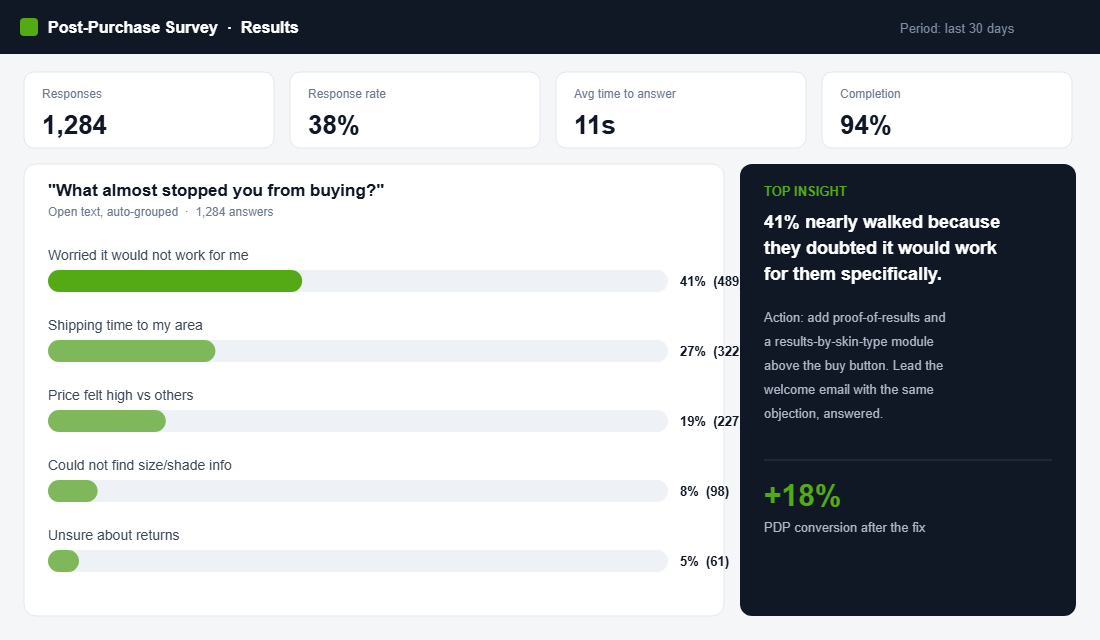
The magic is not in any single answer. It is in the repetition. When 40 out of 100 people say the same thing nearly stopped them, you have just found the headline for your next landing page. The customer wrote your copy for you. You just have to listen.
Part 3: Talk to Ten Actual Humans (The Part Everyone Skips)
Surveys give you breadth. Interviews give you depth. This is the part almost every founder skips because it feels slow and awkward, and it is exactly why the founders who do it pull ahead. You only need ten conversations to start seeing the patterns clearly.
Recruit two groups. Five recent first-time buyers, and five lapsed customers who bought once and never came back. The lapsed group is uncomfortable to talk to and twice as valuable, because they tell you where the relationship broke. Offer a AUD 50 gift card for twenty minutes on Zoom and you will fill the slots faster than you expect.
Keep the questions open and let them talk. Your job is to shut up and record.
- Walk me through the day you first bought. What was going on? You are looking for the trigger event.
- What had you tried before this? Maps the journey and the frustration that led to you.
- What did you tell yourself this purchase would change? This is the identity question, and it is the one that matters most.
- If we disappeared tomorrow, what would you miss? Surfaces your real value, not the value you think you offer.
Record every call with permission and run it through a transcription tool like Otter or Dovetail so you can search the language later. Within ten interviews you will hear the same phrases come up again and again. Those phrases are not data points. They are your next round of ad hooks, email subject lines, and product page bullets, pre-tested by the only people whose opinion converts: paying customers.
Part 4: Build an Identity-First Profile, Not a Demographic Sheet
Now you assemble what you have learned into a profile you will actually use. And here is where you throw out the old template. Nobody buys because they are a 34-year-old mother of two in Brisbane. People buy a version of who they are quietly trying to become. Identity steers the ship. Demographics are just the registration plate.
Replace the demographic checklist with five fields drawn straight from your research. This is the profile that changes how you write.
- The trigger. What was happening in their life the moment they started looking? Not “wanted skincare” but “had a wedding in six weeks and panicked about their skin”.
- The struggle. The specific frustration in their own words, lifted from a review or interview.
- The desired identity. Who they want to feel like after buying. The person who has their health sorted. The founder who looks legit. The parent who has it together.
- The objection. The number one reason they nearly walked, from your survey data.
- The alternatives. What they genuinely considered instead, including doing nothing.
Who Gives A Crap, the Aussie toilet paper brand, is a masterclass in identity-first positioning. They do not sell two-ply. They sell the identity of being someone who gives a crap, someone whose everyday boring purchase quietly does some good in the world. The product is a commodity. The identity is the entire business. That only works because they understand the person, not the demographic.
Write one of these profiles per core segment. Most stores have two or three, not twelve. Pin them above your desk and read them before you write a single ad.
Part 5: Segment Inside Shopify and Actually Act on It
Research that lives in a Google Doc is a hobby. Research that drives different messages to different people is a growth lever. The last part is turning your profiles into live segments inside Shopify and Klaviyo so the right customer gets the right message.
Shopify has native customer segmentation built in, and most founders never touch it. To set it up, go to Customers, then Segments, then create a segment using the query editor. A few that earn their keep from day one:
- First-time buyers in the last 30 days. Funnel these into a strong welcome and second-purchase flow.
- Two or more orders, none in 90 days. Your win-back segment. These people loved you once.
- Top 10% by total spend. Your VIPs. They deserve early access and a human thank-you, not the same email everyone gets.
This is RFM thinking in plain English: recency, frequency, and monetary value. Sync these segments to Klaviyo and the message changes per group. The objection you found in Part 2 becomes the hook in your welcome flow. The desired identity from Part 4 becomes the theme of your VIP emails.
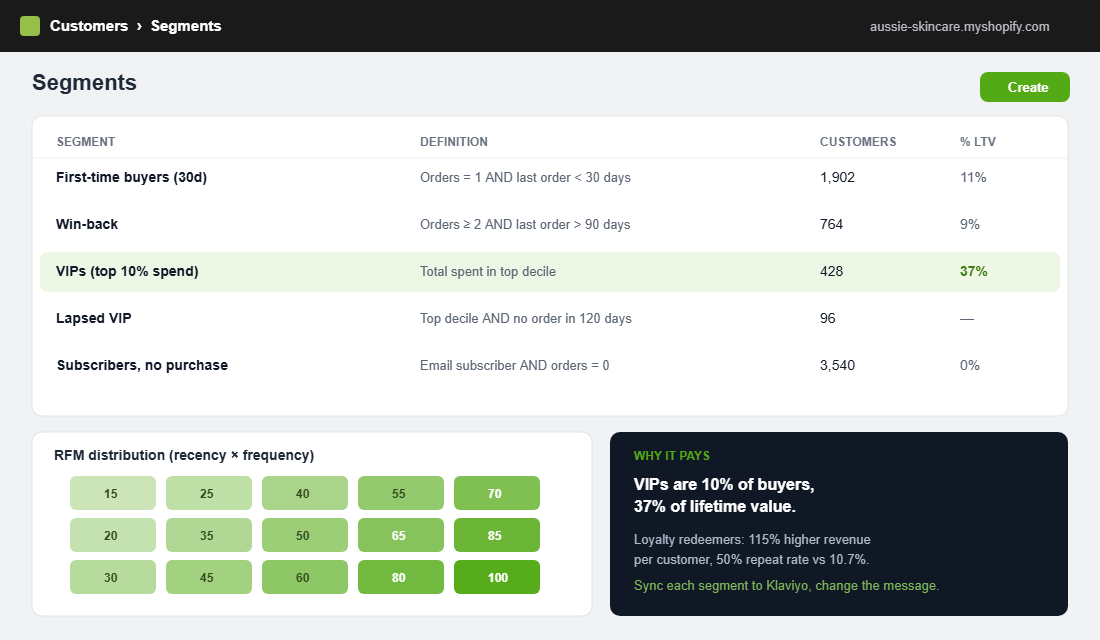
The payoff is real money. Customers who redeem loyalty rewards generate around 115% higher revenue per customer and hit a 50% repeat purchase rate, compared with just 10.7% for those who never engage. Segmentation is what lets you treat those people differently in the first place. For the full retention maths, our Customer Lifetime Value Playbook shows how to turn these segments into LTV you can bank on.
The Three Mistakes That Make Customer Research Useless
Plenty of founders go through the motions of research and still end up with nothing they can use. It almost always comes down to one of three mistakes, and each one is easy to avoid once you have seen it.
The first is asking leading questions. “How much did you love the fast shipping?” is not research, it is fishing for a compliment. You will get a warm answer and learn nothing. Ask neutral, open questions and let the customer take you somewhere you did not expect. The uncomfortable answers are the valuable ones.
The second is paraphrasing. The moment you rewrite “I was sick of products that promised the world and did nothing” into “customer wanted effective products”, you have thrown away the gold. The specific, slightly messy wording is the entire point. It is what makes your copy sound human. Keep the verbatim quote, always.
The third, and most common, is researching once and never acting. A 2023 avatar gathering dust helps nobody. Customer behaviour shifts with seasons, prices, and competitors, which is why the brands that pull ahead run a light research loop every quarter rather than a heavy one every few years. Small and regular beats big and rare, every time.
The Compound Effect: How the Five Parts Become a Flywheel
Run these five parts as separate tasks and you get five mediocre outputs. Run them as a loop and you get a flywheel that gets harder for competitors to catch every quarter.
Here is how the loop turns. Mining your reviews and surveys feeds you the exact language customers use. That language sharpens your copy, which lifts conversion on the same traffic you already pay for. Higher conversion means more customers, which means more reviews and survey responses, which means richer research next quarter. Meanwhile your segments turn those customers into repeat buyers, and repeat buyers give you the deepest interviews of all because they actually care.
This is why first-party data has become non-negotiable, with 92% of marketers now calling it essential. The third-party tracking that used to do this work has gone dark. Your own customer research is the durable advantage that no privacy update or ad platform change can take away from you. You own it. Competitors who keep guessing cannot copy it.
If you are running ads to win back browsers, the same research powers smarter targeting and creative. It pairs directly with the audiences you build in The Shopify Retargeting Playbook, because the objection you uncovered is the exact message a window shopper needs to see.
Your Customer Research One-Pager (Copy This Template)
Here is the template we hand members to run this in a single afternoon each quarter. Copy it into a doc and fill one out per core segment.
- Segment name: A human name your team will remember, not “Segment B”.
- Trigger event: What was happening when they started looking?
- The struggle (their words): Pull a real quote from a review or interview.
- Desired identity: Who they want to feel like after buying.
- Top objection: The number one “what almost stopped you” answer.
- Real alternatives: What they considered, including doing nothing.
- Their words for the outcome: The exact phrase to put on the product page.
- Shopify segment query: The live segment this profile maps to.
- One copy change this unlocks: The single edit you will make this week.
The last line is the one that matters. Research that does not change a word on your site is a museum piece. The point is action: one objection answered, one headline rewritten, one segment treated differently. Do that every quarter and within a year your store speaks your customer’s language better than any competitor relying on a stock-photo avatar from 2023.
Start This Week
You do not need a research budget or a new hire to begin. Open your reviews tonight and tag twenty of them into the four buckets from Part 1. Switch on a one-question post-purchase survey tomorrow. Book two customer calls for next week. By the end of the month you will know your customer better than you did after years of guessing, and your copy, your ads, and your retention will all show it.
Inside eCommerce Circle, customer research is one of the core pillars we work on with every member, because everything else in the business gets easier once you truly know who you are selling to. If you want a second opinion on yours, let’s talk.