Father’s Day in Australia lands on Sunday 6 September this year, and most Shopify founders will do exactly what they did last year: throw up a “20% off for Dad” banner in the last week and hope. That approach is leaving real money on the table, because the shape of this event has quietly changed.
What’s in This Article
Here is what shifted. In 2025, fewer Australians bought Father’s Day gifts, but the ones who did spent a lot more each. Around 4.7 million Australians spent a combined $720 million, yet participation fell to roughly 20% of the population while the average spend per gift-buyer jumped about 44% to $145. Fewer people, bigger baskets. That single change should rewrite how you run the event.
This playbook is the system we use with members to win a higher-value, smaller-crowd gifting event: plan backwards from the shipping cutoff, merchandise for gift-buyers rather than your usual shopper, and run a proper multi-week cadence instead of a last-minute discount. Done well, Father’s Day becomes a genuine September revenue spike, not an afterthought.
Read the Room: What the Numbers Tell Aussie Founders
Before you plan a single email, understand who is actually buying. The data points to a clear strategy, and it is not “discount harder”.
- Fewer buyers, higher intent. Participation dropped from around 36% to 20% of Australians, but a quarter of gift-buyers plan to spend more than $200. The people showing up are serious. Merchandise for them.
- Premium beats bargain. With average spend up 44% to $145, the winning move is a better gift, not a cheaper one. Bundles and premium options outperform blanket discounts.
- Category matters. The most-bought Father’s Day gifts are alcohol and food, clothing and footwear, grooming, tech, and experiences. If you sit in or near those lanes, lean in hard.
- Timing is everything. Roughly 90% of Father’s Day purchases happen in the 30 days before the day, with search interest building three to six weeks out. Start early or miss the window.
The takeaway for a $50k to $500k a month store is simple. This is not a clearance event. It is a considered-gifting event, and the brands that treat it that way capture the buyers who are happy to spend $145 or more on the right thing.
Stage 1: Plan Backwards From the Shipping Cutoff
Every good seasonal campaign is built in reverse. You do not start from “when should we launch”. You start from the last day a customer can order and still get the gift before Sunday 6 September, then work backwards from there.
Map your real shipping cutoffs first. For most Australian stores that means a standard-post cutoff around five to seven days out and an express cutoff two to three days out. Those dates anchor everything. Miss them in your messaging and you will eat refunds and one-star reviews from dads who got their gift on the Monday.
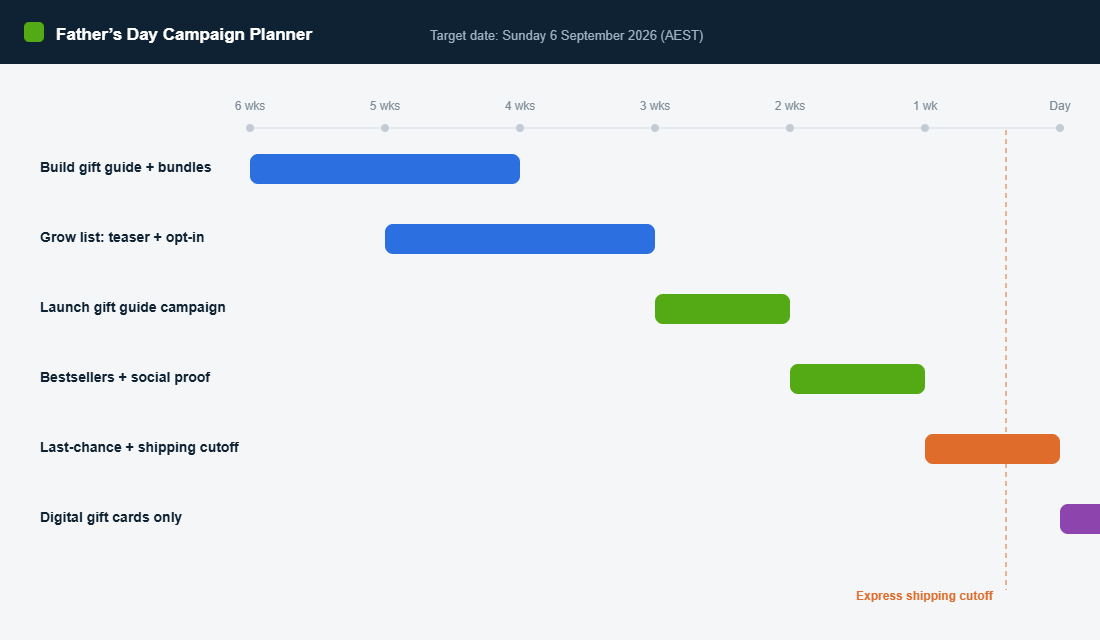
From the cutoff, block out the phases: build and merchandise about six weeks out, grow your list and tease four weeks out, launch the gift guide three weeks out, push bestsellers and social proof two weeks out, then run last-chance and shipping-deadline messaging in the final week. After the express cutoff, you pivot the whole store to one thing: digital gift cards.
Put these dates in a shared calendar now. The founders who win Father’s Day are not more creative, they are earlier. This is the same backwards-planning discipline that drives every seasonal peak, and it is why the plan beats the panic every time.
Stage 2: Build a Gift Guide That Sorts by Dad and by Budget
Here is the mindset shift that changes your conversion rate: on Father’s Day, your customer is not shopping for themselves. They are a gift-buyer, often browsing your store for the first time, unsure what Dad wants, and worried about getting it wrong. Your job is to remove that anxiety.
The single highest-leverage asset is a dedicated Father’s Day gift guide, merchandised two ways at once: by budget and by persona. Gift-buyers think in exactly those terms.
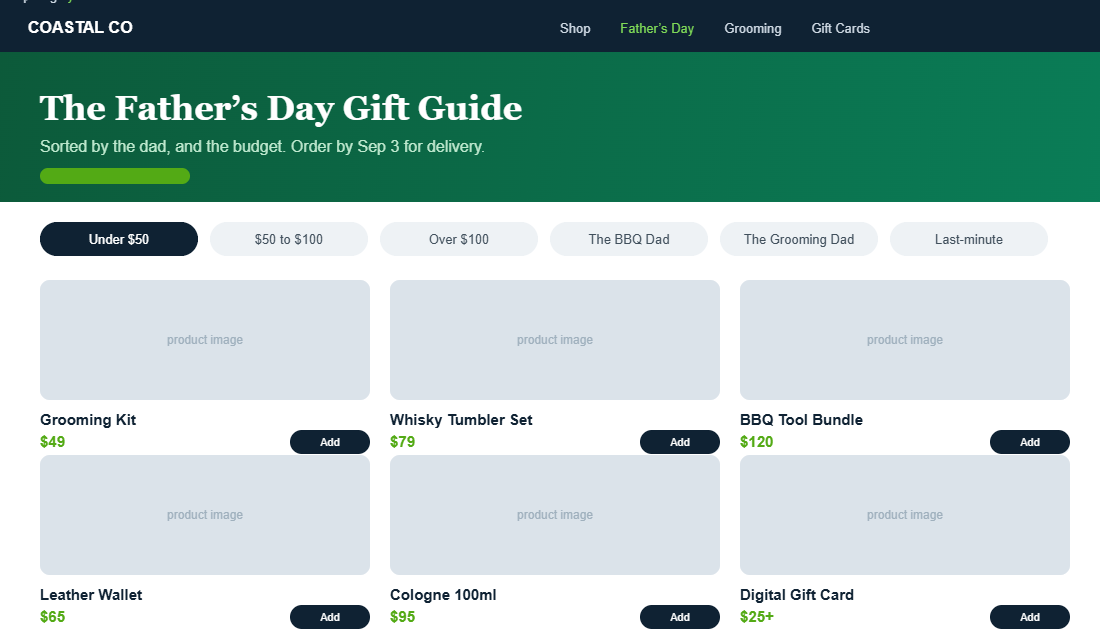
Build the guide as a Shopify collection with clear entry points:
- By budget. “Under $50”, “$50 to $100”, “The premium pick”. This lets a buyer with $145 to spend find the right tier instantly, and nudges them up.
- By persona. “The BBQ Dad”, “The Grooming Dad”, “The Tech Dad”, “The Dad who has everything”. Personas do the thinking for an unsure buyer.
- By speed. A “Last-minute” or “Arrives in time” filter that surfaces in-stock, fast-ship items and, eventually, gift cards.
Give every gift a reason to be given. Short, benefit-led copy that says why this is a good gift, not just product specs. And add gift-buyer reassurance across the guide: easy returns, gift messaging, and a clear delivery-by date. If bundles are part of your plan, feature them here too, which leads straight into the next stage. Our product bundle playbook covers how to build them so they lift order value instead of eroding it.
Build the guide mobile-first. The bulk of Father’s Day gift browsing happens on a phone, often in spare minutes on the couch, so the persona and budget filters need to be big, thumb-friendly tap targets, and every gift needs to load fast. A guide that is a pain to scroll on mobile is a guide that does not convert, no matter how good the gifts are.
Stage 3: Use Bundles and Gifting Mechanics to Lift Order Value
With average spend up 44%, Father’s Day rewards stores that make it easy to spend more, not stores that race to the bottom on price. Bundles are the cleanest way to do that. A curated “Father’s Day set” at $89 feels like a thoughtful gift, converts better than three separate products, and lifts your average order value in the process.
The gifting mechanics that pull the most weight:
- Curated gift sets. Package complementary products into a ready-to-give bundle at a slight saving. The value is in the curation, so the buyer does not have to think.
- Gift wrapping and a message. Offer optional gift wrapping and a personal note at checkout. Small add-on, big perceived value, and it signals you understand gifting.
- A gift-with-purchase threshold. “Spend $120, get a free [item]” nudges the exact behaviour the data shows dads’ gift-buyers already lean towards.
- Premium tiers. Make sure you have a genuine over-$100 option in each persona. A quarter of buyers want to spend more than $200. Let them.
Aussie brands in the gifting lanes already run this play. Grooming label Triumph and Disaster leans on gift sets and bundled kits around the event, and whisky-and-experience brands like The Whisky Club frame their product as the considered gift for the dad who is hard to buy for. You do not need their scale, just their intent: sell the gift, not the discount.
Do not forget experiences and non-physical gifts. Experiences like dinners and trips are one of the fastest-growing Father’s Day categories, and they share a superpower with digital gift cards: no shipping deadline. If any part of your range can be delivered instantly, feature it prominently for the buyers who leave it late, which every year is a large slice of them.
Stage 4: Run a Real Campaign Cadence, Not a Single Blast
One “Father’s Day sale” email on the Thursday before is how most stores under-perform. The buyers move through distinct mindsets over the month, and your cadence should meet each one. Email opens run around 12 to 15% higher than baseline in the three weeks before the day, so the attention is there if you earn it.
Run the sequence across email and SMS in four beats:
- Teaser (about 4 weeks out). “Father’s Day is coming, here is early access.” Build anticipation and capture intent before competitors start shouting.
- Gift guide launch (about 3 weeks out). Send the guide as inspiration. This is your biggest single send. Segment by budget and persona where you can.
- Bestsellers and social proof (about 2 weeks out). “Most-gifted this year” plus reviews. Certainty converts the undecided middle.
- Last-chance and shipping cutoff (final week). Urgency that is real: “Order by [date] for delivery before Father’s Day.” This is where a lot of the revenue lands.
Then, after the express cutoff, switch the entire message to digital gift cards. Last-minute and interstate buyers have not gone away, they have just run out of shipping time, and a gift card is the perfect save. This is why gift cards deserve their own plan, covered in our gift card playbook.
Stage 5: Segment So You Do Not Annoy the People Who Skip It
Not everyone celebrates Father’s Day, and for some it is a genuinely hard day. Blasting your entire list five times in a fortnight is the fastest way to spike unsubscribes and complaints. Segmentation is not just about performance here, it is about respect.
A few smart moves protect your list and lift results at the same time:
- Offer an opt-out. Early in the sequence, send one message giving people the option to opt out of Father’s Day emails specifically, without leaving your list. It builds enormous goodwill.
- Segment by gifting behaviour. Prioritise past gift-buyers and customers who shop your gifting categories. They are your warmest Father’s Day audience.
- Suppress the wrong people. Exclude very recent buyers of the same item, and anyone who took the opt-out, from the heavy-sell sends.
Send the right message to the right customer and you get more revenue from fewer, better sends. Our customer segmentation playbook is the backbone for building these segments once so you can reuse them every seasonal event.
Stage 6: Measure the Event Like a Mini Peak Season
Father’s Day is small enough to run in a month and big enough to learn from, which makes it a perfect dress rehearsal for BFCM. Measure it properly and you build a playbook that compounds every year.
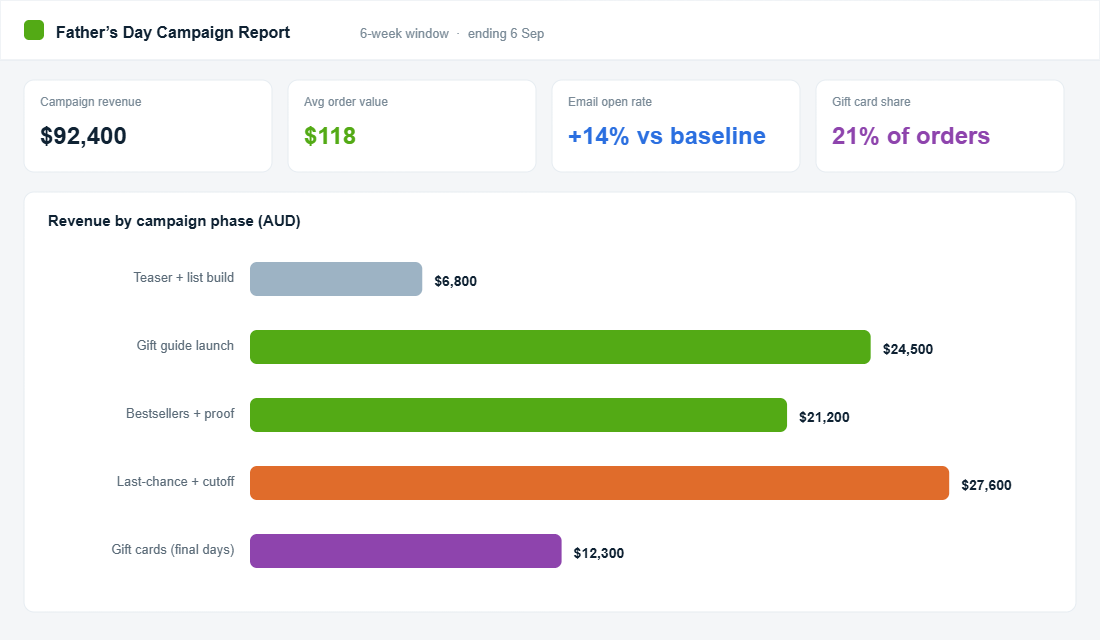
Track the numbers that tell you what to repeat and what to fix:
- Revenue by campaign phase. Which beat drove the most, teaser, guide, bestsellers, last-chance, or gift cards? That tells you where to double down next year.
- Average order value. Did bundles and premium tiers actually lift it? This is the whole thesis of a higher-value event.
- Gift card share. How much of the final-days revenue came from gift cards? Usually more than founders expect.
- New versus returning buyers. Gifting events pull in first-time customers. Capture them into a welcome flow so Father’s Day funds future retention, not just a one-day spike.
Write down what worked within a week, while it is fresh. That single document turns a good Father’s Day into a better one next year, and a template you can reshape for Mother’s Day, Christmas, and beyond.
Three Father’s Day Mistakes That Cost Stores Sales
Most under-performing Father’s Day campaigns fail for the same three reasons, and all of them are avoidable with a bit of planning.
Mistake one: starting in the final week. With 90% of purchases happening in the 30 days before the day and search interest building weeks out, a store that only shows up in the last seven days has already missed the majority of the buying window. The early, higher-intent gift-buyers have bought elsewhere. Start three to four weeks out, every time.
Mistake two: reaching for a discount instead of a gift. This event rewards the store with the best gift, not the cheapest price. A blanket “20% off” trains customers to wait for sales and eats the margin on an event where buyers are already willing to spend $145 or more. Lead with curated bundles and premium options, and keep discounting disciplined.
Mistake three: ignoring shipping reality. Promising a delivery date you cannot hit turns a happy gift-buyer into a refund and a bad review the week after Father’s Day. Over-communicate your cutoffs, put the delivery-by date on the guide and in every last-chance email, and switch cleanly to digital gift cards the moment the express cutoff passes.
The Compound Effect: One Event, A Reusable System
Look at how the stages connect. Backwards planning gives you time. The gift guide converts anxious first-time buyers. Bundles and premium tiers capture the higher spend the data says is there. The cadence meets buyers in every mindset. Segmentation protects your list. And measurement turns the whole thing into a repeatable asset.
The real prize is not the September revenue, welcome as it is. It is that you now own a seasonal-event system: a merchandising pattern, a cadence, and a set of segments you can point at Christmas, Valentine’s Day, and Mother’s Day with a weekend of work instead of a fortnight of scrambling. Father’s Day becomes the rehearsal that makes every other peak easier.
Fewer people are buying, but they are spending more than ever on the right gift. Be the store that makes finding it effortless, and this quieter, richer event becomes one of the most profitable weekends on your calendar.
Setting the Gift Guide Up in Shopify
You do not need a new app for most of this. The core build uses tools you already have. Here is the fastest path to a live gift guide:
- Create a “Father’s Day” collection. Use automated collection rules to auto-populate it (for example, tag gift-suitable products “fathers-day”) so you can add and remove items in bulk without hand-picking.
- Add persona and budget tags. Tag products by persona (“bbq-dad”, “grooming-dad”) and price band, then expose them as collection filters so buyers can sort the way they think.
- Build your bundles as products. Create each gift set as its own product with its own photography and gift-led copy, so it can be merchandised, linked, and measured on its own.
- Turn on gift options. Enable a gift message and optional wrapping at checkout, and make sure digital gift cards are live and easy to find for the last-minute rush.
- Schedule the cadence in Klaviyo or Shopify Email. Pre-build the teaser, guide, bestsellers, and last-chance sends now, segmented, so launch week is execution, not creation.
Set this up once and most of it becomes a template. Next year, and for the next gifting event, you clone the collection, swap the products and dates, and you are ninety percent of the way there.
Your Father’s Day Campaign Checklist
Work this backwards from Sunday 6 September.
- Confirm shipping cutoffs (standard and express) and build the whole calendar back from them.
- Launch a gift guide sorted by budget and by dad persona, with benefit-led copy.
- Build two or three bundles and a genuine over-$100 option in each persona.
- Add gifting mechanics: wrapping, a gift message, and a spend threshold gift-with-purchase.
- Run the four-beat cadence: teaser, guide launch, bestsellers, last-chance, then gift cards.
- Segment and offer an opt-out so you respect the people who skip the day.
- Pivot to digital gift cards the moment the express cutoff passes.
- Capture new gift-buyers into a welcome flow, and review revenue by phase within a week.
Inside eCommerce Circle, turning seasonal events into repeatable revenue systems is one of the core pillars we work on with every member. If you want a second opinion on your Father’s Day plan before September, let’s talk.