Most Aussie Shopify founders treat the welcome email like an afterthought. One generic “Welcome to the family” subject line, a flat 10% off code, and a single send that lands in the promotions tab a few hours later. Then they wonder why their email program does 12% of revenue when it should be doing 30%.
What’s in This Article
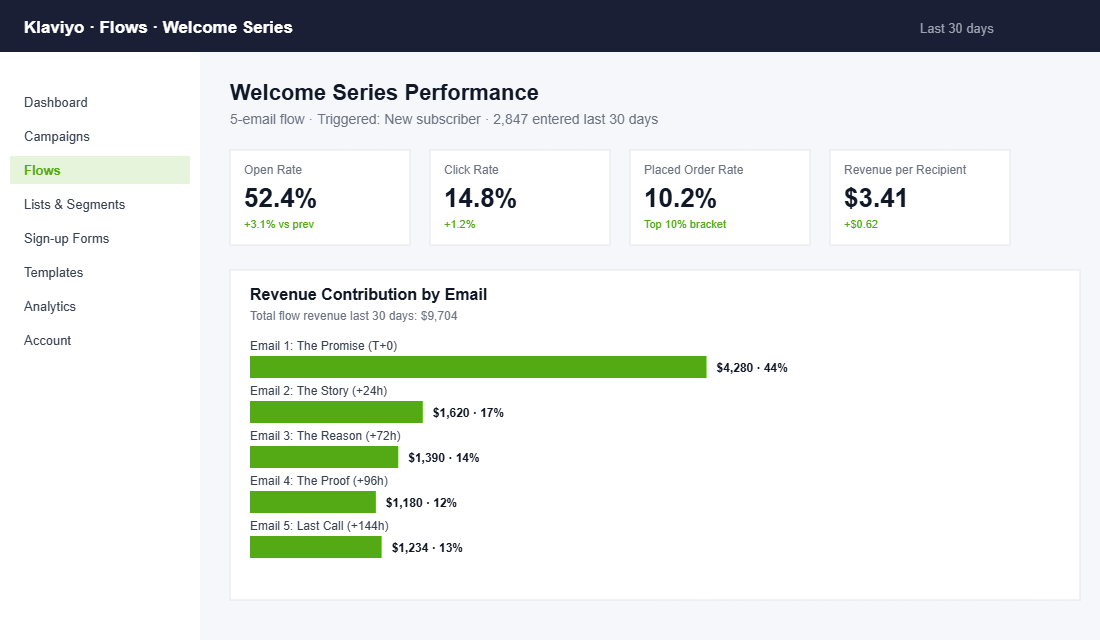
The welcome flow is the single highest-revenue automation you will ever build. Klaviyo’s 2026 benchmark data shows welcome series average a 45 to 50% open rate and an 8 to 12% conversion rate. Top performers hit a 10.53% placed order rate and pull $2.65 in revenue per recipient. Compare that to your average campaign blast at $0.11 per recipient and you can see the gap. Your welcome flow is doing 24x the work of a normal send.
The problem is not the technology. It is that most founders write one email when they should be writing five, and they treat the discount as the offer when the offer is actually the relationship. Here is the 5-email sequence we use with hundreds of Aussie Shopify founders inside eCommerce Circle. It is built to convert cold subscribers into first-time buyers within 7 days, then hand the relationship over to your post-purchase flow.
Why the Welcome Flow Earns More Than Anything Else in Your Store
Run the numbers and the case writes itself. If your store gets 30,000 sessions a month and 2% of visitors hand over an email through your popup, that is 600 new subscribers. A poor welcome flow ($1.20 RPR) earns you $720 a month. A solid welcome flow ($2.65 RPR) earns you $1,590. A top-decile welcome flow ($4.00+ RPR) earns you $2,400 plus.
That is $20,000 a year of pure margin sitting on the table for the difference between a one-email “Here is your code” sequence and a proper five-email arc. Multiply by the lifetime impact of those buyers (because welcome-flow buyers are 2.3x more likely to become repeat customers) and the gap widens.
Klaviyo’s data is even more telling: nearly 48% of all flow-driven email revenue comes from new buyers. The welcome flow is where you earn that revenue. Get it wrong and you bleed it.
The Opt-In: The Input That Decides the Output
Before we touch the emails, we need to fix the popup. Garbage in, garbage out. If your popup says “Sign up for 10% off our newsletter”, you are catching discount hunters with no intent to buy. They open the first email, copy the code, never come back.
The popup is the first email of the welcome flow. It needs to do three things:
- Filter for intent. Use a two-step popup. Step one asks a qualifying question (e.g. “What are you shopping for: Men, Women, Kids?”). Step two captures the email. Engaged subscribers convert 3 to 4x better than cold subscribers.
- Frame the offer as a welcome gift, not a discount. “Get $15 off your first order” beats “Save 10% today” because it specifies a dollar value tied to an action.
- Promise the next step. “Check your inbox in 60 seconds for your code” sets the expectation that the email is coming and primes them to open it.
Aussie sustainable fashion brand Bhumi Organic Cotton runs a clean version of this pattern. The popup uses a single-step capture with a soft “Join the Bhumi family” line, then the welcome flow does the heavy lifting. Top brands hit 25 to 35% popup conversion rates this way. Most stores sit at 3 to 5%. The math here matters more than the design.
Email 1: The Promise (Sent Immediately, T+0 Minutes)
Goal: deliver the code, set the brand frame, drive the click. This email gets the highest open rate of the entire flow (often 60%+). Use that attention.
- Subject line: “Your $15 is inside, [Name]” or “[Brand] x You: here is the gift”. Specificity wins. Avoid “Welcome to [Brand]”.
- Hero block: A single bold line that names the gift and the next step. No carousel. No four-column hero. One promise.
- The code: Generate a unique single-use code per subscriber via Klaviyo’s dynamic coupon code feature. Klaviyo’s own data shows unique codes outperform static codes (WELCOME15) on conversion because they cannot be shared, screenshotted to TikTok, or stacked.
- Expiry: 7 days. Long enough to convert the considered buyers, short enough to drive urgency.
- CTA: One button. “Use my $15 now”. Link to a curated collection (best sellers, new arrivals) not the homepage.
Klaviyo’s own benchmarks show that more than 50% of subscribers who click a link in a welcome email go on to buy. Your job is to make the click happen.
Email 2: The Story (Sent 24 Hours Later)
Goal: build belief. The first email told them what. This one tells them why. Brand-led purchases convert at 2x the rate of price-led purchases over a 90-day window.
The structure of email 2 is a founder letter. Personal, signed, and short. It answers three questions in 250 words or less:
- Why does this brand exist? The problem you saw, the gap in the category, the moment that started it.
- Who is it for? A specific customer the reader recognises themselves in. Not “everyone”.
- What makes the product different? One technical or sourcing detail that proves you care more than the competitor. Material, ingredients, manufacturing, founder ethos.
End with a soft re-pitch of the code from email 1. “Your $15 is still waiting if you want to try us.” The CTA points to the same collection, not a new one. Consistency reduces decision fatigue.
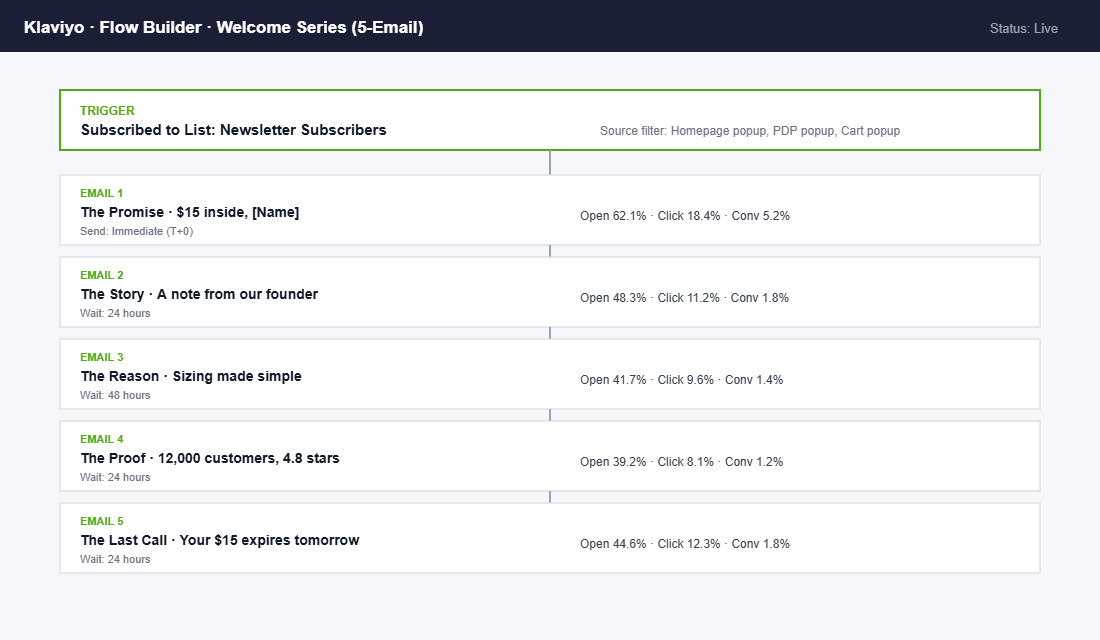
Email 3: The Reason (Sent 48 Hours After Email 2)
Goal: handle the rational objection. By now the subscriber has had two emotional touches (the gift, the story). If they have not bought, something is holding them back. Email 3 answers the unspoken question.
For most Aussie Shopify brands, the unspoken question is one of three things: “Will it actually fit / work / suit me?”, “Is shipping fast and free?”, or “What if I don’t like it?”. Pick the one that hurts the most based on your category and answer it head-on.
Format ideas that work:
- “How to choose your size” guide for apparel and footwear. Embed real customer height/weight examples.
- “Our 60-day no-questions returns” reassurance for considered purchases. Lead with the policy, then the social proof.
- “What is in the box” walkthrough for skincare, supplements, or anything where ingredients matter. Tie each ingredient to a specific outcome.
- “Free Aussie-wide shipping over $X” calculator for stores where freight friction kills conversions.
This is the email where you stop selling and start helping. Counter-intuitively, it is the highest-converting email in the back half of the flow.
Email 4: The Proof (Sent 24 Hours After Email 3)
Goal: borrow trust from people who have already bought. Subscribers who reach email 4 are warm but cautious. Social proof closes the gap.
Build email 4 around three blocks:
- One hero review. A 5-star with the customer’s name, location (Melbourne, Sydney, Perth), and the specific problem the product solved. Not “love it!”. Real outcome language.
- Three short proof points. “Over 12,000 Aussie customers.” “Featured in [credible local press].” “4.8 average rating across 2,400 reviews.” Stack the numbers.
- UGC carousel or single best-performing UGC video. Real customers using the product. If you do not have UGC, use customer-submitted unboxing photos.
The CTA shifts in this email. Instead of pointing back at the discount, it points at “See what 12,000 customers are saying” linked to a reviews page or a category page sorted by best-reviewed. The buyer who needed proof is now ready to browse.
Email 5: The Last Call (Sent 24 Hours Before Code Expiry)
Goal: convert the procrastinators. About 30 to 40% of welcome-flow revenue arrives in the final 48 hours of the discount window. Email 5 captures it.
Three rules for the last-call email:
- Subject line names the urgency. “Your $15 expires tomorrow night” or “Last call, [Name]”. Honest urgency only. Never say “tomorrow” if it expires next week.
- Restate the gift, the proof, and the policy in one screen. Code, top product, top review, returns policy, all visible without scroll on mobile. The buyer should not need to remember anything from the previous four emails.
- Optional second-chance offer for non-converters only. Klaviyo lets you split the flow on “has not placed an order” and offer a 24-hour extension or a small upgrade (“free shipping added”). Use it sparingly. Train subscribers that the original offer was real and final, otherwise next time they wait you out.
The Three Rules That Separate the Top 10%
Most Aussie Shopify brands can build the flow. Few build it right. After auditing hundreds of welcome programs inside eCommerce Circle, three patterns separate the top decile.
Rule 1: Segment the flow by source. A subscriber from your homepage popup is different from a subscriber from your “first order on me” PDP popup, who is different again from a subscriber captured at the cart. Build a parent welcome flow with shared steps, then split copy by entry point. The PDP subscriber already showed product intent. Talk to them about that product, not your origin story.
Rule 2: Pair email with SMS. Klaviyo SMS opens at 95%+ within 15 minutes. Drop a short SMS at email 1 (“Hey, your $15 is in your inbox, search ‘welcome’ if you cannot find it”) and email 5 (“Last call, your $15 expires at midnight”). SMS subscribers who get both channels convert 30 to 50% higher than email-only. We covered the full SMS playbook in our SMS marketing for Shopify guide.
Rule 3: Land in the inbox, not promotions. A 50% open rate on a flow that lands in spam is meaningless. Set up DKIM, SPF, and DMARC properly. Warm a new sending domain over 30 days. Monitor your spam-complaint rate (keep it under 0.1%). Our email deliverability guide covers the full technical setup. And segment your overall list properly so your sender reputation stays clean: see our Klaviyo segmentation breakdown for the seven segments every store needs.
The Five Welcome Flow Mistakes That Cost Aussie Brands the Most Money
Auditing welcome flows for hundreds of Aussie Shopify founders, the same five mistakes show up over and over. Each one is a tax on your highest-revenue automation. Fix them in the order below.
- One email instead of five. The single most common mistake. A one-email welcome program leaves 60 to 70% of available revenue on the table. If you only have time to add one more email, add the proof email (email 4). It is the cheapest revenue you will ever earn.
- Static discount code instead of unique. WELCOME15 ends up on coupon sites within 48 hours and gets stacked on every order from day one. Klaviyo’s dynamic code feature takes 5 minutes to set up and ringfences the discount to genuine new subscribers.
- Sending email 1 hours later. If the popup says “Check your inbox in 60 seconds” and the email arrives 4 hours later, you have already broken the promise. Every minute of delay reduces email 1 open rate. Test the delay end-to-end on a fresh device before turning the flow on.
- CTA links to the homepage. The homepage is a bouncer. New subscribers need a curated path. Best sellers, new arrivals, or a category aligned with the popup intent answer convert 2 to 3x better than the generic homepage drop.
- No flow exit on purchase. Subscribers who buy from email 1 should never receive emails 2 through 5. Add an exit condition on “placed order since starting flow” or you will look amateurish and slightly desperate. Klaviyo handles this with a single setting most people never check.
If your current flow makes more than two of these mistakes, you are sitting on a 30 to 50% revenue lift inside a single weekend of work. Fix the worst three first, watch the data for two weeks, then fix the rest.
How to A/B Test Your Welcome Flow Without Breaking It
A welcome flow that earns $2.65 per recipient today can earn $4.00 per recipient in 90 days if you test it properly. Klaviyo has built-in A/B testing on every flow step. Use it. Most stores never do.
Pick one variable per email per month. Run a 50/50 split until you have at least 1,000 recipients per variant. Then declare a winner, ship it, and pick the next test. The variables that consistently move the needle:
- Subject line. Test specific dollar value vs. percentage (“$15 inside” vs. “15% off”). Specific dollars usually win for AOV under $200.
- Discount level. Test 10% vs. 15% vs. free shipping. Free shipping often beats both because it removes the friction without training discount behaviour.
- Email 2 sender name. Test brand name (“Bhumi”) vs. founder name (“Vinita from Bhumi”). Founder name lifts open rates 5 to 10% on email 2.
- Email 3 angle. Test the “fit guide” version vs. the “shipping and returns” version. The winner tells you what is actually blocking your buyer.
- Hero image vs. product collage in email 4. Single hero usually wins on mobile, where 70%+ of opens happen.
Track three numbers per test: open rate, click rate, and revenue per recipient. Open rate alone is misleading. A subject line can lift opens 15% and tank conversions if it sets the wrong expectation. Always rank by revenue per recipient.
Three Aussie Welcome Flows Worth Studying
Worth subscribing to a few of the best Aussie welcome flows just to see how the pros structure them. Three to study:
- Bhumi Organic Cotton. Sustainable fashion brand running a soft “Join the Bhumi family” framing with a discount delivered via a clean, mobile-first email. Founder letter in email 2 leans on the brand origin story without going overboard. Worth borrowing the founder voice.
- Tluxe. Australian designer fashion using a two-step popup that segments by collection (Knitwear, Tees, Accessories) before capturing the email. Email 1 then shows the collection the subscriber chose. Borrow the entry-source segmentation.
- Frank Body. Aussie skincare with arguably the strongest brand voice in the country. Their welcome flow doubles as an education sequence on how to use the products. Borrow the proof email structure (real before-and-afters, real customer first names).
Subscribe through an incognito browser, capture the full sequence over 7 days, then mark up your own flow against theirs. Pattern recognition is the fastest way to improve. Best brands borrow shamelessly from each other and put their own spin on the structure.
Segmenting the Flow by Where the Subscriber Came From
Most brands run one welcome flow for every subscriber, regardless of how that person arrived. Someone who spent nine minutes reading a product page and then subscribed gets the identical five emails as someone who entered a giveaway on Instagram. Those two people are not the same person and they should not receive the same sequence.
You do not need a separate flow for each source. You need conditional splits inside the one flow, driven by the source property Klaviyo already captures on the profile. Three splits cover almost everything:
- High-intent product page popups. This person was already shopping. Shorten the runway. Send the offer in email one, and reference the category they were browsing. Expect placed-order rates on this branch to run 2x to 3x the flow average.
- Homepage or footer signups. Genuine interest, no specific product in mind. This is the branch the standard five-email sequence was written for. Leave it alone.
- Giveaway, competition and lead-magnet entries. Lowest intent by a wide margin. Add one extra education email before the offer and expect conversion rates around a third of the product-page branch. Do not judge your whole flow’s performance on a month where a competition flooded this branch.
One more split worth building if you sell across categories: if the profile has a viewed-product event before subscribing, pull that product’s category into email two. It costs you one conditional block and a dynamic content tag, and it reliably lifts click rate by 15% to 25% because the email is about the thing they were actually looking at.
Keep the branches to three or four. Every extra split halves your sample size for testing, and a flow you cannot test is a flow that will never improve. Our Klaviyo segmentation guide covers the property setup if your source data is not being captured cleanly yet.
Day 8: What Happens When the Welcome Flow Ends
Here is the gap almost nobody closes. Email five goes out, the discount code expires, and roughly 88% to 92% of subscribers have not bought anything. That is normal. An 8% to 12% conversion rate on a welcome flow is a good result. But those non-buyers are now sitting in your list with nothing scheduled, waiting for whenever the next campaign happens to go out.
That gap is expensive. A subscriber’s engagement peaks in the first fortnight and decays fast after it. Leave them for three weeks with no contact and your open rate on their first campaign email will be a fraction of what it would have been on day nine.
Build a short nurture flow that triggers on exiting the welcome sequence without a purchase. Four emails over eighteen days, all value, no discount:
- Day 8 — the objection email. Take the single most common reason people do not buy and answer it directly. Sizing, ingredients, delivery time, whatever your support inbox tells you it is.
- Day 12 — social proof at scale. Not one testimonial. A wall of them, or a UGC compilation. This one consistently earns the highest click rate of the four.
- Day 18 — the useful email. Genuinely helpful content with no ask attached. A guide, a comparison, a how-to. You are buying goodwill and inbox reputation here.
- Day 26 — the soft return. Best sellers, what is new, and a low-pressure invitation back. If they have not engaged with any of the four, this is also your signal to move them to a reduced-frequency segment.
Expect this nurture flow to convert another 3% to 5% of the original cohort. On a list adding 2,000 subscribers a month at a $95 AOV, that is somewhere between $5,700 and $9,500 a month recovered from people your welcome flow had already written off. It is one afternoon of build for revenue that repeats every month afterwards.
Two things to watch. First, suppress anyone who buys mid-flow, obviously, and route them into your post-purchase sequence instead. Second, set an engagement floor. If a subscriber has not opened anything across the welcome flow and this nurture flow, stop sending to them at full frequency. Continuing to mail people who never open is the fastest way to damage the deliverability that makes all of this work in the first place. Our deliverability playbook covers where to set that floor and how to run a sunset flow that protects your sender reputation without silently shrinking your reachable list.
The Compound Effect: How the 5 Emails Work as a System
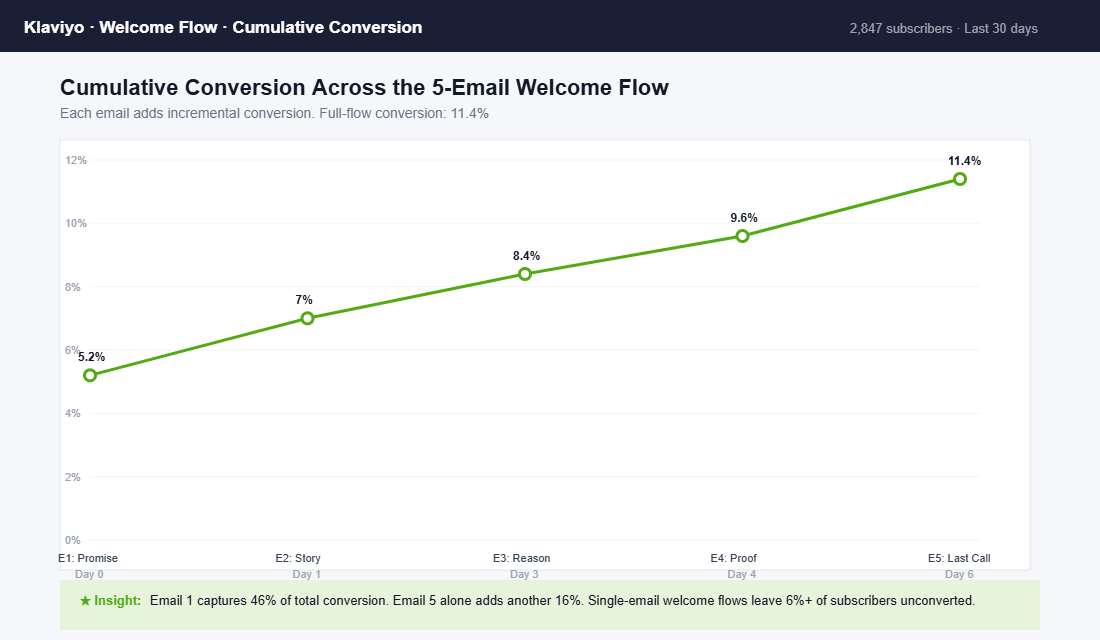
Each email in isolation is fine. The system is what wins. Email 1 captures the impulse buyer. Email 2 builds belief for the considered buyer. Email 3 removes the rational objection. Email 4 borrows trust from your existing customers. Email 5 closes the procrastinator before the discount expires.
By the end of day 7, you have spoken to your subscriber five times across five different psychological triggers, with five distinct CTAs that all lead to one outcome: the first order. Brands running this structure consistently see 8 to 12% conversion across the full flow, with $2.50 to $4.00 in revenue per recipient.
The compound effect goes further. A subscriber who buys via the welcome flow shows a 25 to 35% higher 90-day repeat rate than a subscriber who buys via a campaign. The welcome flow is not just a first-order machine. It is a customer-quality filter. The buyers it produces are the buyers you actually want.
The Weekly Welcome Flow Review (15 Minutes Every Monday)
Most Aussie founders set the welcome flow live and then never look at it again. Six months later they discover email 3 has a broken merge tag, the discount code expired in February, and the popup has been off since the last theme update. Don’t be that founder.
Block 15 minutes every Monday morning to run this review. The whole pass costs you an hour a month and protects the highest-revenue automation in your store. Open Klaviyo, open the welcome flow, and walk down this list:
- Subscribers entered (last 7 days). Compare to the previous week. A drop of more than 20% usually means a popup is broken or a paid traffic channel paused. Investigate before you lose another week of subscribers.
- Open rate per email. Email 1 should sit at 55%+. If it dips below 45%, check sender reputation and inbox placement. Emails 2 to 5 should sit between 35% and 50%. A sudden drop usually means a deliverability issue, not a content issue.
- Click rate per email. Each email should get a 3 to 8% click rate. If email 3 (the objection handler) sits at 2%, you have picked the wrong objection. Test the alternative angle.
- Placed orders attributed to the flow (last 7 days). The headline number. Multiply by your AOV to see flow revenue. Compare against last week and last month to spot trends early.
- Revenue per recipient. The single number that summarises the health of the whole flow. Target $2.50 minimum, $4.00+ for elite performance. Falling RPR is the earliest warning that something is breaking.
- Discount code redemptions vs. expiries. Healthy welcome flows redeem 20 to 30% of issued codes. If redemptions sit below 10%, the offer is wrong, the timing is wrong, or the code is broken. Test on a fresh email address before assuming it is a strategy problem.
Document the numbers in a simple Google Sheet with one row per week. After 8 weeks you will see seasonal patterns, the lift from any A/B test, and the real long-term trajectory of the flow. Without the sheet, every weekly look is anecdotal. With the sheet, you can prove the flow is improving and tie real dollars to specific changes.
Your Welcome Flow Build Checklist
Print this. Tick each line off before you turn the flow on.
- Two-step popup live with qualifying question and dollar-value gift framing
- Email 1 sent at T+0, hero promise, unique single-use code, 7-day expiry, single CTA to a curated collection
- Email 2 sent at T+24h, founder letter format, 250 words, soft re-pitch of the code
- Email 3 sent at T+72h, addresses your top objection (fit, shipping, returns, ingredients)
- Email 4 sent at T+96h, hero review plus three proof stats plus UGC, CTA points at reviews page
- Email 5 sent at T+144h, urgency subject line, recap on one screen, optional 24h extension for non-converters
- SMS bounce-back at email 1 and email 5 for SMS subscribers
- Flow split by entry source (homepage, PDP, cart) with copy variants
- DKIM, SPF, DMARC configured. Spam complaint rate under 0.1%
- Conversion target: 8% minimum, 10% goal, 12%+ elite. Revenue per recipient target: $2.50 minimum, $4.00 goal
Build this once and it earns for years. Rebuild it every 12 months as your brand evolves and your data tells you what is working. The welcome flow is not a set-and-forget asset. It is your single highest-earning piece of marketing infrastructure, and it deserves the attention.
Inside eCommerce Circle, welcome flow architecture is one of the core pillars we work on with every member. If you want a second opinion on yours, let’s talk.
Related Reading
- The 5 Klaviyo Flows Every Shopify Store Needs Before Spending on Ads
- Klaviyo Segmentation for Shopify: 5 Segments That Drive 80% of Email Revenue
- Customer Retention: Why Your Second Sale Matters More Than Your First