Most Aussie Shopify founders have a Gen Z strategy that fits on a sticky note: “post more on TikTok, pay a creator, add Afterpay.” Then they watch a 22-year-old buy the same product from a competitor because her housemate sent her a link.
What’s in This Article
That is the gap. You are marketing to a stereotype. She is shopping inside a friendship group, cross-checking you on Google, TikTok search and ChatGPT, and deciding whether your brand is honest before she decides whether your product is good.
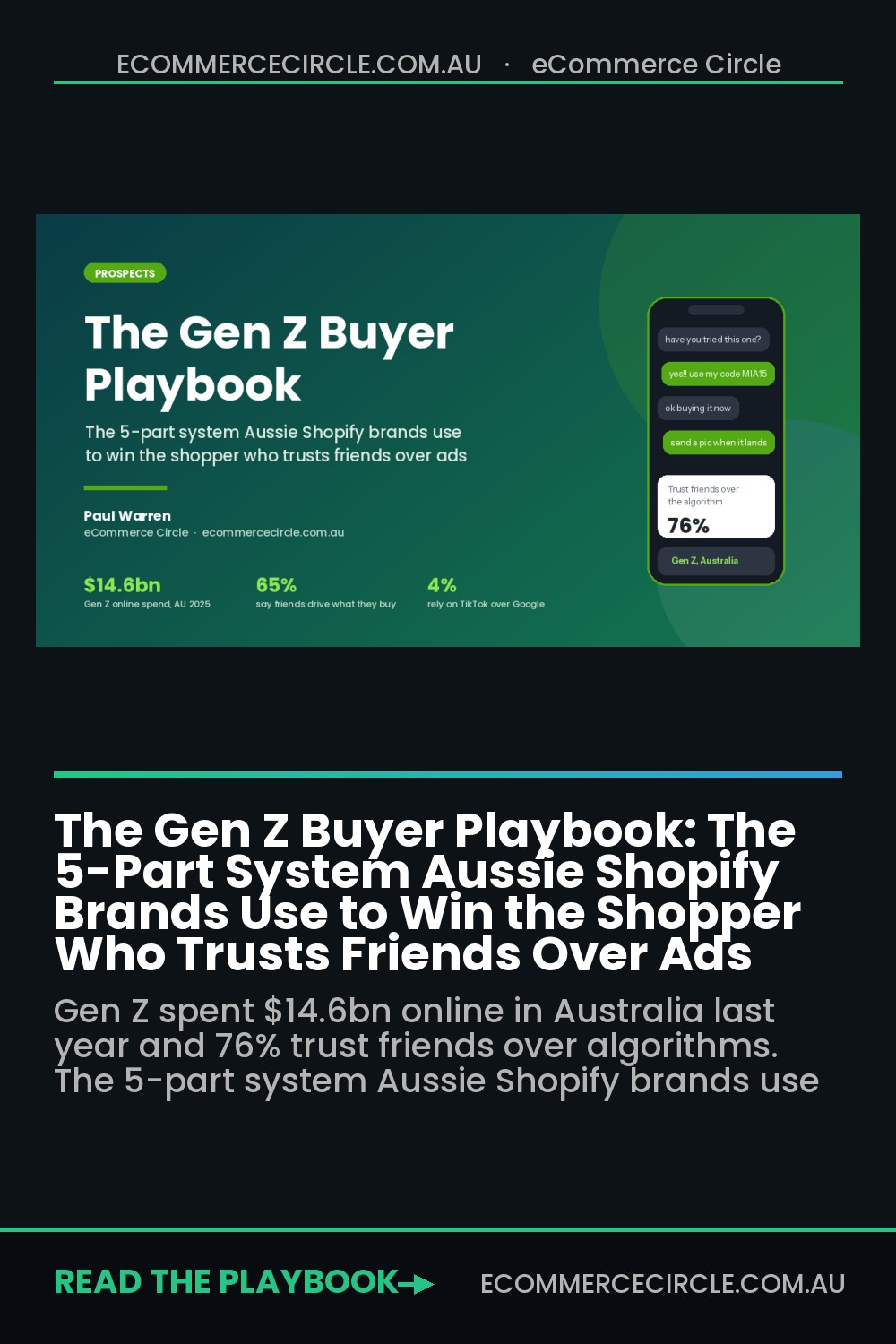
The size of the prize is not small. Australia Post’s 2026 eCommerce Report puts Gen Z’s online spend at $14.6 billion in 2025, inside a total online market that grew 14% to $82.6 billion. Roughly one in five Australians is Gen Z, and they already make up about 27% of the workforce. Their incomes are rising every year. The brands that build the right system now inherit that spend for the next decade.
This playbook gives you that system: five parts, the numbers behind each, the exact moves to make this month, and a scorecard at the end.
Four Gen Z Myths That Are Quietly Wasting Your Budget
Before the system, clear out the folklore. Most of what gets repeated about Gen Z in Aussie marketing meetings is either two years out of date or was never true.
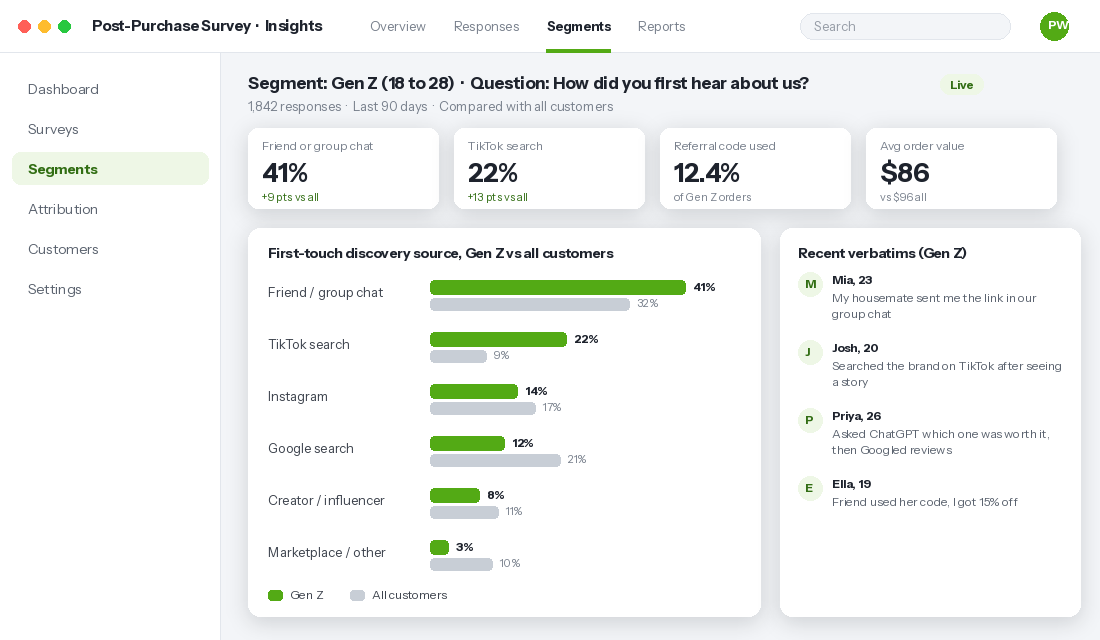
- Myth 1: “TikTok has replaced Google for them.” Adobe’s February 2026 search study found 65% of Gen Z have used TikTok as a search engine, but only 4% say they are more likely to rely on TikTok than Google, down from 8% in 2024. Google is still the starting point for 46% of 18 to 24 year olds. Gen Z did not swap search engines. They added three more.
- Myth 2: “They are broke, so they only buy on discount.” Fourteen-point-six billion dollars of online spend says otherwise. What is true is that they are value-literate: Australia Post found Gen Z and Millennials actively hunt for 20% to 30% off during sale events, and 40% of Gen Z hold out for Black Friday and Click Frenzy. They are not cheap. They are patient.
- Myth 3: “They only shop online.” Salesforce’s 2025 data found 75% of Gen Z prefer physical retail and will go in-store even for Black Friday. Princess Polly, one of Australia’s biggest Gen Z brands, spent years as a pure-play and now has 14 stores because its customers asked for somewhere to go.
- Myth 4: “Influencers tell them what to buy.” Snapchat’s 2025 study of more than 3,000 young Australians found 65% say friends play a crucial role in what they buy, 76% trust friends over algorithmic recommendations, and 61% believe “algorithms are killing our personal style.” The influencer is a discovery channel. The friend is the closer.
Get those four straight and the rest of this playbook makes sense. Gen Z is a multi-search, friend-verified, value-obsessed buyer who wants to be treated as an individual, not a demographic.
Part 1: The Friend Layer (Engineer the Recommendation, Not the Ad)
If 76% of Aussie Gen Z trust a friend over an algorithm, your job is to make the friend recommendation as easy and as rewarding as a Meta ad click. Most stores never build this layer. They build a referral program in 2023, bury the link in a footer, and call it done.
The friend layer has three parts, and they compound.
1. Make sharing a native step, not an afterthought. Put a “Send this to a mate” button on the product page and the order confirmation page, pre-loaded with a short message and a personal code. On mobile that should open the native share sheet so it drops straight into iMessage, WhatsApp or Snapchat, which is where these conversations actually happen. Snapchat reports it reaches more than 90% of Aussie Gen Z, so if your share button only offers Facebook and X you have built it for their parents.
2. Reward both sides, and make the reward social. Two-sided referral rewards (give 15%, get 15%) outperform one-sided by a wide margin because the sender is not “selling” a mate, they are handing over a gift. Add a visible progress state (“2 of 3 friends have used your code, one more earns free shipping for a year”) and you turn a one-off share into a small campaign the customer runs for you. We covered the mechanics in detail in The Shopify Referral Program Playbook.
3. Treat customer content as the ad creative. Snapchat found 61% of Gen Z describe shopping as a “big fun dopamine rush” and 49% say shopping with friends is their favourite way to connect. That energy is already being filmed. Your job is to collect it (post-purchase email at day 10 asking for a 15-second clip, with a store credit incentive), tag it to the product it features, and run it as your paid creative.
Benchmark to aim for: 8% to 12% of new Gen Z customers should be attributable to a referral or share code within six months of launching the layer. If you are under 3%, the button is hidden or the reward is not worth the social risk of recommending you.
Part 2: Multi-Search Presence (Be Findable on All Four Screens)
Here is how a 20-year-old in Brisbane buys a $90 skincare product today. She sees it on a friend’s story. She searches the brand name on TikTok to watch three real people use it. She Googles “brand name review” and skims the top result. She asks ChatGPT whether it is worth it versus two alternatives. Then she buys. Four searches, four platforms, one purchase.
Adobe’s 2026 data shows the mix: when asked which platforms are most helpful for search, consumers ranked Google first at 85%, then Reddit at 29%, ChatGPT at 26%, YouTube at 24% and TikTok at 16%. Twelve per cent of Gen Z now say they are more likely to rely on ChatGPT than Google. If you only rank on one of those, you are invisible for three of her four checks.
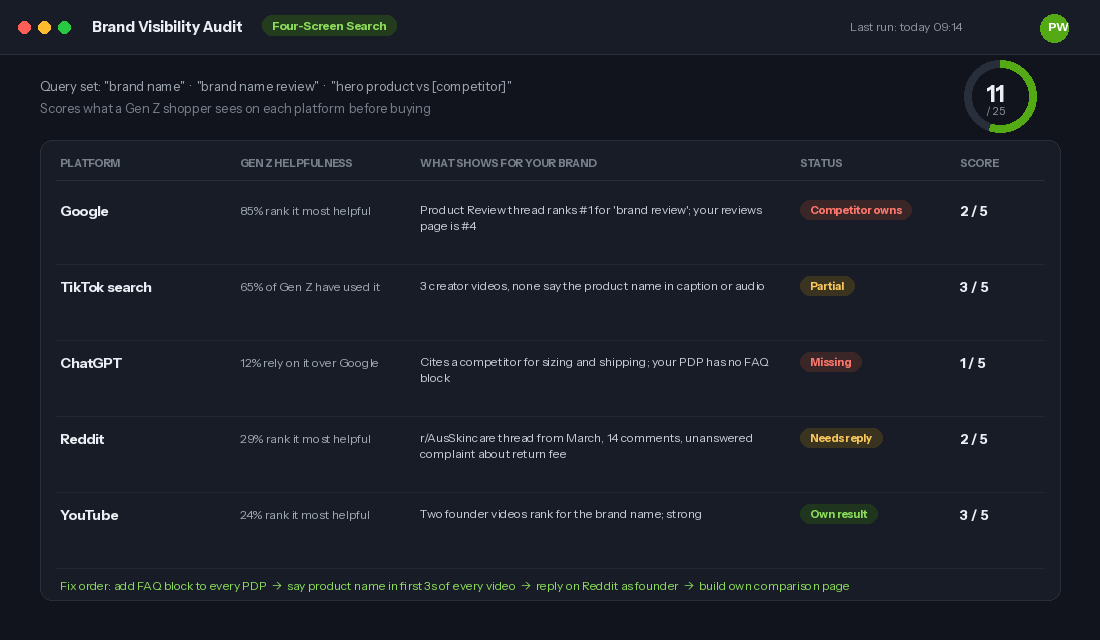
Run this four-screen audit on your own brand this week. Search your brand name and your top product on each platform and score what comes back.
- Google. Does “your brand + review” return your own reviews page or a Product Review thread you do not control? You want a dedicated reviews page with schema markup, plus at least one comparison article on your own blog (“X vs Y”) so you own the comparison search, not a competitor.
- TikTok search. TikTok ranks search results on keywords in captions, on-screen text and spoken audio. Every product video you post should say the product name out loud in the first three seconds and carry it in the caption. Pin the three best videos to the top of your profile so a searcher sees proof, not your latest sale post.
- ChatGPT and Perplexity. AI answers pull from pages that state facts plainly: ingredients, sizing, shipping times, returns, price. If your product page is all mood and no specification, the model has nothing to cite. Add an FAQ block to every product page that answers the ten questions your support inbox gets most.
- Reddit. Aussie subreddits like r/AusFemaleFashion, r/AusSkincare and r/australia are where Gen Z checks whether a brand is legit. Do not astroturf. Do search your brand name monthly, answer questions from a clearly labelled founder account, and fix whatever complaint keeps coming up. Our Shopify Social Listening Playbook shows you how to set that monitoring up in an afternoon.
Part 3: Value Over Logo (Price Like They Are Reading the Fine Print, Because They Are)
Snapchat’s Australian study found 71% of Gen Z prioritise value and efficacy over brand names, and do not care about the label “if the aesthetic is right.” Seventy-one per cent are telling you the logo premium your brand has been charging is worth very little to them. What they will pay for is a product that visibly does the job, at a price that feels fair, on terms that fit a fortnightly pay cycle.
Three pricing moves follow from that.
Show the working. Gen Z buyers respond to “why it costs this” far better than to “was $120, now $89.” A short block on the product page (what is in it, where it is made, what the comparable big-brand version costs) does more for conversion than a strike-through price. It also inoculates you against the Temu and Shein comparison, because you have told them exactly what the extra dollars buy.
Offer instalments, but do not lead with them. BNPL penetration among Australian Gen Z sits at 58% according to the 2026 Australia Buy Now Pay Later Business Report, and nearly half will abandon a purchase if their preferred payment method is missing. So Afterpay or Zip belongs at checkout. But the same generation is increasingly wary of debt, so lead your product page with the full price and show the instalment as an option, not a headline. If you have not done the maths on what BNPL fees do to your contribution margin, read The Shopify BNPL Playbook before you turn it on for every SKU.
Plan for the patient buyer. Forty per cent of Gen Z will wait for Black Friday or Click Frenzy. You cannot stop that, but you can stop training them to wait for you. Kill the weekly 15% off email. Replace it with two or three real events a year and a loyalty mechanism that rewards buying at full price (early access, member pricing on a small subset of products, birthday credit). A Gen Z customer who learns your discounts are rare and your full price is fair buys in March, not just in November.
Part 4: The Proof Stack (Honesty Is the Product Feature)
YouGov’s 2025 research found the three things Gen Z want most from a brand are honesty, trustworthiness, and consistency between what a brand says and what it does. Sixty-five per cent of Gen Z adults like companies that stand for something, compared with 53% of Gen X and Boomers. That does not mean you need a cause. It means you need to be caught telling the truth, repeatedly, in public.
Build the proof stack in this order, because each layer is checked before the next.
- Layer 1: Reviews that include the bad ones. A 4.9 average from 40 reviews reads as curated. A 4.6 from 900 reviews with visible three-star comments and a founder reply under each one reads as real. Turn on verified-buyer badges, never delete a negative review that is not abusive, and respond to every review under four stars within 48 hours. The Shopify Reviews Playbook covers the collection flow.
- Layer 2: Policies in plain English, above the fold. Shipping cost, delivery window for their postcode, and the returns window, all visible on the product page without a click. Gen Z reads terms. A “free returns” badge that turns into a $12.95 return fee at the returns portal costs you the customer and the friends they were going to tell.
- Layer 3: Show the people. Founder face on the About page, warehouse or studio content in your feed, real names on customer service replies. Anonymous brands read as dropshippers to this audience, and dropshippers do not get recommended.
- Layer 4: Values you can prove, not values you claim. If you say “sustainable,” Gen Z will ask which certification. If you say “Australian made,” they will check the label. Melbourne beauty brand Fluff built its whole positioning on this: founder Erika Geraerts runs a podcast on consumption and mental health in beauty, opens the store only four times a year, and turns that restraint into the brand story. That is a value you can watch being lived, which is the only kind this generation credits.
The test for every layer is simple. Could a sceptical 19-year-old screenshot it and send it to a group chat with the caption “is this legit?” and get a yes back? If not, that layer is still marketing, not proof.
Part 5: The Personal Screen (Mobile, Interactive, and Built for One Person)
Fifty-three per cent of Gen Z teens shop from a smartphone according to a 2026 Emarketer and T-Mobile survey. Every Aussie Shopify founder already knows mobile matters. Fewer have noticed what Gen Z wants that screen to do.
The Snapchat study is the clearest guide. Forty-nine per cent of Aussie Gen Z are more likely to buy from brands that use interactive ads or features. Fifty per cent prefer gamified shopping experiences. Forty per cent are more likely to purchase if they can try a product on with augmented reality. And on personalisation, Twilio found 65% of Gen Z will spend more with brands that personalise their marketing, while Amperity’s 2026 study found 29% are “much more likely” to buy when an offer feels personal to them.
Translate that into a mobile build list, in priority order.
- Shop Pay and a one-thumb checkout. Accelerated checkout is not optional for a buyer who is standing at a bus stop. Turn on Shop Pay, Apple Pay and Google Pay (nearly half of Gen Z use the wallet options), and cut every field you can. Our Shopify Mobile Conversion Playbook has the full checklist.
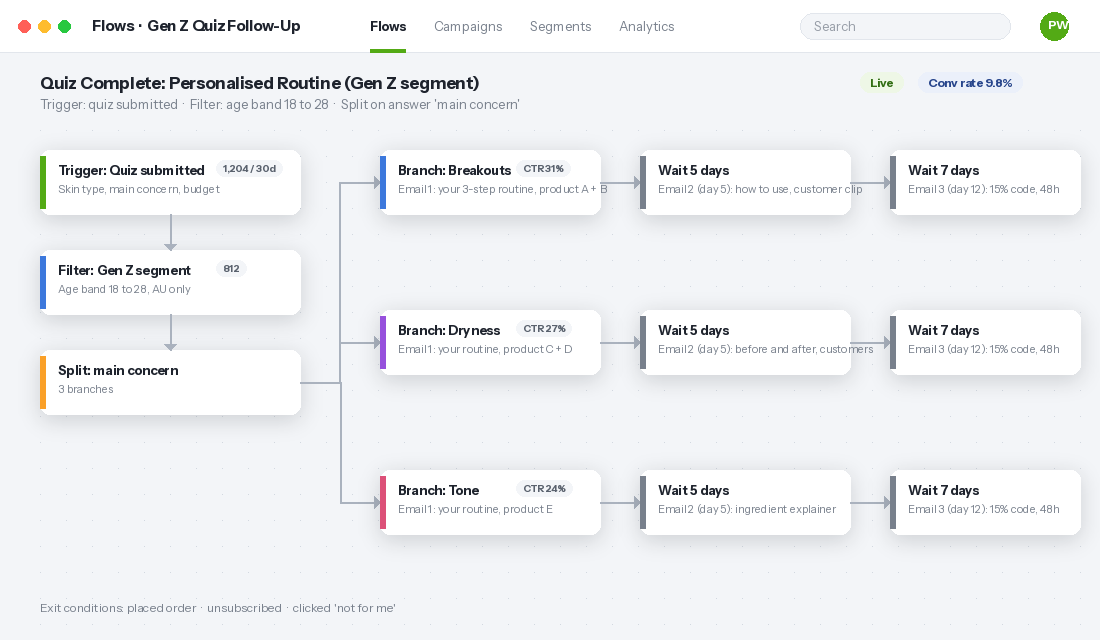
- A product quiz that actually personalises. A three-question quiz (“skin type, main concern, budget”) that returns a named routine and a personal discount code does two jobs: it is the interactive feature 49% want, and it gives you zero-party data to personalise every email that follows. Route quiz completions into a Klaviyo flow segmented by answer, not one generic welcome series.
- Video on every product page. A 15-second customer clip beside the hero image outperforms a sixth product photo.
- Try-on or visualisation where it fits. For eyewear, jewellery, cosmetics and furniture, an AR try-on app on Shopify is now a weekend install. Forty per cent more likely to buy is a large lift for a small build.
- Segmented flows, not blasts. Use Shopify Segments to split Gen Z by first product, quiz answer and channel of acquisition, then write flows that reference what they actually bought. “Your cleanser is about to run out” beats “20% off everything” for this buyer every time.
Two Aussie Brands That Already Run This System
Princess Polly (Gold Coast). Princess Polly is the second most searched Australian fashion brand globally at around 243,100 monthly searches, with 2.2 million Instagram followers and 930,000 on TikTok. Its mobile app generates 28% of revenue with a 98.4% retention rate, which is the personal-screen layer done properly. When Gen Z customers asked for real-life experiences, the brand opened stores designed, in its own words, for “discovery, content and connection,” and now has 14 globally with more planned across Australia and the US in 2026. Its parent A.K.A. Brands credits growth in Australia and New Zealand for a 2.2% lift in order numbers in the third quarter of 2025.
White Fox Boutique (Sydney). White Fox started as an eBay seller in 2013 and is now the most searched Australian fashion brand in the world, with 3 million Instagram followers and close to a million on TikTok. Its Australian store alone generated around US$99 million in 2025 before counting the US and UK sites. The engine is customer content at scale: the feed is dominated by real customers and creators wearing the product, the brand comments and reposts constantly, and the drop calendar gives the community something to talk about every week. That is the friend layer turned into a media channel.
The Tool to Set Up This Week: Shopify Collabs
Part 1 and Part 4 both depend on real people talking about your product. Shopify Collabs is the free, native way to run that. Here is the setup, start to finish.
- Install Collabs from the Shopify App Store (it is free on all plans) and open it from your admin sidebar.
- Build your application page. Under Recruit, create the public page creators apply through. Add three screening questions: which platform they post on most, their typical audience age, and a link to a video they made about a product they bought themselves. That last question filters out anyone who only wants free stock.
- Set commission and gifting rules. Start at 10% to 15% on first-order revenue with a 30-day cookie, and define which products qualify for gifting (your hero SKU and one low-cost add-on, nothing else).
- Create an open-access offer for customers. Turn on the “become an affiliate” invitation for existing customers. Your best Gen Z advocates are already buying; this gives them a code to share with their group chat and a reason to keep sharing it.
- Recruit from the creator directory. Filter by Australia, audience size 5,000 to 50,000, and your category. Nano and micro creators at that size convert better for this audience than anyone with a million followers, because their followers are friends, not fans.
- Send personalised invites with a gift, not a brief. Ship the product with a handwritten note and no script. Content that looks briefed reads as an ad to Gen Z. Content that looks like a mate’s honest take gets sent to another mate.
- Review the Collabs dashboard weekly. Track sales per creator, average order value on affiliate orders versus site average, and repeat rate at 60 days. Cut anyone under 1 sale per 1,000 followers per month and double the gifting budget for anyone above 5.
Give it 90 days before judging it. The friend layer is slow to start and fast once it turns, and the creators you gifted in month one are the reviews and search results Gen Z finds in month four.
The Gen Z Fit Scorecard: 15 Checks Before You Spend Another Dollar on Ads
Score one point for each “yes.” Under 8 and your Gen Z ad spend is leaking into a bucket with no bottom. Twelve or more and you are ready to scale acquisition.
- Friend layer: Native share button on product and thank-you pages. Two-sided referral reward live. Customer video collected automatically post-purchase.
- Multi-search: Brand plus “review” on Google returns a page you own. Product name is spoken and captioned in your TikTok videos. Every product page has an FAQ block. You have checked Reddit for your brand in the last 30 days.
- Value: Product page explains what the price buys. BNPL available at checkout but full price leads. No more than three site-wide discount events a year.
- Proof stack: Reviews show verified badges and visible sub-four-star comments with replies. Shipping cost, delivery window and returns terms visible before the click. Founder and team visible on site and social.
- Personal screen: Shop Pay and digital wallets on. Quiz or interactive element feeds segmented email flows.
Score it honestly and fix the lowest section first.
How the Five Parts Compound
Here is why this is a system and not a list of tips. A friend sends the link (Part 1). The buyer searches you on TikTok and Google and finds creator content and honest reviews (Part 2 and Part 4). The product page tells her what the price buys and offers Afterpay without pushing it (Part 3). She completes the quiz on her phone, checks out with Shop Pay in 40 seconds, and gets a follow-up email about the exact product she bought (Part 5). Ten days later she films a clip for store credit and sends her own referral code to the group chat, and the loop starts again with three new people.
Each part makes the next one cheaper. Referral customers cost a fraction of paid ones. Search presence turns paid discovery into organic conversion. Honest proof lifts conversion on every channel at once. And a personal mobile experience raises repeat rate, which is what makes the whole machine profitable rather than just busy. Australian households now shop across 16 brands a year on average. Gen Z will only keep coming back to the handful that feel like they were built for them and their mates.
Inside eCommerce Circle, understanding exactly who your buyer is and how they decide is the Prospects pillar of the More Orders Operating System, and it sits underneath every other lever in the business. If you want to see where your store is being capped right now, take the free More Orders Scorecard. It takes two minutes, it is free, and it shows you which of the 10 P’s to fix first.